


Gear Changing
 05-09-08 | 12:28 PM
#1
Thread Starter
Junior Member
Joined: May 2008
Posts: 5
Likes: 0
From: Scotland
Bikes: Dawes Galaxy 2007
Gear Changing
I have a Dawes Galaxy 2007 with bar end gear shifters. I can change the rear cog quite happily, because I can feel and hear the click of the lever as it changes. I have difficulty with the changing the triple on the crank, as the lever for that does not click and the only indication I get is when I hear the chain slip to the new position ( by which time I have usually lost momentum) which for me a newbie is most disconcerting. Any suggestions to ease the matter would be helpful.
The other question I have how do you effectively change gear. For example if I am approaching a hill with the chain on the centre cog front and the big cog rear, I can happily change down through the nine gears. When I get to the lowest gear set if need be I then have to change to an even lower gear presumably by dropping to the small cog front, first. This leaves me in the position where I am in an extremely low gear (since my rear cog is also the smallest) and I am left wasting energy by spinning pedals. Is this correct or am I doing something wrong ?
The other question I have how do you effectively change gear. For example if I am approaching a hill with the chain on the centre cog front and the big cog rear, I can happily change down through the nine gears. When I get to the lowest gear set if need be I then have to change to an even lower gear presumably by dropping to the small cog front, first. This leaves me in the position where I am in an extremely low gear (since my rear cog is also the smallest) and I am left wasting energy by spinning pedals. Is this correct or am I doing something wrong ?
 05-09-08 | 12:59 PM
#2

Senior Member
Joined: Apr 2008
Posts: 828
Likes: 0
From: Chicago
The front derailer is probably set for friction shifting, meaning there is no indexing. There is actually an advantage to this, in that you can micro-adjust the front derailer to avoid chain rub. Some shifters can be switched from index to friction and back. Otherwise, you just practice with friction shifting and eventually you'll learn how far you need to move it and get good at it.
05-09-08 | 01:41 PM
#3
Senior Member
Joined: Jan 2006
Posts: 541
Likes: 0
From: Brooklyn, New York
Bikes: Nothing special, but it works.
I have a Dawes Galaxy 2007 with bar end gear shifters. I can change the rear cog quite happily, because I can feel and hear the click of the lever as it changes. I have difficulty with the changing the triple on the crank, as the lever for that does not click and the only indication I get is when I hear the chain slip to the new position ( by which time I have usually lost momentum) which for me a newbie is most disconcerting. Any suggestions to ease the matter would be helpful.
The other question I have how do you effectively change gear. For example if I am approaching a hill with the chain on the centre cog front and the big cog rear, I can happily change down through the nine gears. When I get to the lowest gear set if need be I then have to change to an even lower gear presumably by dropping to the small cog front, first. This leaves me in the position where I am in an extremely low gear (since my rear cog is also the smallest) and I am left wasting energy by spinning pedals. Is this correct or am I doing something wrong ?
The other question I have how do you effectively change gear. For example if I am approaching a hill with the chain on the centre cog front and the big cog rear, I can happily change down through the nine gears. When I get to the lowest gear set if need be I then have to change to an even lower gear presumably by dropping to the small cog front, first. This leaves me in the position where I am in an extremely low gear (since my rear cog is also the smallest) and I am left wasting energy by spinning pedals. Is this correct or am I doing something wrong ?
There's a very useful gearing calculator here https://www.sheldonbrown.com/gears/ that will help you figure out exactly what combinations of chainring and cog are higher or lower.
05-09-08 | 01:56 PM
#4


You don't necessarily need to go all the way to the end of the cogset before shifting the chainrings.
If you see a hill approaching, drop down to the smaller chainring, then shift to harder (smaller) cogs in the back, until your cadence or pedal effort is similar to what you were doing before the chainring shift. This way, you have more gear choices without having to shift the chainrings while on the hill.
With more experience, you'll know which chainring to use in different road conditions - flat, shallow uphill, steep uphill, rolling. You'll still switch chainrings as needed, but you'll more often be in the middle of the cogs, making shifts up or down a cog easy.
You want to avoid extreme crosschaining, like small chainring to small cog, but doing it occasionally won't hurt anything.
If you see a hill approaching, drop down to the smaller chainring, then shift to harder (smaller) cogs in the back, until your cadence or pedal effort is similar to what you were doing before the chainring shift. This way, you have more gear choices without having to shift the chainrings while on the hill.
With more experience, you'll know which chainring to use in different road conditions - flat, shallow uphill, steep uphill, rolling. You'll still switch chainrings as needed, but you'll more often be in the middle of the cogs, making shifts up or down a cog easy.
You want to avoid extreme crosschaining, like small chainring to small cog, but doing it occasionally won't hurt anything.
Last edited by rm -rf; 05-09-08 at 02:13 PM.
05-09-08 | 02:08 PM
#5
Mike Sherman's gear calculator is helpful.
Here's a typical 12-27 cog, 30-39-52 triple road bike gear table.
It shows the kph at 85 rpm cadence for each gear combination. On the web site, you can change the gear sizes and try different cadences, too. Or change to miles per hour.
85 to 90 rpm is a good cadence for many riders. You'll probably have a slower cadence on steep hills, and a faster cadence if you are accelerating.
So the smallest chainring, 30 teeth, is good for speeds of 23 kph down to 12 kph at this cadence (I skip the 12 and 13, since these are to be avoided)
The middle is good for 35 kph down to 15 kph. You can see the three sets have an overlap in their speed ranges.
Notice that the 52-21 is similar to the 39-17 and the 30-13, for example.
------12---13---14---15---17---19---21---24---27
----+------------------------------------------------------
52 | 46.7 43.1 39.9 37.3 33.0 29.5 26.7 23.3 20.8
39 | 34.9 32.3 29.9 28.0 24.6 22.0 20.0 17.5 15.6
30 | 26.9 24.8 23.0 21.6 19.0 17.1 15.4 13.5 11.9
Here's a typical 12-27 cog, 30-39-52 triple road bike gear table.
It shows the kph at 85 rpm cadence for each gear combination. On the web site, you can change the gear sizes and try different cadences, too. Or change to miles per hour.
85 to 90 rpm is a good cadence for many riders. You'll probably have a slower cadence on steep hills, and a faster cadence if you are accelerating.
So the smallest chainring, 30 teeth, is good for speeds of 23 kph down to 12 kph at this cadence (I skip the 12 and 13, since these are to be avoided)
The middle is good for 35 kph down to 15 kph. You can see the three sets have an overlap in their speed ranges.
Notice that the 52-21 is similar to the 39-17 and the 30-13, for example.
------12---13---14---15---17---19---21---24---27
----+------------------------------------------------------
52 | 46.7 43.1 39.9 37.3 33.0 29.5 26.7 23.3 20.8
39 | 34.9 32.3 29.9 28.0 24.6 22.0 20.0 17.5 15.6
30 | 26.9 24.8 23.0 21.6 19.0 17.1 15.4 13.5 11.9
05-12-08 | 10:20 AM
#7

Senior Member
Joined: Sep 2006
Posts: 1,195
Likes: 0
Bikes: Kona Cinder Cone, Sun EZ-3 AX
The other question I have how do you effectively change gear. For example if I am approaching a hill with the chain on the centre cog front and the big cog rear, I can happily change down through the nine gears. When I get to the lowest gear set if need be I then have to change to an even lower gear presumably by dropping to the small cog front, first. This leaves me in the position where I am in an extremely low gear (since my rear cog is also the smallest) and I am left wasting energy by spinning pedals. Is this correct or am I doing something wrong ?
Here's a calculation I did for my mountain bike:
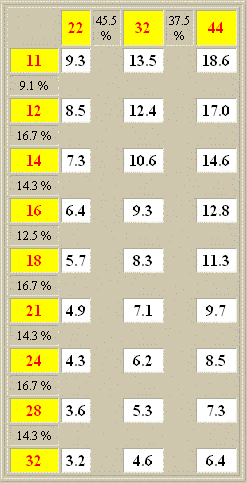
The figures are in mph at a cadence of 60 rpm at the pedals. Notice the large amount of overlap of the gearing available with the different front gears. Even the largest and smallest overlap by several rear gears.
Last edited by deraltekluge; 05-12-08 at 11:29 AM.
