


The Art of Cantilevers
 10-23-17 | 10:42 AM
#1

Thread Starter
Senior Member


Joined: Feb 2017
Posts: 4,244
Likes: 908
From: Northern Shenandoah Valley
Bikes: More bikes than riders
The Art of Cantilevers
I bought a used 1997 Trek MultiTrack 750 earlier this season and it had the stock Shimano BR-MC16 cantilever brake arms on it. I put some new inexpensive Shimano CT91 brake shoes on it and had a lot of shudder from the front fork. Disappointed, and having been frustrated in the past with cantilever brakes, I threw on a set of used Tektro Mini-Vs I scored for cheap on eBay and went on my way.
I recently wanted to try the cantilevers again. The bike came with BR-MC16s (pictured below) and I also have numerous sets of other Shimano low-proflie cantilevers that I've tried. The biggest difference between these is the MC16s mount the brake shoe posts on the inboard side of the brake arm, rather than on the outboard side as many other Shimano cantilever brakes do. I used the same straddle wire arrangement that is pictured below with the various types of Shimano brake arms, and found a notable difference in braking power -- with the MC16s seeming to provide more braking power than I was able to get out of the other brakes. Shimano claim that the inboard mounting of the brake shoe results in less flex in the system and less torque on the brake bosses. I don't know how true any of that is, but it seems to work well in practice.
I got the very nice Tektro straddle wire triangles and the Tektro fork-mount cable hanger at my local bike shop, and used regular ol' MTB brake cables as the straddle wires themselves. I set the triangle height at about thumb-width above each tire, and was sure to set the brake shoe depth so the brake arm was vertical or just slightly outbound of vertical when it contacts the tire. To finish it, I took some jeweler's rouge on a Dremel pad to the MC16 brake arms to polish them up.
I'm very pleased with the results. It looks super clean to me and braking power is at least as good as it was with the Mini-Vs. I haven't tried to end-o yet, but I can grab enough brake to slide the rear tire when seated, and I figure that's about all I can ask. I'm pretty happy with how well this 20 year old bike stops now...and it looks good doing it.
Does anyone else have success with this particular type of cantilever arm...or have any thoughts about the relative merits (or demerits) of having the shoe inboard vs. outboard of the arm?
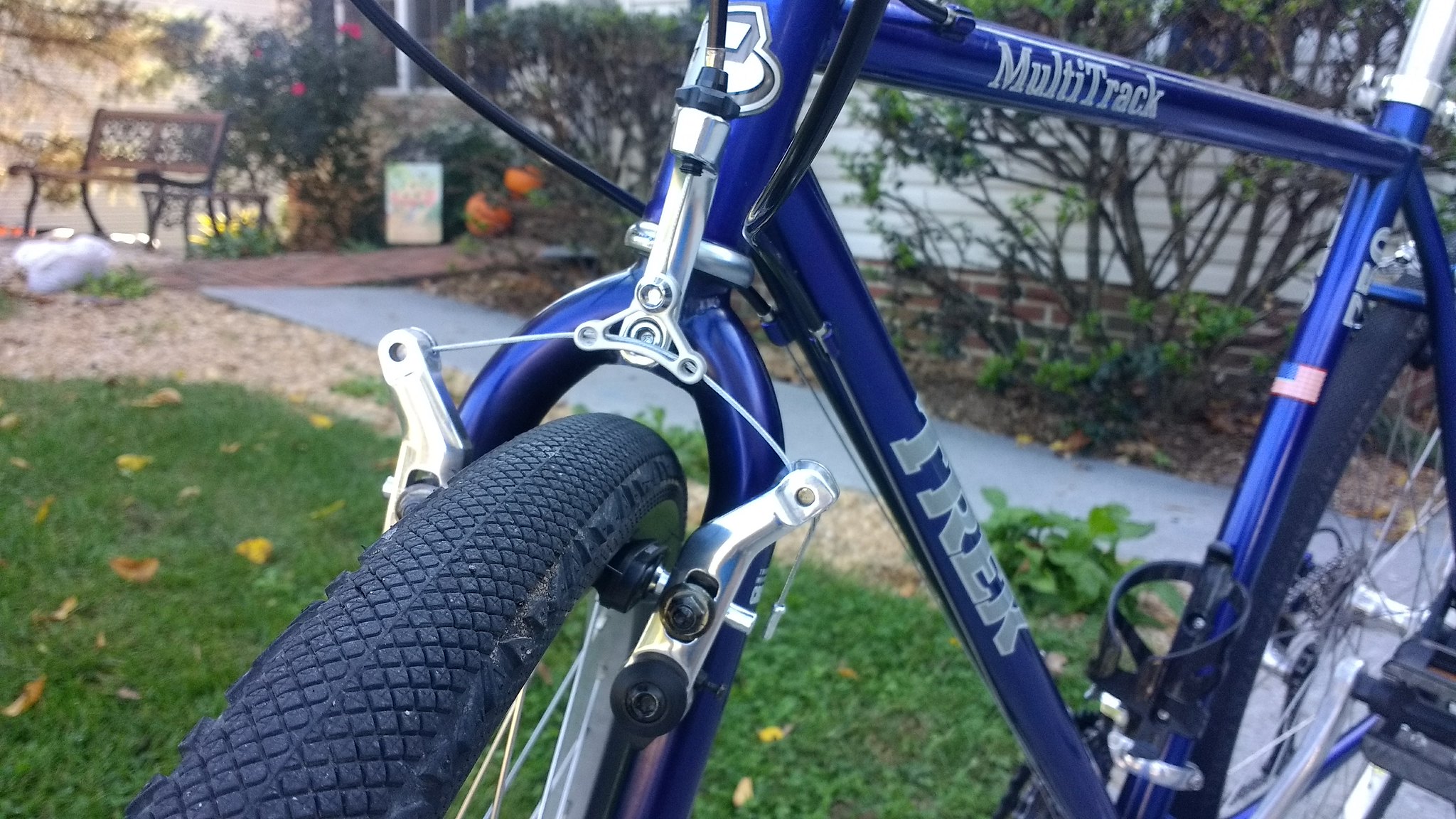
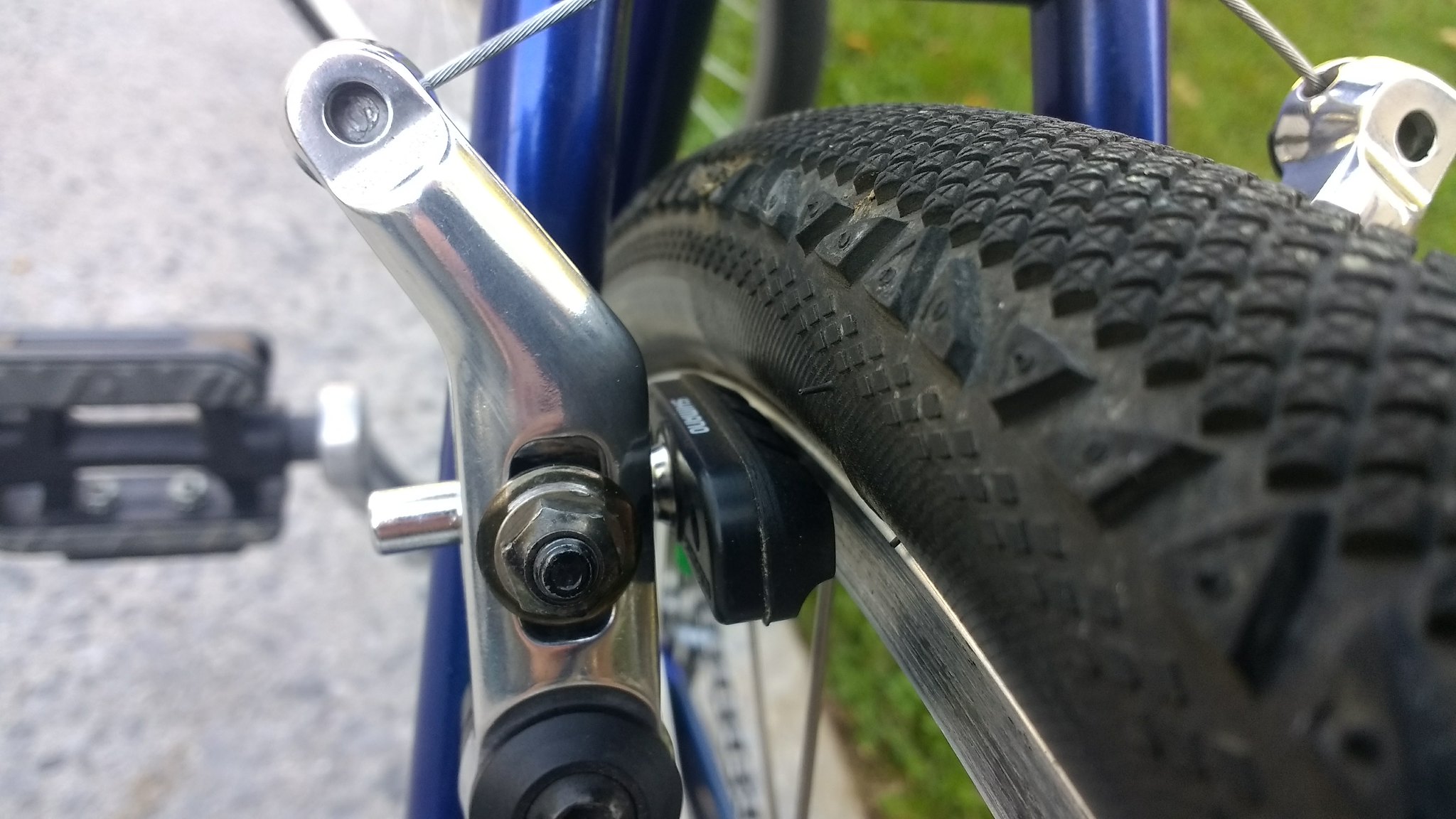
I recently wanted to try the cantilevers again. The bike came with BR-MC16s (pictured below) and I also have numerous sets of other Shimano low-proflie cantilevers that I've tried. The biggest difference between these is the MC16s mount the brake shoe posts on the inboard side of the brake arm, rather than on the outboard side as many other Shimano cantilever brakes do. I used the same straddle wire arrangement that is pictured below with the various types of Shimano brake arms, and found a notable difference in braking power -- with the MC16s seeming to provide more braking power than I was able to get out of the other brakes. Shimano claim that the inboard mounting of the brake shoe results in less flex in the system and less torque on the brake bosses. I don't know how true any of that is, but it seems to work well in practice.
I got the very nice Tektro straddle wire triangles and the Tektro fork-mount cable hanger at my local bike shop, and used regular ol' MTB brake cables as the straddle wires themselves. I set the triangle height at about thumb-width above each tire, and was sure to set the brake shoe depth so the brake arm was vertical or just slightly outbound of vertical when it contacts the tire. To finish it, I took some jeweler's rouge on a Dremel pad to the MC16 brake arms to polish them up.
I'm very pleased with the results. It looks super clean to me and braking power is at least as good as it was with the Mini-Vs. I haven't tried to end-o yet, but I can grab enough brake to slide the rear tire when seated, and I figure that's about all I can ask. I'm pretty happy with how well this 20 year old bike stops now...and it looks good doing it.
Does anyone else have success with this particular type of cantilever arm...or have any thoughts about the relative merits (or demerits) of having the shoe inboard vs. outboard of the arm?
 10-23-17 | 10:48 AM
#2
Banned
Joined: Jun 2010
Posts: 43,586
Likes: 1,380
From: NW,Oregon Coast
Bikes: 8
Its approaching being a Short arm V brake, just not direct pull , I have 3 bikes with various cantilever brakes .. going back to Mafac, in 1970.
whats the real issue ?, I see None. you need a reason to buy something else?
....
whats the real issue ?, I see None. you need a reason to buy something else?
....
10-23-17 | 10:55 AM
#3
Thread Starter
Senior Member
Joined: Feb 2017
Posts: 4,244
Likes: 908
From: Northern Shenandoah Valley
Bikes: More bikes than riders
Yikes -- I must not have been clear. No issues -- I'm happy with the brakes. I was just sharing my experiences with this particular cantilever, and seeing if anyone else had thoughts on these. The majority of cantilever arms (at least from Shimano) seem to mount the brake shoe outboard of the arm, so it was curious to me that these were opposite of that.
10-23-17 | 11:22 AM
#4
Banned
Joined: Jun 2010
Posts: 43,586
Likes: 1,380
From: NW,Oregon Coast
Bikes: 8
What are you talking about? show examples . (other than Yours)
L type Mafac cantilevrer brakes * fall in a type 1 lever in classical mechanics Work (The Brake Pad) fulcrum (pivot) effort, where the cable is attached , pulling it .
crowbars and teeter totters are also that type lever..
put the fulcrum at the end and the work in the middle , and effort applied, again, on the in the end is a Type 2 Lever..
the way you hold a wheelbarrow , is essentially a type 2 leverage..
https://en.wikipedia.org/wiki/Lever.....
* https://www.cxmagazine.com/wp-conten...yee-2916_1.jpg
.....
L type Mafac cantilevrer brakes * fall in a type 1 lever in classical mechanics Work (The Brake Pad) fulcrum (pivot) effort, where the cable is attached , pulling it .
crowbars and teeter totters are also that type lever..
put the fulcrum at the end and the work in the middle , and effort applied, again, on the in the end is a Type 2 Lever..
the way you hold a wheelbarrow , is essentially a type 2 leverage..
https://en.wikipedia.org/wiki/Lever.....
* https://www.cxmagazine.com/wp-conten...yee-2916_1.jpg
.....
Last edited by fietsbob; 10-23-17 at 11:36 AM.
10-23-17 | 11:32 AM
#5
Thread Starter
Senior Member
Joined: Feb 2017
Posts: 4,244
Likes: 908
From: Northern Shenandoah Valley
Bikes: More bikes than riders
I'm not talking about lever type.
I'm talking about how the brake shoe post mounts to the arm. The ones on this bike hold the posts inboard of the arm (between the frame or fork and the arm). This does not seem to be the predominant design for smooth post cantilevers -- most seem to hold the posts outboard of the arm.
For example, see these brakes:
Set Up A Cantilever Rim Brake - MadeGood | Free bike repair resource
Or the "Basic cantilevers" here:
https://sheldonbrown.com/harris/cantilevers/
The brake shoe posts are mounted to the outboard side of the arm. Shimano's BR-MC16s seem to be a little unique for smooth post cantilevers in that they hold the shoes inboard of the arm. That's all I'm saying -- I'm just commenting that this particular design of cantilever worked very well for me, and was wondering if others have found the same.
I'm talking about how the brake shoe post mounts to the arm. The ones on this bike hold the posts inboard of the arm (between the frame or fork and the arm). This does not seem to be the predominant design for smooth post cantilevers -- most seem to hold the posts outboard of the arm.
For example, see these brakes:
Set Up A Cantilever Rim Brake - MadeGood | Free bike repair resource
Or the "Basic cantilevers" here:
https://sheldonbrown.com/harris/cantilevers/
The brake shoe posts are mounted to the outboard side of the arm. Shimano's BR-MC16s seem to be a little unique for smooth post cantilevers in that they hold the shoes inboard of the arm. That's all I'm saying -- I'm just commenting that this particular design of cantilever worked very well for me, and was wondering if others have found the same.
 10-23-17 | 12:05 PM
#7
Thread Starter
Senior Member
Joined: Feb 2017
Posts: 4,244
Likes: 908
From: Northern Shenandoah Valley
Bikes: More bikes than riders
It has completely cured the brake shudder that I had. I was using these exact shoes earlier this year they they shuddered like mad on the front fork (it's a relatively flexible fork). I put the shoes and cantilever arms away this summer and used something else until now. I'm happy to say that the fork-mounted brake hanger has completely eliminated any shudder. It's smooth as butter now.
10-23-17 | 02:12 PM
#9
Senior Member
Joined: Aug 2005
Posts: 33,657
Likes: 1,119
From: Pittsburgh, PA
Bikes: '96 Litespeed Catalyst, '05 Litespeed Firenze, '06 Litespeed Tuscany, '20 Surly Midnight Special, All are 3x10. It is hilly around here!
Was that bike even ridden before you bought it? For a 20 year old bike it looks in almost new condition.
10-23-17 | 03:17 PM
#10
Banned
Joined: Jun 2010
Posts: 43,586
Likes: 1,380
From: NW,Oregon Coast
Bikes: 8
I'm not talking about lever type.
I'm talking about how the brake shoe post mounts to the arm. The ones on this bike hold the posts inboard of the arm (between the frame or fork and the arm). This does not seem to be the predominant design for smooth post cantilevers -- most seem to hold the posts outboard of the arm.
For example, see these brakes:
Set Up A Cantilever Rim Brake - MadeGood | Free bike repair resource
Or the "Basic cantilevers" here:
https://sheldonbrown.com/harris/cantilevers/
The brake shoe posts are mounted to the outboard side of the arm. Shimano's BR-MC16s seem to be a little unique for smooth post cantilevers in that they hold the shoes inboard of the arm. That's all I'm saying -- I'm just commenting that this particular design of cantilever worked very well for me, and was wondering if others have found the same.
I'm talking about how the brake shoe post mounts to the arm. The ones on this bike hold the posts inboard of the arm (between the frame or fork and the arm). This does not seem to be the predominant design for smooth post cantilevers -- most seem to hold the posts outboard of the arm.
For example, see these brakes:
Set Up A Cantilever Rim Brake - MadeGood | Free bike repair resource
Or the "Basic cantilevers" here:
https://sheldonbrown.com/harris/cantilevers/
The brake shoe posts are mounted to the outboard side of the arm. Shimano's BR-MC16s seem to be a little unique for smooth post cantilevers in that they hold the shoes inboard of the arm. That's all I'm saying -- I'm just commenting that this particular design of cantilever worked very well for me, and was wondering if others have found the same.
the work is done with friction of the pad rubbing against the rim,
this a slow day at work?
 10-23-17 | 05:02 PM
#12
Thread Starter
Senior Member
Joined: Feb 2017
Posts: 4,244
Likes: 908
From: Northern Shenandoah Valley
Bikes: More bikes than riders
It was quite mint when I bought it. There are a few nicks here and there, and some areas of paint I'd like to touch up. This paint Trek used is a super thick paint that almost feels soft to the touch, like it has some polymer or vinyl mixed in (like a "poly coat"). It's a little odd, but it has a great hue to it.
10-23-17 | 05:08 PM
#13
Thread Starter
Senior Member
Joined: Feb 2017
Posts: 4,244
Likes: 908
From: Northern Shenandoah Valley
Bikes: More bikes than riders
I guess I'll just quit asking BikeForums about nuances of bike component design. With the huge knowledge base here, I was hoping someone would have a story like, "oh yeah, Shimano tried that design just before cantilever brakes fell out of favor; it was a better design for these reasons, but it never was popularized because of its timing coincident with linear pull brakes", or "Shimano tried to re-invent the wheel with those, but they were harder to adjust or they didn't become popular for these reasons", or ... ... ...
Apparently, I shall be satisfied with the elementary knowledge that the fiction of the pad rubbing the rim stops the bike and anything more nuanced than that is not worthy of discussion.
Apparently, I shall be satisfied with the elementary knowledge that the fiction of the pad rubbing the rim stops the bike and anything more nuanced than that is not worthy of discussion.
10-23-17 | 05:24 PM
#14
Full Member
Joined: Nov 2016
Posts: 490
Likes: 44
From: SoCal
Bikes: 2014 Bruce Gordon Rock&Road, 1995 Santana Visa Tandem, 1990 Trek 520, 2012 Surly LHT
Yes it seems that most cantilevers had the post mounted "outboard" of the arm. However, you really need to compare whether the brake pad post is really any further away from the fork or seat stay. It may be that the brake arms are just manufactured differently (I suspect this was for ease of setup, maybe), but the brake pad posts are almost all the same distance from the fork or seat stay. But you are correct, the further out the brake pad post is, the more torque you will get on the brake boss, and the fork or seat stay. The more torque, the more twisting you can get. This is one reason that cantilever brakes are commonly toed in; as the fork/stays twist, the brake pad becomes flatter on the rim. By the way, I use cartridge pad holders so that I don't have to reset everything when installing new pads. Oh, and nice polishing job.
10-23-17 | 06:00 PM
#15
Senior Member
Joined: Aug 2007
Posts: 268
Likes: 2
From: Chicago suburbs
Bikes: 2007 & 2008 Specialized Tricross Comp
 10-23-17 | 07:21 PM
#16
Senior Member

Joined: Feb 2012
Posts: 3,036
Likes: 1,068
From: Golden, CO and Tucson, AZ
Bikes: 2012 Specialized Elite Disc, 1983 Trek 520
I've had to learn cantilever geometry lately. Some of it does seem like an art. So your thread title caught my eye.
I notice you have a very low yoke angle, giving high mechanical advantage but at the cost of longer pull needed. With the levers I have, I can't go that low on the straddle cable.
In the bottom photo, it's hard to tell but is there negative toe-in? Probably a lens issue.
I've thought about switching to shorty linear pulls (I have road brifters), but I learned I couldn't gain any (theoretical) advantage. Realizing that made me learn how to fine-tune the cantis.
I believe it is easier to set up linear pulls correctly, without having a solid background in geometry and physics.
I notice you have a very low yoke angle, giving high mechanical advantage but at the cost of longer pull needed. With the levers I have, I can't go that low on the straddle cable.
In the bottom photo, it's hard to tell but is there negative toe-in? Probably a lens issue.
I've thought about switching to shorty linear pulls (I have road brifters), but I learned I couldn't gain any (theoretical) advantage. Realizing that made me learn how to fine-tune the cantis.
I believe it is easier to set up linear pulls correctly, without having a solid background in geometry and physics.
10-23-17 | 07:54 PM
#17
Senior Member
Joined: Aug 2005
Posts: 33,657
Likes: 1,119
From: Pittsburgh, PA
Bikes: '96 Litespeed Catalyst, '05 Litespeed Firenze, '06 Litespeed Tuscany, '20 Surly Midnight Special, All are 3x10. It is hilly around here!
10-23-17 | 10:15 PM
#18
Banned
Joined: Jun 2010
Posts: 43,586
Likes: 1,380
From: NW,Oregon Coast
Bikes: 8
do your own testing
install a variety of brakes (fronts matter more)
and form your own Opinion.
I, am just a mechanic..I make them work.
there are cycle publication writers.. doing the writing..
...
install a variety of brakes (fronts matter more)
and form your own Opinion.
I, am just a mechanic..I make them work.
there are cycle publication writers.. doing the writing..
...
10-23-17 | 10:45 PM
#19

Senior Member

Joined: Oct 2014
Posts: 14,180
Likes: 5,312
From: Portland, OR
Bikes: (2) ti TiCycles, 2007 w/ triple and 2011 fixed, 1979 Peter Mooney, ~1983 Trek 420 now fixed and ~1973 Raleigh Carlton Competition gravel grinder
I find your setup interesting. My Mooney has had Shimano OEM cantis off a Miyata 610 the past 2O years. (The early version of the triangle model they made for a few years.) They are, geometry-wise, virtually Mafacs although they share none of the construction. I now have the bike set up fix gear and find I usually want less power to keep hard stops less exciting. So I put V-brake levers on (primarily to get the wonderful huge handholds for hard climbing). I love the feel. Very positive. Little lever travel, so kinda like the old Campy NR brakes feel-wise with one huge difference. Yes I have to apply a real squeeze, but when I do, the bike stops!
So, I have the horizontal "wing" cantis, a long bridle and V-brake levers. Hung from an ancient (Schwinn? Raleigh? hanger at the headset. Wonderful braking that I love. (But I am guessing my brakes and yours feel quite different.)
Ben
So, I have the horizontal "wing" cantis, a long bridle and V-brake levers. Hung from an ancient (Schwinn? Raleigh? hanger at the headset. Wonderful braking that I love. (But I am guessing my brakes and yours feel quite different.)
Ben
10-24-17 | 03:16 AM
#20
Senior Member
Joined: Jun 2014
Posts: 233
Likes: 5
I appreciate this thread. Last winter, I bought a long neglected Trek 730 MultiTrack. Spent hours cleaning the wheels and brake tracks. Installed some of those salmon-colored Kool Stop pads and got the adjustments just right. My braking is smooth and powerful.
10-24-17 | 06:07 AM
#21
Thread Starter
Senior Member
Joined: Feb 2017
Posts: 4,244
Likes: 908
From: Northern Shenandoah Valley
Bikes: More bikes than riders
Shimano did seemed to introduce these in the late 1990s, when most mass-market bikes were switching over to linear pull (their STX-RC groupset already had a linear pull option by this time). Thus, I just haven't seen these very often (which piqued my curiosity about them).To others: yes, my straddle cable is set somewhat low, for better mechanical advantage. I emulated a guy in a YouTube video I saw.
(1) Without any cabling connected, I set my desired toe and brake shoe depth (with respect to the brake arm). As noted before, I didn't slide the shoe into the arm as far as I used to (I would bottom it out). Instead, I set it so the brake arms were just barely not quite to vertical when the shoe contacts the rim. The brake shoes do have the desired toe -- the second picture is the rear brake looking forward.
(2) I unscrewed the barrel adjuster at the brake lever all the way out -- as far out as I could get it without losing it out of the lever housing. At this position, I set my brake triangle height, cut that primary cable, and clamped it down.
(3) I then slid my straddle cable through the triangle and over to the other side. I squeezed the brake arms in and tightened the straddle cable bolt. As an aside, that's another interesting part about these brake arms. The right side brake arm doesn't actually have any threads in it (as most right side brake arms do). Instead, they have a square recess into which a square-headed bolt and nut just sit. You slide the straddle cable through a small hole in that bolt and tighten the nut down, and it just sits in the "seat" in the right side brake arm. Why they went to this design rather than the traditional method of clamping the cable to the top of the arm, I don't know.
(4) At this point, with the brake lever at rest, the shoes are pretty much in contact with the rims. On both front and rear, I screwed the barrel adjusters back into the lever housings more or less halfway. I like a little free-play in my brake levers, and I typically set them up so that they're nearly bottomed out against the grip at full braking force.
Compared with the 85mm linear pull arms I had on it before (with the stock Tektro pads they came with), I'd say these cantilever brakes are about as good. These brakes have just a bit less initial "bite" I think, but they have better feel. The linear pulls would haul you down RIGHT NOW, but the effort was so easy, they almost felt "numb".
10-24-17 | 06:11 AM
#22
Thread Starter
Senior Member
Joined: Feb 2017
Posts: 4,244
Likes: 908
From: Northern Shenandoah Valley
Bikes: More bikes than riders
Yes it seems that most cantilevers had the post mounted "outboard" of the arm. However, you really need to compare whether the brake pad post is really any further away from the fork or seat stay. It may be that the brake arms are just manufactured differently (I suspect this was for ease of setup, maybe), but the brake pad posts are almost all the same distance from the fork or seat stay. But you are correct, the further out the brake pad post is, the more torque you will get on the brake boss, and the fork or seat stay. The more torque, the more twisting you can get. This is one reason that cantilever brakes are commonly toed in; as the fork/stays twist, the brake pad becomes flatter on the rim. By the way, I use cartridge pad holders so that I don't have to reset everything when installing new pads. Oh, and nice polishing job.
10-24-17 | 08:09 AM
#23

Senior Member

Joined: Feb 2004
Posts: 30,225
Likes: 649
From: St Peters, Missouri
Bikes: Catrike 559 I own some others but they don't get ridden very much.
I agree that's a clean looking candy installation. I especially like the Tectro hanger and straddle wire triangle.
Do you have any tricks for getting the brake shoe aligned in all three dimensions?
Do you have any tricks for getting the brake shoe aligned in all three dimensions?
__________________
My greatest fear is all of my kids standing around my coffin and talking about "how sensible" dad was.
My greatest fear is all of my kids standing around my coffin and talking about "how sensible" dad was.
10-24-17 | 08:26 AM
#24
Senior Member
Joined: Oct 2014
Posts: 14,180
Likes: 5,312
From: Portland, OR
Bikes: (2) ti TiCycles, 2007 w/ triple and 2011 fixed, 1979 Peter Mooney, ~1983 Trek 420 now fixed and ~1973 Raleigh Carlton Competition gravel grinder
I've been using crescent wrenches to hold the pads. Works with two of the three degrees of freedom.
Ben
10-24-17 | 08:36 AM
#25
Senior Member
Joined: Oct 2014
Posts: 14,180
Likes: 5,312
From: Portland, OR
Bikes: (2) ti TiCycles, 2007 w/ triple and 2011 fixed, 1979 Peter Mooney, ~1983 Trek 420 now fixed and ~1973 Raleigh Carlton Competition gravel grinder
To do this you will need both the wire bridle and the yoke fitting (the Tectro triangle on the OP's bike or a more simple bent aluminum triangle with a singe bolt for the primary brake cable).
Ben