Does this spoke look weird?
 08-21-18 | 12:22 PM
#1

Thread Starter
Senior Member
Joined: Jun 2016
Posts: 984
Likes: 243
From: Boston Roads
Bikes: 2012 Canondale Synapse 105, 2017 REI Co-Op ADV 3.1
Does this spoke look weird?
I noticed an unusual bend in one of my spokes - see below. Some but not all of the spokes on that side of the wheel have a similar deflected profile, though not as pronounced. The other side, with the disc brake, looks more normal.
Is this indicative of a problem?
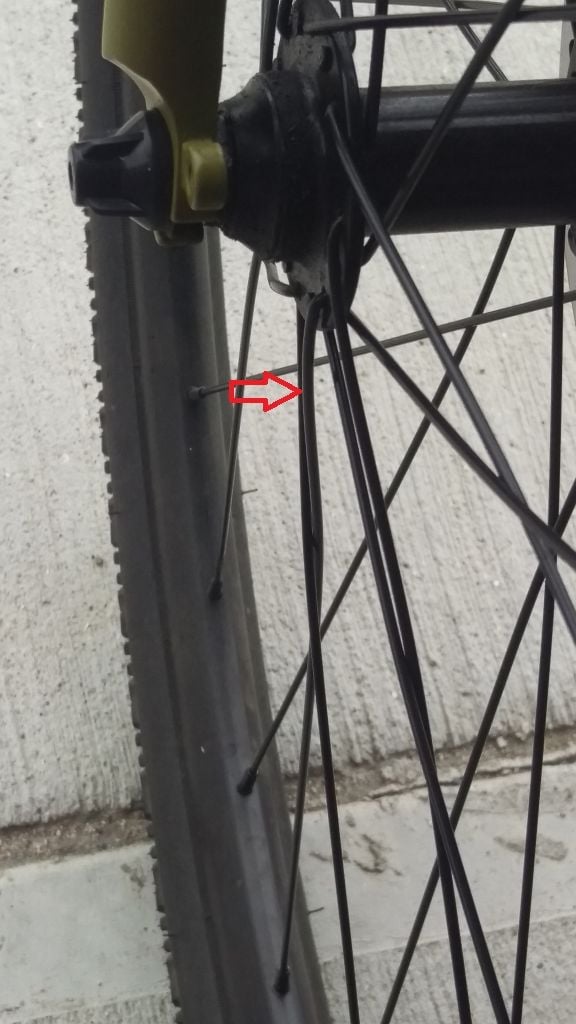
Is this indicative of a problem?
 08-21-18 | 01:24 PM
#2

Really Old Senior Member


Joined: Feb 2007
Posts: 14,635
Likes: 1,883
From: Mid Willamette Valley, Orygun
Bikes: 87 RockHopper,2008 Specialized Globe. Both upgraded to 9 speeds. 2019 Giant Explore E+3
Pluck them and compare tone.
All the spokes on the same side should sound the same.
Disc side will be higher pitched.
A pic from the side may be useful because of depth perception issues with just one pic.
All the spokes on the same side should sound the same.
Disc side will be higher pitched.
A pic from the side may be useful because of depth perception issues with just one pic.
Last edited by Bill Kapaun; 08-21-18 at 01:27 PM.
 08-21-18 | 01:26 PM
#3

Senior Member
Joined: Jun 2006
Posts: 1,407
Likes: 0
One of the steps in the wheel building process is to push down on the elbow-out spokes so that they incorporate an appropriate bend around the flange before heading out to the rim. The person (or more likely, machine) that built your wheel skipped this part. The result is a generally less durable wheel as the tension in the spoke is not held as constant during use. You can do the job yourself by pushing aggressively on the spokes just above the flange until they take a tight curve past the flange and a direct line out toward the rim, but this is best done by someone familiar with wheel building or at the very least wheel truing. The process will reduce spoke tension on those elbow-out spokes and the wheel will need to be re-tensioned and trued after being properly aligned.
*edited to add* - This process of aligning the spokes is best done earlier in the wheel building process, so that there is less tension in the spokes and they are more easy to align properly. This job will be harder now that the spokes are under high tension.
-Jeremy
*edited to add* - This process of aligning the spokes is best done earlier in the wheel building process, so that there is less tension in the spokes and they are more easy to align properly. This job will be harder now that the spokes are under high tension.
-Jeremy
08-21-18 | 09:37 PM
#5

Full Member
Joined: Sep 2015
Posts: 340
Likes: 72
From: Denver Colorado
Bikes: 2020 Pivot Vault, 1983 Rossin Record, Garneau R1, Mesamods home built gravel/rain commuter bike, 1995 Barracuda A2V modified with Surley single speed dropouts, 1969 Bottecchia junkyard special fixed gear, Cervelo P4, Mesamods 650b klunker
Kind of hard to tell from that photo, but that wheel doesn't look like it's built correctly. More photos from different angles would be helpful.
08-22-18 | 07:19 AM
#6
Senior Member
Joined: Oct 2009
Posts: 1,280
Likes: 322
From: Sherwood, OR
It appears to be laced correctly (more photos would help verify) but a I agree that the wasn't built properly. The spokes need to be better seated at the flange. The process will certainly require retensioning and truing, and it is probably better to do it now instead of waiting for spokes to break and needing a more expensive rebuild.
I would also also guess that either the tension is very low, or it will be after riding it. Nothing is worse for a spoke than riding at a tension so low that the spoke will go slack. I would get it looked at by a competent wheel builder ASAP. I will cost far less to do it now than after the wheel has failed.
I would also also guess that either the tension is very low, or it will be after riding it. Nothing is worse for a spoke than riding at a tension so low that the spoke will go slack. I would get it looked at by a competent wheel builder ASAP. I will cost far less to do it now than after the wheel has failed.
08-22-18 | 03:34 PM
#7
Senior Member
Joined: Jun 2006
Posts: 1,407
Likes: 0
It appears to be laced correctly (more photos would help verify) but a I agree that the wasn't built properly. The spokes need to be better seated at the flange. The process will certainly require retensioning and truing, and it is probably better to do it now instead of waiting for spokes to break and needing a more expensive rebuild.
I would also also guess that either the tension is very low, or it will be after riding it. Nothing is worse for a spoke than riding at a tension so low that the spoke will go slack. I would get it looked at by a competent wheel builder ASAP. I will cost far less to do it now than after the wheel has failed.
I would also also guess that either the tension is very low, or it will be after riding it. Nothing is worse for a spoke than riding at a tension so low that the spoke will go slack. I would get it looked at by a competent wheel builder ASAP. I will cost far less to do it now than after the wheel has failed.
-Jeremy
08-22-18 | 04:21 PM
#8

Full Member

Joined: Jun 2011
Posts: 291
Likes: 16
From: The Open Road
Another part of the procedure in the same article was to use pliers to bend the spoke just above the nipple so the nipple comes out of the rim as straight as possible rather than some extreme angle and poorly supported by the holes, but I haven't seen that recommendation repeated many other places. Does anyone around here actually do this?
Last edited by streetstomper; 08-22-18 at 07:26 PM.