


Chain sag on small cogs!
 08-10-19 | 05:45 AM
#1
Thread Starter
Junior Member
Joined: Aug 2019
Posts: 5
Likes: 0
From: Snowdon, Wales.
Bikes: 29" Voodoo Bazango
Chain sag on small cogs!
Hi! I have a Voodoo Bazango. Never noticed before but on the small front cog and 2nd smallest and smallest rear cog, the chain sags at the bottom (photo coming). It sags so much in rear2nd smallest that it's just touching the frame, same with the smallest rear. Gears change quick and smooth.
Questions:
Is this normal?
I read that the low rear cogs on the low front cogs are never used?
Many thanks I'll take some pics now.
Questions:
Is this normal?
I read that the low rear cogs on the low front cogs are never used?
Many thanks I'll take some pics now.
 08-10-19 | 05:59 AM
#3
Mechanic/Tourist
Joined: Apr 2007
Posts: 7,522
Likes: 12
From: Syracuse, NY
Bikes: 2008 Novara Randonee - love it. Previous bikes:Motobecane Mirage, 1972 Moto Grand Jubilee (my fave), Jackson Rake 16, 1983 C'dale ST500.
If the chain has been replaced it may have been sized too long. Also possible there is a problem with the pulley tensioning spring. "Never" is an exaggeration, but especially the small-small combo is generally avoided. On almost all bikes the next smaller chainring with one of the larger cogs is close to the same gear ratio. Running the small-small is much harder on your chain and cogs - fewer teeth engaged and a large chain angle.
08-10-19 | 06:08 AM
#4

Old fart


Joined: Nov 2004
Posts: 26,361
Likes: 5,271
From: Appleton WI
Bikes: Several, mostly not name brands.
Sounds like a chain wrap issue. A longer-arm rear derailleur would likely fix this. Sometimes, all that is needed is a little adjustment of the "B-screw" on the derailleur.
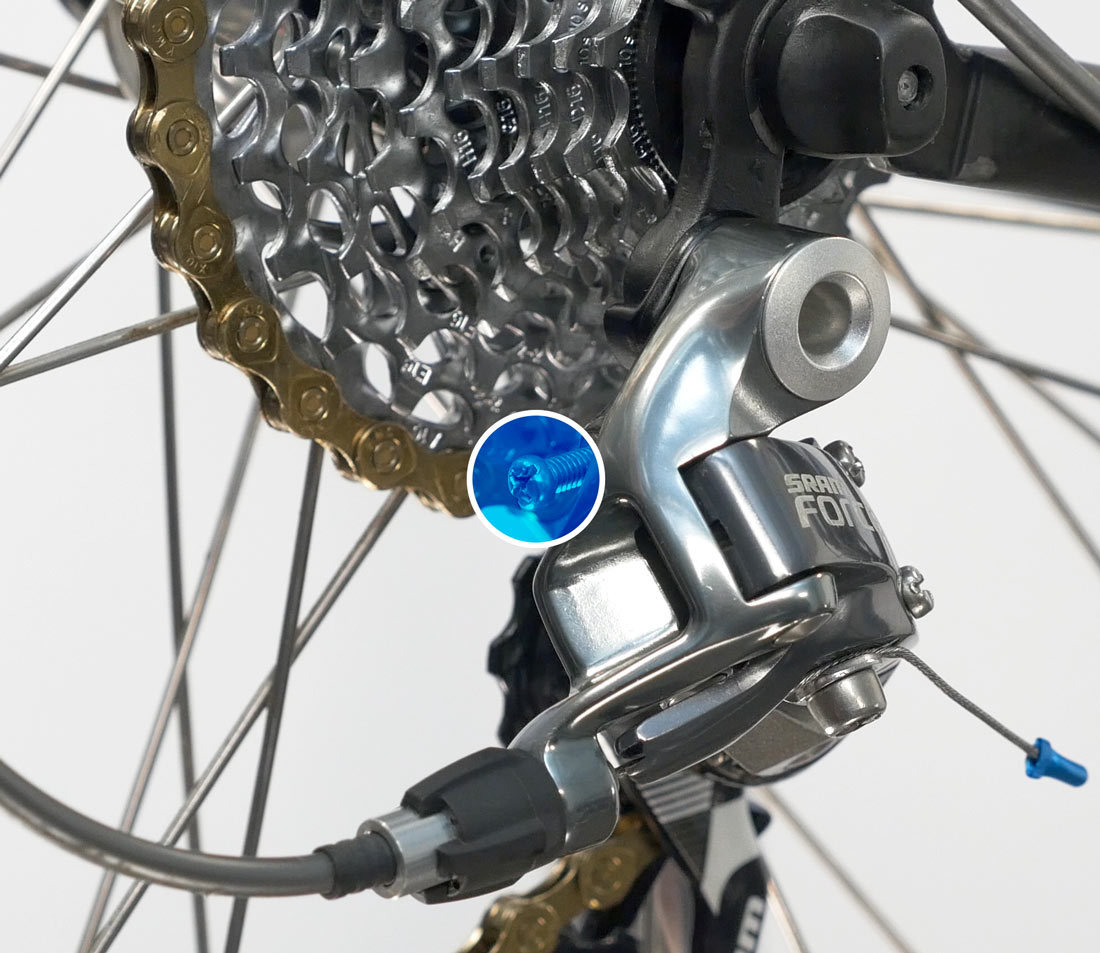
https://www.parktool.com/blog/repair...eur-adjustment
https://www.parktool.com/blog/repair...eur-adjustment
08-10-19 | 06:17 AM
#5
Thread Starter
Junior Member
Joined: Aug 2019
Posts: 5
Likes: 0
From: Snowdon, Wales.
Bikes: 29" Voodoo Bazango
Ah noticed that when I adjust, is it the B screw, to widen the gap it corrects itself. But is the gap between the rear large cog and inner derailer cog supposed to be about 6mm? It was sold with a wide gap but I watched a video by park tool about gap being small? Is the Idea to adjust the B screw to get the smallest gap without sag? Reading your link now.
Last edited by Dafydd_Cymru; 08-10-19 at 06:28 AM.
08-10-19 | 08:52 AM
#7

Senior Member
Joined: Jul 2005
Posts: 7,572
Likes: 223
As long as you don't change the size of the largest cog on your cassette and the largest chainring on your crankset during the life of the chain, here is a summary:
The chain should be sized by running it around the cassette's largest cog and the crankset's largest chainring, without running the chain through the rear derailleur, and finding the shortest point on the chain where the chain could be connected together, and then add one inch (from one pin to the other is one half-inch, so skip one pin and go to the next to get the inch measurement).
If, in doing this, you are "between links" in finding the nearest point where the chain can be connected, size up rather than down; better to have a chain that is a half inch longer than it needs to be than a chain that is a half inch too short. This chain sizing method is often referred to as the "big-big plus one method," and will give you the shortest chain possible to work safely with your drivetrain. Keep in mind that the most important rule in chain length sizing is that the chain absolutely must be at least long enough to safely shift to the largest chainring/largest cog combination. If not, even if you are determined to never shift to that combination, all it takes is one brain lapse and you will likely do major damage to your bike.
If you use the "big-big plus one" chain sizing method, and find that your chain is slack when in the smallest chainring and smallest cog(s), then your rear derailleur doesn't have enough chain wrap capacity for your drivetrain. As you have found, the result of this is usually not a big deal. Those gears are rarely used anyway, and the bike will usually still work okay unless it is an extreme case of too much chain for the derailleur to handle.
The chain should be sized by running it around the cassette's largest cog and the crankset's largest chainring, without running the chain through the rear derailleur, and finding the shortest point on the chain where the chain could be connected together, and then add one inch (from one pin to the other is one half-inch, so skip one pin and go to the next to get the inch measurement).
If, in doing this, you are "between links" in finding the nearest point where the chain can be connected, size up rather than down; better to have a chain that is a half inch longer than it needs to be than a chain that is a half inch too short. This chain sizing method is often referred to as the "big-big plus one method," and will give you the shortest chain possible to work safely with your drivetrain. Keep in mind that the most important rule in chain length sizing is that the chain absolutely must be at least long enough to safely shift to the largest chainring/largest cog combination. If not, even if you are determined to never shift to that combination, all it takes is one brain lapse and you will likely do major damage to your bike.
If you use the "big-big plus one" chain sizing method, and find that your chain is slack when in the smallest chainring and smallest cog(s), then your rear derailleur doesn't have enough chain wrap capacity for your drivetrain. As you have found, the result of this is usually not a big deal. Those gears are rarely used anyway, and the bike will usually still work okay unless it is an extreme case of too much chain for the derailleur to handle.

 08-10-19 | 01:06 PM
#8

Really Old Senior Member

Joined: Feb 2007
Posts: 14,639
Likes: 1,887
From: Mid Willamette Valley, Orygun
Bikes: 87 RockHopper,2008 Specialized Globe. Both upgraded to 9 speeds. 2019 Giant Explore E+3
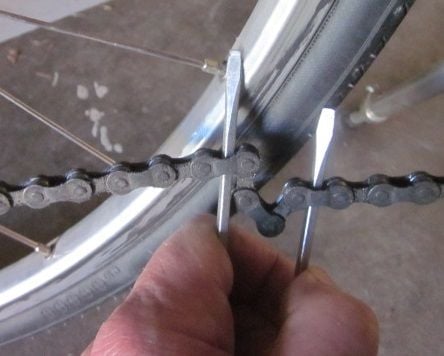
Here's the way I check chain length on the bike.
With the chain on BIG:BIG, see how much slack you can "pull". Pull it snug, but don't force it.
Anything over 2 link SETS is excess.
08-10-19 | 01:25 PM
#9

Senior Member
Joined: Sep 2010
Posts: 8,327
Likes: 1,110
From: Roswell, GA
Bikes: '93 Trek 750, '92 Schwinn Crisscross, '93 Mongoose Alta
Never Fix A Running Piece.
You shouldn't be using the small cogs when in the small chain ring anyway, it is called cross-chaining and it wears the drivetrain more quickly and is less efficient than using the equivalent ratios on the larger chain ring.
If you decide to mess with it anyway and want to shorten the chain, you MUST always have the chain long enough to go onto the big cog and big chain ring without strain, which you shouldn't do either (cross-chaining again) but you might forget.
You shouldn't be using the small cogs when in the small chain ring anyway, it is called cross-chaining and it wears the drivetrain more quickly and is less efficient than using the equivalent ratios on the larger chain ring.
If you decide to mess with it anyway and want to shorten the chain, you MUST always have the chain long enough to go onto the big cog and big chain ring without strain, which you shouldn't do either (cross-chaining again) but you might forget.
08-10-19 | 01:31 PM
#10

Senior Member


Joined: Nov 2014
Posts: 27,576
Likes: 5,456
From: Eugene, Oregon, USA
[MENTION=503957]Dafydd_Cymru[/MENTION]'s photos:
https://www.bikeforums.net/g/user/503957
https://www.bikeforums.net/g/album/14804753


https://www.bikeforums.net/g/user/503957
https://www.bikeforums.net/g/album/14804753
 08-10-19 | 01:48 PM
#12

Half way there
Joined: Sep 2015
Posts: 2,967
Likes: 895
From: North Carolina
Bikes: Many, and the list changes frequently
Pictures show a chain that is a bit too long. @Dafydd_Cymru: Could you post a similar shot of the chain on the largest rings and cogs?
08-10-19 | 02:00 PM
#13
Senior Member
Joined: Nov 2014
Posts: 27,576
Likes: 5,456
From: Eugene, Oregon, USA
I think you have the chain too long. See [MENTION=78399]Bill Kapaun[/MENTION]'s notes about chain sizing, big/big rings. But, removing a single double link pair may be enough, although I like to size my chain so it is in the middle, not over-streched on the big/big, but not too lax on the small/small.
As [MENTION=205349]dsbrantjr[/MENTION] mentions, the problem occurs with cross-chaining, small/small.
Your derailleur looks like it should be able to take up a fair amount of chain. I can't see exactly your cassette/chainring details. The modern systems aren't designed for 40+ teeth on the rear + a triple on the front. But, I don't think that is the case on your bike.
Here is the "B-Screw" adjustment. It might help a little bit, but I'd check the chain length first.
Derailleur_Adjustment.jpg
As [MENTION=205349]dsbrantjr[/MENTION] mentions, the problem occurs with cross-chaining, small/small.
Your derailleur looks like it should be able to take up a fair amount of chain. I can't see exactly your cassette/chainring details. The modern systems aren't designed for 40+ teeth on the rear + a triple on the front. But, I don't think that is the case on your bike.
Here is the "B-Screw" adjustment. It might help a little bit, but I'd check the chain length first.
Derailleur_Adjustment.jpg
08-10-19 | 02:33 PM
#14
Senior Member
Joined: Nov 2014
Posts: 27,576
Likes: 5,456
From: Eugene, Oregon, USA
Pictures show a chain that is a bit too long. @Dafydd_Cymru: Could you post a similar shot of the chain on the largest rings and cogs?
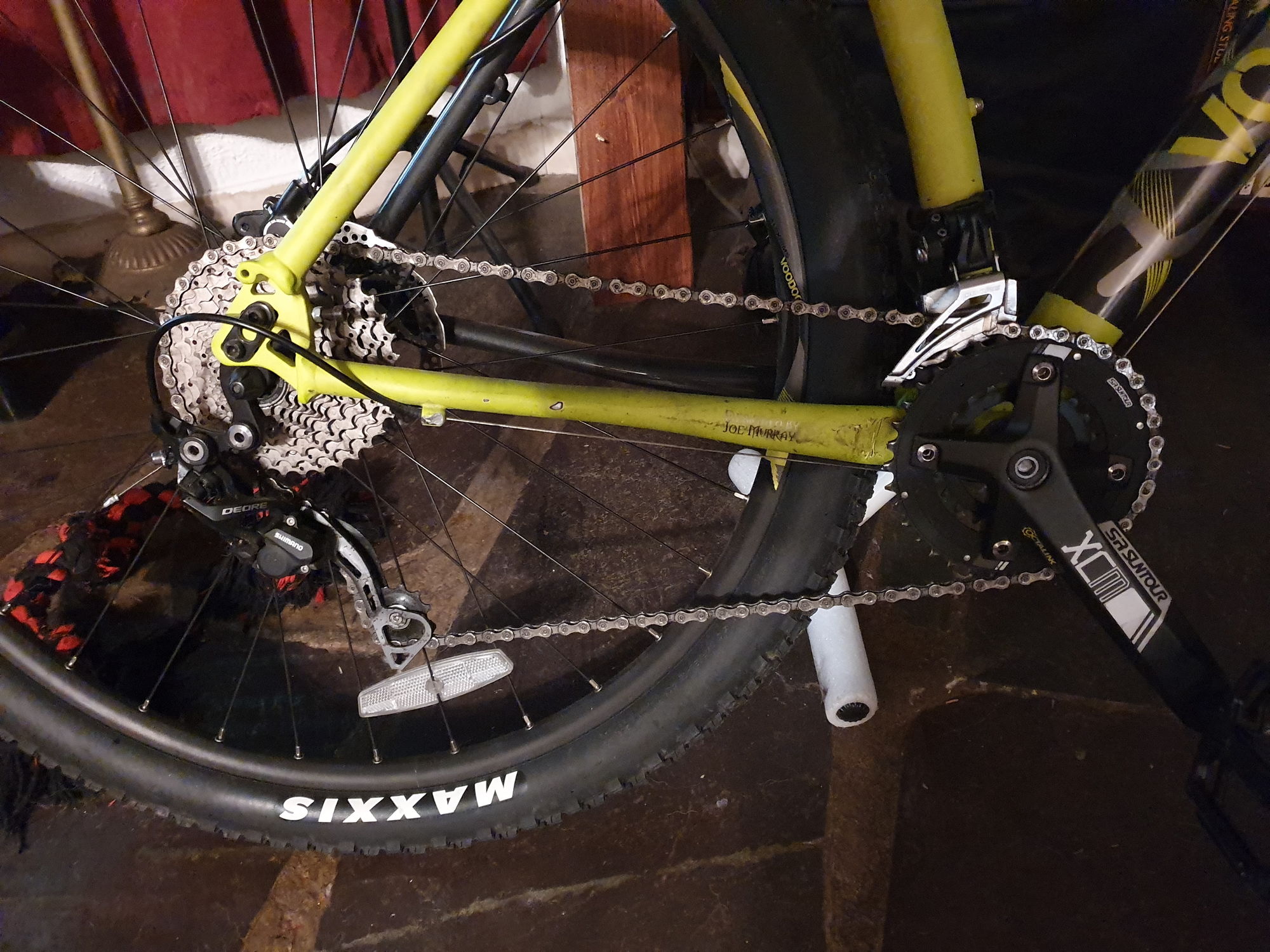
It looks to me like the chain could be shortened at least one double-link, if not a pair of double-links (2 or 4 single links).
08-10-19 | 06:22 PM
#15
Half way there
Joined: Sep 2015
Posts: 2,967
Likes: 895
From: North Carolina
Bikes: Many, and the list changes frequently
08-12-19 | 05:09 PM
#16
Senior Member
Joined: Jul 2010
Posts: 13,912
Likes: 1,242
From: Montreal Canada
hey there Welshman, or woman,
check out this reliable, well made, how to vid.
My guess also is chain is a bit too long, its easy to find out, if you can figure out how to undo your chain, hopefully it has a quick link.
easiest way is once chain is apart, big big , not through derailleur, and add two links.
watch vid, and read up on it to be sure, its not a hard thing to do, and if you've never taken apart a quick link , (if your chain has one) its a good exercise to do. Can be a bit fiddly, but good to know how to fight with one and remove it and put it back on.
check out this reliable, well made, how to vid.
My guess also is chain is a bit too long, its easy to find out, if you can figure out how to undo your chain, hopefully it has a quick link.
easiest way is once chain is apart, big big , not through derailleur, and add two links.
watch vid, and read up on it to be sure, its not a hard thing to do, and if you've never taken apart a quick link , (if your chain has one) its a good exercise to do. Can be a bit fiddly, but good to know how to fight with one and remove it and put it back on.
08-12-19 | 05:35 PM
#17

Senior Member
Joined: Oct 2014
Posts: 14,164
Likes: 5,295
From: Portland, OR
Bikes: (2) ti TiCycles, 2007 w/ triple and 2011 fixed, 1979 Peter Mooney, ~1983 Trek 420 now fixed and ~1973 Raleigh Carlton Competition gravel grinder
My question - do the slack chained small-small combinations work? Would you use them if they did?
On most of my bikes, those combinations run funky. On some, the chain fully doubles back on itself and rubs. But on all the bikes where the next chainring doesn't pick up the chain (cursed pick-up pins), these combinations are ride-able and I use them, although not for long periods of time. (Say when a tough climb levels out for a short stretch and I really do not want to do two double shifts.) That they are noisy is a good reminder not to stay there.
Edit: looking at CliffordK's first photo of the OP's bike, small-small - looks to me like the spring for the derailleur cage isn't tight enough. The cage is not pulled all the way back/up and not fully tightening the chain. (It won't take out all that slack but it should be taking out more.) I do not know the Deore derailleurs but on the old SunTours, we would just take the cage off, open the spring cylinder and wind the spring a a notch or more tighter and reassemble. I'm guessing someone here can say how that is done with Deores.
Ben
On most of my bikes, those combinations run funky. On some, the chain fully doubles back on itself and rubs. But on all the bikes where the next chainring doesn't pick up the chain (cursed pick-up pins), these combinations are ride-able and I use them, although not for long periods of time. (Say when a tough climb levels out for a short stretch and I really do not want to do two double shifts.) That they are noisy is a good reminder not to stay there.
Edit: looking at CliffordK's first photo of the OP's bike, small-small - looks to me like the spring for the derailleur cage isn't tight enough. The cage is not pulled all the way back/up and not fully tightening the chain. (It won't take out all that slack but it should be taking out more.) I do not know the Deore derailleurs but on the old SunTours, we would just take the cage off, open the spring cylinder and wind the spring a a notch or more tighter and reassemble. I'm guessing someone here can say how that is done with Deores.
Ben
Last edited by 79pmooney; 08-12-19 at 05:45 PM.
08-12-19 | 07:43 PM
#18
Senior Member
Joined: Jul 2010
Posts: 13,912
Likes: 1,242
From: Montreal Canada
Mr mooney, I dunno, I cant imagine that a fairly new deore rd is slack. Heck, I have a nearly 30 yr old one on my old touring bike that is still good and snappy, and have a 9 or 10 season old one on one of my bikes, same thing.
I also dont know if you can change this spring tension, like on older v brakes with changing the hole the spring goes into.
it seems to me that in the big big photo, the rd isnt as far forward as it is when I do this funky test on my bikes, which I really dont like doing....which would point to the chain being a bit too long.
if his chain is a shimano, it prob wont have a quick link, so probably not encouraging to do a chain length test.
who knows, maybe this was a replacement chain put on without measuring, and put on with all the links on it in box.
I also dont know if you can change this spring tension, like on older v brakes with changing the hole the spring goes into.
it seems to me that in the big big photo, the rd isnt as far forward as it is when I do this funky test on my bikes, which I really dont like doing....which would point to the chain being a bit too long.
if his chain is a shimano, it prob wont have a quick link, so probably not encouraging to do a chain length test.
who knows, maybe this was a replacement chain put on without measuring, and put on with all the links on it in box.
08-14-19 | 01:09 AM
#20
Junior Member
Joined: Jul 2014
Posts: 12
Likes: 1
Did the bike come with these cassette chain rings, and rear derailler hanger?
From the Shimano web site:
Total capacity 41T
Do the math. Big chain ring number of teeth + biggest rear cog # of teeth. Then get the number of teeth on the small front + small rear. Is the difference greater than 41?
From the Shimano web site:
Total capacity 41T
Do the math. Big chain ring number of teeth + biggest rear cog # of teeth. Then get the number of teeth on the small front + small rear. Is the difference greater than 41?
08-14-19 | 06:02 AM
#21
Senior Member
Joined: Jul 2010
Posts: 13,912
Likes: 1,242
From: Montreal Canada
hey there Dafydd,
did you put this chain on your bike?
If you did, we always have to take a few links off a new chain, and we have to do that chain length test, "big-big not thru derailleur" to see how many links to take off.
Did you buy it new, used?
get back to let us know.
Had family in Aber for years btw
cheers
did you put this chain on your bike?
If you did, we always have to take a few links off a new chain, and we have to do that chain length test, "big-big not thru derailleur" to see how many links to take off.
Did you buy it new, used?
get back to let us know.
Had family in Aber for years btw
cheers
07-26-20 | 09:52 AM
#22
Newbie
Joined: Jul 2020
Posts: 1
Likes: 0
Solved
First time running serious hills on my new bike. Small chainring, and largest rear cog for the main climb. Once that had levelled out and before the next climb I went through the gears to a smaller rear cog and found a load of slack (probably more than what the OP has shown).
Solved by tightening the B screw, which took up all of the slack. As an added bonus, turns out my pulley and cog were too close together and my chain was getting pinched in the large chainring and largest rear cog. Now this is also solved.
Not planning on cross chaining for long periods but in amongst climbs it's better than double shifting.
Solved by tightening the B screw, which took up all of the slack. As an added bonus, turns out my pulley and cog were too close together and my chain was getting pinched in the large chainring and largest rear cog. Now this is also solved.
Not planning on cross chaining for long periods but in amongst climbs it's better than double shifting.
07-26-20 | 10:15 AM
#23

Mad bike riding scientist
Joined: Nov 2004
Posts: 29,155
Likes: 6,213
From: Denver, CO
Bikes: Some silver ones, a red one, a black and orange one, and a few titanium ones
__________________
Stuart Black
Dreamin' of Bemidji Down the Mississippi (in part)
Plan Epsilon Around Lake Michigan in the era of Covid
Gold Fever Three days of dirt in Colorado
Pokin' around the Poconos A cold ride around Lake Erie
Dinosaurs in Colorado A mountain bike guide to the Purgatory Canyon dinosaur trackway
Solo Without Pie. The search for pie in the Midwest.
Picking the Scablands. Washington and Oregon, 2005. Pie and spiders on the Columbia River!
Stuart Black
Dreamin' of Bemidji Down the Mississippi (in part)
Plan Epsilon Around Lake Michigan in the era of Covid
Gold Fever Three days of dirt in Colorado
Pokin' around the Poconos A cold ride around Lake Erie
Dinosaurs in Colorado A mountain bike guide to the Purgatory Canyon dinosaur trackway
Solo Without Pie. The search for pie in the Midwest.
Picking the Scablands. Washington and Oregon, 2005. Pie and spiders on the Columbia River!
07-26-20 | 10:56 AM
#25
Really Old Senior Member
Joined: Feb 2007
Posts: 14,639
Likes: 1,887
From: Mid Willamette Valley, Orygun
Bikes: 87 RockHopper,2008 Specialized Globe. Both upgraded to 9 speeds. 2019 Giant Explore E+3
That’s a great idea for a chain that’s already on the bike. The one refinement I would suggest is to use hemostats instead of two screwdrivers
2 screw drivers work fine, especially if you aren't trying to hold a camera in the other hand.
A person could use a couple nails as far as that goes.