


Rockhopper or Hardrock fork on a Stumpy?
 01-25-22 | 12:45 PM
#1
Thread Starter
Senior Member

Joined: Feb 2016
Posts: 1,860
Likes: 821
From: SE Wisconsin
Bikes: Lemond '01 Maillot Jaune, Lemond '02 Victoire, Lemond '03 Poprad, Lemond '03 Wayzata DB conv(Poprad), '79 AcerMex Windsor Carrera Professional(pur new), '88 GT Tequesta(pur new), '01 Bianchi Grizzly, 1993 Trek 970 DB conv, Trek 8900 DB conv
Rockhopper or Hardrock fork on a Stumpy?
My knowledge specifically on Specialized bikes is limited as I've never owned one nor spent any time around them.
Given a rigid 1990ish to 1996ish Specialized Stumpjumper, are the DirectDrive CroMoly forks on a Rockhopper or (less likely?) a Hardrock-Ultra the same as the OEM Direct Drive CroMoly fork that would have come with the same year(approx) Stumpjumper? In the catalogs they tend to use the same terminology "DirectDrive fork" with the rigid models.
Stumpjumpers transitioned to 1 1/8th threadless steerer tubes in 1994(per German catalog) and the top end Rockhoppers also went threadless. Not sure about the Hardrock as I've never looked into them much.
Would a 1" threaded DirectDrive CroMo fork from a Rockhopper (or upper-end Hardrock) be the same as that used on a Stumpy?
Would a 1 1/8ths threadless DirectDrive CroMo fork from a Rockhopper (or upper-end Hardrock) be the same as that used on a Stumpy?
Bonus question (slightly off topic): In the 1991-1996 range, were FS Stumpy frames any different than the rigid-fork frames or did they just mount a suspended fork on the same frame as the rigid bikes? They had fairly short travel suspended forks back then..
thx..
Given a rigid 1990ish to 1996ish Specialized Stumpjumper, are the DirectDrive CroMoly forks on a Rockhopper or (less likely?) a Hardrock-Ultra the same as the OEM Direct Drive CroMoly fork that would have come with the same year(approx) Stumpjumper? In the catalogs they tend to use the same terminology "DirectDrive fork" with the rigid models.
Stumpjumpers transitioned to 1 1/8th threadless steerer tubes in 1994(per German catalog) and the top end Rockhoppers also went threadless. Not sure about the Hardrock as I've never looked into them much.
Would a 1" threaded DirectDrive CroMo fork from a Rockhopper (or upper-end Hardrock) be the same as that used on a Stumpy?
Would a 1 1/8ths threadless DirectDrive CroMo fork from a Rockhopper (or upper-end Hardrock) be the same as that used on a Stumpy?
Bonus question (slightly off topic): In the 1991-1996 range, were FS Stumpy frames any different than the rigid-fork frames or did they just mount a suspended fork on the same frame as the rigid bikes? They had fairly short travel suspended forks back then..
thx..
 01-25-22 | 01:51 PM
#2
Senior Member
Joined: Oct 2020
Posts: 478
Likes: 254
I know the hard rock has both fender and rack eyes on the fork. and rock hopper only has fender eyes. The forks looks the same other that including the stickers.
yes at least some of the 94 hard rocks had 1 1/8 steerers not sure if all versions did.
Yes I have swapped used a fork from a hard rock on a rock hopper. assuming the steerer is the correct length.
I can see no reason why you couldn't swap the 1 1/8" ones I have never messed with a rigid one all the ones I have messed with had shocks.
the FS ones I have zero experience with but would really like to find one.
There is someone on here that will have a way better answer than mine. but thats what I have observed...
yes at least some of the 94 hard rocks had 1 1/8 steerers not sure if all versions did.
Yes I have swapped used a fork from a hard rock on a rock hopper. assuming the steerer is the correct length.
I can see no reason why you couldn't swap the 1 1/8" ones I have never messed with a rigid one all the ones I have messed with had shocks.
the FS ones I have zero experience with but would really like to find one.
There is someone on here that will have a way better answer than mine. but thats what I have observed...
01-25-22 | 07:30 PM
#3
Senior Member

Joined: May 2013
Posts: 2,313
Likes: 1,187
From: Kips Bay, NY
Bikes: Ritchey Swiss Cross | Teesdale Kona Hot | Haro Extreme | Specialized Stumpjumper Comp | Cannondale F1000 | Shogun 1000 | Cannondale M500 | Norco Charger | Marin Muirwoods 29er | Shogun Kaze | Breezer Lightning
The early suspended models had 1-1/8" steerers, rigid ones were 1".
Stumpjmpers used lighter steel on frame and fork; the early Stumpjumper fork is famous for being in the 600gram range.
Stumpjmpers used lighter steel on frame and fork; the early Stumpjumper fork is famous for being in the 600gram range.
01-26-22 | 06:44 AM
#4
Senior Member
Joined: Jun 2019
Posts: 583
Likes: 184
To elaborate on DorkDisk's comment - using 1994 as an example (catalog available on retrobike), the rigid fork on the stumpjumper is listed as "DD Tange Chromoly, tapered blades". For the Rockhopper models, it's just "DD Chromoly" and for the hardrocks (except for Hardrock ultra), it's "high-tensile steel". So the fork quality tracks with the frame quality. Expect the Stumpy forks to be lighter and slightly more flexible than the lower models.
01-26-22 | 07:08 AM
#5
Senior Member

Joined: Jul 2010
Posts: 13,912
Likes: 1,242
From: Montreal Canada
No answer here, but I have a slightly newer rockhopper 97? that i use as my winter bike, ride it daily. What makes me laugh though is the whole "DirectDrive" marketing thing, my bike has this written on it also and it always makes me roll my eyes at the term, i mean I've never seen an "indirect drive" chain driven bicycle before, but the spesh boys and girls in marketing obviously thought that would make a snazzy name didn't they?
01-26-22 | 07:19 AM
#6
Senior Member
Joined: May 2013
Posts: 2,313
Likes: 1,187
From: Kips Bay, NY
Bikes: Ritchey Swiss Cross | Teesdale Kona Hot | Haro Extreme | Specialized Stumpjumper Comp | Cannondale F1000 | Shogun 1000 | Cannondale M500 | Norco Charger | Marin Muirwoods 29er | Shogun Kaze | Breezer Lightning
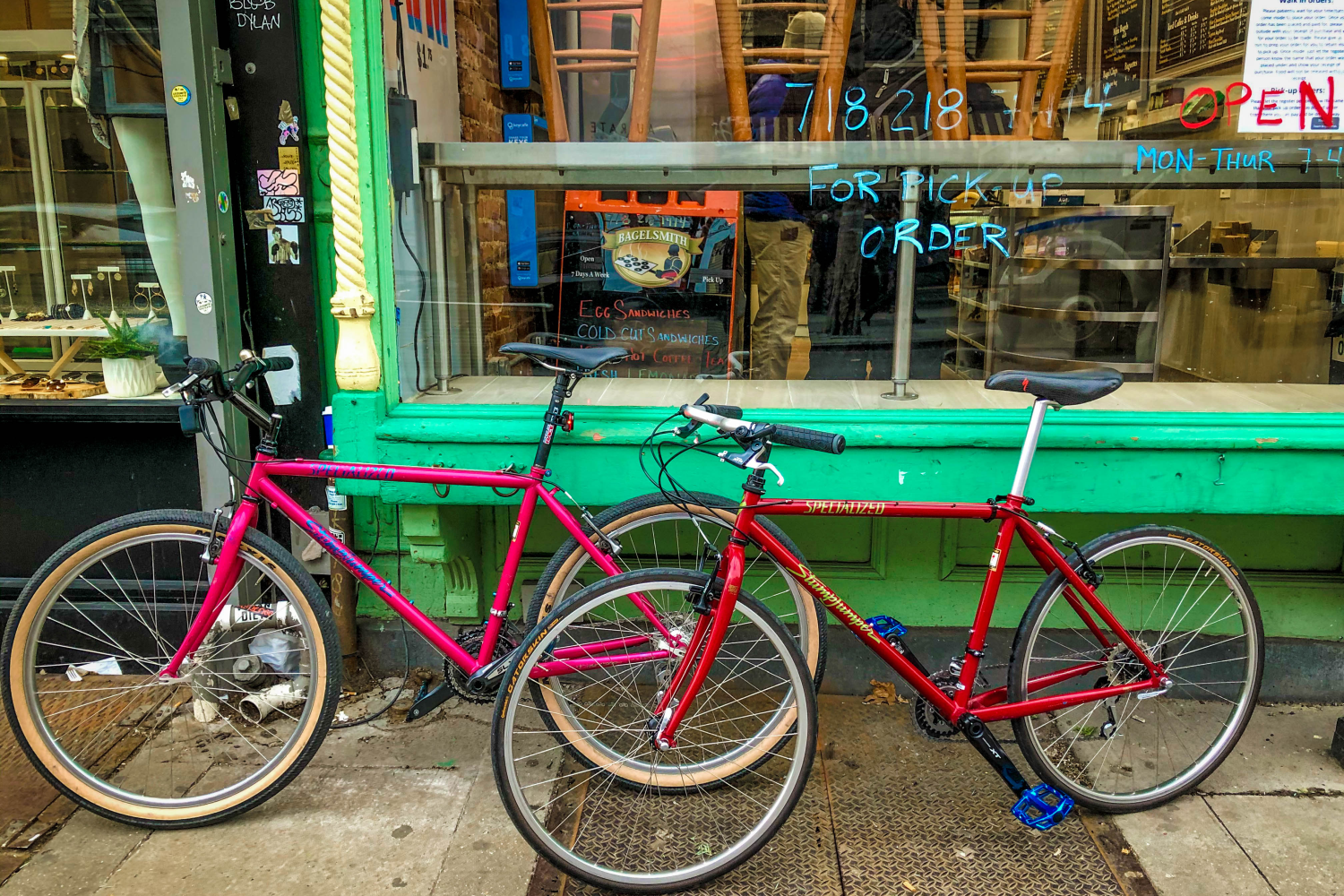
The ride of these 600g steel forks is really nice. I'd go out of my way to track one down.
01-26-22 | 08:16 AM
#7
Thread Starter
Senior Member
Joined: Feb 2016
Posts: 1,860
Likes: 821
From: SE Wisconsin
Bikes: Lemond '01 Maillot Jaune, Lemond '02 Victoire, Lemond '03 Poprad, Lemond '03 Wayzata DB conv(Poprad), '79 AcerMex Windsor Carrera Professional(pur new), '88 GT Tequesta(pur new), '01 Bianchi Grizzly, 1993 Trek 970 DB conv, Trek 8900 DB conv
To elaborate on DorkDisk's comment - using 1994 as an example (catalog available on retrobike), the rigid fork on the stumpjumper is listed as "DD Tange Chromoly, tapered blades". For the Rockhopper models, it's just "DD Chromoly" and for the hardrocks (except for Hardrock ultra), it's "high-tensile steel". So the fork quality tracks with the frame quality. Expect the Stumpy forks to be lighter and slightly more flexible than the lower models.
Thx..good info.
01-26-22 | 08:29 AM
#8
Thread Starter
Senior Member
Joined: Feb 2016
Posts: 1,860
Likes: 821
From: SE Wisconsin
Bikes: Lemond '01 Maillot Jaune, Lemond '02 Victoire, Lemond '03 Poprad, Lemond '03 Wayzata DB conv(Poprad), '79 AcerMex Windsor Carrera Professional(pur new), '88 GT Tequesta(pur new), '01 Bianchi Grizzly, 1993 Trek 970 DB conv, Trek 8900 DB conv
No answer here, but I have a slightly newer rockhopper 97? that i use as my winter bike, ride it daily. What makes me laugh though is the whole "DirectDrive" marketing thing, my bike has this written on it also and it always makes me roll my eyes at the term, i mean I've never seen an "indirect drive" chain driven bicycle before, but the spesh boys and girls in marketing obviously thought that would make a snazzy name didn't they?
Anybody know what Specialized Direct Drive tubing is?
Trek used Multitrack and Singletrack in their hybrid and mtn models with some descriptor on the decals regarding the tubing that's reasonably descriptive/accurate. Lemond used a variety of tubing-specific terms to describe the (ovalized) tubing they used in the MJ & Zurich models that set them apart from the round tubing used for the BA or Tourmalet models that set them apart the Poprad & Wayzata. But "Direct Drive"..ok..huh?
Last edited by fishboat; 01-26-22 at 08:45 AM.
01-26-22 | 09:02 AM
#9
Thread Starter
Senior Member
Joined: Feb 2016
Posts: 1,860
Likes: 821
From: SE Wisconsin
Bikes: Lemond '01 Maillot Jaune, Lemond '02 Victoire, Lemond '03 Poprad, Lemond '03 Wayzata DB conv(Poprad), '79 AcerMex Windsor Carrera Professional(pur new), '88 GT Tequesta(pur new), '01 Bianchi Grizzly, 1993 Trek 970 DB conv, Trek 8900 DB conv
In the short term, if I wanted to obtain a no-fork Stumpy frame and build it up, there appears to be a couple fork options with Carver and Soma (and a number of others, but these two seem the most viable). Longer term is to track down an original fork, one way or another, or pick up a frame-fork set..
BF historical posts are a big help in figuring things out.
26 inch Rigid fork: Soma vs. Carver
The Soma looks nice, though this leads into the "how much does A to C variation impact handling?" question..which I'm researching now.
On a slightly different topic,
Does anyone have any thoughts on: In the 1991-1996 range, were suspended fork Stumpy frames any different than the rigid-fork frames or did they just mount a suspended fork on the same frame as the rigid bikes? They had fairly short travel suspended forks back then.
Great info folks..much appreciated.
01-26-22 | 10:00 AM
#10
Senior Member
Joined: May 2013
Posts: 2,313
Likes: 1,187
From: Kips Bay, NY
Bikes: Ritchey Swiss Cross | Teesdale Kona Hot | Haro Extreme | Specialized Stumpjumper Comp | Cannondale F1000 | Shogun 1000 | Cannondale M500 | Norco Charger | Marin Muirwoods 29er | Shogun Kaze | Breezer Lightning
I was hoping for an end-run to get there..if I picked up a Stumpy M2 without a fork I could then pick up a ratty, but sound, donor Rockhopper or Hardrock-Ultra to get the fork. No such luck.
In the short term, if I wanted to obtain a no-fork Stumpy frame and build it up, there appears to be a couple fork options with Carver and Soma (and a number of others, but these two seem the most viable). Longer term is to track down an original fork, one way or another, or pick up a frame-fork set..
BF historical posts are a big help in figuring things out.
26 inch Rigid fork: Soma vs. Carver
The Soma looks nice, though this leads into the "how much does A to C variation impact handling?" question..which I'm researching now.
On a slightly different topic,
Does anyone have any thoughts on: In the 1991-1996 range, were suspended fork Stumpy frames any different than the rigid-fork frames or did they just mount a suspended fork on the same frame as the rigid bikes? They had fairly short travel suspended forks back then.
Great info folks..much appreciated.
In the short term, if I wanted to obtain a no-fork Stumpy frame and build it up, there appears to be a couple fork options with Carver and Soma (and a number of others, but these two seem the most viable). Longer term is to track down an original fork, one way or another, or pick up a frame-fork set..
BF historical posts are a big help in figuring things out.
26 inch Rigid fork: Soma vs. Carver
The Soma looks nice, though this leads into the "how much does A to C variation impact handling?" question..which I'm researching now.
On a slightly different topic,
Does anyone have any thoughts on: In the 1991-1996 range, were suspended fork Stumpy frames any different than the rigid-fork frames or did they just mount a suspended fork on the same frame as the rigid bikes? They had fairly short travel suspended forks back then.
Great info folks..much appreciated.
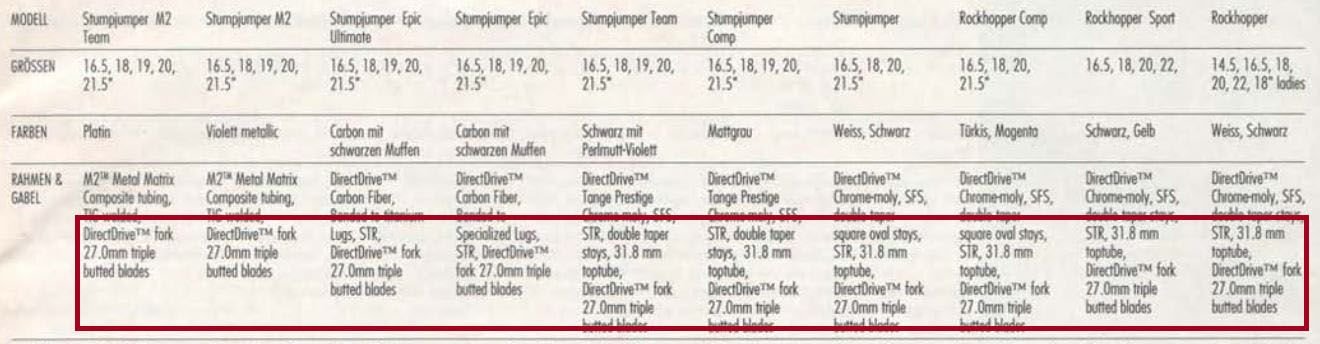
I'd start with identifying the year of the frame and then figuring our the fork it came with and deriving the A-C from that. Some years, it appears that Special Ed did use nicer forks on all their bikes. This is from 91; all triple butted. But they're all likely 1" except for the M2, and with very short A-C
 01-26-22 | 07:05 PM
#11
Thread Starter
Senior Member
Joined: Feb 2016
Posts: 1,860
Likes: 821
From: SE Wisconsin
Bikes: Lemond '01 Maillot Jaune, Lemond '02 Victoire, Lemond '03 Poprad, Lemond '03 Wayzata DB conv(Poprad), '79 AcerMex Windsor Carrera Professional(pur new), '88 GT Tequesta(pur new), '01 Bianchi Grizzly, 1993 Trek 970 DB conv, Trek 8900 DB conv
Thanks DD, looks like a good approach.
Been doing more digging. For the sake of posterity and anyone stumbling across this thread in the future I'll post what I found and where I netted out. I'm reasonably sure this is correct, though with most of the available catalogs I've found being printed in German, it's a challenge. Also, there's the assumption that the German market = USA offerings..no way for me to know.
It seems when Specialized introduced suspension forks 1992 or 1993 (I don't have a 1992 catalog, there were no hardtails in the 1991 catalog and they do exist in the 93 catalog) they had the standard-previous Stumpy frames(fork A2C of 394mm) and they had the FS models. The FS models were basically "suspension fork ready" frames. The FS models were offered as rigid bikes as well as hardtails with a suspension fork. The rigid FS models had a suspension corrected fork with an A2C of 410mm. That number varied in the references (various forums) between 406 and 413...for the sake of a short quarter inch..we'll call it 410mm. The Mag21 (or Judy?) suspension forks offered on the FS had two travel lengths, 48 and 63mm. The 63mm travel fork had a 420mm A2C unloaded. Fork rakes for all models were listed as 42mm in a 1996 catalog I located.
The above is correct as far as I can tell so far. If anyone has better info feel free to pop in..
DD's..."I'd start with identifying the year of the frame and then figuring out the fork it came with and deriving the A-C from that." would be the way to go..thx..
As far as how much does varying the A2C from a frame's original spec impact handling...that seems to be a topic that has been discussed in many places at length. I netted out that if the replacement fork is within 20-25mm of the original A2C spec, then things should be ok. Rake(offset) should also be within 3-5mm(??) of original spec. There's always some folks that say the A2C variation must be minimal and others that run a fork at +50mm from spec and they say handling is great. Such are opinions on forums..
Been doing more digging. For the sake of posterity and anyone stumbling across this thread in the future I'll post what I found and where I netted out. I'm reasonably sure this is correct, though with most of the available catalogs I've found being printed in German, it's a challenge. Also, there's the assumption that the German market = USA offerings..no way for me to know.
It seems when Specialized introduced suspension forks 1992 or 1993 (I don't have a 1992 catalog, there were no hardtails in the 1991 catalog and they do exist in the 93 catalog) they had the standard-previous Stumpy frames(fork A2C of 394mm) and they had the FS models. The FS models were basically "suspension fork ready" frames. The FS models were offered as rigid bikes as well as hardtails with a suspension fork. The rigid FS models had a suspension corrected fork with an A2C of 410mm. That number varied in the references (various forums) between 406 and 413...for the sake of a short quarter inch..we'll call it 410mm. The Mag21 (or Judy?) suspension forks offered on the FS had two travel lengths, 48 and 63mm. The 63mm travel fork had a 420mm A2C unloaded. Fork rakes for all models were listed as 42mm in a 1996 catalog I located.
The above is correct as far as I can tell so far. If anyone has better info feel free to pop in..
DD's..."I'd start with identifying the year of the frame and then figuring out the fork it came with and deriving the A-C from that." would be the way to go..thx..
As far as how much does varying the A2C from a frame's original spec impact handling...that seems to be a topic that has been discussed in many places at length. I netted out that if the replacement fork is within 20-25mm of the original A2C spec, then things should be ok. Rake(offset) should also be within 3-5mm(??) of original spec. There's always some folks that say the A2C variation must be minimal and others that run a fork at +50mm from spec and they say handling is great. Such are opinions on forums..
01-26-22 | 10:08 PM
#12

Senior Member
Joined: Feb 2015
Posts: 6,006
Likes: 2,286
From: Mission Viejo
Bikes: 1986 Cannondale SR400 (Flat bar commuter), 1988 Cannondale Criterium XTR, 1992 Serotta T-Max, 1995 Trek 970
The old suspension fork rule of thumb was 1 degree for every 20mm of additional fork length.
If your head angle is 71* and you add 20mm ATC, it will be around 70*.
On pavement with skinny tires it might be technically a bit slower steering, but on trails, a little more slack HA with a shorter stem and wider bars, than stock, is generally an improvement over early 90’s geometry.
John
If your head angle is 71* and you add 20mm ATC, it will be around 70*.
On pavement with skinny tires it might be technically a bit slower steering, but on trails, a little more slack HA with a shorter stem and wider bars, than stock, is generally an improvement over early 90’s geometry.
John
