


Is this classed as a "Horizontal dropout"?


 07-30-22 | 05:29 AM
#2

Old fart


Joined: Nov 2004
Posts: 26,345
Likes: 5,251
From: Appleton WI
Bikes: Several, mostly not name brands.
Yes, that would be a "horizontal" dropout.
N.B. the quick release in your picture is intended to be used with vertical dropouts and may not clamp firmly enough to prevent the wheel from pulling out of alignment on a horizontal dropout. Consider replacing it with a traditional enclosed-cam quick release.
N.B. the quick release in your picture is intended to be used with vertical dropouts and may not clamp firmly enough to prevent the wheel from pulling out of alignment on a horizontal dropout. Consider replacing it with a traditional enclosed-cam quick release.

 07-30-22 | 06:53 AM
#3
Thread Starter
Newbie
Joined: Jul 2022
Posts: 44
Likes: 9
Yes, that would be a "horizontal" dropout.
N.B. the quick release in your picture is intended to be used with vertical dropouts and may not clamp firmly enough to prevent the wheel from pulling out of alignment on a horizontal dropout. Consider replacing it with a traditional enclosed-cam quick release.
N.B. the quick release in your picture is intended to be used with vertical dropouts and may not clamp firmly enough to prevent the wheel from pulling out of alignment on a horizontal dropout. Consider replacing it with a traditional enclosed-cam quick release.
07-30-22 | 06:55 AM
#4
Senior Member

Joined: Aug 2006
Posts: 1,323
Likes: 472
From: Valley Forge: Birthplace of Freedom
Bikes: Novara Safari, CAAD9, WABI Classic, WABI Thunder
07-30-22 | 07:10 AM
#5

SE Wis
Joined: Apr 2005
Posts: 11,548
Likes: 4,329
From: Milwaukee, WI
Bikes: '68 Raleigh Sprite, '02 Raleigh C500, '84 Raleigh Gran Prix, '91 Trek 400, 2013 Novara Randonee, 1990 Trek 970
 07-30-22 | 08:17 AM
#7
Senior Member
Joined: Sep 2021
Posts: 1,596
Likes: 864
From: SW Florida, USA
Bikes: Yes
The late Sheldon Brown's website has a page with an explanation of the various dropouts and an excellent diagram showing the differences between them. The diagram is found not quite halfway thru this page:
https://www.sheldonbrown.com/no-derailers.html.
For the reasons noted in the other Sheldon Brown page cited above, you really should use an enclosed-cam skewer with that type of dropout.
07-30-22 | 09:05 AM
#9
Thread Starter
Newbie
Joined: Jul 2022
Posts: 44
Likes: 9
07-30-22 | 09:05 AM
#10
Thread Starter
Newbie
Joined: Jul 2022
Posts: 44
Likes: 9
07-30-22 | 09:06 AM
#11
Thread Starter
Newbie
Joined: Jul 2022
Posts: 44
Likes: 9
As others have said, that's indeed a horizontal dropout. It looks to be the short version; can't tell if it's stamped or forged from the photo.
The late Sheldon Brown's website has a page with an explanation of the various dropouts and an excellent diagram showing the differences between them. The diagram is found not quite halfway thru this page:
https://www.sheldonbrown.com/no-derailers.html.
For the reasons noted in the other Sheldon Brown page cited above, you really should use an enclosed-cam skewer with that type of dropout.
The late Sheldon Brown's website has a page with an explanation of the various dropouts and an excellent diagram showing the differences between them. The diagram is found not quite halfway thru this page:
https://www.sheldonbrown.com/no-derailers.html.
For the reasons noted in the other Sheldon Brown page cited above, you really should use an enclosed-cam skewer with that type of dropout.
07-31-22 | 08:56 AM
#12

Senior Member

Joined: Feb 2012
Posts: 19,349
Likes: 5,466
From: Rochester, NY
Bikes: Stewart S&S coupled sport tourer, Stewart Sunday light, Stewart Commuting, Stewart Touring, Co Motion Tandem, Stewart 3-Spd, Stewart Track, Fuji Finest, Mongoose Tomac ATB, GT Bravado ATB, JCP Folder, Stewart 650B ATB
I will disagree with this statement. The most easily snagged position for a QR skewer lever to be at is when is points away from the stays/blades. For a front wheel this means pointing forwards or down. For a rear wheel down or rearwards. Having the skewer lever run parallel or slightly crossing the stay/blade reduces the ability for something to snag the lever as the frame acts as a guard of sorts. Additionally if a rear QR lever is positioned running rearwards the rider behind you might not like having their ft wheel trapped between yoiur lever and rear wheel when you slow down faster than they do and they overlap wheel with you.
I generally position the lever to run parallel to the blade or stay, just off enough to easily grab with you hand but not hanging out like a hook looking for it's fish. Andy
__________________
AndrewRStewart
AndrewRStewart
 07-31-22 | 03:27 PM
#13
Senior Member

Joined: Jul 2017
Posts: 568
Likes: 155
From: Western WI (USA)
Bikes: TNTL (Too numerous to list)
I will disagree with this statement. The most easily snagged position for a QR skewer lever to be at is when is points away from the stays/blades. For a front wheel this means pointing forwards or down. For a rear wheel down or rearwards. Having the skewer lever run parallel or slightly crossing the stay/blade reduces the ability for something to snag the lever as the frame acts as a guard of sorts. Additionally if a rear QR lever is positioned running rearwards the rider behind you might not like having their ft wheel trapped between yoiur lever and rear wheel when you slow down faster than they do and they overlap wheel with you.
I generally position the lever to run parallel to the blade or stay, just off enough to easily grab with you hand but not hanging out like a hook looking for it's fish. Andy
I generally position the lever to run parallel to the blade or stay, just off enough to easily grab with you hand but not hanging out like a hook looking for it's fish. Andy
07-31-22 | 04:40 PM
#14
Old fart
Joined: Nov 2004
Posts: 26,345
Likes: 5,251
From: Appleton WI
Bikes: Several, mostly not name brands.
The larger radius of the open-cam design has less mechanical advantage than the traditional enclosed-cam design. The wheel can't shift out of position in a vertical dropout, so less mechanical advantage doesn't matter.
07-31-22 | 05:10 PM
#15

Disco Infiltrator

Joined: May 2013
Posts: 15,328
Likes: 3,518
From: Folsom CA
Bikes: Stormchaser, Paramount, Tilt, Samba tandem
Turns out the number one reason for through axles on new road bikes is people on Bike Forums saying, “Your skewer is wrong. It’s the wrong kind of skewer, the handle is pointed in the wrong direction, it’s on the wrong side of the bike, it’s too far back or forward, it looks like it’s open, just think what would happen if you were riding this very old ten speed bike in a peloton and had a crash… but I don’t need lawyer lips on my fork.“
Last edited by Darth Lefty; 07-31-22 at 05:14 PM.
07-31-22 | 06:02 PM
#16
Senior Member
Joined: Feb 2012
Posts: 19,349
Likes: 5,466
From: Rochester, NY
Bikes: Stewart S&S coupled sport tourer, Stewart Sunday light, Stewart Commuting, Stewart Touring, Co Motion Tandem, Stewart 3-Spd, Stewart Track, Fuji Finest, Mongoose Tomac ATB, GT Bravado ATB, JCP Folder, Stewart 650B ATB
While I still believe that having the lever pointing to the rear is "best practice" (and I believe it's the way the designers intended), I can see some validity in your method IF the tip of the lever crosses the blade or the stay as that would offer some level of protection from a branch snagging the lever and popping it open. You lost me tho on your description of how the front wheel of a rider to the rear would somehow manage to wedge itself between the rear pointing QR lever and the rear wheel and pop the lever open. In a tight peloton of highly competitive riders, I would suppose the situation COULD present itself but for the majority of the rest of the cycling world, I doubt it. For the record, the position of the lever in the OP's photo does not seem to meet the description of how you describe the best method and I stand by my suggestion that it could be subject to being popped open if snagged by a branch! There's no need to start a "range war" over this issue so we may have to "agree to disagree"!
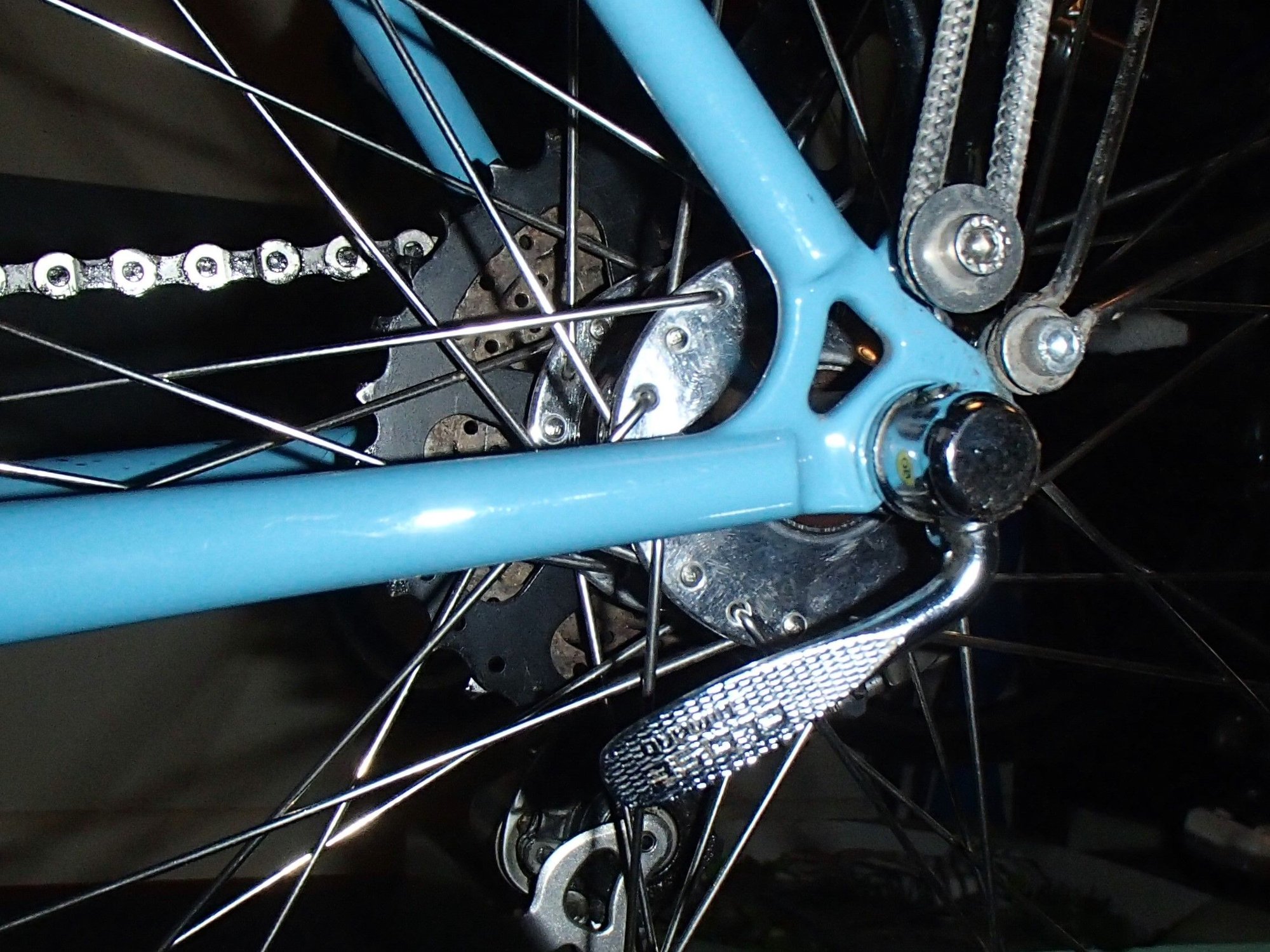
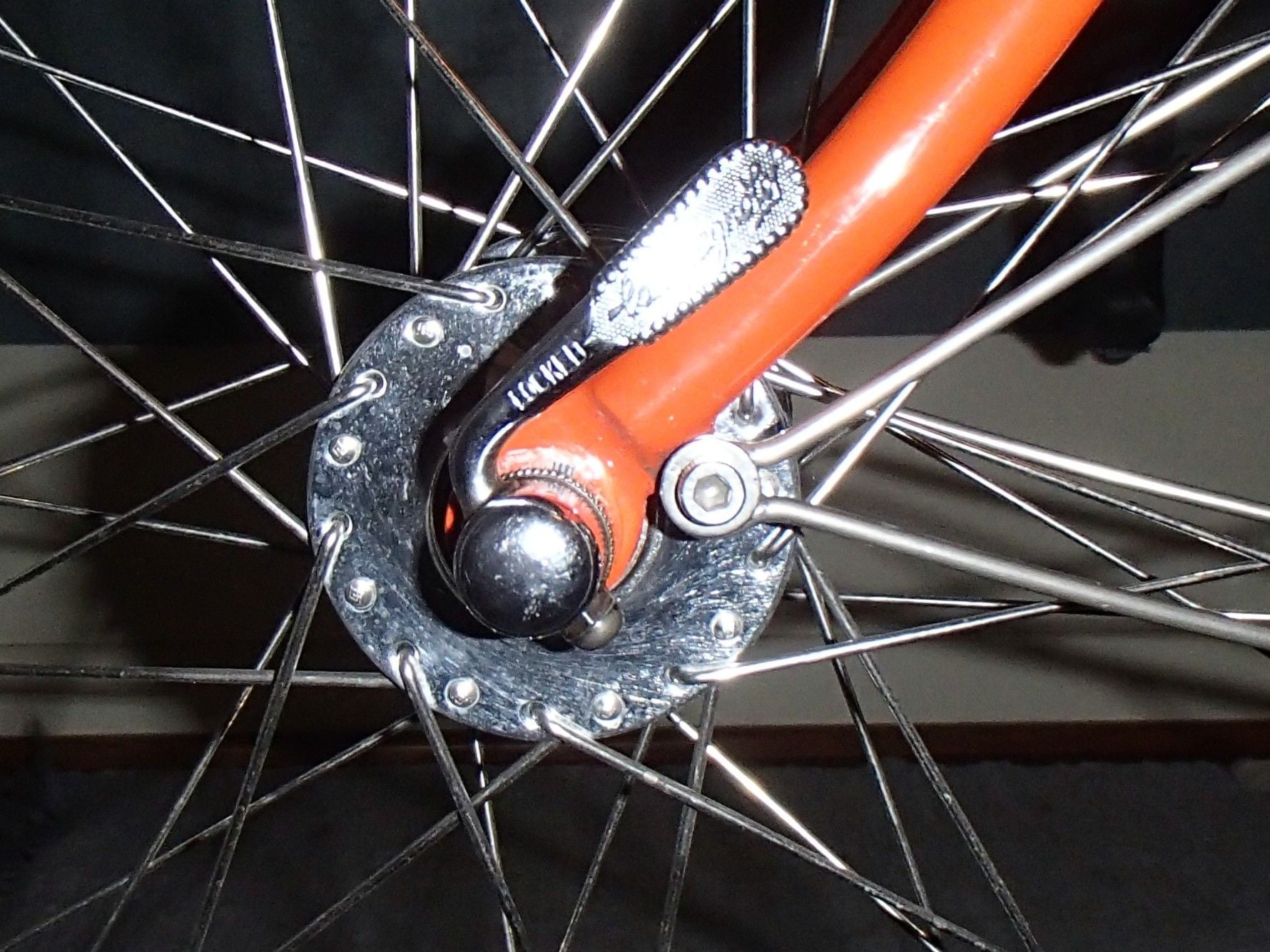
Two shots of my station wagon bike QEs. The rear could be a few degrees more up and parallel to the chain stay. But I think my preference is shown well. Note that the skewers are steel and enclosed cams even though I built this frame with vertical drop outs. Also note the lack of front dropout retention lips. Only my disk braked bikes have them. Andy
__________________
AndrewRStewart
AndrewRStewart
Last edited by Andrew R Stewart; 07-31-22 at 06:07 PM.
 07-31-22 | 07:35 PM
#17
Senior Member
Joined: Dec 2020
Posts: 6,997
Likes: 3,842
From: Wake Forest, NC
Bikes: 1989 Cinelli Supercorsa
While I still believe that having the lever pointing to the rear is "best practice" (and I believe it's the way the designers intended), I can see some validity in your method IF the tip of the lever crosses the blade or the stay as that would offer some level of protection from a branch snagging the lever and popping it open.
07-31-22 | 09:00 PM
#18

Senior Member
Joined: Oct 2014
Posts: 14,159
Likes: 5,284
From: Portland, OR
Bikes: (2) ti TiCycles, 2007 w/ triple and 2011 fixed, 1979 Peter Mooney, ~1983 Trek 420 now fixed and ~1973 Raleigh Carlton Competition gravel grinder
Actually it is more among the non pros that wheel overlapping, and the risk of that point rearward QR lever acting as a hook or latch, that is likely the greater concern. Any one who hasn't ridden up the backside of the rider who they were following (drafting if at speed) doesn't yet have that school of hard knocks pig skin. If the QR lever is pointing rearwards it will prevent the front wheel of the rider behind you from easily steering out and away from you. Generally the pros have had coaching and mentors to heed from, besides their pack riding skills are far more practiced. Gym strong locals, who think riding a trainer or spin bike is great training, are a whole 'nother issue with club packs.
Two shots of my station wagon bike QEs. The rear could be a few degrees more up and parallel to the chain stay. But I think my preference is shown well. Note that the skewers are steel and enclosed cams even though I built this frame with vertical drop outs. Also note the lack of front dropout retention lips. Only my disk braked bikes have them. Andy
Two shots of my station wagon bike QEs. The rear could be a few degrees more up and parallel to the chain stay. But I think my preference is shown well. Note that the skewers are steel and enclosed cams even though I built this frame with vertical drop outs. Also note the lack of front dropout retention lips. Only my disk braked bikes have them. Andy
07-31-22 | 09:10 PM
#19
Senior Member
Joined: Oct 2014
Posts: 14,159
Likes: 5,284
From: Portland, OR
Bikes: (2) ti TiCycles, 2007 w/ triple and 2011 fixed, 1979 Peter Mooney, ~1983 Trek 420 now fixed and ~1973 Raleigh Carlton Competition gravel grinder
I bet it has happened. You'd be surprised what you see if you do not own a car, live where distances start at three miles and there is no public transportation. (And you live in a place of real weather.) I didn't own a car until my early 30s. I've ridden in storms more than a few times. I build and mount my front wheels inside spokes pulling because I fear that branch wedging between wheel and fork. Fallen branches have taken me down but so far, not by opening rear facing front QRs or jamming in my fork.
08-01-22 | 07:25 AM
#20
Senior Member
Joined: Dec 2020
Posts: 6,997
Likes: 3,842
From: Wake Forest, NC
Bikes: 1989 Cinelli Supercorsa
I bet it has happened. You'd be surprised what you see if you do not own a car, live where distances start at three miles and there is no public transportation. (And you live in a place of real weather.) I didn't own a car until my early 30s. I've ridden in storms more than a few times. I build and mount my front wheels inside spokes pulling because I fear that branch wedging between wheel and fork. Fallen branches have taken me down but so far, not by opening rear facing front QRs or jamming in my fork.
I place my rear QR facing forward over the stay so I can use the stay for leverage, squeezing the stay and the lever together.
08-01-22 | 12:46 PM
#21
Senior Member
Joined: Apr 2007
Posts: 7,743
Likes: 1,731
Turns out the number one reason for through axles on new road bikes is people on Bike Forums saying, “Your skewer is wrong. It’s the wrong kind of skewer, the handle is pointed in the wrong direction, it’s on the wrong side of the bike, it’s too far back or forward, it looks like it’s open, just think what would happen if you were riding this very old ten speed bike in a peloton and had a crash… but I don’t need lawyer lips on my fork.“
 (meant facetiously of course)
Actually it is more among the non pros that wheel overlapping, and the risk of that point rearward QR lever acting as a hook or latch, that is likely the greater concern. Any one who hasn't ridden up the backside of the rider who they were following (drafting if at speed) doesn't yet have that school of hard knocks pig skin. If the QR lever is pointing rearwards it will prevent the front wheel of the rider behind you from easily steering out and away from you. Generally the pros have had coaching and mentors to heed from, besides their pack riding skills are far more practiced. Gym strong locals, who think riding a trainer or spin bike is great training, are a whole 'nother issue with club packs.
Two shots of my station wagon bike QEs. The rear could be a few degrees more up and parallel to the chain stay. But I think my preference is shown well. Note that the skewers are steel and enclosed cams even though I built this frame with vertical drop outs. Also note the lack of front dropout retention lips. Only my disk braked bikes have them. Andy
Two shots of my station wagon bike QEs. The rear could be a few degrees more up and parallel to the chain stay. But I think my preference is shown well. Note that the skewers are steel and enclosed cams even though I built this frame with vertical drop outs. Also note the lack of front dropout retention lips. Only my disk braked bikes have them. Andy
For the rear lever, I've always set it in the triangle/V of the seat and chain stays, kind of "tucked" in there.
I guess I've always assumed that the tendency to set the levers horizontal and rearward came from mountain biking? I don't think I ever saw it on a road bike until MTB entered the scene?
But I'm an old guy who is, in regard to QR skewers, stuck in the way it was done in the 70s. Dumb, I know.
 08-01-22 | 06:59 PM
#23

Dirty Heathen
Joined: Oct 2015
Posts: 2,323
Likes: 1,046
From: MC-778, 6250 fsw
Bikes: 1997 Cannondale, 1976 Bridgestone, 1998 SoftRide, 1989 Klein, 1989 Black Lightning #0033
Hi, 90’s MTB guy here:
Generally, on a rigid, it wasn’t a whole lot different than a road bike, but often we’d run the front lever on the right, so you could put it vertically behind the fork blade. (Especially East-Coast woods bikes)
Rear QR would usually go inside the triangle, just above the chainstay, so the lever tip would be “in the shadow” of the frame tubes. Oversized chain stays and chunky dropouts sometimes prevents this, but straight back was usually the last resort; you don’t want anything unnecessarily sticking out, in any direction.
Generally, on a rigid, it wasn’t a whole lot different than a road bike, but often we’d run the front lever on the right, so you could put it vertically behind the fork blade. (Especially East-Coast woods bikes)
Rear QR would usually go inside the triangle, just above the chainstay, so the lever tip would be “in the shadow” of the frame tubes. Oversized chain stays and chunky dropouts sometimes prevents this, but straight back was usually the last resort; you don’t want anything unnecessarily sticking out, in any direction.
08-01-22 | 08:49 PM
#24
Senior Member
Joined: May 2005
Posts: 2,335
Likes: 133
From: SFBay
Bikes: n, I would like n+1
I’ve personally seen a rear (external cam) QR shoved open mid ride. Exactly as described above. Two I experienced riders in close formation. Front one slowed suddenly for a car. Rear rider overlapped wheels and turned away to the left at the last minute. It swung open the rear QR of the rider in the front. Fortunately it was a vertical dropout bike, so nothing catastrophic happened. The front rider felt something off, and slowly came to a stop to fix the issue. This could also get a front QR that was forward facing, though you seldom see that.
I’ve also seen a front QR open, though the bike was static. Bike parked at a bike rack. Someone else trying to force another bike into a not big enough space, and opened the backward facing front QR. Easy enough to find if you do a basic pre-ride check, but less so if you don’t.
I put my front QR parallel to or just behind the fork as shown above, depending on QR type and handle shape. The rear I tuck between the stays.
I’ve also seen a front QR open, though the bike was static. Bike parked at a bike rack. Someone else trying to force another bike into a not big enough space, and opened the backward facing front QR. Easy enough to find if you do a basic pre-ride check, but less so if you don’t.
I put my front QR parallel to or just behind the fork as shown above, depending on QR type and handle shape. The rear I tuck between the stays.
