


Straddle wire question
 09-28-24 | 10:01 AM
#1
Thread Starter
Full Member
Joined: Aug 2022
Posts: 206
Likes: 33
Straddle wire question
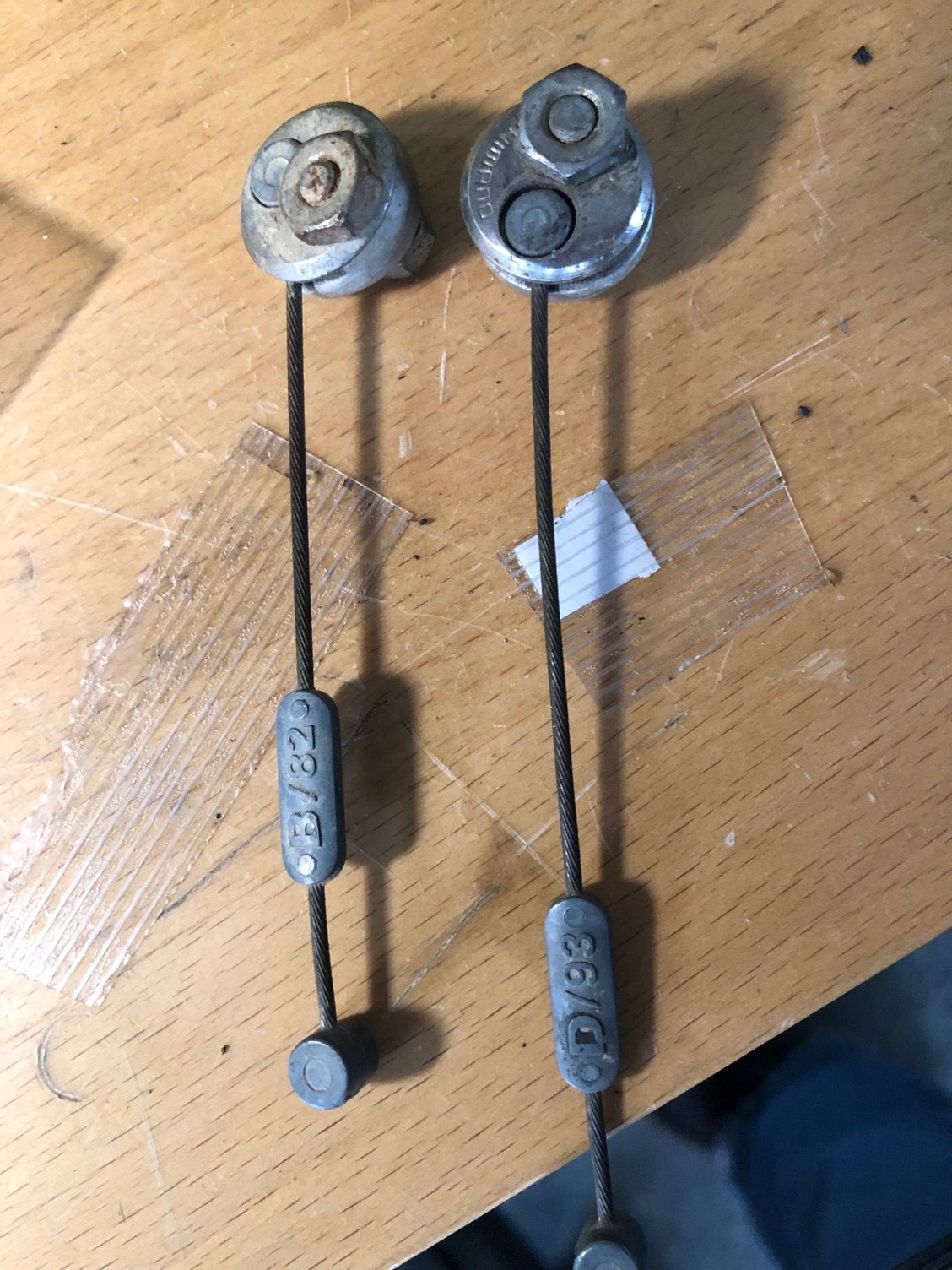
I wasn't paying attention as usual, and have researched this but didn't get a consensus. I took these straddle wires off an older Schwinn high plains assuming they would be the same but .........alas. Can anyone save me some trail and error and let me know which of these goes on the front? Thanks!
 09-28-24 | 02:15 PM
#2
Banned.
Joined: Aug 2024
Posts: 10
Likes: 2
It sounds like you're dealing with some frustrating trial and error! For older Schwinns, the front straddle wire typically has a longer length to accommodate the front brake setup. If you can compare the lengths, the longer one should be the front.
09-28-24 | 02:46 PM
#3

Senior Member


Joined: Apr 2016
Posts: 3,910
Likes: 1,811
I wasn't paying attention as usual, and have researched this but didn't get a consensus. I took these straddle wires off an older Schwinn high plains assuming they would be the same but .........alas. Can anyone save me some trail and error and let me know which of these goes on the front? Thanks!
09-28-24 | 06:38 PM
#4

Senior Member

Joined: Jul 2015
Posts: 7,495
Likes: 3,299
From: NW Oregon
Bikes: 1982 Trek 930R Custom, '91 Diamondback Ascent w/ XT, XTR updates, Fuji Team Pro CF road flyer, Specialized Sirrus Gravel Convert, '09 Comencal Meta 5.5 XC, '02 Marin MBX500, '84 Gitane Criterium bike
the shorter straddle cable will increase braking power... the longer cable typically goes on the rear brake to decrease skidding.
the front tire can accept more braking force because of weight transfer when braking hard, so the shorter cable gets placed on that brake.
I've used shorter or longer strads to get around problems too.. racks, fenders, reflector brackets, odd forks, low cable stop bridges on frames, etc.
this is assuming that both brake levers are the same pull ratio, and not adjustable.
there are more variables to consider with canti brakes too... their tune-ability and shear braking power make them popular with CX racers that haven't switched to disc, or got tired of fighting brake squeal from their disc brakes..
here's a decent little primer on the subject of canti setup...
https://bike.bikegremlin.com/1739/ca...ke-adjustment/
the front tire can accept more braking force because of weight transfer when braking hard, so the shorter cable gets placed on that brake.
I've used shorter or longer strads to get around problems too.. racks, fenders, reflector brackets, odd forks, low cable stop bridges on frames, etc.
this is assuming that both brake levers are the same pull ratio, and not adjustable.
there are more variables to consider with canti brakes too... their tune-ability and shear braking power make them popular with CX racers that haven't switched to disc, or got tired of fighting brake squeal from their disc brakes..
here's a decent little primer on the subject of canti setup...
https://bike.bikegremlin.com/1739/ca...ke-adjustment/
Last edited by maddog34; 09-28-24 at 06:54 PM.
09-28-24 | 08:01 PM
#5

Senior Member

Joined: Feb 2012
Posts: 19,381
Likes: 5,527
From: Rochester, NY
Bikes: Stewart S&S coupled sport tourer, Stewart Sunday light, Stewart Commuting, Stewart Touring, Co Motion Tandem, Stewart 3-Spd, Stewart Track, Fuji Finest, Mongoose Tomac ATB, GT Bravado ATB, JCP Folder, Stewart 650B ATB
The vast majority of hybrids and MtBs that use these link wires (and it's a LOT of bikes) have the shorter link wire on the rear brake. Usually due to the reduced distance from the casing hanger to the canti arms when compared to the front. If the brake pads have the smooth shaft mounting their placement WRT the canti arms also affect the leverage range possible as the canti arms rotate outwards with the pads being clamped further out on their smooth post/shafts.
To add specificness to maddog34's reply- For a skilled rider having the greater leveraged set up on the front is great. Certainly, the front brake is the one that will save your life if you're unlucky, or ruin your face if you're not skilled and go end over. However the bike industry is very liability aware and, actually, front brake "power" is often purposely reduced with lower leverage set ups or spring loaded cable noodles (for linear brakes) often seen of the more recreationally oriented bikes.
So the question as to which brake (front or rear) "should have" the greater leverage is opinion. Luckily the OP lives in the good old USA where one can do what they want (to some degree ) Andy
To add specificness to maddog34's reply- For a skilled rider having the greater leveraged set up on the front is great. Certainly, the front brake is the one that will save your life if you're unlucky, or ruin your face if you're not skilled and go end over. However the bike industry is very liability aware and, actually, front brake "power" is often purposely reduced with lower leverage set ups or spring loaded cable noodles (for linear brakes) often seen of the more recreationally oriented bikes.
So the question as to which brake (front or rear) "should have" the greater leverage is opinion. Luckily the OP lives in the good old USA where one can do what they want (to some degree
) Andy
__________________
AndrewRStewart
AndrewRStewart
09-29-24 | 10:00 AM
#6

Senior Member

Joined: Jul 2005
Posts: 4,992
Likes: 712
From: Boulder County, CO
Bikes: '80 Masi Gran Criterium, '12 Trek Madone, early '60s Frejus track
The longer cable requires longer lever travel for a given measure of caliper travel. It's like gearing. Lower gearing on the input side means more power on the output side (for climbing hills). Higher gearing on the input side means more speed on the output side. Therefore, the longer straddle cable allows more braking force for a given measure of hand strength. Use long cable on the end where the bosses are farther apart.


