


Fork Replacement - Geometry Concerns
 06-26-25 | 03:52 AM
#1
Thread Starter
Newbie
Joined: Jun 2025
Posts: 4
Likes: 1
Fork Replacement - Geometry Concerns
Hi everyone
(Appologies for my bad English and for posting something probably already discussed; I did not find what I am after, though)
I want to replace an old (don't know the exact year) RST tr pro i sl 7 with a rigid fork. Now my concerns:
1.- Anyone happens to know the exact geometry of that RST fork? I wrote to RST customer service to no avail.
2.- The AtC is 47cm. Assuming a 10% sag, the new fork should be around 42cm long, shouldn't it?
3.- What about the rake? How can I measure it? Maybe with a plumb?
Thank you in advance,
(Appologies for my bad English and for posting something probably already discussed; I did not find what I am after, though)
I want to replace an old (don't know the exact year) RST tr pro i sl 7 with a rigid fork. Now my concerns:
1.- Anyone happens to know the exact geometry of that RST fork? I wrote to RST customer service to no avail.
2.- The AtC is 47cm. Assuming a 10% sag, the new fork should be around 42cm long, shouldn't it?
3.- What about the rake? How can I measure it? Maybe with a plumb?
Thank you in advance,


 06-26-25 | 07:31 AM
#3

Senior Member


Joined: Apr 2016
Posts: 3,836
Likes: 1,770
I want to replace an old (don't know the exact year) RST tr pro i sl 7 with a rigid fork. Now my concerns:
1.- Anyone happens to know the exact geometry of that RST fork? I wrote to RST customer service to no avail.
2.- The AtC is 47cm. Assuming a 10% sag, the new fork should be around 42cm long, shouldn't it?
3.- What about the rake? How can I measure it? Maybe with a plumb?
1.- Anyone happens to know the exact geometry of that RST fork? I wrote to RST customer service to no avail.
2.- The AtC is 47cm. Assuming a 10% sag, the new fork should be around 42cm long, shouldn't it?
3.- What about the rake? How can I measure it? Maybe with a plumb?
I couldn't find that specific fork model, but it seems to be a trekking fork so 700C wheel and maybe 50 mm of travel. Any 700C rigid fork, with the appropriate brake attachment and steerer type, that's around the same axle-to-crown should be fine. I've replaced a few suspension forks with rigid on my bikes, without paying much attention to geometry beyond a similar a-to-c, and nothing bad has happened.
06-26-25 | 07:55 AM
#4

Senior Member

Joined: Feb 2012
Posts: 19,352
Likes: 5,469
From: Rochester, NY
Bikes: Stewart S&S coupled sport tourer, Stewart Sunday light, Stewart Commuting, Stewart Touring, Co Motion Tandem, Stewart 3-Spd, Stewart Track, Fuji Finest, Mongoose Tomac ATB, GT Bravado ATB, JCP Folder, Stewart 650B ATB
A very close measurement of rake with the fork still on the bike is to measure from the BB shell to the ft axle (obviously the wheel has been removed...), write this amount down. Now spin the fork around 180*, so it's backwards. Remeasure from the shell to the axle and write that down. Add the two measurements and divide by 2.
Better is to remove the fork from the frame, support the steerer on a Vee block parallel to a flat surface and do two height measurements. One from the surface to the steerer's center (or top, or bottom if you also know the steerer diameter/radius) and the other from the surface to the axle center. Subtract the first from the second. Andy
Better is to remove the fork from the frame, support the steerer on a Vee block parallel to a flat surface and do two height measurements. One from the surface to the steerer's center (or top, or bottom if you also know the steerer diameter/radius) and the other from the surface to the axle center. Subtract the first from the second. Andy
__________________
AndrewRStewart
AndrewRStewart
 06-26-25 | 08:12 AM
#5
Senior Member
Joined: Apr 2016
Posts: 3,836
Likes: 1,770
A very close measurement of rake with the fork still on the bike is to measure from the BB shell to the ft axle (obviously the wheel has been removed...), write this amount down. Now spin the fork around 180*, so it's backwards. Remeasure from the shell to the axle and write that down. Add the two measurements and divide by 2.
06-26-25 | 08:56 AM
#6

Senior Member

Joined: Jul 2015
Posts: 7,370
Likes: 3,218
From: NW Oregon
Bikes: 1982 Trek 930R Custom, '91 Diamondback Ascent w/ XT, XTR updates, Fuji Team Pro CF road flyer, Specialized Sirrus Gravel Convert, '09 Comencal Meta 5.5 XC, '02 Marin MBX500, '84 Gitane Criterium bike
assume a 30% sag, because that is the standard sag of a well tuned suspension fork....
and you won't be able to notice any minor difference in the geometry anyway...
find a fork that has enough steerer length, is meant for the same rim diameter that you have now, and has the correct brake mount style, quit worrying about "Exact", put it on your bike, and go ride.
and you won't be able to notice any minor difference in the geometry anyway...
find a fork that has enough steerer length, is meant for the same rim diameter that you have now, and has the correct brake mount style, quit worrying about "Exact", put it on your bike, and go ride.
Last edited by maddog34; 06-27-25 at 10:40 AM.
06-27-25 | 12:51 AM
#8
Highly Enriched Driftium

Joined: Apr 2017
Posts: 6,709
Likes: 2,174
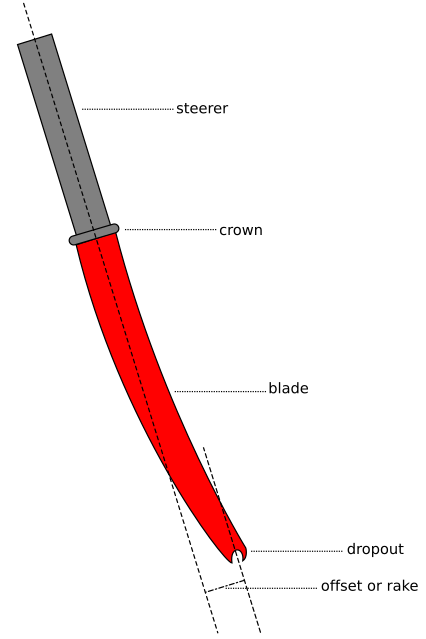
The head-tube/steering-axis angle and rake are very closely related, I don't think can be considered separately. The steering axis extended to the ground, then measured to the center of the tire contact patch (directly below the axle center) would have an excessively large trail/caster, so then the fork rake (curve or angle) extends the axle forward to reduce that number.
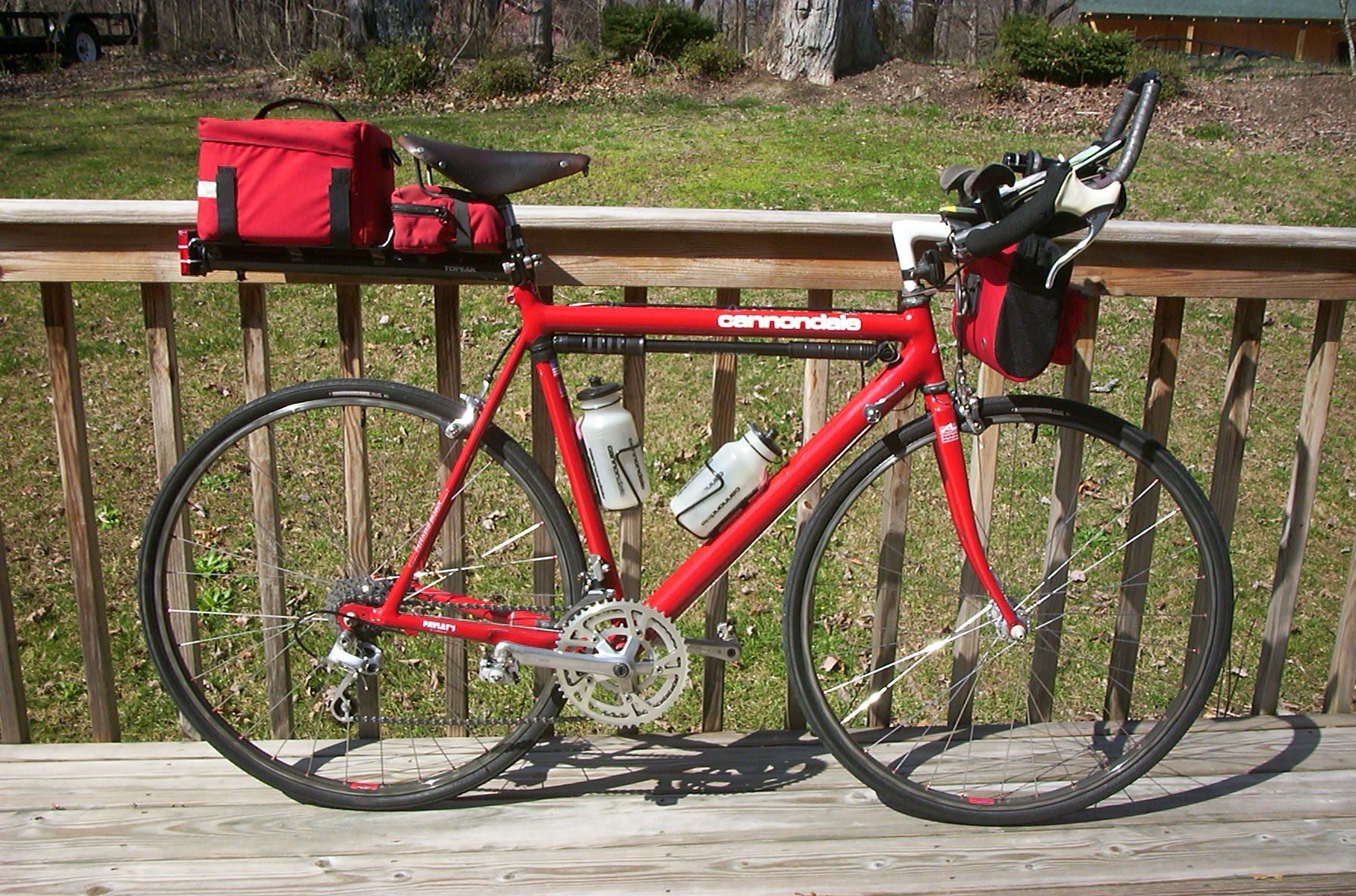
My criterium road race bike, notably had relatively "steep" head tube angle (74 deg IIRC), so less trail than a more "slack" (smaller) angle, thus, the fork blades has less rake than most. Also note, that when talking angles and rake, the angles are often reversed/complimentary if description is talking about motorcycle forks. But as an example, my old crit race bike:
Also, for a given fork geometry, deeper (higher) section tires, increases trail/caster.
My criterium road race bike, notably had relatively "steep" head tube angle (74 deg IIRC), so less trail than a more "slack" (smaller) angle, thus, the fork blades has less rake than most. Also note, that when talking angles and rake, the angles are often reversed/complimentary if description is talking about motorcycle forks. But as an example, my old crit race bike:
Also, for a given fork geometry, deeper (higher) section tires, increases trail/caster.
Last edited by Duragrouch; 06-27-25 at 12:55 AM.
