


Derailleur replacement big fail
 08-06-25 | 03:43 PM
#26

Really Old Senior Member


Joined: Feb 2007
Posts: 14,685
Likes: 1,921
From: Mid Willamette Valley, Orygun
Bikes: 87 RockHopper,2008 Specialized Globe. Both upgraded to 9 speeds. 2019 Giant Explore E+3
Capacity is the amount of "take up" or "wrap" it has.
Largest cog-smallest cog +largest ring-smallest ring.
11-34 cassette =23.
Presuming a 50-34 crank, than 16 more.
23+16=39.
You'd just fit within spec.
Largest cog-smallest cog +largest ring-smallest ring.
11-34 cassette =23.
Presuming a 50-34 crank, than 16 more.
23+16=39.
You'd just fit within spec.
 08-06-25 | 03:52 PM
#27

Senior Member


Joined: Jul 2015
Posts: 7,498
Likes: 3,301
From: NW Oregon
Bikes: 1982 Trek 930R Custom, '91 Diamondback Ascent w/ XT, XTR updates, Fuji Team Pro CF road flyer, Specialized Sirrus Gravel Convert, '09 Comencal Meta 5.5 XC, '02 Marin MBX500, '84 Gitane Criterium bike
This one has a 1.7 pull with a medium cage. I am a bit confused on the spec below as it says
- Max Cog: 30-34T
- Capacity: 39T <<< confused with this bit**********??
As I am running a 34 cog on the back and now running a 52 on the crank would this be compatible?
Also the cable might have to go into the derailleur with a longer curve route. Maybe another derailleur with a sensible angle in would be the sensible option?
Thanks guys.
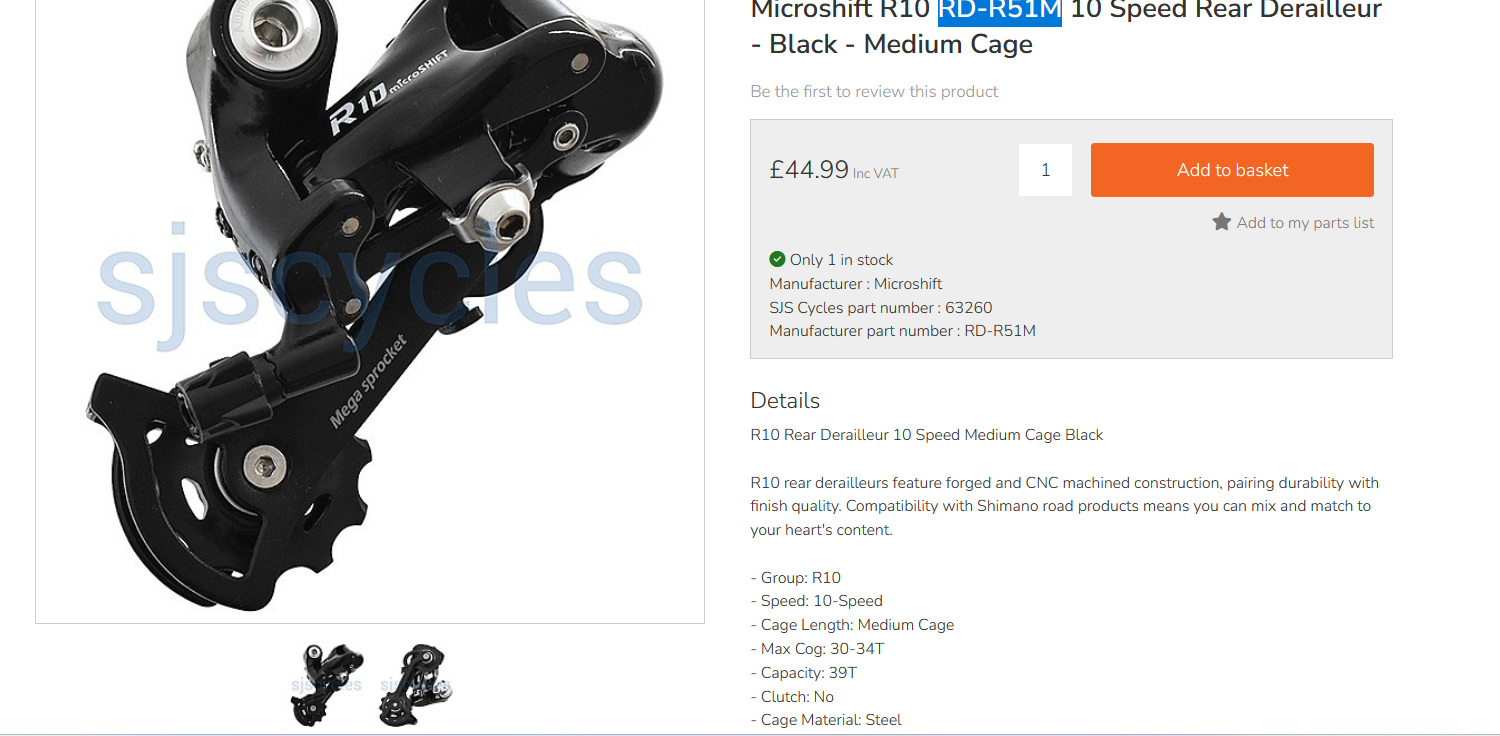
- Max Cog: 30-34T
- Capacity: 39T <<< confused with this bit**********??
As I am running a 34 cog on the back and now running a 52 on the crank would this be compatible?
Also the cable might have to go into the derailleur with a longer curve route. Maybe another derailleur with a sensible angle in would be the sensible option?
Thanks guys.
Last edited by maddog34; 08-06-25 at 05:50 PM.
08-06-25 | 05:49 PM
#28
Really Old Senior Member
Joined: Feb 2007
Posts: 14,685
Likes: 1,921
From: Mid Willamette Valley, Orygun
Bikes: 87 RockHopper,2008 Specialized Globe. Both upgraded to 9 speeds. 2019 Giant Explore E+3
I should have added this when I first posted, but it went over my head-
You tried a Shimano rd-m6000.
Looking up the spec's for that, it's=
1. Only intended for an 11-42T cassette. 31T diff.
2. A 10T front difference. Total wrap & capacity is spec'd at 41T.
Basically, one you've down shifted off the 2-3 highest (smallest cogs), the RDER is expecting to "see" larger cogs.
It's designed to move at an angle appropriate for an "oversize" cassette, relative to standards of a few years ago when 34 was your max on about anything.
https://bike.shimano.com/en-NA/produ...-M6000-GS.html
My Ebike has the M-592 for its (9 speed) 11-36 1X.
https://www.google.com/url?sa=t&sour...cftaXggpkDsE4F
I currently have it with a cobbled together 13-30 cassette and made no adjustments other then a couple clicks on the adjuster.
It works adequately for me that I'm not going to try to "improve it". I do have a new 12-26 to install when the mood strikes.
You tried a Shimano rd-m6000.
Looking up the spec's for that, it's=
1. Only intended for an 11-42T cassette. 31T diff.
2. A 10T front difference. Total wrap & capacity is spec'd at 41T.
Basically, one you've down shifted off the 2-3 highest (smallest cogs), the RDER is expecting to "see" larger cogs.
It's designed to move at an angle appropriate for an "oversize" cassette, relative to standards of a few years ago when 34 was your max on about anything.
https://bike.shimano.com/en-NA/produ...-M6000-GS.html
My Ebike has the M-592 for its (9 speed) 11-36 1X.
https://www.google.com/url?sa=t&sour...cftaXggpkDsE4F
I currently have it with a cobbled together 13-30 cassette and made no adjustments other then a couple clicks on the adjuster.
It works adequately for me that I'm not going to try to "improve it". I do have a new 12-26 to install when the mood strikes.
Last edited by Bill Kapaun; 08-06-25 at 06:11 PM.
08-07-25 | 10:55 AM
#29
Thread Starter
Newbie
Joined: Jul 2009
Posts: 48
Likes: 7
From: Devon England
Bikes: Cube gtc 2011
I should have added this when I first posted, but it went over my head-
You tried a Shimano rd-m6000.
Looking up the spec's for that, it's=
1. Only intended for an 11-42T cassette. 31T diff.
2. A 10T front difference. Total wrap & capacity is spec'd at 41T.
Basically, one you've down shifted off the 2-3 highest (smallest cogs), the RDER is expecting to "see" larger cogs.
It's designed to move at an angle appropriate for an "oversize" cassette, relative to standards of a few years ago when 34 was your max on about anything.
https://bike.shimano.com/en-NA/produ...-M6000-GS.html
My Ebike has the M-592 for its (9 speed) 11-36 1X.
https://www.google.com/url?sa=t&sour...cftaXggpkDsE4F
I currently have it with a cobbled together 13-30 cassette and made no adjustments other then a couple clicks on the adjuster.
It works adequately for me that I'm not going to try to "improve it". I do have a new 12-26 to install when the mood strikes.
You tried a Shimano rd-m6000.
Looking up the spec's for that, it's=
1. Only intended for an 11-42T cassette. 31T diff.
2. A 10T front difference. Total wrap & capacity is spec'd at 41T.
Basically, one you've down shifted off the 2-3 highest (smallest cogs), the RDER is expecting to "see" larger cogs.
It's designed to move at an angle appropriate for an "oversize" cassette, relative to standards of a few years ago when 34 was your max on about anything.
https://bike.shimano.com/en-NA/produ...-M6000-GS.html
My Ebike has the M-592 for its (9 speed) 11-36 1X.
https://www.google.com/url?sa=t&sour...cftaXggpkDsE4F
I currently have it with a cobbled together 13-30 cassette and made no adjustments other then a couple clicks on the adjuster.
It works adequately for me that I'm not going to try to "improve it". I do have a new 12-26 to install when the mood strikes.
08-07-25 | 10:56 AM
#30
Thread Starter
Newbie
Joined: Jul 2009
Posts: 48
Likes: 7
From: Devon England
Bikes: Cube gtc 2011
08-08-25 | 12:44 AM
#31

Newbie
Joined: Sep 2024
Posts: 17
Likes: 15
From: Texas
Bikes: Marinoni Custom Columbus Max
08-08-25 | 11:23 AM
#32
Senior Member
Joined: Jul 2015
Posts: 7,498
Likes: 3,301
From: NW Oregon
Bikes: 1982 Trek 930R Custom, '91 Diamondback Ascent w/ XT, XTR updates, Fuji Team Pro CF road flyer, Specialized Sirrus Gravel Convert, '09 Comencal Meta 5.5 XC, '02 Marin MBX500, '84 Gitane Criterium bike
so there are those considerations to consider...
08-08-25 | 12:03 PM
#33
Newbie
Joined: Sep 2024
Posts: 17
Likes: 15
From: Texas
Bikes: Marinoni Custom Columbus Max
except the der. it's replacing uses a far shorter final cable housing, and if the cable was already clamped and cut., it won't be long enough, and the clamped portion will be inside the new, longer housing, if the cable was not yet cut, causing excess drag and shifting troubles.
so there are those considerations to consider...
so there are those considerations to consider...
08-08-25 | 02:55 PM
#34
Senior Member
Joined: Jul 2015
Posts: 7,498
Likes: 3,301
From: NW Oregon
Bikes: 1982 Trek 930R Custom, '91 Diamondback Ascent w/ XT, XTR updates, Fuji Team Pro CF road flyer, Specialized Sirrus Gravel Convert, '09 Comencal Meta 5.5 XC, '02 Marin MBX500, '84 Gitane Criterium bike
i have seen shift housings wrapped with about a foot of electrical tape to splice two chunks together... no, it didn't work out well.
another customer tied a loop in his rear brake cable, then put a zip tie thru that loop, and was pulling that as a "brake" after the cable had broken...he lives two blocks from my shop, and i "fixed the mess" for 7 dollars (cable, housing, adjust and center, rear wheel trued some) to reduce the chance of his early death.... he's now in his late 40s...
a now deceased customer had a habit of screwing up EVERY cable he'd touch, then removing the front brakes from a long list of bikes... one of those bikes had been ?"borrowed"? from yet another customer... he also removed the front der with tin snips, and turned the bike into a single speed(more zip ties!), and locked the front suspension fork with two hose clamps... it WAS a nearly perfect Giant MTB before he got ahold of it.... this ruination happened over about one month, IIRC. He later reported it as "stolen".
Last edited by maddog34; 08-08-25 at 03:30 PM.
08-08-25 | 04:24 PM
#35

Senior Member
Joined: Apr 2016
Posts: 3,916
Likes: 1,820
a now deceased customer had a habit of screwing up EVERY cable he'd touch, then removing the front brakes from a long list of bikes... one of those bikes had been ?"borrowed"? from yet another customer... he also removed the front der with tin snips, and turned the bike into a single speed(more zip ties!), and locked the front suspension fork with two hose clamps... it WAS a nearly perfect Giant MTB before he got ahold of it.... this ruination happened over about one month, IIRC. He later reported it as "stolen".
08-08-25 | 09:23 PM
#36
Senior Member
Joined: Jul 2015
Posts: 7,498
Likes: 3,301
From: NW Oregon
Bikes: 1982 Trek 930R Custom, '91 Diamondback Ascent w/ XT, XTR updates, Fuji Team Pro CF road flyer, Specialized Sirrus Gravel Convert, '09 Comencal Meta 5.5 XC, '02 Marin MBX500, '84 Gitane Criterium bike
Working in a bike shop would be great if it weren't for the customers. Well, most of them don't elicit a groan when they walk through the door, but some definitely do. I've ceased to be amazed by ludicrous displays of incompetence and dishonesty since I started watching "Just Rolled In" and similar stuff on YouTube. At least with bicycles it's mostly just the crazy person that suffers the outcome of their crazy stuff.
i once saw his "wheel stash"... under a semi trailer, and every last axle, cone, and ball bearing had been removed.
when i asked why, he said "because they're worth money, of course!".. i then asked if he still had them... he said yes, but wasn't really sure WHERE they were....
Drugs are a bad way to ruin a life.
he was hospitalized with a "headache", it was a brain bleed... Andrew never really woke up again...
he rode like the wind, and i'd seen him bunny hop a 16" fir log like it was nothing.
in his mid 30s...
local bike thefts dropped to nearly nothing after he went.
rumor has it that there's a big pile of bikes out in the woods... somewhere.
08-09-25 | 05:45 AM
#37
Senior Member

Joined: Jan 2017
Posts: 1,253
Likes: 163
My derailleur which is confusingly rated for both 10 and 11 speed mtb, moves a bit too far causing chain rub at the innermost or outermost cogs, so I swapped three of the 11 speed spacers for 10 speed spacers which are 2.35 mm. So I've increased my cassette width by around 0.5mm.
I also use a last position cog from a 10 speed cassette which is missing around 0.5 mm of the offset that an 11 speed last position cog has. (Which might partially explain the chain rubbing at the outer cogs if the derailleur is designed to move a greater distance at the outside)
With the entire cassette offset an extra 1mm outward, there's not enough thread engagement on the steel lock nut that comes with the cheaper Shimano cassettes. So I had to use the aluminum lock nuts that come with more expensive Shimano cassette because their threads are 1 mm longer.
Last edited by tomtomtom123; 08-09-25 at 05:57 AM.
08-09-25 | 09:26 AM
#39
Senior Member
Joined: Jan 2017
Posts: 1,253
Likes: 163
I measured the 2 cogs of the first two positions stacked together and divide by 2 to get the pitch, and subtract the thicknesses of the teeth to calculate the width of the built-in spacers.
The pitch of the cogs in the first two positions are slightly greater than the nominal pitch of the cogs in the other positions. I assume this is partly to help prevent the chain from catching on the second and third position cogs when the chain is maximally angled inwards while in the first and second positions.
Last edited by tomtomtom123; 08-09-25 at 09:30 AM.
08-09-25 | 05:53 PM
#40

Senior Member
Joined: Apr 2011
Posts: 12,791
Likes: 4,889
The inner cogs are approximately 1.6mm thick for both 10 and 11 speed road and MTB. The 11 speed spacers for the inners for both road and MTB are spec at 2.18mm thick. So the nominal 11 speed pitch is 3.78mm. However the outer 2 cogs with built in spacers are much thicker at the spacer, I don't remember how much, maybe 0.2-0.3mm.
My derailleur which is confusingly rated for both 10 and 11 speed mtb, moves a bit too far causing chain rub at the innermost or outermost cogs, so I swapped three of the 11 speed spacers for 10 speed spacers which are 2.35 mm. So I've increased my cassette width by around 0.5mm.
I also use a last position cog from a 10 speed cassette which is missing around 0.5 mm of the offset that an 11 speed last position cog has. (Which might partially explain the chain rubbing at the outer cogs if the derailleur is designed to move a greater distance at the outside)
With the entire cassette offset an extra 1mm outward, there's not enough thread engagement on the steel lock nut that comes with the cheaper Shimano cassettes. So I had to use the aluminum lock nuts that come with more expensive Shimano cassette because their threads are 1 mm longer.
My derailleur which is confusingly rated for both 10 and 11 speed mtb, moves a bit too far causing chain rub at the innermost or outermost cogs, so I swapped three of the 11 speed spacers for 10 speed spacers which are 2.35 mm. So I've increased my cassette width by around 0.5mm.
I also use a last position cog from a 10 speed cassette which is missing around 0.5 mm of the offset that an 11 speed last position cog has. (Which might partially explain the chain rubbing at the outer cogs if the derailleur is designed to move a greater distance at the outside)
With the entire cassette offset an extra 1mm outward, there's not enough thread engagement on the steel lock nut that comes with the cheaper Shimano cassettes. So I had to use the aluminum lock nuts that come with more expensive Shimano cassette because their threads are 1 mm longer.
10 and 11 speed MTB derailleurs are the same because they have the same pull ratio - the amount of cable per lateral movement of the pulley. Same as how Shimano 6 speed road derailleurs could be used with 10 speed shifters and cogs.
08-10-25 | 12:56 AM
#41
Senior Member
Joined: Apr 2019
Posts: 3,926
Likes: 1,511
From: UK
I don't know what you think is misleading. I've already taken into account the overlap between the built-in spacers of the cogs in the first two positions. If I hadn't, then the stated increase in pitch would have been much greater than just the 0.2 mm, since the overlap is around 1 mm or more.
I measured the 2 cogs of the first two positions stacked together and divide by 2 to get the pitch, and subtract the thicknesses of the teeth to calculate the width of the built-in spacers.
The pitch of the cogs in the first two positions are slightly greater than the nominal pitch of the cogs in the other positions. I assume this is partly to help prevent the chain from catching on the second and third position cogs when the chain is maximally angled inwards while in the first and second positions.
I measured the 2 cogs of the first two positions stacked together and divide by 2 to get the pitch, and subtract the thicknesses of the teeth to calculate the width of the built-in spacers.
The pitch of the cogs in the first two positions are slightly greater than the nominal pitch of the cogs in the other positions. I assume this is partly to help prevent the chain from catching on the second and third position cogs when the chain is maximally angled inwards while in the first and second positions.
How was I supposed to know you’d already taken that into account since you didn’t mention it?
I wasn’t sure if this was the reason, hence the question mark.
Chill.
You might be right about it being deliberate to avoid “cog rub”
