


How to fix a taco wheel
 10-01-08 | 03:06 AM
#1

Thread Starter
Senior Member

Joined: Jul 2000
Posts: 5,391
Likes: 2
From: Snowy midwest
How to fix a taco wheel
Check this out. I tacoed this baby good. I was going into a turn, skidded, hit traction, and BOING.
Amazingly, none of the spokes broke.
Obviously, too warped to fix with a spoke wrench....
How do you fix a wheel like this?
Amazingly, none of the spokes broke.
Obviously, too warped to fix with a spoke wrench....
How do you fix a wheel like this?


 10-01-08 | 03:37 AM
#3

Senior Member
Joined: Apr 2006
Posts: 2,343
Likes: 0
From: Gainesville/Tampa, FL
Bikes: Trek 1000, two mtbs and working on a fixie for commuting.
Did you skid and then hit something? Or did the countersteer leave an "impression" on your wheel?
I would say you'd need to bend the rim back into shape and probably *better* if you did it after you uninstall the whole thing, including the spokes. You can do it just as is - I remember someone saying they just worked it against a tree. It will not be as good as before - changing spokes and/or the rim would be *best* - hub is probably barely affected so that is fine though I would check the flange/spoke holes to damage.
I would think using the same spokes would make it impossible for both a radial true and a lateral true and have proper/consistent spoke tension. It'll be safe to ride without swapping out anything, but in my experience, it requires truing more often than a good wheel.
Also, from what I read around here, aren't you a relatively experienced bike mechanic? I've only been dealing with bikes for a grand total of 3 years. If you think otherwise than what I said, you're probably more likely to be right.
Good luck.
I would say you'd need to bend the rim back into shape and probably *better* if you did it after you uninstall the whole thing, including the spokes. You can do it just as is - I remember someone saying they just worked it against a tree. It will not be as good as before - changing spokes and/or the rim would be *best* - hub is probably barely affected so that is fine though I would check the flange/spoke holes to damage.
I would think using the same spokes would make it impossible for both a radial true and a lateral true and have proper/consistent spoke tension. It'll be safe to ride without swapping out anything, but in my experience, it requires truing more often than a good wheel.
Also, from what I read around here, aren't you a relatively experienced bike mechanic? I've only been dealing with bikes for a grand total of 3 years. If you think otherwise than what I said, you're probably more likely to be right.
Good luck.
10-01-08 | 03:58 AM
#4
Thread Starter
Senior Member
Joined: Jul 2000
Posts: 5,391
Likes: 2
From: Snowy midwest
Did you skid and then hit something? Or did the countersteer leave an "impression" on your wheel?
I would say you'd need to bend the rim back into shape and probably *better* if you did it after you uninstall the whole thing, including the spokes. You can do it just as is - I remember someone saying they just worked it against a tree. It will not be as good as before - changing spokes and/or the rim would be *best* - hub is probably barely affected so that is fine though I would check the flange/spoke holes to damage.
I would think using the same spokes would make it impossible for both a radial true and a lateral true and have proper/consistent spoke tension. It'll be safe to ride without swapping out anything, but in my experience, it requires truing more often than a good wheel.
Also, from what I read around here, aren't you a relatively experienced bike mechanic? I've only been dealing with bikes for a grand total of 3 years. If you think otherwise than what I said, you're probably more likely to be right.
Good luck.
I would say you'd need to bend the rim back into shape and probably *better* if you did it after you uninstall the whole thing, including the spokes. You can do it just as is - I remember someone saying they just worked it against a tree. It will not be as good as before - changing spokes and/or the rim would be *best* - hub is probably barely affected so that is fine though I would check the flange/spoke holes to damage.
I would think using the same spokes would make it impossible for both a radial true and a lateral true and have proper/consistent spoke tension. It'll be safe to ride without swapping out anything, but in my experience, it requires truing more often than a good wheel.
Also, from what I read around here, aren't you a relatively experienced bike mechanic? I've only been dealing with bikes for a grand total of 3 years. If you think otherwise than what I said, you're probably more likely to be right.
Good luck.
Yes, I could take the whole thing apart and rebuild the wheel, but well.... alas, that is just more than I want to do - especially with the rear wheel and trying to figure out dish, etc. This is an old 27" wheel - If I can't fix it in some practical way, I will bone it out for the spare spokes and bearings.
My friend Johnny used to be able to fix wheels like this with a wooden mallet and an old bentwood chair. Alas, Johnny is gone and it is the one magic trick he did not pass on to me before he died.
So, I am looking for some knowledge here...
10-01-08 | 05:07 AM
#5

Senior Member
Joined: Mar 2005
Posts: 863
Likes: 0
From: Portugal-Israel
Good Luck
Last edited by caotropheus; 10-01-08 at 05:36 AM.
10-01-08 | 05:29 AM
#6
Senior Member
Joined: Mar 2008
Posts: 8,687
Likes: 300
My method:
1) tape spokes together at outer cross
2) undo spokes from wheel
3) bend rim straight. I usually do it by putting a broom handle or similar on the floor, then putting the rim's "troughs" on the broom handle, then I step on the "crests". Repeat, with various implements and foot positions until an acceptable trueness has been reached.
4) reattach spokes. The tape at the crosses should make this a reasonably speedy affair. True, tension and hope for the best.
Some will cringe in horror at the thought of this procedure, but IME it's proven good enough for beater bikes and casual riding. It might be good enough for more, but that's all I've used them for.
An alternate method is to clamp rim to work bench/table, and use that as a brace to bend portions of the rim back.
Yet an other alternate method is to use brute force until it snaps out of the taco configuration, but that's usually only considered a ride-home fix.
Some will say that loosening spokes and then bending back will be sufficient. But IME the spokes will go tense and prevent you from reaching the amount of overbend needed for the rim not to spring back when you release it.
1) tape spokes together at outer cross
2) undo spokes from wheel
3) bend rim straight. I usually do it by putting a broom handle or similar on the floor, then putting the rim's "troughs" on the broom handle, then I step on the "crests". Repeat, with various implements and foot positions until an acceptable trueness has been reached.
4) reattach spokes. The tape at the crosses should make this a reasonably speedy affair. True, tension and hope for the best.
Some will cringe in horror at the thought of this procedure, but IME it's proven good enough for beater bikes and casual riding. It might be good enough for more, but that's all I've used them for.
An alternate method is to clamp rim to work bench/table, and use that as a brace to bend portions of the rim back.
Yet an other alternate method is to use brute force until it snaps out of the taco configuration, but that's usually only considered a ride-home fix.
Some will say that loosening spokes and then bending back will be sufficient. But IME the spokes will go tense and prevent you from reaching the amount of overbend needed for the rim not to spring back when you release it.
10-01-08 | 05:38 AM
#7

Senior Member


Joined: Aug 2003
Posts: 13,973
Likes: 145
From: Tampa, Florida
My method:
1) tape spokes together at outer cross
2) undo spokes from wheel
3) bend rim straight. I usually do it by putting a broom handle or similar on the floor, then putting the rim's "troughs" on the broom handle, then I step on the "crests". Repeat, with various implements and foot positions until an acceptable trueness has been reached.
4) reattach spokes. The tape at the crosses should make this a reasonably speedy affair. True, tension and hope for the best..
1) tape spokes together at outer cross
2) undo spokes from wheel
3) bend rim straight. I usually do it by putting a broom handle or similar on the floor, then putting the rim's "troughs" on the broom handle, then I step on the "crests". Repeat, with various implements and foot positions until an acceptable trueness has been reached.
4) reattach spokes. The tape at the crosses should make this a reasonably speedy affair. True, tension and hope for the best..
I loosen all of the spokes but dont remove them from the rim. Once loosened, I use a similar technique to strighten the rim. Once its fairly straight I'll place a know straight rim against the bent one and continue to straighten it.
10-01-08 | 06:10 AM
#8

You gonna eat that?
Joined: Sep 2008
Posts: 14,917
Likes: 543
From: Fort Worth, Texas Church of Hopeful Uncertainty
Bikes: 1966 Raleigh DL-1 Tourist, 1973 Schwinn Varsity, 1983 Raleigh Marathon, 1994 Nishiki Sport XRS
I did that to my wheel the other day although perhaps not as bad (the bike was still rideable but felt terrible).
I took it to an LBS who told me I need a new rim. I took it to another LBS and they gave it to some guy in the shop who grabbed onto the rim opposite the bent area and hit it HARD on the floor to knock it back into shape more or less.... inspected it and then hit it one more time. About 10 minutes of adjusting the spokes and it's almost as good as new.
I took it to an LBS who told me I need a new rim. I took it to another LBS and they gave it to some guy in the shop who grabbed onto the rim opposite the bent area and hit it HARD on the floor to knock it back into shape more or less.... inspected it and then hit it one more time. About 10 minutes of adjusting the spokes and it's almost as good as new.
__________________
I stop for people / whose right of way I honor / but not for no one.
 Originally Posted by bragi
  "However, it's never a good idea to overgeneralize."
I stop for people / whose right of way I honor / but not for no one.
Originally Posted by bragi "However, it's never a good idea to overgeneralize."
10-01-08 | 06:47 AM
#9
Senior Member
Joined: Mar 2008
Posts: 8,687
Likes: 300
I did that to my wheel the other day .. I took it to another LBS and they gave it to some guy in the shop who grabbed onto the rim opposite the bent area and hit it HARD on the floor to knock it back into shape more or less.... inspected it and then hit it one more time. About 10 minutes of adjusting the spokes and it's almost as good as new.
Depending on lots of things this might still leave you with a serviceable and reasonably durable wheel, but for anything more than a ride-home fix I definitely prefer straightening the rim while untensioned first over that method.
10-01-08 | 07:06 AM
#10
You gonna eat that?
Joined: Sep 2008
Posts: 14,917
Likes: 543
From: Fort Worth, Texas Church of Hopeful Uncertainty
Bikes: 1966 Raleigh DL-1 Tourist, 1973 Schwinn Varsity, 1983 Raleigh Marathon, 1994 Nishiki Sport XRS
I agree; I was just pointing out one method that worked. I would never attempt this myself, mind you...
__________________
I stop for people / whose right of way I honor / but not for no one.
Originally Posted by bragi "However, it's never a good idea to overgeneralize."
I stop for people / whose right of way I honor / but not for no one.
Originally Posted by bragi "However, it's never a good idea to overgeneralize."
10-01-08 | 07:37 AM
#11

Call me The Breeze
Joined: Aug 2006
Posts: 3,702
Likes: 8
From: Cooper Ontario
Bikes: 2004 Litespeed Siena, 1996 Litespeed Obed, 1992 Miele (unknown model), 1982 Meile Uno LS.
10-05-08 | 04:11 PM
#12
Senior Member
Joined: Apr 2006
Posts: 2,343
Likes: 0
From: Gainesville/Tampa, FL
Bikes: Trek 1000, two mtbs and working on a fixie for commuting.
And somebody mentioned taping the spokes... tape is a good thing to have with you on rides. Can be used for a bunch of stuff: taping broken spokes so you can limo hom, tape some ripped clothes together for modesty, etc.
10-05-08 | 05:04 PM
#13

use your best eye
Joined: Mar 2006
Posts: 3,050
Likes: 1
From: Olympia, Washington
Bikes: '75 Bertin, '93 Parkpre Team 925, '04 Kona King Kikapu, '05 Bianchi Vigorelli
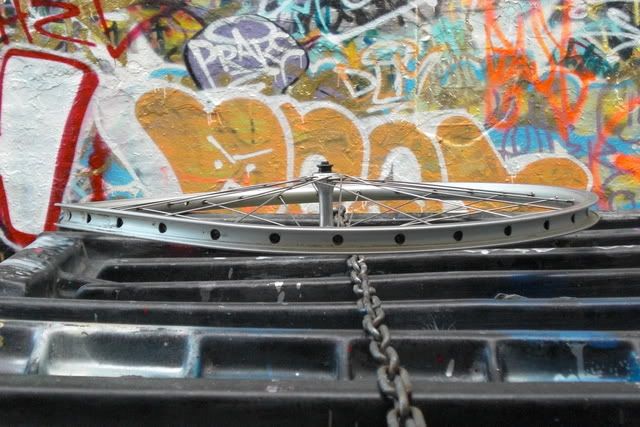
This is one of mine from a month or so ago. I have used a tree, log, rock, etc. to temporarily fix a wheel to limp back to the car. Most stuff this bad will NOT fix by spoke tension alone. I personally will not trust any rim 'brought back' by bending, you have fatigued the metal by doing so (was already fatigued once by whatever mishap had occurred), and aluminum does not fatigue well at all. I would replace the wheel or rebuild with new rim/spokes/nipples.
__________________
"I tell you, We are here on earth to fart around, and don't let anybody tell you any different." - Kurt Vonnegut jr.
"I tell you, We are here on earth to fart around, and don't let anybody tell you any different." - Kurt Vonnegut jr.

 10-05-08 | 09:55 PM
#15

Bicycle Repair Man !!!
Joined: Sep 2007
Posts: 27,266
Likes: 152
From: YEG
Bikes: See my sig...
Aluminium does not like to be straightened after it has been bent while steel rims tend to be more workable... I restore a lot of old bikes and in many cases rim salvage is an important operation when you don't have an abundance of replacements.
Things like EA1 rims and 28 inch Westwood rims are worth the effort it takes to straighten them but a low end steel or aluminum wheel in a common size isn't that hard to find.
Things like EA1 rims and 28 inch Westwood rims are worth the effort it takes to straighten them but a low end steel or aluminum wheel in a common size isn't that hard to find.
10-05-08 | 10:00 PM
#16
cab horn
Joined: Jun 2004
Posts: 28,353
Likes: 31
From: Toronto
Bikes: 1987 Bianchi Campione
My method:
1) tape spokes together at outer cross
2) undo spokes from wheel
3) bend rim straight. I usually do it by putting a broom handle or similar on the floor, then putting the rim's "troughs" on the broom handle, then I step on the "crests". Repeat, with various implements and foot positions until an acceptable trueness has been reached.
4) reattach spokes. The tape at the crosses should make this a reasonably speedy affair. True, tension and hope for the best.
Some will cringe in horror at the thought of this procedure, but IME it's proven good enough for beater bikes and casual riding. It might be good enough for more, but that's all I've used them for.
An alternate method is to clamp rim to work bench/table, and use that as a brace to bend portions of the rim back.
Yet an other alternate method is to use brute force until it snaps out of the taco configuration, but that's usually only considered a ride-home fix.
Some will say that loosening spokes and then bending back will be sufficient. But IME the spokes will go tense and prevent you from reaching the amount of overbend needed for the rim not to spring back when you release it.
1) tape spokes together at outer cross
2) undo spokes from wheel
3) bend rim straight. I usually do it by putting a broom handle or similar on the floor, then putting the rim's "troughs" on the broom handle, then I step on the "crests". Repeat, with various implements and foot positions until an acceptable trueness has been reached.
4) reattach spokes. The tape at the crosses should make this a reasonably speedy affair. True, tension and hope for the best.
Some will cringe in horror at the thought of this procedure, but IME it's proven good enough for beater bikes and casual riding. It might be good enough for more, but that's all I've used them for.
An alternate method is to clamp rim to work bench/table, and use that as a brace to bend portions of the rim back.
Yet an other alternate method is to use brute force until it snaps out of the taco configuration, but that's usually only considered a ride-home fix.
Some will say that loosening spokes and then bending back will be sufficient. But IME the spokes will go tense and prevent you from reaching the amount of overbend needed for the rim not to spring back when you release it.
10-06-08 | 08:21 AM
#17
Senior Member
Joined: Mar 2008
Posts: 8,687
Likes: 300
...which is hard to label as a waste if I like the challenge, haven't got anything else that needs doing at the moment and it's only stealing time from watching TV.
A price, however affordable, I don't have to pay merely by sacrificing an inane sit-com. Money that can be spent on something I merely want instead of on something I need.
....which by repeated experimentation has shown itself capable of doing decent service on beater bikes. Good enough to be useful but still pretty much a write-off is the ideal status on a bike that gets left in a theft-prone area on a regular basis.
But "easiest" rarely equals "most satisfying".
If I wanted "easy" I would have gone by car or not left home in the first place.
A price, however affordable, I don't have to pay merely by sacrificing an inane sit-com. Money that can be spent on something I merely want instead of on something I need.
....which by repeated experimentation has shown itself capable of doing decent service on beater bikes. Good enough to be useful but still pretty much a write-off is the ideal status on a bike that gets left in a theft-prone area on a regular basis.
If I wanted "easy" I would have gone by car or not left home in the first place.
10-06-08 | 11:11 AM
#18
messenger
Joined: Aug 2008
Posts: 599
Likes: 1
From: WLA
Bikes: pinarellos and a colnago
lets give thanks in this country-- that we dont have to deal with rims on our bikes like this if
we can afford not to ---- trash the band, save the spokes and hubs for another day if your
handy and want to learn how to transfer bands.... my 2$
we can afford not to ---- trash the band, save the spokes and hubs for another day if your
handy and want to learn how to transfer bands.... my 2$
10-31-09 | 08:11 AM
#19

jmonsw21
Joined: May 2009
Posts: 102
Likes: 0
From: Miami, Fl


 10-31-09 | 11:56 PM
#23

Frame Catastrophizer
Joined: Dec 2008
Posts: 450
Likes: 0
From: Suburban Chicago
Bikes: Surly Instigator
I watched a buddy straighten my taco'ed wheel for me after a crash by banging it against
a log and then messing around with a spoke wrench for about 5 minutes.
I was able to ride rather than walk the mile or so back to the truck.
Another 15 or 20 minutes and you could barely tell it had been bent.
I beat on it off-road for another year or so after that.
a log and then messing around with a spoke wrench for about 5 minutes.
I was able to ride rather than walk the mile or so back to the truck.
Another 15 or 20 minutes and you could barely tell it had been bent.
I beat on it off-road for another year or so after that.
11-01-09 | 06:38 AM
#24

Senior Member

Joined: Feb 2004
Posts: 30,225
Likes: 649
From: St Peters, Missouri
Bikes: Catrike 559 I own some others but they don't get ridden very much.
What happened was the rim went "over center" and caused the spokes to pull from the wrong angle. Surprisingly, sometimes you can just "bang it back" into it's original shape.