


wheelset speed gains
 03-29-09 | 03:30 PM
#26

Senior Member
Joined: Feb 2005
Posts: 9,438
Likes: 9
From: Oklahoma
Bikes: Trek 5500, Colnago C-50
 03-29-09 | 11:05 PM
#27

Senior Member
Joined: Sep 2006
Posts: 334
Likes: 3
From: PDX
You are probably right, I will measure the rims. It was a nice fantasy while it lasted. If I have a flatter tire profile it may explain why the bike feels really different on turn in to fast corners when I lean it over. The wheels are different but I really couldn't put my finger on why the bike feels like it does on turn in.
03-30-09 | 08:22 PM
#28

Senior Member

Joined: Oct 2005
Posts: 628
Likes: 139
From: Left bank, Knoxville TN
And you're wrong.
Who cares what the rider is doing. We're interested in how many watts a wheelset eats up. Granted, it might be more useful with a frame attached to it, but are you goign to start testing every permutation of that wheelset on every production frame?
I don't think it matters.
Who cares what the rider is doing. We're interested in how many watts a wheelset eats up. Granted, it might be more useful with a frame attached to it, but are you goign to start testing every permutation of that wheelset on every production frame?
I don't think it matters.
Air flow across wheels on an actual bike with a rider interacts with the rest of the bike in complex ways. The down tube drafts the front wheel and the rear wheel drafts the seat tube. Meanwhile, the rider's legs are churning the air all around the wheels and frame, and the rider's body, compared to the wheels and frame, is basically a parachute.
MIT wind tunnel testing with a bike and rider shows that "... wearing gloves in a time trial will slow you down more than using a nonaero front wheel." "The drag difference between a vented road helmet and an aero-helmet is 2-4 times larger than the difference between a good aero-wheelset and a 32-spoked wheelset."
And those comments are based on the rider in a time-trial position. A rider on the drops of regular road bars, or worse yet, on the hoods, has such a big affect on aerodynamics that your choice of wheels (from an aerodynamic perspective) is even more trivial.
In addition, low-spoke-count wheels require heavy rims to distribute the stresses, so they accelerate more slowly.
For the 400-watt pro, a second or two in a time trial matters, but for the rest of us, aero wheels are jewelry.
Refences: https://www.pezcyclingnews.com/defaul...lstory&id=3574
https://www.bicycling.com/article/0,6...4995-1,00.html
03-30-09 | 08:45 PM
#29

The space coyote lied.


Joined: Sep 2008
Posts: 48,904
Likes: 11,095
From: dusk 'til dawn.
Bikes: everywhere
03-30-09 | 08:50 PM
#30

aka Tom Reingold

Joined: Jan 2009
Posts: 44,338
Likes: 6,639
From: New York, NY, and High Falls, NY, USA
Bikes: 1962 Rudge Sports, 1971 Raleigh Super Course, 1971 Raleigh Pro Track, 1974 Raleigh International, 1975 Viscount Fixie, 1982 McLean, 1996 Lemond (Ti), 2002 Burley Zydeco tandem
Those are interesting tidbits, sluggo!
__________________
Tom Reingold, tom@noglider.com
New York City and High Falls, NY
Blogs: The Experienced Cyclist; noglider's ride blog
“When man invented the bicycle he reached the peak of his attainments.” — Elizabeth West, US author
Please email me rather than PM'ing me. Thanks.
Tom Reingold, tom@noglider.com
New York City and High Falls, NY
Blogs: The Experienced Cyclist; noglider's ride blog
“When man invented the bicycle he reached the peak of his attainments.” — Elizabeth West, US author
Please email me rather than PM'ing me. Thanks.
 03-31-09 | 11:57 AM
#32

Senior Member
Joined: Jul 2005
Posts: 11,754
Likes: 26
From: Mesa, AZ
Bikes: Moots RCS, tandem, beach-cruiser, MTB, Specialized-Allez road-bike, custom track-bike
Well, that's not really a good test since there were so many variables that weren't controlled. The only way to measure the difference in wheel-performance is to at least maintain constant speed or constant power-output. And control all other variables like air-temp, wind-direction and speed, relative-humidity, as well as air-density (same course on different days will have different air-density due to varying atmospheric conditions). You MAY be able to compensate for those variations if you measured all those conditions, but they weren't recorded. And the rider's fitness-level and recovery-state will be different on two different days as well. Way, way too many variables to narrow down the performance differences between two wheelsets.
Well, I'd like to answer the OP's question anyway since this is such an academic discussion. First, let's use the Kreuzotter site to calculate bicycle-speed given various aerodynamic positions and power-outputs: https://kreuzotter.de/english/espeed.htm. I used the following changes from the default settings:
1. roadster
2. hands on drops
3. air-temp = 70F for STP
4. height above sea-level = 0ft for STP
5. blank out watts box in lower-left
6. enter 31mph in speed box in lower-right
7. hit CALCULATE
And we get 565 watts required to push that bike at 31mph in the drops at sea-level. Al1943 is correct in that using steady 50kph is an unrealistic test-speed as most riders won't be able to output 565-watts for long. However, let's use that speed since that was one of the few instrumented tests with data we can use. And it may closely match the sprint of an average rider and he'd want to know how much faster he can beat his friends if he upgrade his wheels.
Let's use the 18-watt difference between the "slowest" Mavic R-sys wheel used in that test versus the "fastest" Zipp-808 and plug that difference into the model:
8. blank out speed box in lower-right
9. enter 583 in the watts box, basically 565 generated watts + 18 "free" watts from "faster" wheels
10. hit CALCULATE
and we get an increase of 0.4mph to 31.4mph when upgrading to the "fastest" Zipp-808 wheels or 1.3%. Of course this is only from the Mavic R-sys wheels. Depending upon what wheels you originally had, your speed-increase will be more or less than this.
For the 400-watt pro, a second or two in a time trial matters, but for the rest of us, aero wheels are jewelry.
Refences: https://www.pezcyclingnews.com/defaul...lstory&id=3574
https://www.bicycling.com/article/0,6...4995-1,00.html
Refences: https://www.pezcyclingnews.com/defaul...lstory&id=3574
https://www.bicycling.com/article/0,6...4995-1,00.html
1. roadster
2. hands on drops
3. air-temp = 70F for STP
4. height above sea-level = 0ft for STP
5. blank out watts box in lower-left
6. enter 31mph in speed box in lower-right
7. hit CALCULATE
And we get 565 watts required to push that bike at 31mph in the drops at sea-level. Al1943 is correct in that using steady 50kph is an unrealistic test-speed as most riders won't be able to output 565-watts for long. However, let's use that speed since that was one of the few instrumented tests with data we can use. And it may closely match the sprint of an average rider and he'd want to know how much faster he can beat his friends if he upgrade his wheels.
Let's use the 18-watt difference between the "slowest" Mavic R-sys wheel used in that test versus the "fastest" Zipp-808 and plug that difference into the model:
8. blank out speed box in lower-right
9. enter 583 in the watts box, basically 565 generated watts + 18 "free" watts from "faster" wheels
10. hit CALCULATE
and we get an increase of 0.4mph to 31.4mph when upgrading to the "fastest" Zipp-808 wheels or 1.3%. Of course this is only from the Mavic R-sys wheels. Depending upon what wheels you originally had, your speed-increase will be more or less than this.
Last edited by DannoXYZ; 03-31-09 at 04:56 PM.
03-31-09 | 02:13 PM
#33
Gear Hub fan
Joined: Nov 2008
Posts: 2,829
Likes: 2
From: Reno, NV
Bikes: Civia Hyland Rohloff, Swobo Dixon, Colnago, Univega
Danno;
Thanks, the best post of the whole thread IMO. It actually provides a quantitative comparison and shows the amount of difference in performance likely with a change of wheels, very minor for the average road rider.
I would expect tires to make a bigger difference than wheels as far as the average rider is concerned. The general rule for tires seems to be narrower and higher pressure is the way to go though it also seems subjectively that rolling resistance varies considerably with construction. By reputation it seems in a given size the most puncture resistant tire is going to have the highest rolling resistance. Apparently no such thing as a free lunch.
Do you have a link to information on tire rolling resistance data by tire make, model and size?
Thanks, the best post of the whole thread IMO. It actually provides a quantitative comparison and shows the amount of difference in performance likely with a change of wheels, very minor for the average road rider.
I would expect tires to make a bigger difference than wheels as far as the average rider is concerned. The general rule for tires seems to be narrower and higher pressure is the way to go though it also seems subjectively that rolling resistance varies considerably with construction. By reputation it seems in a given size the most puncture resistant tire is going to have the highest rolling resistance. Apparently no such thing as a free lunch.
Do you have a link to information on tire rolling resistance data by tire make, model and size?
__________________
Gear Hubs Owned: Rohloff disc brake, SRAM iM9 disc brake, SRAM P5 freewheel, Sachs Torpedo 3 speed freewheel, NuVinci CVT, Shimano Alfine SG S-501, Sturmey Archer S5-2 Alloy. Other: 83 Colnago Super Record, Univega Via De Oro
Visit and join the Yahoo Geared Hub Bikes group for support and links.
https://groups.yahoo.com/group/Geared_hub_bikes/
Gear Hubs Owned: Rohloff disc brake, SRAM iM9 disc brake, SRAM P5 freewheel, Sachs Torpedo 3 speed freewheel, NuVinci CVT, Shimano Alfine SG S-501, Sturmey Archer S5-2 Alloy. Other: 83 Colnago Super Record, Univega Via De Oro
Visit and join the Yahoo Geared Hub Bikes group for support and links.
https://groups.yahoo.com/group/Geared_hub_bikes/
03-31-09 | 04:44 PM
#34
Senior Member
Joined: Jul 2005
Posts: 11,754
Likes: 26
From: Mesa, AZ
Bikes: Moots RCS, tandem, beach-cruiser, MTB, Specialized-Allez road-bike, custom track-bike
Well.... tyre rolling-resistance is measured in grams of drag (or milli-Newtons). Not much of a milli-wattage difference between the fastest and slowest tyres in terms of rolling-resistance. Their aerodynamic profile is a bigger contributing factor to speed and narrow tyres block less wind, and weigh less for hillclimbs. Jobst Brandt, the granddaddy of biking physics did a study on rolling-resistance decades ago. As well as Damon Rinard. I'll look for some graphs somewhere.
Meanwhile, power-required to overcome rolling-resistance remains fairly constant relative to speed due to the low-RPMs of bike wheels, while power-required to overcome wind-resistance goes up to the 3rd-power of speed. What this means is that the grams of rolling-resistance doesn't really increase much when you double your speed. However, aero-drag is measured in kilograms of drag and you need 8 TIMES more power to overcome aero-drag at twice the speed (or use Newtons pushing you back):
Check out this site where Damon Rinard graphs rolling-resistance versus aero-drag relative to speed:
https://www.sheldonbrown.com/rinard/aero/formulas.htm
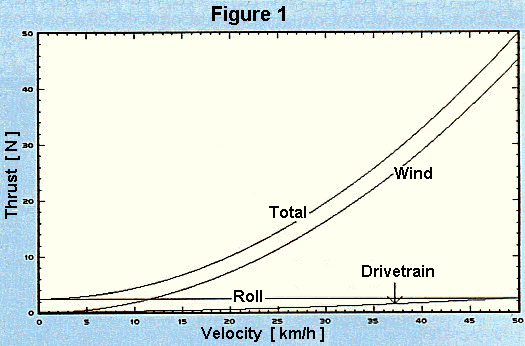
Basically the faster you go, the less and less drivetrain/rolling-resistance contributes to total-drag while aero-drag becomes much, much more important. For beginners who want to get faster, the most dramatic increases will come from learning an efficient pedaling-motion and getting the flexibily to generate high-wattage while tucked down in an aero position with flat back and horizontal forearms. This will easily give you +5-7mph or more for the same power-output.
Meanwhile, power-required to overcome rolling-resistance remains fairly constant relative to speed due to the low-RPMs of bike wheels, while power-required to overcome wind-resistance goes up to the 3rd-power of speed. What this means is that the grams of rolling-resistance doesn't really increase much when you double your speed. However, aero-drag is measured in kilograms of drag and you need 8 TIMES more power to overcome aero-drag at twice the speed (or use Newtons pushing you back):
Check out this site where Damon Rinard graphs rolling-resistance versus aero-drag relative to speed:
https://www.sheldonbrown.com/rinard/aero/formulas.htm
Basically the faster you go, the less and less drivetrain/rolling-resistance contributes to total-drag while aero-drag becomes much, much more important. For beginners who want to get faster, the most dramatic increases will come from learning an efficient pedaling-motion and getting the flexibily to generate high-wattage while tucked down in an aero position with flat back and horizontal forearms. This will easily give you +5-7mph or more for the same power-output.
Last edited by DannoXYZ; 03-31-09 at 04:55 PM.
04-01-09 | 09:50 AM
#35
aka Tom Reingold
Joined: Jan 2009
Posts: 44,338
Likes: 6,639
From: New York, NY, and High Falls, NY, USA
Bikes: 1962 Rudge Sports, 1971 Raleigh Super Course, 1971 Raleigh Pro Track, 1974 Raleigh International, 1975 Viscount Fixie, 1982 McLean, 1996 Lemond (Ti), 2002 Burley Zydeco tandem
DannoXYZ, your avatar's demeanor doesn't match your intellect.
__________________
Tom Reingold, tom@noglider.com
New York City and High Falls, NY
Blogs: The Experienced Cyclist; noglider's ride blog
“When man invented the bicycle he reached the peak of his attainments.” — Elizabeth West, US author
Please email me rather than PM'ing me. Thanks.
Tom Reingold, tom@noglider.com
New York City and High Falls, NY
Blogs: The Experienced Cyclist; noglider's ride blog
“When man invented the bicycle he reached the peak of his attainments.” — Elizabeth West, US author
Please email me rather than PM'ing me. Thanks.
