


Another threaded fork threadless headset thread
 05-01-11 | 11:29 PM
#1

Thread Starter
Constant tinkerer
Joined: May 2010
Posts: 8,040
Likes: 156
From: Madison, WI
Another threaded fork threadless headset thread
I just picked up a 1980s Trek road bike. Full Reynolds 531. The bike was severely neglected, and now I discover the fork is bent. It's a smaller frame, and I have carbon fiber fork with a steel steerer tube. 1" threaded. The steerer on the carbon fork is very long. Long enough that I could cut off the threaded portion and clamp a stem on the remaining portion.
So, all I would need to do this conversion is to get a 1" threadless headset and stem, right? I just want to make sure before I buy. This is what I'm planning on getting:
Headset: https://cgi.ebay.com/Ritchey-Logic-He...item5643968b08
Stem: https://cgi.ebay.com/1-INCH-THREADLES...item4cf66bc8f6
Any comments, suggestions, etc are welcome. Thanks.
So, all I would need to do this conversion is to get a 1" threadless headset and stem, right? I just want to make sure before I buy. This is what I'm planning on getting:
Headset: https://cgi.ebay.com/Ritchey-Logic-He...item5643968b08
Stem: https://cgi.ebay.com/1-INCH-THREADLES...item4cf66bc8f6
Any comments, suggestions, etc are welcome. Thanks.
 05-01-11 | 11:37 PM
#2

Pleasurable Pain
Joined: Aug 2006
Posts: 354
Likes: 0
From: Bloomington, IN
Bikes: Voodoo Rada, KHS Alite 4000, Smith & Wesson Tactical, Diamondback Response
Yes, thats all you would need assuming you have the tools to remove and set a headset, and cut the threads off your steer tube. Sounds like its going to be a sweet ride, I love steel! You might be able to find a nicer used 1" threadless set at a bike shop for cheaper trying to pawn them off.
05-01-11 | 11:45 PM
#3
Thread Starter
Constant tinkerer
Joined: May 2010
Posts: 8,040
Likes: 156
From: Madison, WI
I've already removed the old headset, and should have no trouble installing the new one and cutting the fork. Thanks for the response.
05-02-11 | 03:14 AM
#4
Senior Member
Joined: Oct 2007
Posts: 5,773
Likes: 105
From: West Yorkshire, United Kingdom
You may want to get the alignment of the rest of the frame checked as the fork was bent; you never know how much damage was done when the fork was wrecked.
For the stem, you are not just restriced to 1" stems, there are 1" - 1 1/8" converter shims avaliable, and some stems come with these, I did a similar conversion to you several years a go, as getting a nice 1" stem was impossible at the time.
Also make sure the stem you linked to has the correct handelbar diamter for your bar
For the stem, you are not just restriced to 1" stems, there are 1" - 1 1/8" converter shims avaliable, and some stems come with these, I did a similar conversion to you several years a go, as getting a nice 1" stem was impossible at the time.
Also make sure the stem you linked to has the correct handelbar diamter for your bar
05-02-11 | 08:28 AM
#5
Thread Starter
Constant tinkerer
Joined: May 2010
Posts: 8,040
Likes: 156
From: Madison, WI
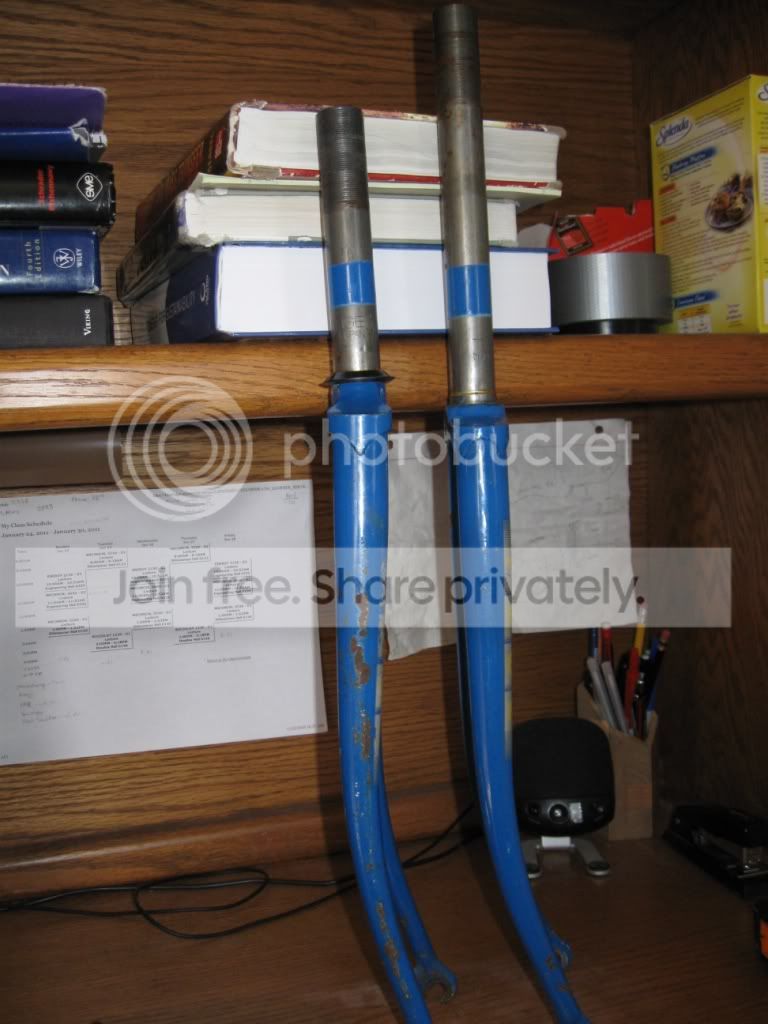
Thanks jim. I did measure my bars, and I will keep the 1 1/8" shimmed stems in mind. The fork doesn't look that bad. Honestly it took me a while to decide that it's bent. How does it look? The fork on the left is in question, next to a known straight fork. I'd just like a second opinion before I retire something perfectly good.
05-02-11 | 08:42 PM
#6

Senior Member

Joined: Jul 2005
Posts: 4,985
Likes: 709
From: Boulder County, CO
Bikes: '80 Masi Gran Criterium, '12 Trek Madone, early '60s Frejus track
Remember that the steerer on the threaded fork only needs to extend beyond the head tube to accommodate the threading of the headset cone, the washer, and the lock ring. The steerer on a threadless fork needs to extend far enough beyond the head tube to accommodate the top cap of the headset, the stem clamp, and as many spacers as you wish to use to raise the handlebar. It appears that if you cut your replacement fork at the end of the threading you might no't have enough left for the stem.


 05-03-11 | 03:02 PM
#9
Thread Starter
Constant tinkerer
Joined: May 2010
Posts: 8,040
Likes: 156
From: Madison, WI
Thanks for confirming that it's bent. Maybe I'll use it as a truing stand.
The fork on the left came from an '84 610, which was a Reynolds fork according to the sticker on the frame and the '84 brochure. The fork on the right is from an '84 460, a Tange 1000 frame.
Both forks say Tange on the steerer, so I don't know where that leaves me. I suppose it doesn't matter much since I'm replacing it with carbon...
The fork on the left came from an '84 610, which was a Reynolds fork according to the sticker on the frame and the '84 brochure. The fork on the right is from an '84 460, a Tange 1000 frame.
Both forks say Tange on the steerer, so I don't know where that leaves me. I suppose it doesn't matter much since I'm replacing it with carbon...
Last edited by FastJake; 05-04-11 at 01:15 PM. Reason: I referred to both forks as being on the left. Oops..
05-04-11 | 01:11 PM
#10

coffeeeeee
Joined: Aug 2007
Posts: 238
Likes: 3
From: somewhere in Pennsyl-tucky
Bikes: all that I ride
I've been thinking about this same kind of problem for a while now and have an alternative solution. It requires you to have access to a lathe though. The whole problem (allegedly) with using a threaded fork with a threadless stem is that the threaded portion of the steerer is not strong enough to withstand the clamping force of the stem.
On Alpha carbon forks, instead of a compression plug fitting, they give you an flanged aluminum tube with a star nut pre-intalled and tell you to give it to your shop or epoxy the thing in there yourself after cutting the steerer to size.
I don't see why something similar - a flanged sleeve w/ starnut in the threaded portion of the steerer - wouldn't yield the same result. heck if you make it just the right size it wouldn't even need to be epoxied in place as clamping force may keep the whole thing locked together. That way you can utilize the full length of the threaded steerer to acheive a good handlebar height with the usual 10º stems available.
somebody here tell my why this is a bad idea - that's what you all seem to be good at ;p
matt
On Alpha carbon forks, instead of a compression plug fitting, they give you an flanged aluminum tube with a star nut pre-intalled and tell you to give it to your shop or epoxy the thing in there yourself after cutting the steerer to size.
I don't see why something similar - a flanged sleeve w/ starnut in the threaded portion of the steerer - wouldn't yield the same result. heck if you make it just the right size it wouldn't even need to be epoxied in place as clamping force may keep the whole thing locked together. That way you can utilize the full length of the threaded steerer to acheive a good handlebar height with the usual 10º stems available.
somebody here tell my why this is a bad idea - that's what you all seem to be good at ;p
matt

Thread
Thread Starter
Forum
Replies
Last Post
daveizdum
Bicycle Mechanics
6
10-03-10 12:59 AM
