


Can CO2 Cartridges Explode?


 06-15-11 | 05:41 PM
#3

Senior Member
Joined: Nov 2007
Posts: 634
Likes: 38
06-15-11 | 06:30 PM
#4

Senior Member

Joined: Apr 2006
Posts: 2,473
Likes: 1
From: Gig Harbor, WA
Bikes: Surly Long Haul Trucker, Gary Fisher Hoo Koo E Koo, Dahon Mu P 24 , Ritchey Breakaway Cross, Rodriguez Tandem, Wheeler MTB
If something is under pressure, then it's possible. Have you checked the box they come in, or maybe the side of the bottle. I'd think a temp limit would be shown if it could be a problem.
06-15-11 | 07:13 PM
#5

Certified Bike Brat
Joined: Jan 2011
Posts: 4,251
Likes: 6
From: Montreal, Quebec
Since an explosion describes a kind of uncontrolled combustion and CO2 isn`t combustable - it can`t explode.
So lets assume you mean burst due to temperature or pressure extremes. Due to its design (the end you pierce is the weakest part of the cylinder) the worst that could possibly happen is the cylinder could vent through that end. But I`ve never had or heard of that happening myself.
So lets assume you mean burst due to temperature or pressure extremes. Due to its design (the end you pierce is the weakest part of the cylinder) the worst that could possibly happen is the cylinder could vent through that end. But I`ve never had or heard of that happening myself.
06-15-11 | 07:18 PM
#6
Senior Member
Joined: Nov 2008
Posts: 7,239
Likes: 8
From: Bay Area, Calif.
I've seen a max. temperature listing of 50C which is only 122F, so it could be an issue if left in a parked car on a sunny day. But I'm sure there's a pretty good safety margin above the specified max. temp.
06-15-11 | 07:40 PM
#7
Senior Member
Joined: Mar 2007
Posts: 6,401
Likes: 19
When I was a kid I was given several hundred cartridges for use with pellet guns. I used a bunch for that purpose, but eventually got bored and started experimenting. The short version is that I found a number of ways to get the ends to rupture (moderately exciting, kind of loud) but never could get them to "explode", even by tossing them into the fire, duct taping them to railroad tracks, or shooting them with the pellet gun. So even if you encounter extreme conditions, you might get them to vent as described by Burton above, but I'd be pretty surprised if you could get one to rupture out the side, mimicking an explosion.
06-15-11 | 07:52 PM
#8
Senior Member
Joined: Mar 2011
Posts: 54
Likes: 0
When I was a kid I was given several hundred cartridges for use with pellet guns. I used a bunch for that purpose, but eventually got bored and started experimenting. The short version is that I found a number of ways to get the ends to rupture (moderately exciting, kind of loud) but never could get them to "explode", even by tossing them into the fire, duct taping them to railroad tracks, or shooting them with the pellet gun. So even if you encounter extreme conditions, you might get them to vent as described by Burton above, but I'd be pretty surprised if you could get one to rupture out the side, mimicking an explosion.
+1 ...... Love it
06-15-11 | 08:21 PM
#11
Senior Member
Joined: Apr 2011
Posts: 438
Likes: 0
From: Arizona
Bikes: Raleigh Venture 3.0
https://www.merriam-webster.com/dictionary/explode
1. b. under intransitive verb
1. b. under intransitive verb
b : to burst violently as a result of pressure from within
06-15-11 | 09:17 PM
#12
Thread Starter
Senior Member
Joined: Aug 2010
Posts: 459
Likes: 0
From: Denver
Bikes: Secteur, Camber, Trek 930
^ Yep, explosions can happen without combustibles.
Anyway, no probs with them in my saddle bag in 95F heat, nor with a new box of Daisy CO2 cartridges sitting on my doorstep in the hot sun. I'll find out how they hold up at 14,265' or so this summer. The box says don't heat above 140F, but the cartridges themselves say 120F (WTF?). Anyhow, I'm pointing them forward in my saddle bag so that if they do burst and act like missiles, I'll get a boost.
Anyway, no probs with them in my saddle bag in 95F heat, nor with a new box of Daisy CO2 cartridges sitting on my doorstep in the hot sun. I'll find out how they hold up at 14,265' or so this summer. The box says don't heat above 140F, but the cartridges themselves say 120F (WTF?). Anyhow, I'm pointing them forward in my saddle bag so that if they do burst and act like missiles, I'll get a boost.
06-15-11 | 09:24 PM
#13
Senior Member
Joined: May 2010
Posts: 1,099
Likes: 3
From: Madison, WI
This is from paintball, but the chart works for any CO2 cartridge:
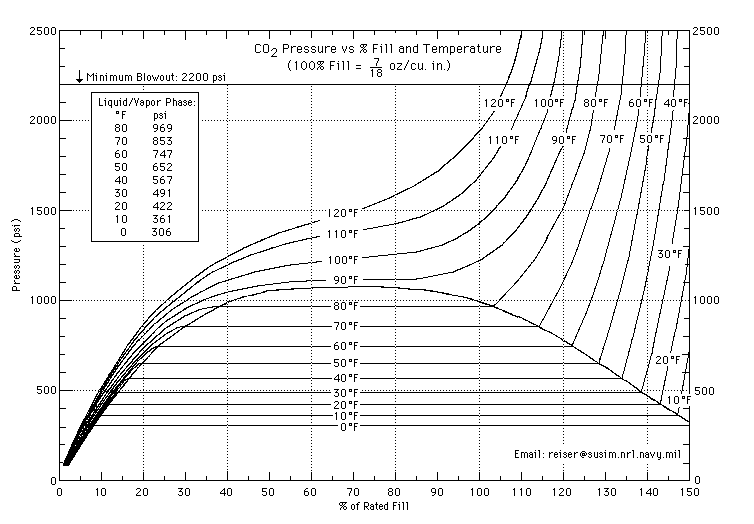
The 'Minimum blowout' line is the burst disc pressure on refillible CO2 cartridges. 12/16 gram cartridges may have higher burst pressures, but it likely works as a rough guide.
The 'Minimum blowout' line is the burst disc pressure on refillible CO2 cartridges. 12/16 gram cartridges may have higher burst pressures, but it likely works as a rough guide.
06-15-11 | 09:39 PM
#14

Senior Member
Joined: Aug 2010
Posts: 899
Likes: 7
From: Coupeville, WA
Bikes: 84 Raleigh Technium- 89 Shogun Mt. Bike-96 Miyata 914
When I was a kid I was given several hundred cartridges for use with pellet guns. I used a bunch for that purpose, but eventually got bored and started experimenting. The short version is that I found a number of ways to get the ends to rupture (moderately exciting, kind of loud) but never could get them to "explode", even by tossing them into the fire, duct taping them to railroad tracks, or shooting them with the pellet gun. So even if you encounter extreme conditions, you might get them to vent as described by Burton above, but I'd be pretty surprised if you could get one to rupture out the side, mimicking an explosion.
It's a wonder no one put their eye out.
06-15-11 | 11:03 PM
#15

Mad bike riding scientist


Joined: Nov 2004
Posts: 29,173
Likes: 6,242
From: Denver, CO
Bikes: Some silver ones, a red one, a black and orange one, and a few titanium ones
Since an explosion describes a kind of uncontrolled combustion and CO2 isn`t combustable - it can`t explode.
So lets assume you mean burst due to temperature or pressure extremes. Due to its design (the end you pierce is the weakest part of the cylinder) the worst that could possibly happen is the cylinder could vent through that end. But I`ve never had or heard of that happening myself.
So lets assume you mean burst due to temperature or pressure extremes. Due to its design (the end you pierce is the weakest part of the cylinder) the worst that could possibly happen is the cylinder could vent through that end. But I`ve never had or heard of that happening myself.
The pressure in a 9 g CO2 cartridge is 850 psi at 72F. The pressure doesn't climb all that fast with temperature. It would reach 975 psi at 120 F which is high but not horribly high. The burst disc on the top of the cartridge blows out around 2200 psi which isn't reached until around 1200F...think camp fire.
If the burst disc ruptured, the difference between that and an explosion would be a matter of semantics. If you were near one, it'd make a hell of a noise and you'd probably call it an explosion.
__________________
Stuart Black
Dreamin' of Bemidji Down the Mississippi (in part)
Plan Epsilon Around Lake Michigan in the era of Covid
Gold Fever Three days of dirt in Colorado
Pokin' around the Poconos A cold ride around Lake Erie
Dinosaurs in Colorado A mountain bike guide to the Purgatory Canyon dinosaur trackway
Solo Without Pie. The search for pie in the Midwest.
Picking the Scablands. Washington and Oregon, 2005. Pie and spiders on the Columbia River!
Stuart Black
Dreamin' of Bemidji Down the Mississippi (in part)
Plan Epsilon Around Lake Michigan in the era of Covid
Gold Fever Three days of dirt in Colorado
Pokin' around the Poconos A cold ride around Lake Erie
Dinosaurs in Colorado A mountain bike guide to the Purgatory Canyon dinosaur trackway
Solo Without Pie. The search for pie in the Midwest.
Picking the Scablands. Washington and Oregon, 2005. Pie and spiders on the Columbia River!
06-16-11 | 06:01 AM
#16
Certified Bike Brat
Joined: Jan 2011
Posts: 4,251
Likes: 6
From: Montreal, Quebec
Check out the wikipedia for explosion and you won`t find anything not associated with explosives. Pressure vessles rupture or burst. They only explode when the contents are flamable and heat causes them to rupture and then explode when the contents ignite.
This may be largely symantics but since the OP posted a safety concern I think it was appropriate to point out the difference.
06-16-11 | 06:20 AM
#17

Senior Member
Joined: Feb 2004
Posts: 30,225
Likes: 649
From: St Peters, Missouri
Bikes: Catrike 559 I own some others but they don't get ridden very much.
Oh oh! I'm sensing another word (like fume) that has a special meaning that only applies to certain people. The most recent word to bother me is bladder. I pee from my bladder. I drink from my hydration reservoir.
06-16-11 | 07:56 AM
#18
Mad bike riding scientist
Joined: Nov 2004
Posts: 29,173
Likes: 6,242
From: Denver, CO
Bikes: Some silver ones, a red one, a black and orange one, and a few titanium ones
Explosion was originally a description used to describe the detonation of explosives. Like lots of other words, many have been used and abused simply to add drama to sentences so now sprinters `explode out of the starting gates`. I hope they don`t hurt themselves too much in the process.
Check out the wikipedia for explosion and you won`t find anything not associated with explosives. Pressure vessles rupture or burst. They only explode when the contents are flamable and heat causes them to rupture and then explode when the contents ignite.
This may be largely symantics but since the OP posted a safety concern I think it was appropriate to point out the difference.
Check out the wikipedia for explosion and you won`t find anything not associated with explosives. Pressure vessles rupture or burst. They only explode when the contents are flamable and heat causes them to rupture and then explode when the contents ignite.
This may be largely symantics but since the OP posted a safety concern I think it was appropriate to point out the difference.
Electrical and magnetic
A high current electrical fault can create an electrical explosion by forming a high energy electrical arc which rapidly vaporizes metal and insulation material. This arc flash hazard is a danger to persons working on energized switchgear. Also, excessive magnetic pressure within an ultra-strong electromagnet can cause a magnetic explosion.
Mechanical and vapour
Strictly a physical process, as opposed to chemical or nuclear, e.g., the bursting of a sealed or partially-sealed container under internal pressure is often referred to as a 'mechanical explosion'. Examples include an overheated boiler or a simple tin can of beans tossed into a fire.
Boiling liquid expanding vapour explosions are one type of mechanical explosion that can occur when a vessel containing a pressurized liquid is ruptured, causing a rapid increase in volume as the liquid evaporates. Note that the contents of the container may cause a subsequent chemical explosion, the effects of which can be dramatically more serious - such as a propane tank in the midst of a fire. In such a case, to the effects of the mechanical explosion when the tank fails are added the effects from the explosion resulting from the released (initially liquid and then almost instantaneously gaseous) propane in the presence of an ignition source. For this reason, emergency workers often differentiate between the two events.
A high current electrical fault can create an electrical explosion by forming a high energy electrical arc which rapidly vaporizes metal and insulation material. This arc flash hazard is a danger to persons working on energized switchgear. Also, excessive magnetic pressure within an ultra-strong electromagnet can cause a magnetic explosion.
Mechanical and vapour
Strictly a physical process, as opposed to chemical or nuclear, e.g., the bursting of a sealed or partially-sealed container under internal pressure is often referred to as a 'mechanical explosion'. Examples include an overheated boiler or a simple tin can of beans tossed into a fire.
Boiling liquid expanding vapour explosions are one type of mechanical explosion that can occur when a vessel containing a pressurized liquid is ruptured, causing a rapid increase in volume as the liquid evaporates. Note that the contents of the container may cause a subsequent chemical explosion, the effects of which can be dramatically more serious - such as a propane tank in the midst of a fire. In such a case, to the effects of the mechanical explosion when the tank fails are added the effects from the explosion resulting from the released (initially liquid and then almost instantaneously gaseous) propane in the presence of an ignition source. For this reason, emergency workers often differentiate between the two events.
explode
1530s, "to reject with scorn," from L. explodere "drive out or off by clapping, hiss off, hoot off," originally theatrical, "to drive an actor off the stage by making noise," hence "drive out, reject" (a sense surviving in an exploded theory), from ex- "out" (see ex-) + plaudere "to clap the hands, applaud," of uncertain origin. Athenian audiences were highly demonstrative. clapping and shouting approval, stamping, hissing, and hooting for disapproval. The Romans seem to have done likewise.
At the close of the performance of a comedy in the Roman theatre one of the actors dismissed the audience, with a request for their approbation, the expression being usually plaudite, vos plaudite, or vos valete et plaudite. [William Smith, "A First Latin Reading Book," 1890]
English used it to mean "drive out with violence and sudden noise" (1650s), later, "go off with a loud noise" (Amer.Eng. 1790); sense of "to burst with destructive force" is first recorded 1882; of population, 1959. Related: Exploded; exploding.
1530s, "to reject with scorn," from L. explodere "drive out or off by clapping, hiss off, hoot off," originally theatrical, "to drive an actor off the stage by making noise," hence "drive out, reject" (a sense surviving in an exploded theory), from ex- "out" (see ex-) + plaudere "to clap the hands, applaud," of uncertain origin. Athenian audiences were highly demonstrative. clapping and shouting approval, stamping, hissing, and hooting for disapproval. The Romans seem to have done likewise.
At the close of the performance of a comedy in the Roman theatre one of the actors dismissed the audience, with a request for their approbation, the expression being usually plaudite, vos plaudite, or vos valete et plaudite. [William Smith, "A First Latin Reading Book," 1890]
English used it to mean "drive out with violence and sudden noise" (1650s), later, "go off with a loud noise" (Amer.Eng. 1790); sense of "to burst with destructive force" is first recorded 1882; of population, 1959. Related: Exploded; exploding.
__________________
Stuart Black
Dreamin' of Bemidji Down the Mississippi (in part)
Plan Epsilon Around Lake Michigan in the era of Covid
Gold Fever Three days of dirt in Colorado
Pokin' around the Poconos A cold ride around Lake Erie
Dinosaurs in Colorado A mountain bike guide to the Purgatory Canyon dinosaur trackway
Solo Without Pie. The search for pie in the Midwest.
Picking the Scablands. Washington and Oregon, 2005. Pie and spiders on the Columbia River!
Stuart Black
Dreamin' of Bemidji Down the Mississippi (in part)
Plan Epsilon Around Lake Michigan in the era of Covid
Gold Fever Three days of dirt in Colorado
Pokin' around the Poconos A cold ride around Lake Erie
Dinosaurs in Colorado A mountain bike guide to the Purgatory Canyon dinosaur trackway
Solo Without Pie. The search for pie in the Midwest.
Picking the Scablands. Washington and Oregon, 2005. Pie and spiders on the Columbia River!
Last edited by cyccommute; 06-16-11 at 08:02 AM.
 06-16-11 | 09:46 AM
#20

Senior Member
Joined: Mar 2008
Posts: 5,559
Likes: 53
From: The 'Wack, BC, Canada
Bikes: Norco (2), Miyata, Canondale, Soma, Redline
CO2 in containers is funny stuff. It's actually sensitive to how full the container is between liquid and gas. Check out this chart. It actually shows that for a full cartridge cycommute's figures for the higher temperatures are low if the cartridges are filled to capacity;

It's an odd chart but if you look at the % fill line for 100% and go up to the 120F line the pressure is actually up around 1900 psi. And if the tops on the cartridges are set to blow off at around 2200 or so that is going to occur at around 130 by extrapolation since there's no temperature lines beyond 120.
The funny flat lines under the lowest curve are indicative of the bi-phase state where there's liquid and gas in the container at the same time. At temperatures and fill amounts in that area the pressure will remain constant over a wide range of fill amounts. But at around just under 90F the CO2 converts to all gas with no liquid content.
Mind you once you start to vent the gas off during use or in the event of a burst end cap the temperature will fall fast even on an overheated cartridge.
It's an odd chart but if you look at the % fill line for 100% and go up to the 120F line the pressure is actually up around 1900 psi. And if the tops on the cartridges are set to blow off at around 2200 or so that is going to occur at around 130 by extrapolation since there's no temperature lines beyond 120.
The funny flat lines under the lowest curve are indicative of the bi-phase state where there's liquid and gas in the container at the same time. At temperatures and fill amounts in that area the pressure will remain constant over a wide range of fill amounts. But at around just under 90F the CO2 converts to all gas with no liquid content.
Mind you once you start to vent the gas off during use or in the event of a burst end cap the temperature will fall fast even on an overheated cartridge.
06-16-11 | 10:09 AM
#21

Senior Member
Joined: Dec 2006
Posts: 398
Likes: 0
From: UT
Bikes: Ibex Xray
CO2 in containers is funny stuff. It's actually sensitive to how full the container is between liquid and gas. Check out this chart. It actually shows that for a full cartridge cycommute's figures for the higher temperatures are low if the cartridges are filled to capacity;
It's an odd chart but if you look at the % fill line for 100% and go up to the 120F line the pressure is actually up around 1900 psi. And if the tops on the cartridges are set to blow off at around 2200 or so that is going to occur at around 130 by extrapolation since there's no temperature lines beyond 120.
The funny flat lines under the lowest curve are indicative of the bi-phase state where there's liquid and gas in the container at the same time. At temperatures and fill amounts in that area the pressure will remain constant over a wide range of fill amounts. But at around just under 90F the CO2 converts to all gas with no liquid content.
Mind you once you start to vent the gas off during use or in the event of a burst end cap the temperature will fall fast even on an overheated cartridge.
It's an odd chart but if you look at the % fill line for 100% and go up to the 120F line the pressure is actually up around 1900 psi. And if the tops on the cartridges are set to blow off at around 2200 or so that is going to occur at around 130 by extrapolation since there's no temperature lines beyond 120.
The funny flat lines under the lowest curve are indicative of the bi-phase state where there's liquid and gas in the container at the same time. At temperatures and fill amounts in that area the pressure will remain constant over a wide range of fill amounts. But at around just under 90F the CO2 converts to all gas with no liquid content.
Mind you once you start to vent the gas off during use or in the event of a burst end cap the temperature will fall fast even on an overheated cartridge.
06-16-11 | 10:23 AM
#22
Senior Member
Joined: Mar 2008
Posts: 5,559
Likes: 53
From: The 'Wack, BC, Canada
Bikes: Norco (2), Miyata, Canondale, Soma, Redline
Don't panic over it. Besides your 16gm cartridges hold 16 gms of CO2. They are rated by weight, not volume, since at room temperature the CO2 is mostly a liquid as far as the mass which is liquid and the mass which is gas. If you want to check it google for CO2 liquid density and figure that 15.5 grams of the 16 is likely liquid. Same with CO2 fire extinguishers and paintball bottles. They are rated by weight for a full fill that produces the correct safe fill volume.
If you really want to scare yourself saw an empty cartridge in half lengthwise some time. The walls on these things look pop can thin. On second thought don't. It'll scare you so badly that you'll never want to hold one again knowing how much pressure is inside and what the metal could do if one were to suddenly decide to burst....
I KID! I KID! But the walls really ARE thin.
If you really want to scare yourself saw an empty cartridge in half lengthwise some time. The walls on these things look pop can thin. On second thought don't. It'll scare you so badly that you'll never want to hold one again knowing how much pressure is inside and what the metal could do if one were to suddenly decide to burst....
I KID! I KID!
But the walls really ARE thin.
06-16-11 | 02:24 PM
#25

It's MY mountain

Joined: Sep 2006
Posts: 10,175
Likes: 4,236
From: Mt.Diablo
Bikes: Klein, Merckx, Trek
The simple way is to have a measuring cup of water and measure how much the level goes up when you dunk the cart... true volume will be a little less of course, but pretty close.