


Found a good source for patch glue/rubber-cement
 05-11-16 | 04:17 PM
#76
Junior Member
Joined: May 2016
Posts: 8
Likes: 0
I bought an 8oz can of the Rema fluid a few years ago and it works well with the all the patches I've tried (for all I know, I may have bought it as a result of the recommendations in this very thread way back then!). However lately I've noticed that what's left in the can seems to be slowly getting thicker and gooier, presumably due to the solvent drying out over time. Is there some point at which it will become ineffective/unreliable, or is it okay to use as long as it's still liquid enough to brush onto the tube?
 05-11-16 | 11:29 PM
#77
Banned.
Joined: Jun 2010
Posts: 434
Likes: 2
I buy the Slime classic patch kit 'for all rubber repairs', the one with a million patches in a cardboard tube, from AutoZone. It works as well as any other patch I've used. which includes Rema. I inflate to 110. Walmart sells the same, sometimes, but for more. I have to cut down the larger patches.
05-12-16 | 12:00 PM
#78

aka Tom Reingold


Joined: Jan 2009
Posts: 44,306
Likes: 6,564
From: New York, NY, and High Falls, NY, USA
Bikes: 1962 Rudge Sports, 1971 Raleigh Super Course, 1971 Raleigh Pro Track, 1974 Raleigh International, 1975 Viscount Fixie, 1982 McLean, 1996 Lemond (Ti), 2002 Burley Zydeco tandem
Clever! I'll do this, as I also have that big can.
__________________
Tom Reingold, tom@noglider.com
New York City and High Falls, NY
Blogs: The Experienced Cyclist; noglider's ride blog
“When man invented the bicycle he reached the peak of his attainments.” — Elizabeth West, US author
Please email me rather than PM'ing me. Thanks.
Tom Reingold, tom@noglider.com
New York City and High Falls, NY
Blogs: The Experienced Cyclist; noglider's ride blog
“When man invented the bicycle he reached the peak of his attainments.” — Elizabeth West, US author
Please email me rather than PM'ing me. Thanks.
05-12-16 | 01:48 PM
#79

Senior Member

Joined: Aug 2011
Posts: 22,676
Likes: 2,643
From: CID
Bikes: 1991 Bianchi Eros, 1964 Armstrong, 1988 Diamondback Ascent, 1988 Bianchi Premio, 1987 Bianchi Sport SX, 1980s Raleigh mixte (hers), All-City Space Horse (hers)
07-31-19 | 05:13 PM
#80
Senior Member
Joined: Jul 2006
Posts: 522
Likes: 95
From: TX
Bikes: Downtube IX NS&FS, Dahon Speed8Pro/Matrix/Curve, Brom S2L,Montague Para, ICE-XL w/Rollie/Schlumpf, Trident Spike, ebikes, BFSatRDay
Seals, even soldered cans, can be porous enough to lose solvent over time. (See: Paraffin creep)
I patch 6-10 a year and find glue in small disposable tubes work best for me.
Beware of the anecdotes. Understand probability. Minimize risk.
Data is not the plural of anecdote.
Good news is the MDS/MSDS will help you compare products and no toxicity is declared on MOST.
E.g., https://www.sigmaaldrich.com/catalog/papers/24503 on 1,2- dichloroethane, not declared as being in most ,seen in at least one.
I do not trust American chemists ,and sure don't trust the Chinese ones, to declare toxicities.
So, best to avoid contact and fumes. Solvents can permeate skin and carry other compounds through your skin.
Be careful. It may be toxic and is sure flammable.
The lucky think they are smart.
The smart know they are lucky.
I patch 6-10 a year and find glue in small disposable tubes work best for me.
Beware of the anecdotes. Understand probability. Minimize risk.
Data is not the plural of anecdote.
Good news is the MDS/MSDS will help you compare products and no toxicity is declared on MOST.
E.g., https://www.sigmaaldrich.com/catalog/papers/24503 on 1,2- dichloroethane, not declared as being in most ,seen in at least one.
I do not trust American chemists ,and sure don't trust the Chinese ones, to declare toxicities.
So, best to avoid contact and fumes. Solvents can permeate skin and carry other compounds through your skin.
Be careful. It may be toxic and is sure flammable.
The lucky think they are smart.
The smart know they are lucky.
Last edited by bikebikebike; 08-01-19 at 05:55 AM.
08-27-19 | 08:18 PM
#81
aka Tom Reingold
Joined: Jan 2009
Posts: 44,306
Likes: 6,564
From: New York, NY, and High Falls, NY, USA
Bikes: 1962 Rudge Sports, 1971 Raleigh Super Course, 1971 Raleigh Pro Track, 1974 Raleigh International, 1975 Viscount Fixie, 1982 McLean, 1996 Lemond (Ti), 2002 Burley Zydeco tandem
[MENTION=503745]Celticgirl[/MENTION], I see you liked my post from 2012 (seven years ago). I learned that Elmer's does NOT work as well as patch kit type glue. I'm back to using Rema vulcanizing fluid.
__________________
Tom Reingold, tom@noglider.com
New York City and High Falls, NY
Blogs: The Experienced Cyclist; noglider's ride blog
“When man invented the bicycle he reached the peak of his attainments.” — Elizabeth West, US author
Please email me rather than PM'ing me. Thanks.
Tom Reingold, tom@noglider.com
New York City and High Falls, NY
Blogs: The Experienced Cyclist; noglider's ride blog
“When man invented the bicycle he reached the peak of his attainments.” — Elizabeth West, US author
Please email me rather than PM'ing me. Thanks.
10-13-19 | 01:40 AM
#82
Member
Joined: Apr 2008
Posts: 26
Likes: 0
Quick glance through ingredients shows:
Elmer's No-Wrinkle Rubber Cement
>70% Heptane
20-25% natural latex rubber
1-5% Isopropol alcohol
Rema Vulcanizing Fluid
60-95% Naphtha, petroleum, hydrotreated light
1-2.5% N-Ethylcyclohexylamine
other brands also contains: acetone, heptane, trichlorethylene, zinc-dibutyl dithiocarbamate/dibutylamine
Now we can see that the office-stationary "rubber cement" is clearly of different composition than "vulcanizing fluid" regardless of how it's labeled. Leave a bottle of rubber-cement open and you end up with a ball of rubber about 25% the size of the container. Leave a bottle of vulcanizing fluid open and it evaporates to nothing; very different stuff. The N-Ethylcyclohexylamine is a vulcanizing accelerator/catalyst which speeds up vulcanizing enough to occur at room-temperature (heat does the same thing). Ever see "RTV" on various rubber-sealants like caulk? The red uncured rubber on the patches provides the sulfur and in the old days with skinwall tyres, you can see a brown circle appearing on your tyre if you install the patched tube right away. This is caused by the release of various gases during the curing process.
A lot has changed in the past 20-30 years. Just because there was only one way to vulcanize rubber 30-years ago, doesn't mean that technology hasn't improved. Look at how materials technology has improved in frame materials, and how mechanical engineering designs created index shifting. Auto and computer technology has improved significantly in the past 30-years.
In the end, it's not an all-or-nothing, black & white, yes/no issue on patches. It comes down to a shades-of-grey on how well various compounds holds a patch to a tube. I'll do a demo video of "rubber cement" versus "vulcanizing fluid" after 24-hrs curing and show how easy or difficult it is to pull off a patch using both these products.
Elmer's No-Wrinkle Rubber Cement
>70% Heptane
20-25% natural latex rubber
1-5% Isopropol alcohol
Rema Vulcanizing Fluid
60-95% Naphtha, petroleum, hydrotreated light
1-2.5% N-Ethylcyclohexylamine
other brands also contains: acetone, heptane, trichlorethylene, zinc-dibutyl dithiocarbamate/dibutylamine
Now we can see that the office-stationary "rubber cement" is clearly of different composition than "vulcanizing fluid" regardless of how it's labeled. Leave a bottle of rubber-cement open and you end up with a ball of rubber about 25% the size of the container. Leave a bottle of vulcanizing fluid open and it evaporates to nothing; very different stuff. The N-Ethylcyclohexylamine is a vulcanizing accelerator/catalyst which speeds up vulcanizing enough to occur at room-temperature (heat does the same thing). Ever see "RTV" on various rubber-sealants like caulk? The red uncured rubber on the patches provides the sulfur and in the old days with skinwall tyres, you can see a brown circle appearing on your tyre if you install the patched tube right away. This is caused by the release of various gases during the curing process.
A lot has changed in the past 20-30 years. Just because there was only one way to vulcanize rubber 30-years ago, doesn't mean that technology hasn't improved. Look at how materials technology has improved in frame materials, and how mechanical engineering designs created index shifting. Auto and computer technology has improved significantly in the past 30-years.
In the end, it's not an all-or-nothing, black & white, yes/no issue on patches. It comes down to a shades-of-grey on how well various compounds holds a patch to a tube. I'll do a demo video of "rubber cement" versus "vulcanizing fluid" after 24-hrs curing and show how easy or difficult it is to pull off a patch using both these products.
Nagging question: is "vulcanizing fluid" just plain old rubber cement?
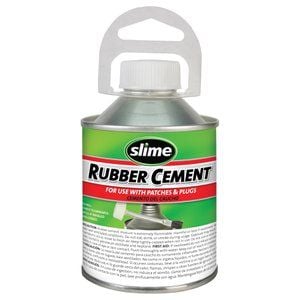
[ You can get 8oz Slime rubber cement can for $6 at Pep Boys (more than twice expensive $15 on Ebay)
[url]https://www.pepboys.com/slime-rubber-cement-8-oz-can/product/166478?quantity=1 ]
via https://cdn.shopify.com/s/files/1/22..._-_NA.pdf?1202
3 Composition/information on ingredients ·
Chemical characterization:
Mixtures · Components:
8032-32-4 Ligroine 40-60%
9003-35-4 Formaldehyde, oligomeric reaction products with phenol 10-20%
586-62-9 Terpinolene Asp. < 10%
Chemical characterization:
Mixtures · Components:
8032-32-4 Ligroine 40-60%
9003-35-4 Formaldehyde, oligomeric reaction products with phenol 10-20%
586-62-9 Terpinolene Asp. < 10%
Someone correctly pointed out, it's better to match REMA vulcanizing fluid with REMA patches (which I like, you can get 100 pack for $16 from Ebay)
I've used Elmer's Rubber Cement with varying success with REMA patches. Sometimes they seal, sometimes they don't
Last edited by chimpanzee; 10-13-19 at 01:54 AM.
10-13-19 | 06:57 AM
#83
Senior Member

Joined: Jul 2004
Posts: 8,162
Likes: 647
From: Brooklyn NY
Bikes: Kuota Kredo/Chorus, Trek 7000 commuter, Trek 8000 MTB and a few others
As mentioned somewhere in this old thread, you can buy a can of the real Rema cement and that costs $20, which may be 3 or 4 times what you pay for the other stuff, but you'll never need to buy it again. Why would you buy anything else?
I carry two spare tubes with me now on my rides, and no longer carry a patch kit. If I get a flat I repair it at home. If I get two flats on a ride, I'll make sure I get back within NYC limits where there is always the long silver limousine. The only place I go outside the limits on any regular basis is across the George Washington Bridge to NJ, and there are 3 bike shops along that route and the A train stops right at the NYC end of the bridge.
I carry two spare tubes with me now on my rides, and no longer carry a patch kit. If I get a flat I repair it at home. If I get two flats on a ride, I'll make sure I get back within NYC limits where there is always the long silver limousine. The only place I go outside the limits on any regular basis is across the George Washington Bridge to NJ, and there are 3 bike shops along that route and the A train stops right at the NYC end of the bridge.
10-17-19 | 04:37 AM
#84
Member
Joined: Apr 2008
Posts: 26
Likes: 0
In another thread, people are saying Slime Rubber Cement is a candidate
Nagging question: is "vulcanizing fluid" just plain old rubber cement?
[ You can get 8oz Slime rubber cement can for $6 at Pep Boys (more than twice expensive $15 on Ebay)
[url]https://www.pepboys.com/slime-rubber-cement-8-oz-can/product/166478?quantity=1 ]
via https://cdn.shopify.com/s/files/1/22..._-_NA.pdf?1202
The chemicals don't match the ones for Rema (see above, in BOLD RED)
Someone correctly pointed out, it's better to match REMA vulcanizing fluid with REMA patches (which I like, you can get 100 pack for $16 from Ebay)
I've used Elmer's Rubber Cement with varying success with REMA patches. Sometimes they seal, sometimes they don't
[ Can also be obtained from Pep Boys for $5.36 (20% sale), or Walmart for $5.97 ]
The patch with Elmer's rubber-cement failed for a 700c tube. I cleaned it up, & used Slime rubber cement. The instructions made no mention of allowing it to completely dry (as in REMA vulcanizing vluid), so I applied the (used) patch with cement still wet (I did allow it to dry somewhat). It seems to work..!!
I returned the Elmer's Glue to Office Depot.
I've had car tire repairs, using a patch. The tire guy used a grinder to clean the roughen the tire, applied glue (Slime, Xtra Seal, whatever..), applied patch, then used a pizza-cutter type of tool to press it in.
Last edited by chimpanzee; 10-17-19 at 04:46 AM.
10-17-19 | 04:49 AM
#85
Senior Member
Joined: Mar 2017
Posts: 531
Likes: 60
From: Williston FL
Bikes: 1988 Panasonic, 1989 Fuji, Schwinn Beach Cruiser
Salam aleikhim and alahu akhbar! What a deal, Kuran isn’t on every 7-11 shelf by the register like christian bibles are.
Ok, couldn’t resist the first heckle, I am actually Jewish.
Ok, couldn’t resist the first heckle, I am actually Jewish.
10-17-19 | 02:34 PM
#86

Senior Member
Joined: Jan 2013
Posts: 3,702
Likes: 105
From: Llano Estacado
Bikes: old clunker
BTW Islam is not evangelical like the Pharisees.
Last edited by AnkleWork; 10-17-19 at 03:49 PM.
10-17-19 | 03:34 PM
#87
Senior Member
Joined: Aug 2011
Posts: 22,676
Likes: 2,643
From: CID
Bikes: 1991 Bianchi Eros, 1964 Armstrong, 1988 Diamondback Ascent, 1988 Bianchi Premio, 1987 Bianchi Sport SX, 1980s Raleigh mixte (hers), All-City Space Horse (hers)
Finally! Maybe now this stupid thread will get locked. 
10-28-19 | 10:51 AM
#88
Full Member
Joined: Aug 2009
Posts: 202
Likes: 11
From: New York City
Not yet. I demand having the last word.
Reading about how solvents may still evaporate through even tightly sealed containers made me think about why my old bottle of Slime Rubber Cement wasn't gluing down patches as well as when I first bought it.
Believing that I've successfully patched the inside tube, I would inflate the tire to not even half the recommended air pressure and leave it like that overnight just to give the glue some more chance to cure. Next day I finished inflating it to full pressure only to find that it would hold pressure for several minutes before suddenly springing a leak soon to be revealed as coming from underneath the patch.
Anyway, thinking about Naptha and solvents, I added a little bit, not even a fluid ounce, of Coleman Camp Fuel to the Slime Rubber Cement. Maybe that's still a sizeable proportion for an 8-ounce can though. Just to be on the safe side, I put on protective eyewear and did perform this chemistry experiment outdoors. Just to be on the safe side.
Nothing exploded or burst into flames and there was no hint of any exothermic chemical reaction when I retrieved the can from outside a half-hour later.
This seems to have revived the rubber cement. When I applied the Rema patch on to the tube, the red compound on the patch started to melt after about five or maybe ten seconds of coming in contact with the glue there. I don't recall that happening this quickly with the old cement. I may be a premature in declaring success because I've yet to put this particular tube back into a tire and I've been fooled before.
I guess that this information may be useful to the tiny subset of people here who camp or bicycle tour and use a liquid-fuel stove for cooking. Everybody else may as well just buy a new can of Rema.
Reading about how solvents may still evaporate through even tightly sealed containers made me think about why my old bottle of Slime Rubber Cement wasn't gluing down patches as well as when I first bought it.
Believing that I've successfully patched the inside tube, I would inflate the tire to not even half the recommended air pressure and leave it like that overnight just to give the glue some more chance to cure. Next day I finished inflating it to full pressure only to find that it would hold pressure for several minutes before suddenly springing a leak soon to be revealed as coming from underneath the patch.
Anyway, thinking about Naptha and solvents, I added a little bit, not even a fluid ounce, of Coleman Camp Fuel to the Slime Rubber Cement. Maybe that's still a sizeable proportion for an 8-ounce can though. Just to be on the safe side, I put on protective eyewear and did perform this chemistry experiment outdoors. Just to be on the safe side.
Nothing exploded or burst into flames and there was no hint of any exothermic chemical reaction when I retrieved the can from outside a half-hour later.
This seems to have revived the rubber cement. When I applied the Rema patch on to the tube, the red compound on the patch started to melt after about five or maybe ten seconds of coming in contact with the glue there. I don't recall that happening this quickly with the old cement. I may be a premature in declaring success because I've yet to put this particular tube back into a tire and I've been fooled before.
I guess that this information may be useful to the tiny subset of people here who camp or bicycle tour and use a liquid-fuel stove for cooking. Everybody else may as well just buy a new can of Rema.
11-03-19 | 09:50 PM
#89
Junior Member
Joined: Jun 2011
Posts: 183
Likes: 20
From: MASS
Bikes: Mostly low-income, poorly maintained broken ones
Not yet. I demand having the last word.
Reading about how solvents may still evaporate through even tightly sealed containers made me think about why my old bottle of Slime Rubber Cement wasn't gluing down patches as well as when I first bought it.
Believing that I've successfully patched the inside tube, I would inflate the tire to not even half the recommended air pressure and leave it like that overnight just to give the glue some more chance to cure. Next day I finished inflating it to full pressure only to find that it would hold pressure for several minutes before suddenly springing a leak soon to be revealed as coming from underneath the patch.
Anyway, thinking about Naptha and solvents, I added a little bit, not even a fluid ounce, of Coleman Camp Fuel to the Slime Rubber Cement. Maybe that's still a sizeable proportion for an 8-ounce can though. Just to be on the safe side, I put on protective eyewear and did perform this chemistry experiment outdoors. Just to be on the safe side.
Nothing exploded or burst into flames and there was no hint of any exothermic chemical reaction when I retrieved the can from outside a half-hour later.
This seems to have revived the rubber cement. When I applied the Rema patch on to the tube, the red compound on the patch started to melt after about five or maybe ten seconds of coming in contact with the glue there. I don't recall that happening this quickly with the old cement. I may be a premature in declaring success because I've yet to put this particular tube back into a tire and I've been fooled before.
I guess that this information may be useful to the tiny subset of people here who camp or bicycle tour and use a liquid-fuel stove for cooking. Everybody else may as well just buy a new can of Rema.
Reading about how solvents may still evaporate through even tightly sealed containers made me think about why my old bottle of Slime Rubber Cement wasn't gluing down patches as well as when I first bought it.
Believing that I've successfully patched the inside tube, I would inflate the tire to not even half the recommended air pressure and leave it like that overnight just to give the glue some more chance to cure. Next day I finished inflating it to full pressure only to find that it would hold pressure for several minutes before suddenly springing a leak soon to be revealed as coming from underneath the patch.
Anyway, thinking about Naptha and solvents, I added a little bit, not even a fluid ounce, of Coleman Camp Fuel to the Slime Rubber Cement. Maybe that's still a sizeable proportion for an 8-ounce can though. Just to be on the safe side, I put on protective eyewear and did perform this chemistry experiment outdoors. Just to be on the safe side.
Nothing exploded or burst into flames and there was no hint of any exothermic chemical reaction when I retrieved the can from outside a half-hour later.
This seems to have revived the rubber cement. When I applied the Rema patch on to the tube, the red compound on the patch started to melt after about five or maybe ten seconds of coming in contact with the glue there. I don't recall that happening this quickly with the old cement. I may be a premature in declaring success because I've yet to put this particular tube back into a tire and I've been fooled before.
I guess that this information may be useful to the tiny subset of people here who camp or bicycle tour and use a liquid-fuel stove for cooking. Everybody else may as well just buy a new can of Rema.
Make sure the cement is dry (2-4 minutes) before you remove the backing on the patch and apply it over the puncture firmly.
The times these patch jobs failed to hold was either very old "paste" cement or it was one of the tubes that feel very slick, almost like plastic, and which require applying, drying and removing cement and then reapplying it for them to hold.
Note also that there are different kinds of leaks (at least among the street kids): puncture leaks, then pinch flats (usually from failed "bunny hops") which are horizontal and tend to come in pairs on opposite sides, then abrasion flats (from worn out tires, often from "drifting"), and the most rare, that of the stem.
Your mix of a little Coleman Camp Fuel, a mixture of cyclohexane, nonane, octane, heptane, and pentane, to old cement is interesting.

Thread
Thread Starter
Forum
Replies
Last Post
wroomwroomoops
Bicycle Mechanics
38
06-07-10 01:52 PM
