


Fork materials
 01-12-13 | 06:22 PM
#26

Constant tinkerer
Joined: May 2010
Posts: 8,040
Likes: 156
From: Madison, WI
 01-12-13 | 07:12 PM
#27

Domestic Domestique
Joined: Dec 2007
Posts: 1,742
Likes: 6
From: Michigan
Bikes: Brand New Old Catamount! Schwinn Homegrown, Specialized FSR, Salsa Vaya, Salsa Chile Con Crosso
The Trek STP 400 was Treks go at a carbon soft tail mountain bike. The idea of a soft tail is that rear of the bike has a shock but no hinging point. It uses the flex of the frame material to actuate the shock. Trek used the flex of carbon fiber chain stays to actuate their suspension. While I don't know the exact specs, one would have to assume this design is going to see more cycles and more flex than a typical road bike fork.
01-12-13 | 07:15 PM
#28
Senior Member
Joined: Aug 2005
Posts: 33,657
Likes: 1,119
From: Pittsburgh, PA
Bikes: '96 Litespeed Catalyst, '05 Litespeed Firenze, '06 Litespeed Tuscany, '20 Surly Midnight Special, All are 3x10. It is hilly around here!
The first light weight cast wheels were indeed magnesium alloy (the metal was mostly magnesium with small amounts of alloying elements) due to it's light weight but the high cost made them unattractive for wider use so cast or forged aluminum alloy replace magnesium as the metal of choice. However, the name "Mag" stuck even when applied to wheels made of other metals.
01-12-13 | 08:49 PM
#29

Senior Member
Joined: Aug 2011
Posts: 3,141
Likes: 84
The first light weight cast wheels were indeed magnesium alloy (the metal was mostly magnesium with small amounts of alloying elements) due to it's light weight but the high cost made them unattractive for wider use so cast or forged aluminum alloy replace magnesium as the metal of choice. However, the name "Mag" stuck even when applied to wheels made of other metals.
01-12-13 | 09:22 PM
#30
Senior Member
Joined: Aug 2005
Posts: 33,657
Likes: 1,119
From: Pittsburgh, PA
Bikes: '96 Litespeed Catalyst, '05 Litespeed Firenze, '06 Litespeed Tuscany, '20 Surly Midnight Special, All are 3x10. It is hilly around here!
 I remember a friend in 1964 who had Craegar "Mags" on his brand new '64 Vette and they were already aluminum. By then, true magnesium Mags were pretty much limited to competition cars.
01-13-13 | 09:29 AM
I remember a friend in 1964 who had Craegar "Mags" on his brand new '64 Vette and they were already aluminum. By then, true magnesium Mags were pretty much limited to competition cars.
01-13-13 | 09:29 AM
#31
Thread Starter
Senior Member
Joined: Nov 2009
Posts: 589
Likes: 0
They don't actually fail like an icicle - ice is brittle and shatters by fast crack growth, carbon-fibre reinforced plastics (to give their full name) are fairly resistant to crack growth. The issue with carbon forks is that a metal part will likely give some indication that it's going to fail, often in the form of a visible crack or some sort of ductile deformation, while potential failures in carbon components aren't always as easy to spot.
I don't think it's fair.. a suggestion.. to bring brand names into the discussion. NOT wanting to give anyone some idea one brand is more suspect than another. Who knows.. or could accurately prove that anyway.. especially by online "data".
I already decided prior to this thread not to ride carbon forks. I am now in the situation on one build that a potential buyer WANTS a carbon fork. Of course one online source known for good deals has one. I'm not inclined to mount one.. but decided to have a much harder objective look at them.
Understand well.. not at all.. what's the right wording.. judging anyone's choice of fork material. I did purchase a near new brand name fork online.. frankly I was impressed with it's construction.. had a serial number on it too. But the threaded alloy steer tube was a might short though. A no go for the bike in question... that kind of buy comes along rarely I think.. quality, low useage and cost.
Amen to the comments per all the fork recalls. I get to the LBS rarely... and I've seen two notices per fork recalls. My cynical personal comments per modern QC go to those events... and while yes QC in some areas today are superior.. just as many 'shops' are 'get it out the door' operations. Nuff whining on that... by me anyway.
I do ride a little used aluminum fork.. that bike spent all it's time prior to my purchase in a garage. I can see no real difference to it and the steel one on a near identical steel framed MTB... except of course the M700 weighs about 9 lbs less. But from what I can determine looking around.. aluminum gives notice to failure.. and the likelihood your on your face in an instant is very low odds. IF you can find different.. I for one would like to hear that.
Purely opine of mine.
The aftermarket no name forks.. are not worth the risk. Their might well be decent people making them.. but their lower cost means the manufacturing corners get rounded off.. ie: again 'get them out.. piece counts'. Find yourself injured.. who pays? NOT the marketing company that sold it.. that is for sure. Like I discovered.. one I found didn't even have the kahoona's to admit this. Price means nothing given the nature/importance of a fork's integrity. Younger people.. like me yrs back too.. seemingly IMO are taking unnecessary risks ...to save what? Yes anything has risk.. but again IMO... there's little protection/insurance.. piece of mind riding no name mass produced bike forks. END.

Am looking for a steel or new/near new al fork (brand name).. 8.5"--+.. 1" threaded steer tube. Lighter.. better. PM me if you wish.
01-13-13 | 10:19 AM
#32

Senior Member

Joined: Feb 2008
Posts: 2,149
Likes: 76
From: Arlington, VA USA
t.
Purely opine of mine.
The aftermarket no name forks.. are not worth the risk. Their might well be decent people making them.. but their lower cost means the manufacturing corners get rounded off.. ie: again 'get them out.. piece counts'. Find yourself injured.. who pays? NOT the marketing company that sold it.. that is for sure. Like I discovered.. one I found didn't even have the kahoona's to admit this. Price means nothing given the nature/importance of a fork's integrity. Younger people.. like me yrs back too.. seemingly IMO are taking unnecessary risks ...to save what? Yes anything has risk.. but again IMO... there's little protection/insurance.. piece of mind riding no name mass produced bike forks. END.
Purely opine of mine.
The aftermarket no name forks.. are not worth the risk. Their might well be decent people making them.. but their lower cost means the manufacturing corners get rounded off.. ie: again 'get them out.. piece counts'. Find yourself injured.. who pays? NOT the marketing company that sold it.. that is for sure. Like I discovered.. one I found didn't even have the kahoona's to admit this. Price means nothing given the nature/importance of a fork's integrity. Younger people.. like me yrs back too.. seemingly IMO are taking unnecessary risks ...to save what? Yes anything has risk.. but again IMO... there's little protection/insurance.. piece of mind riding no name mass produced bike forks. END.
Frankly, my anecdotal experience suggests that its just as plausible that we are at greater risk from metal failure than from carbon failure. I have had various pieces of bikes fail -- a steel chain stay on a Jamis frame cracked at weld (Jamis gave me warranty replacement frame), a Trek alu mountain bike frame cracked in middle of the downtube (I was not original owner so no warranty), and I had alu flange of a shimano hub crack. So metal stuff from big, reliable makers fails. So far I have not had any carbon components fail, but I certainly believe they do too, but for me, at a lower rate than carbon stuff . My anecdotal experience does not valid data make so is no more meaningful from a data analysis standpoint that your concerns about carbon, and at end of day you could be right about your carbon concerns.
I will lastly note that I actually take comfort in recalls I am aware of (Felt, Specialized) rather than view them as indicator of greater likelihood of failure; to me voluntary recalls mean companies are paying attention to quality (and recalls are cheaper than risk of litigation). I suspect recalls are based on the company's quantitative assessment that some specific lots of their production runs don't meet whatever failure standard they have set. So they are taking steps to ensure things get pulled at early sign of any issue even if the chance that an owner of that specific component actually experiences a failure remains very low -- albeit higher than for components that meet the company standard.
01-13-13 | 10:20 AM
#33
Senior Member
Joined: Oct 2009
Posts: 1,921
Likes: 5
From: England, currently dividing my time between university in Guildford and home just outside Reading
Bikes: Too many to list here!
That is what I thought too.. after seeing a golf shaft shattered by much intentional abuse yrs ago. I hung the icicle label on due to a couple online reports of bikes going down the rd and the carbon blade just snapped off. One instant your riding.. the next the guy woke in the ER.
01-13-13 | 11:30 AM
#34
Thread Starter
Senior Member
Joined: Nov 2009
Posts: 589
Likes: 0
Well, the blade didn't "just" snap off - the carbon would almost certainly have been failing for some time. It's just that the imminent failure wasn't obvious like it probably would've been on a metal fork. Fibre-reinforced composites are generally very good at dealing with cracks.
I'd certainly agree. Yet in the instance/s I've read per those blade failures... no performance issue was felt.. ie: front wheel felt normal riding. But who knows on that count...
Would think... metal blades would bend before separating.. [?]... some handling issue would show.
01-13-13 | 11:49 AM
#35
Thread Starter
Senior Member
Joined: Nov 2009
Posts: 589
Likes: 0
You should certainly ride what you feel safe on, but I havent seen any reason in this thread or anywhere else to feel that any material is more or less likely to fail. I will say that your estimation of risk is almost certainly not accurate from a quantitative standpoint. Risk in this case is simply a function of number of items sold and incidences of catastrophic failure. Given shear numbers of items available in market, the risk that you will come to own a component that fails catastrophically is without doubt very low (I would guess some fraction less than a 1/10 of 1% of components will fail but thats a guess). That said, risk is certainly not zero, and any part of risk calculus is always the potential impact of failure even if risk is low; and indeed potential impact of a failed steerer or fork is high. So if you fear it, you won't feel comfortable riding so wont ride. So I would not presume to try and convince you to ride carbon stuff. Hell, I tend to steer clear of carbon components that require other components be clamped to them (seatposts and steerers) because I fear I will damage them by over-tightening clamps -- but thats more a reflection of my lack of confidence in my competence than in the component itself.
Frankly, my anecdotal experience suggests that its just as plausible that we are at greater risk from metal failure than from carbon failure. I have had various pieces of bikes fail -- a steel chain stay on a Jamis frame cracked at weld (Jamis gave me warranty replacement frame), a Trek alu mountain bike frame cracked in middle of the downtube (I was not original owner so no warranty), and I had alu flange of a shimano hub crack. So metal stuff from big, reliable makers fails. So far I have not had any carbon components fail, but I certainly believe they do too, but for me, at a lower rate than carbon stuff . My anecdotal experience does not valid data make so is no more meaningful from a data analysis standpoint that your concerns about carbon, and at end of day you could be right about your carbon concerns.
I will lastly note that I actually take comfort in recalls I am aware of (Felt, Specialized) rather than view them as indicator of greater likelihood of failure; to me voluntary recalls mean companies are paying attention to quality (and recalls are cheaper than risk of litigation). I suspect recalls are based on the company's quantitative assessment that some specific lots of their production runs don't meet whatever failure standard they have set. So they are taking steps to ensure things get pulled at early sign of any issue even if the chance that an owner of that specific component actually experiences a failure remains very low -- albeit higher than for components that meet the company standard.
Frankly, my anecdotal experience suggests that its just as plausible that we are at greater risk from metal failure than from carbon failure. I have had various pieces of bikes fail -- a steel chain stay on a Jamis frame cracked at weld (Jamis gave me warranty replacement frame), a Trek alu mountain bike frame cracked in middle of the downtube (I was not original owner so no warranty), and I had alu flange of a shimano hub crack. So metal stuff from big, reliable makers fails. So far I have not had any carbon components fail, but I certainly believe they do too, but for me, at a lower rate than carbon stuff . My anecdotal experience does not valid data make so is no more meaningful from a data analysis standpoint that your concerns about carbon, and at end of day you could be right about your carbon concerns.
I will lastly note that I actually take comfort in recalls I am aware of (Felt, Specialized) rather than view them as indicator of greater likelihood of failure; to me voluntary recalls mean companies are paying attention to quality (and recalls are cheaper than risk of litigation). I suspect recalls are based on the company's quantitative assessment that some specific lots of their production runs don't meet whatever failure standard they have set. So they are taking steps to ensure things get pulled at early sign of any issue even if the chance that an owner of that specific component actually experiences a failure remains very low -- albeit higher than for components that meet the company standard.
This cynic writing now.. views those voluntary recalls in another light. These marketing companies are all about bottom line.. the legal dept simply pulls the cord and they recall. Some of this is covering their liability.. doubt a large percentage of those actually get replaced. Be interested on that count. But QC must be in place on forks prior to selling. Might well be a human element with 'doing what is right' also.. going to brand name integrity.
FBinNY said it.. I don't want to worrying about bike issues riding either. Considering the issue makes me redouble my 'taking a break' inspections. I make myself get off the bike more often now and enjoy the day.. etc.. more reflective... and going over the bike. This thread for me puts the fork issue in a much more informed light. Thanks to all who contributed.
01-13-13 | 11:50 AM
#36
Senior Member
Joined: Aug 2011
Posts: 3,141
Likes: 84
Once broke a steel motorcycle frame. JRA, all of a sudden the rear end felt vague and bouncy. No warning. Heavy steel, blah, blah, blah. Obviously, I will never trust that dangerous material with my life again.
01-13-13 | 03:34 PM
#37
Senior Member
Joined: Oct 2009
Posts: 1,921
Likes: 5
From: England, currently dividing my time between university in Guildford and home just outside Reading
Bikes: Too many to list here!
I'd certainly agree. Yet in the instance/s I've read per those blade failures... no performance issue was felt.. ie: front wheel felt normal riding. But who knows on that count...
Would think... metal blades would bend before separating.. [?]... some handling issue would show.
Would think... metal blades would bend before separating.. [?]... some handling issue would show.
01-13-13 | 03:36 PM
#38

S'Cruzer
Joined: Jun 2010
Posts: 2,445
Likes: 19
From: 122W 37N
Bikes: too many
but, broken, it just felt bouncy, it didn't drop your butt on the road at speed, no?
01-13-13 | 03:57 PM
#39

Senior Member
Joined: Dec 2010
Posts: 8,951
Likes: 14
I have a vivid memory from when I was a kid riding in the '56 Chevy with my dad and the right lower A-arm broke. We were traveling maybe 50 mph. He swerved around a bit pulling onto shoulder. The front tire and wheel was folded out horizontally. You might say that's not surprising for a car that old, but it was only 4 years old when it happened.
01-13-13 | 04:18 PM
#40
Senior Member
Joined: Aug 2011
Posts: 3,141
Likes: 84
And let us not forget that steel is proven to be the weakest of frame materials.
https://sheldonbrown.com/rinard/EFBe/...tigue_test.htm
01-13-13 | 07:38 PM
#41

Senior Member
Joined: Nov 2010
Posts: 22,994
Likes: 10,496
From: Sacramento, CA
Bikes: old ones
And let us not forget that steel is proven to be the weakest of frame materials.
https://sheldonbrown.com/rinard/EFBe/...tigue_test.htm
 01-13-13 | 07:56 PM
#42
Senior Member
Joined: Aug 2011
Posts: 3,141
Likes: 84
Hold on. The closest thing to an empirical test that anyone has ever done, and published. Carbon was in its infancy. The people doing the test were expecting steel to do well. And steel completely shat the bed. As in not even close. You can feel free to dismiss it. I tend to think that it shows that steel is not the ideal material for lightweight, racing bikes. But hey, until someone else does another empiricalish test, (maybe in another 15 years) it's the best we got...
01-13-13 | 08:23 PM
#43
Senior Member
Joined: Nov 2010
Posts: 22,994
Likes: 10,496
From: Sacramento, CA
Bikes: old ones
There were, at last count, about three thousand threads on this topic......
..........................here is one:
https://www.bikeforums.net/showthread...frame+material
Read it, and you can pretend that every other posting is me arguing with you, if you want to.
Let's cut to the end of the chase: someone who gives a **** can make a pretty good, durable bike
out of any of the commonly used frame materials. Conversely, someone who does not give a ****
can turn out one that will fail, and even some of the better ones can fail in the right circumstances.
Don't you think that if the answer were that simple it would be more widely publicized ?
I smell a conspiracy that leads directly back to Andrew Carnegie and the Illuminati.
https://www.bikeforums.net/showthread...frame+material
Read it, and you can pretend that every other posting is me arguing with you, if you want to.
Let's cut to the end of the chase: someone who gives a **** can make a pretty good, durable bike
out of any of the commonly used frame materials. Conversely, someone who does not give a ****
can turn out one that will fail, and even some of the better ones can fail in the right circumstances.
Don't you think that if the answer were that simple it would be more widely publicized ?
I smell a conspiracy that leads directly back to Andrew Carnegie and the Illuminati.
01-13-13 | 08:30 PM
#44
Senior Member
Joined: Nov 2010
Posts: 22,994
Likes: 10,496
From: Sacramento, CA
Bikes: old ones
[h=1]METALLURGY FOR CYCLISTS[/h]
01-13-13 | 08:34 PM
#45
Banned
Joined: Jun 2010
Posts: 43,586
Likes: 1,380
From: NW,Oregon Coast
Bikes: 8
Thing about carbon fiber bikes, the pros only use them for. maybe, a couple weeks, then replace them.
like aircraft flight logs document hours of service ,the the replacements all have scheduled time to replace them..
like aircraft flight logs document hours of service ,the the replacements all have scheduled time to replace them..
01-13-13 | 08:58 PM
#46


Decrepit Member
Joined: Aug 2005
Posts: 10,488
Likes: 92
From: Santa Rosa, California
Bikes: Waterford 953 RS-22, several Paramounts
If it had been backbone or downtube the results may have been different. If I had been accelerating hard out of a tight corner they almost certainly would have. All materials can break. With little or no warning.
And let us not forget that steel is proven to be the weakest of frame materials.
https://sheldonbrown.com/rinard/EFBe/...tigue_test.htm
And let us not forget that steel is proven to be the weakest of frame materials.
https://sheldonbrown.com/rinard/EFBe/...tigue_test.htm
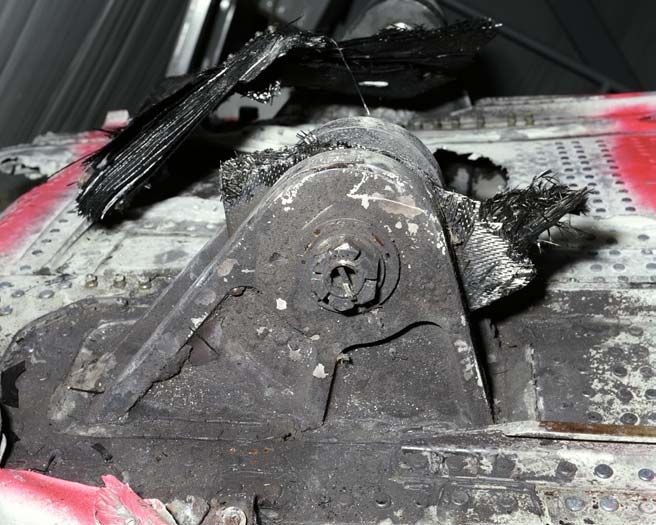
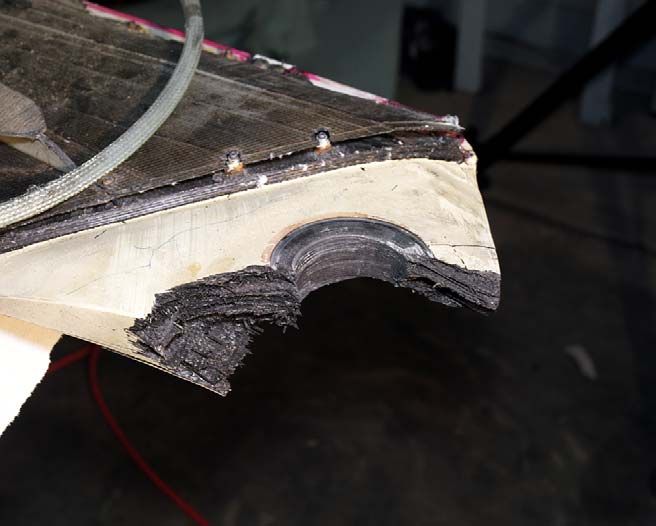
Here are post-mortem photographs of the CFRP vertical stabilizer attachment lugs of the scarebus, er... Airbus 300 equipment used for American Airlines Flight 587. The vertical stabilizer spar attachment lugs, which separated from the airframe in flight resulting in the loss of 260 passengers and crew members and 5 people on the ground, simply snapped because the aerodynamic loading on the rudder exceeded the design stress of the spar to lug attachment. Because of the low elongation of CFRP, the failure mode of CFRP structures is sudden and catastrophic. Would a Boeing airframe billet aluminum vertical stabilizer spar to airframe attachment have failed under similar loading? It might have deformed (bent), but it is highly unlikely that it would have failed so catastrophically.
 01-13-13 | 09:13 PM
#47
Senior Member
Joined: Aug 2011
Posts: 3,141
Likes: 84
Can we please get past this discredited test and get to the crux of the failure mode of CFRP structures?
Here are post-mortem photographs of the CFRP vertical stabilizer attachment lugs of the scarebus, er... Airbus 300 equipment used for American Airlines Flight 587. The vertical stabilizer spar attachment lugs, which separated from the airframe in flight resulting in the loss of 260 passengers and crew members and 5 people on the ground, simply snapped because the aerodynamic loading on the rudder exceeded the design stress of the spar to lug attachment. Because of the low elongation of CFRP, the failure mode of CFRP structures is sudden and catastrophic. Would a Boeing airframe billet aluminum vertical stabilizer spar to airframe attachment have failed under similar loading? It might have deformed (bent), but it is highly unlikely that it would have failed so catastrophically.
Here are post-mortem photographs of the CFRP vertical stabilizer attachment lugs of the scarebus, er... Airbus 300 equipment used for American Airlines Flight 587. The vertical stabilizer spar attachment lugs, which separated from the airframe in flight resulting in the loss of 260 passengers and crew members and 5 people on the ground, simply snapped because the aerodynamic loading on the rudder exceeded the design stress of the spar to lug attachment. Because of the low elongation of CFRP, the failure mode of CFRP structures is sudden and catastrophic. Would a Boeing airframe billet aluminum vertical stabilizer spar to airframe attachment have failed under similar loading? It might have deformed (bent), but it is highly unlikely that it would have failed so catastrophically.
01-13-13 | 09:30 PM
#48
Senior Member
Joined: Nov 2010
Posts: 22,994
Likes: 10,496
From: Sacramento, CA
Bikes: old ones
Holy shnikes, now you are an imaginary expert in airframe engineering. And you quote an article that didn't even bother to do a real experiment, but just spouted a bunch of nonsense and offered that as proof, that the German test, was actually proof that the frames that failed, were in reality stronger. For the record, I ride an aluminum frame. I think steel is capable of being formed into perfectly fine frames, although at a significant weight disadvantage for the same strength to CF and Al. But the imaginary, only on the interwebs nonsense, that posits that steel is in some way stronger than the other common materials for building bikes, is flat out laughable.
came to us direct from the air and space industries.(Reynolds 531,
Titanium tubing, most of the early composite research, etc.)
For obvious reasons, they, too, are very interested in strength to
weight ratios and avoidance of catastrophic failures. They also have
considerably more cash to throw around in terms of systematic testing
and design of these materials, as well as greater resources in logging
and investigating failures.
One begins to suspect that your interest here is less benign than I first assumed.
If you really are interested in the materials science involved in this, I'd suggest
that you embrace a willingness to go beyond the bicycle only literature, amigo.
Edit: OK, in the interests of understanding, I just pulled up some of your recent posts.
You're a ****ing Strava roadie, for god's sake.....can you say'"agenda?"

Last edited by 3alarmer; 01-13-13 at 09:37 PM.
01-13-13 | 09:34 PM
#49

Senior Member


Joined: Jul 2005
Posts: 7,571
Likes: 223
 01-13-13 | 09:57 PM
#50
Senior Member
Joined: Aug 2011
Posts: 3,141
Likes: 84
Actually, most of the more recently popular bicycle frame materials
came to us direct from the air and space industries.(Reynolds 531,
Titanium tubing, most of the early composite research, etc.)
For obvious reasons, they, too, are very interested in strength to
weight ratios and avoidance of catastrophic failures. They also have
considerably more cash to throw around in terms of systematic testing
and design of these materials, as well as greater resources in logging
and investigating failures.
One begins to suspect that your interest here is less benign than I first assumed.
If you really are interested in the materials science involved in this, I'd suggest
that you embrace a willingness to go beyond the bicycle only literature, amigo.
Edit: OK, in the interests of understanding, I just pulled up some of your recent posts.
You're a ****ing Strava roadie, for god's sake.....can you say'"agenda?"
came to us direct from the air and space industries.(Reynolds 531,
Titanium tubing, most of the early composite research, etc.)
For obvious reasons, they, too, are very interested in strength to
weight ratios and avoidance of catastrophic failures. They also have
considerably more cash to throw around in terms of systematic testing
and design of these materials, as well as greater resources in logging
and investigating failures.
One begins to suspect that your interest here is less benign than I first assumed.
If you really are interested in the materials science involved in this, I'd suggest
that you embrace a willingness to go beyond the bicycle only literature, amigo.
Edit: OK, in the interests of understanding, I just pulled up some of your recent posts.
You're a ****ing Strava roadie, for god's sake.....can you say'"agenda?"