


Identifying old (italian?) frame
 07-24-16 | 12:44 AM
#1
Thread Starter
Junior Member
Joined: Jul 2016
Posts: 15
Likes: 0
Identifying old (italian?) frame
Hello everyone,
I recently bought an older road bike frame and I'm having trouble identifying it. The guy I bought it from said it's italian, but i have no evidence on that. Special things: the serial number is located on the bottom lug of the headtube, it has a cycle pump rack, it has a little hole on top of the bottom bracket. There's no special drain hole and i can't find any others signs as to what make it could be. Anyone who knows anything?
Pictures below:
foto 1.jpg
foto 2.jpg
foto 3.jpg
foto 4.jpg
foto 5.jpg
I recently bought an older road bike frame and I'm having trouble identifying it. The guy I bought it from said it's italian, but i have no evidence on that. Special things: the serial number is located on the bottom lug of the headtube, it has a cycle pump rack, it has a little hole on top of the bottom bracket. There's no special drain hole and i can't find any others signs as to what make it could be. Anyone who knows anything?
Pictures below:
foto 1.jpg
foto 2.jpg
foto 3.jpg
foto 4.jpg
foto 5.jpg
 07-24-16 | 01:27 AM
#2
Senior Member
Joined: May 2011
Posts: 3,780
Likes: 17
From: Upstate NY
Bikes: Bianchi San Mateo and a few others
There are guys here with WAY more knowledge than me, but I'll contribute the little I know...
The seatpost binder bolt being placed at the front of the seat cluster is an uncommon arrangement. I don't know who else might've built bikes with that detail, but Bianchi did it in the 1940s and maybe into the early '50s. The pump pegs on the back of the seat tube are also similar to what you might find on some Bianchis of that period.
The hole on the top side of the bottom bracket shell is an oil port. I don't know exactly when those went the way of the dodo, but they were common on bikes built before the 1960s.
What's the size/threading of the bottom bracket? Is it Italian, perchance? (36 mm by 24 tpi, right hand threading on both sides of the frame)
The seatpost binder bolt being placed at the front of the seat cluster is an uncommon arrangement. I don't know who else might've built bikes with that detail, but Bianchi did it in the 1940s and maybe into the early '50s. The pump pegs on the back of the seat tube are also similar to what you might find on some Bianchis of that period.
The hole on the top side of the bottom bracket shell is an oil port. I don't know exactly when those went the way of the dodo, but they were common on bikes built before the 1960s.
What's the size/threading of the bottom bracket? Is it Italian, perchance? (36 mm by 24 tpi, right hand threading on both sides of the frame)
07-24-16 | 06:14 AM
#3

Senior Member

Joined: Feb 2013
Posts: 15,369
Likes: 4,393
From: Alta California
In closeup of fork crown blades appear as if they may be round. Are they round or oval?
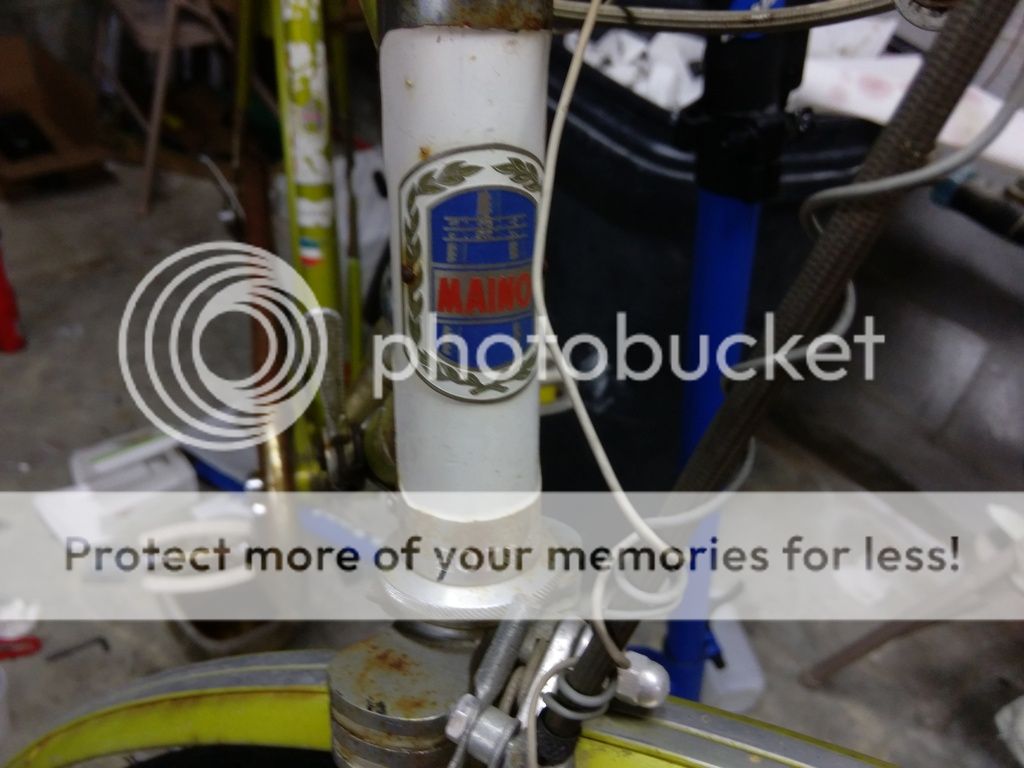
Serial number on lower head lug is something which was also done by Bianchi, but a placement employed by other manufacturers as well such as this Maino:
Frame appears to have internal cable routing for rear brake. Is this correct?
The detail photos are helpful. One we do not see is the head.
Fixed cup appears to be Magistroni, perhaps L. Senior or Zenith.
Seat lug looks to be Agrati "SPORT" pattern. Are head lugs this pattern as well?
Dropouts with point at rear are Agrati item nr. 025.8002 and normally found on juvenile models.
Serial number on lower head lug is something which was also done by Bianchi, but a placement employed by other manufacturers as well such as this Maino:
Frame appears to have internal cable routing for rear brake. Is this correct?
The detail photos are helpful. One we do not see is the head.
Fixed cup appears to be Magistroni, perhaps L. Senior or Zenith.
Seat lug looks to be Agrati "SPORT" pattern. Are head lugs this pattern as well?
Dropouts with point at rear are Agrati item nr. 025.8002 and normally found on juvenile models.
07-25-16 | 12:49 AM
#4
Thread Starter
Junior Member
Joined: Jul 2016
Posts: 15
Likes: 0
Wow, you guys are really helpful! Thanks so far. The fork blades are oval, not round. And yes, it has internal cable routing to the rear.
So what you both are implying so far is, that it might be an old bianchi?
Here comes some more photos:
foto 3.jpg
foto 1.jpg
foto 2.jpg
foto z.jpg
I'll get back with the measures of the bb later
So what you both are implying so far is, that it might be an old bianchi?
Here comes some more photos:
foto 3.jpg
foto 1.jpg
foto 2.jpg
foto z.jpg
I'll get back with the measures of the bb later
07-25-16 | 02:56 AM
#5
Senior Member
Joined: Feb 2013
Posts: 15,369
Likes: 4,393
From: Alta California
Thank you for these additional images.
The second new picture shows the head to be bulge-formed (one-piece). It is made by Agrati and is a pattern called "SPORT" which has the part nr. 000.8056. The seat lug bare, without any form of binder, is also Agrati "SPORT" series and is item nr. 023.8059. Fork ends, while not shown, are likely Agrati nr. 000.8010. Bottom bracket shell looks to be Agrati "SPORT" pattern as well but is not depicted in the catalogue I have. The "SPORT" framebuilding set as a group is item nr. 000.8050/U.
Seat binder arrangement does not make frame a Bianchi. Other manufacturers used this arrangement as well.
Bottom bracket shell will have a width of 70mm and be threaded 36mm X 24TPI.
One variable not as yet mentioned which may potentially advance an identification is serial number format. You mentioned it is located on lower head. If able to post a photo its format may tweak a reader's memory. As to the suggestion of Bianchi-ness the forum has a well established discussion thread on the subject of Bianchi serial numbers you may wish to explore:
https://www.bikeforums.net/classic-vi...ification.html
Through the years the company placed their serials all over the frame. Some spots have included front of seat lug, back of seat lug, upper head lug, lower head lug, bottom bracket shell, dropout, head tube itself, etc.
The second new picture shows the head to be bulge-formed (one-piece). It is made by Agrati and is a pattern called "SPORT" which has the part nr. 000.8056. The seat lug bare, without any form of binder, is also Agrati "SPORT" series and is item nr. 023.8059. Fork ends, while not shown, are likely Agrati nr. 000.8010. Bottom bracket shell looks to be Agrati "SPORT" pattern as well but is not depicted in the catalogue I have. The "SPORT" framebuilding set as a group is item nr. 000.8050/U.
Seat binder arrangement does not make frame a Bianchi. Other manufacturers used this arrangement as well.
Bottom bracket shell will have a width of 70mm and be threaded 36mm X 24TPI.
One variable not as yet mentioned which may potentially advance an identification is serial number format. You mentioned it is located on lower head. If able to post a photo its format may tweak a reader's memory. As to the suggestion of Bianchi-ness the forum has a well established discussion thread on the subject of Bianchi serial numbers you may wish to explore:
https://www.bikeforums.net/classic-vi...ification.html
Through the years the company placed their serials all over the frame. Some spots have included front of seat lug, back of seat lug, upper head lug, lower head lug, bottom bracket shell, dropout, head tube itself, etc.
Last edited by juvela; 07-25-16 at 05:32 AM. Reason: addition
07-25-16 | 05:53 AM
#6
Thread Starter
Junior Member
Joined: Jul 2016
Posts: 15
Likes: 0
I actually thought i posted a photo of the serial number. Well, here it is  It says "A29006"
foto 5.jpg
It says "A29006"foto 5.jpg
07-25-16 | 02:05 PM
#7
Senior Member
Joined: Feb 2013
Posts: 15,369
Likes: 4,393
From: Alta California
Thank you for this additional picture.
Can see nothing about the frame to rule in or out a Bianchi identity.
It is always possible that the letter A is present because the name of the bicycle begins with that letter.
Suggestion: In your post at the Bianchi serial number thread you may wish to add a link back to this thread so that readers there are able to view all of the images you have posted. Possible one of the Bianchi experts there will see a detail to rule the identity in or out.
Can see nothing about the frame to rule in or out a Bianchi identity.
It is always possible that the letter A is present because the name of the bicycle begins with that letter.
Suggestion: In your post at the Bianchi serial number thread you may wish to add a link back to this thread so that readers there are able to view all of the images you have posted. Possible one of the Bianchi experts there will see a detail to rule the identity in or out.
07-27-16 | 06:18 AM
#8
Senior Member

Joined: Nov 2004
Posts: 23,212
Likes: 3,123
If the frame is actually 1974, as stated in another thread, then the chances of it being Bianchi are remote. The serial number format and location are incorrect and Bianchi had moved the cinch bolt to behind the seat lug.
While this location was used by Bianchi in the 1940s and 1950s, all the samples I've seen have used the flared head tube for the integrated headsets.
While this location was used by Bianchi in the 1940s and 1950s, all the samples I've seen have used the flared head tube for the integrated headsets.
07-27-16 | 06:59 PM
#11

Senior Member

Joined: Jun 2006
Posts: 12,921
Likes: 5,494
From: NW Burbs, Chicago
I am not certain of the brand, but I am fairly certain you have an Italian Sport bike. They were made by all the major manufacturers, and many or the minor manufacturers. Typically a straight gauge tubing, they had upright bars, sometimes condorino style. They usually had a single chainring with a 3-5 speed rear, depending on its age. Internal cable routing and pump pegs were also standard on a Sport bike.
The pump pegs behind the seat tube is a good clue. Bianchi had them. Bianchi also had the seat binder bolt on top. And the seat stay attachment says Bianchi. But without an integrated headset, I don't think it is a Bianchi. Also, the lugs aren't screaming Bianchi to me either.
Back to the pump pegs. Behind the seat tube placement ended by the mid 50s. I'm fairly certain it is post war, but I am not certain. My best guess would be right around 1950. But it could be as early as the mid 30s.
Try cruising Paulo's site for an ID. With some time, you can probably find a match.
Bici Classiche
The pump pegs behind the seat tube is a good clue. Bianchi had them. Bianchi also had the seat binder bolt on top. And the seat stay attachment says Bianchi. But without an integrated headset, I don't think it is a Bianchi. Also, the lugs aren't screaming Bianchi to me either.
Back to the pump pegs. Behind the seat tube placement ended by the mid 50s. I'm fairly certain it is post war, but I am not certain. My best guess would be right around 1950. But it could be as early as the mid 30s.
Try cruising Paulo's site for an ID. With some time, you can probably find a match.
Bici Classiche
07-28-16 | 06:05 AM
#12
Thread Starter
Junior Member
Joined: Jul 2016
Posts: 15
Likes: 0
I am not certain of the brand, but I am fairly certain you have an Italian Sport bike. They were made by all the major manufacturers, and many or the minor manufacturers. Typically a straight gauge tubing, they had upright bars, sometimes condorino style. They usually had a single chainring with a 3-5 speed rear, depending on its age. Internal cable routing and pump pegs were also standard on a Sport bike.
The pump pegs behind the seat tube is a good clue. Bianchi had them. Bianchi also had the seat binder bolt on top. And the seat stay attachment says Bianchi. But without an integrated headset, I don't think it is a Bianchi. Also, the lugs aren't screaming Bianchi to me either.
Back to the pump pegs. Behind the seat tube placement ended by the mid 50s. I'm fairly certain it is post war, but I am not certain. My best guess would be right around 1950. But it could be as early as the mid 30s.
Try cruising Paulo's site for an ID. With some time, you can probably find a match.
Bici Classiche
The pump pegs behind the seat tube is a good clue. Bianchi had them. Bianchi also had the seat binder bolt on top. And the seat stay attachment says Bianchi. But without an integrated headset, I don't think it is a Bianchi. Also, the lugs aren't screaming Bianchi to me either.
Back to the pump pegs. Behind the seat tube placement ended by the mid 50s. I'm fairly certain it is post war, but I am not certain. My best guess would be right around 1950. But it could be as early as the mid 30s.
Try cruising Paulo's site for an ID. With some time, you can probably find a match.
Bici Classiche
a specific type of bike? And paulo's site is that bibi classiche?
07-28-16 | 11:54 AM
#13
Senior Member
Joined: Jun 2006
Posts: 12,921
Likes: 5,494
From: NW Burbs, Chicago
As I wrote, a Sport bike has a straight-gauge tubing frame, upright bars, pump pegs, internal cable routing, mostly a single ring up front and a 3-5 speed in the rear. In other words, your bike.
It is not a road bike, it is not a city bike. Consider it an Italian hybrid from 1935-1965. I'd put yours in the middle, 1950-ish.
Yes, bici classiche is Paulo's site. I'd bet you could find a bike their that matches the details of your bike if you want to put in the time.
This was my Bianchi Sport bike.
 Bianchi Sport 099 by iabisdb, on Flickr
This was my Frejus Sport bike. The original owner changed the upright bars to drop bars.
 1948 Frejus 004 by iabisdb, on Flickr
It is not a road bike, it is not a city bike. Consider it an Italian hybrid from 1935-1965. I'd put yours in the middle, 1950-ish.
Yes, bici classiche is Paulo's site. I'd bet you could find a bike their that matches the details of your bike if you want to put in the time.
This was my Bianchi Sport bike.
Bianchi Sport 099 by iabisdb, on FlickrThis was my Frejus Sport bike. The original owner changed the upright bars to drop bars.
1948 Frejus 004 by iabisdb, on Flickr
 08-05-16 | 08:13 AM
#16


I am not certain of the brand, but I am fairly certain you have an Italian Sport bike. They were made by all the major manufacturers, and many or the minor manufacturers. Typically a straight gauge tubing, they had upright bars, sometimes condorino style. They usually had a single chainring with a 3-5 speed rear, depending on its age. Internal cable routing and pump pegs were also standard on a Sport bike.
The pump pegs behind the seat tube is a good clue. Bianchi had them. Bianchi also had the seat binder bolt on top. And the seat stay attachment says Bianchi. But without an integrated headset, I don't think it is a Bianchi. Also, the lugs aren't screaming Bianchi to me either.
Back to the pump pegs. Behind the seat tube placement ended by the mid 50s. I'm fairly certain it is post war, but I am not certain. My best guess would be right around 1950. But it could be as early as the mid 30s.
Try cruising Paulo's site for an ID. With some time, you can probably find a match.
Bici Classiche
The pump pegs behind the seat tube is a good clue. Bianchi had them. Bianchi also had the seat binder bolt on top. And the seat stay attachment says Bianchi. But without an integrated headset, I don't think it is a Bianchi. Also, the lugs aren't screaming Bianchi to me either.
Back to the pump pegs. Behind the seat tube placement ended by the mid 50s. I'm fairly certain it is post war, but I am not certain. My best guess would be right around 1950. But it could be as early as the mid 30s.
Try cruising Paulo's site for an ID. With some time, you can probably find a match.
Bici Classiche
Every time I see that Bianchi image I have this tug to own one just for trips to the local coffee house.
The one I really want is an old Masi example I was sent images of... Oh well
I can easily survive without.
08-05-16 | 10:36 AM
#17

feros ferio

Joined: Jul 2000
Posts: 22,414
Likes: 1,880
From: www.ci.encinitas.ca.us
Bikes: 1959 Capo Modell Campagnolo; 1960 Capo Sieger (2); 1962 Carlton Franco Suisse; 1970 Peugeot UO-8; 1982 Bianchi Campione d'Italia; 1988 Schwinn Project KOM-10;
That Frejus is totally cool. You will have to tell us about that unique derailleur -- I have never seen a non Cambio Corsa system with a Cambio Corsa style shift lever.
I am showing my bias here, but I am glad a prior owner installed the drop bars and that great double water bottle mount.
I am showing my bias here, but I am glad a prior owner installed the drop bars and that great double water bottle mount.
__________________
"Far and away the best prize that life offers is the chance to work hard at work worth doing." --Theodore Roosevelt
Capo: 1959 Modell Campagnolo, S/N 40324; 1960 Sieger (2), S/N 42624, 42597
Carlton: 1962 Franco Suisse, S/N K7911
Peugeot: 1970 UO-8, S/N 0010468
Bianchi: 1982 Campione d'Italia, S/N 1.M9914
Schwinn: 1988 Project KOM-10, S/N F804069
"Far and away the best prize that life offers is the chance to work hard at work worth doing." --Theodore Roosevelt
Capo: 1959 Modell Campagnolo, S/N 40324; 1960 Sieger (2), S/N 42624, 42597
Carlton: 1962 Franco Suisse, S/N K7911
Peugeot: 1970 UO-8, S/N 0010468
Bianchi: 1982 Campione d'Italia, S/N 1.M9914
Schwinn: 1988 Project KOM-10, S/N F804069
08-05-16 | 10:45 AM
#18
Senior Member


Joined: May 2008
Posts: 10,106
Likes: 2,762
From: Fredericksburg, Va
Bikes: ? Proteous, '65 Frejus TDF, '73 Bottecchia Giro d'Italia, '83 Colnago Superissimo, '84 Trek 610, '84 Trek 760, '88 Pinarello Veneto, '88 De Rosa Pro, '89 Pinarello Montello, 'Litespeed Catalyst'94 Burley Duet, 97 Specialized RockHopper, 2010 Langster
Really enjoy those pics IAB
__________________
Bikes don't stand alone. They are two tired.
Bikes don't stand alone. They are two tired.
08-05-16 | 04:27 PM
#19
Senior Member
Joined: Jun 2006
Posts: 12,921
Likes: 5,494
From: NW Burbs, Chicago
That Frejus is totally cool. You will have to tell us about that unique derailleur -- I have never seen a non Cambio Corsa system with a Cambio Corsa style shift lever.
I am showing my bias here, but I am glad a prior owner installed the drop bars and that great double water bottle mount.
I am showing my bias here, but I am glad a prior owner installed the drop bars and that great double water bottle mount.
 1948 Frejus 146 by iabisdb, on Flickr
 1948 Frejus 149 by iabisdb, on Flickr
 Cambio Sport by iabisdb, on Flickr
08-05-16 | 04:33 PM
Cambio Sport by iabisdb, on Flickr
08-05-16 | 04:33 PM
#20
Senior Member
Joined: Jun 2006
Posts: 12,921
Likes: 5,494
From: NW Burbs, Chicago
 08-05-16 | 04:35 PM
#21
Senior Member
Joined: Jun 2006
Posts: 12,921
Likes: 5,494
From: NW Burbs, Chicago
08-05-16 | 05:49 PM
#22

Senior Member
Joined: Jan 2007
Posts: 2,831
Likes: 848
From: Ontario

Thread
Thread Starter
Forum
Replies
Last Post
MrJustin72
Classic & Vintage
9
06-18-17 07:13 AM
bobi.k
Classic and Vintage Bicycles: Whats it Worth? Appraisals.
1
03-29-10 08:28 PM
