


Best option for center-pull brakes?
 10-18-16 | 07:32 PM
#1

Thread Starter
Senior Member
Joined: May 2016
Posts: 139
Likes: 0
Bikes: Fuji Royale
Best option for center-pull brakes?
I'm looking at the Gran Compe 610, from VO. They are gorgeous, come with VO pads, and look like the offer good clearance, and seem to generally be regarded as pretty good brakes. These are brand new, $170 total, which is a bit outrageous. I also found a set without the VO pads for ~$120.
Also, the Shimano 500 center-pull. These also look pretty nice, and are, as I understand, pretty good center-pull brakes. I would of course upgrade the pads, probably KoolStop. These are less than half the price of the Gran Compe, at ~$50 for a pair, not including the price of new pads.
People have also said that Mafac made the best center-pulls. To be honest, aesthetic is important to me, and the Grand Compe and Shimano center-pulls just look so much better than the Mafacs. But I can also get the Mafacs for pretty cheap. Edit: Mafacs actually don't look so bad. I like the Mafac competitions I think. I have read they are hard to set up, though, and I'm also not crazy about the post-style pads.
Which would you get? Something else? I think I'm leaning toward the Shimanos.
This is going on a touring build, so it is important that these brakes be robust, and offer as much clearance as possible.
Also, the Shimano 500 center-pull. These also look pretty nice, and are, as I understand, pretty good center-pull brakes. I would of course upgrade the pads, probably KoolStop. These are less than half the price of the Gran Compe, at ~$50 for a pair, not including the price of new pads.
People have also said that Mafac made the best center-pulls. To be honest, aesthetic is important to me, and the Grand Compe and Shimano center-pulls just look so much better than the Mafacs. But I can also get the Mafacs for pretty cheap. Edit: Mafacs actually don't look so bad. I like the Mafac competitions I think. I have read they are hard to set up, though, and I'm also not crazy about the post-style pads.
Which would you get? Something else? I think I'm leaning toward the Shimanos.
This is going on a touring build, so it is important that these brakes be robust, and offer as much clearance as possible.
Last edited by floyd0117; 10-18-16 at 08:11 PM.
 10-18-16 | 08:16 PM
#2
Senior Member
Joined: Oct 2015
Posts: 6,280
Likes: 612
From: Los Angeles
Bikes: 78 Masi Criterium, 68 PX10, 2016 Mercian King of Mercia, Rivendell Clem Smith Jr
Well I have one of each: Gran Compe 610 and Mafac Racers. I did pick the GC610 for my touring bike. I have used Mafacs for decades. I was going to do a mini review of the Gran Compes after a few more rides. It's more than a bit premature, but I can offer some initial impressions:
The caliper arms themselves are more robust than Mafacs, and they clearly flex much less when they are squeezed. The feel on the road is much more solid, linear and easy to modulate and control your speed. Frankly they remind me a bit of Campy Record sidepulls in this way. I've had Weinmanns old CP also, and those of course are similar, but these are noticeably better. They have been beefed up compared to the original design. I'm using the stock black pads right now, and they are ok but a bit on the hard side. I suspect they will be much better with kool stops. I have some on order.
I wouldn't necessarily say Mafac are the best. They are just different. They do have some good design points. The main thing is Mafacs kind of win the grunt stopping power thing, but they are less linear and cruder feeling to me. Of course much of this will depend on the pads you are using and the set up. BTW another point in their favor is the pads are adjustable in and out and up and down and also by angle, which makes it easier to achieve an ideal pad set up. Also you can easily adjust the yoke length to customize MA to suit. The GC 610 have fixed MA, but you can get little cylinder ends to make custom cables.
I'd avoid the shimanos myself, but that's partly just my own bias against shimano of that era. I only vaguely remember them from my LBS days.
The caliper arms themselves are more robust than Mafacs, and they clearly flex much less when they are squeezed. The feel on the road is much more solid, linear and easy to modulate and control your speed. Frankly they remind me a bit of Campy Record sidepulls in this way. I've had Weinmanns old CP also, and those of course are similar, but these are noticeably better. They have been beefed up compared to the original design. I'm using the stock black pads right now, and they are ok but a bit on the hard side. I suspect they will be much better with kool stops. I have some on order.
I wouldn't necessarily say Mafac are the best. They are just different. They do have some good design points. The main thing is Mafacs kind of win the grunt stopping power thing, but they are less linear and cruder feeling to me. Of course much of this will depend on the pads you are using and the set up. BTW another point in their favor is the pads are adjustable in and out and up and down and also by angle, which makes it easier to achieve an ideal pad set up. Also you can easily adjust the yoke length to customize MA to suit. The GC 610 have fixed MA, but you can get little cylinder ends to make custom cables.
I'd avoid the shimanos myself, but that's partly just my own bias against shimano of that era. I only vaguely remember them from my LBS days.
10-18-16 | 09:11 PM
#3

Senior Member

Joined: Nov 2013
Posts: 1,536
Likes: 675
From: Big Apple
Bikes: yes
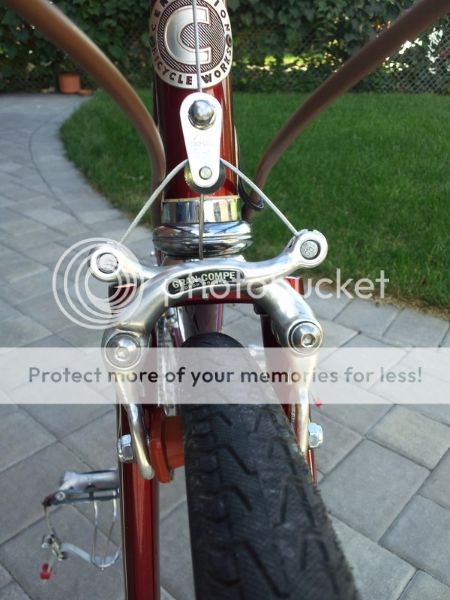
I was looking at the new GC 610s for my Pro-Tour, but couldn't get past the price. They cost more than I paid for the frame! I put on an old pair of mushy-feeling Weinmann 610s, until a pair of used old GC 610s came up on eBay for 10 bucks. Although to all appearances they look exactly like the Weinmann's, the difference in performance with the GC 610s is tremendous. They don't look to shabby either.
 10-19-16 | 01:38 AM
#5

verktyg
Joined: Jul 2006
Posts: 4,034
Likes: 1,271
From: SF Bay Area
Bikes: Current favorites: 1988 Peugeot Birraritz, 1984 Gitane Super Corsa, 1980s DeRosa, 1981 Bianchi Campione Del Mondo, 1992 Paramount OS, 1988 Colnago Technos, 1985 RalieghUSA SBDU Team Pro
A lot of brake effectiveness is dependent on the pads!!!
You can put good pads on crappy brakes and they will work FAR better than vise-versa!
Something else to consider, the braking surfaces of old pads (and many new ones) are going to be harder than the material below the surface.
I sand about a millimeter off of the surfaces of old pads before installing them (or carefully use the side of a grinding wheel). The material underneath is usually a lot softer and will provide a far better grip.
The important thing is to keep the surfaces flat, perpendicular and parallel to the way they were when new.
With new pads I just scuff them up a little.
While off the OP's original topic, is there any particular reason top stick with center pull brakes, especially seeing as how brand names are not an issue?
I only use CP brakes when I'm doing a restoration or want to be period correct on a C&V bike... and then I usually use MAFAC brakes. Before the introduction of Campagnolo side pull brakes in 1969, MAFAC brakes the choice of most pro riders. Some older riders continued using MAFACs into the early 70's....
Back in the day, I came to the conclusion that there were at least 3 types of material used in MAFAC brake blocks:
The worst were about a 50/50 mix of rubber and some kind of string. These were so bad that they would start crumbling after a short amount of use. They were worse than the blocks used on Universal Brakes!
The second kind had a lot more rubber than string but they were hard and didn't brake very well
Both of the "stringy" types of block may have been very old stock that MAFAC pulled out of storage at the height of the bike boom because they couldn't get proper blocks from time to time.
The last versions were almost solid black rubber with very few or no strings. When they were soft and pliable they stopped GREAT! Some batches got old and hard... they were throwaways!
KoolStop makes replacement brake blocks for MAFACs in black or red. I hjave some but I haven't tried them.
Getting back off topic...
I like like to feel a little retinal detachment whenever I have to "lock em up"!
I've been using Dual Pivot brakes on all of post 1985 and later bikes. The stopping power is better than most other designs. I like the Shimano 105 calipers. They are priced right and the performance is as good as the more expensive Shimano models. The early versions had brake pads that stopped poorly - see pictures. Later 105 are great.
Shimano, Cane Creek, IRD Campy and others make Dual Pivot calipers.
verktyg
Chas,
You can put good pads on crappy brakes and they will work FAR better than vise-versa!
Something else to consider, the braking surfaces of old pads (and many new ones) are going to be harder than the material below the surface.
I sand about a millimeter off of the surfaces of old pads before installing them (or carefully use the side of a grinding wheel). The material underneath is usually a lot softer and will provide a far better grip.
The important thing is to keep the surfaces flat, perpendicular and parallel to the way they were when new.
With new pads I just scuff them up a little.
While off the OP's original topic, is there any particular reason top stick with center pull brakes, especially seeing as how brand names are not an issue?
I only use CP brakes when I'm doing a restoration or want to be period correct on a C&V bike... and then I usually use MAFAC brakes. Before the introduction of Campagnolo side pull brakes in 1969, MAFAC brakes the choice of most pro riders. Some older riders continued using MAFACs into the early 70's....
Back in the day, I came to the conclusion that there were at least 3 types of material used in MAFAC brake blocks:
The worst were about a 50/50 mix of rubber and some kind of string. These were so bad that they would start crumbling after a short amount of use. They were worse than the blocks used on Universal Brakes!
The second kind had a lot more rubber than string but they were hard and didn't brake very well
Both of the "stringy" types of block may have been very old stock that MAFAC pulled out of storage at the height of the bike boom because they couldn't get proper blocks from time to time.
The last versions were almost solid black rubber with very few or no strings. When they were soft and pliable they stopped GREAT! Some batches got old and hard... they were throwaways!
KoolStop makes replacement brake blocks for MAFACs in black or red. I hjave some but I haven't tried them.
Getting back off topic...
I like like to feel a little retinal detachment whenever I have to "lock em up"!
I've been using Dual Pivot brakes on all of post 1985 and later bikes. The stopping power is better than most other designs. I like the Shimano 105 calipers. They are priced right and the performance is as good as the more expensive Shimano models. The early versions had brake pads that stopped poorly - see pictures. Later 105 are great.
Shimano, Cane Creek, IRD Campy and others make Dual Pivot calipers.
verktyg
Chas,
__________________
Don't believe everything you think! History is written by those who weren't there....
Chas. ;-)
Don't believe everything you think! History is written by those who weren't there....
Chas. ;-)

 10-19-16 | 06:32 AM
#7

Old fart


Joined: Nov 2004
Posts: 26,402
Likes: 5,333
From: Appleton WI
Bikes: Several, mostly not name brands.

 10-19-16 | 07:10 AM
#8
Senior Member
Joined: Nov 2004
Posts: 23,212
Likes: 3,123
I was looking at the new GC 610s for my Pro-Tour, but couldn't get past the price. They cost more than I paid for the frame! I put on an old pair of mushy-feeling Weinmann 610s, until a pair of used old GC 610s came up on eBay for 10 bucks. Although to all appearances they look exactly like the Weinmann's, the difference in performance with the GC 610s is tremendous. They don't look to shabby either.
Another factor not to be overlooked is the cables. When I was managing a shop in the mid-1970s, we had one brand which was giving us fits with the brakes, when other brands with the same brakes were fine. After much investigation, the mushy feel and poor stopping power was traced to the cables. The brand owner was trying to save a few pennies by specifying lower grade cables.
10-19-16 | 09:44 AM
#9

Senior Member
Joined: Oct 2011
Posts: 10,050
Likes: 2,508
From: Fairplay Co
Bikes: Current 79 Nishiki Custum Sport, Jeunet 620, notable previous bikes P.K. Ripper loop tail, Kawahara Laser Lite, Paramount Track full chrome, Raliegh Internatioanl, Motobecan Super Mirage. 59 Crown royak 3 speed
For ease of use and quality for cost I would go with some vintage made in Japan Diacompe 610, 720 or GS center pulls, with new modern pads. Better quality than most of the new stuff and much easier to work with than the Mafacs. You can pic sets up nos off ebay starting around $30.00.

Vintage Gran Compe Dia Compe Center Pull Bicycle Brake Calipers | eBay
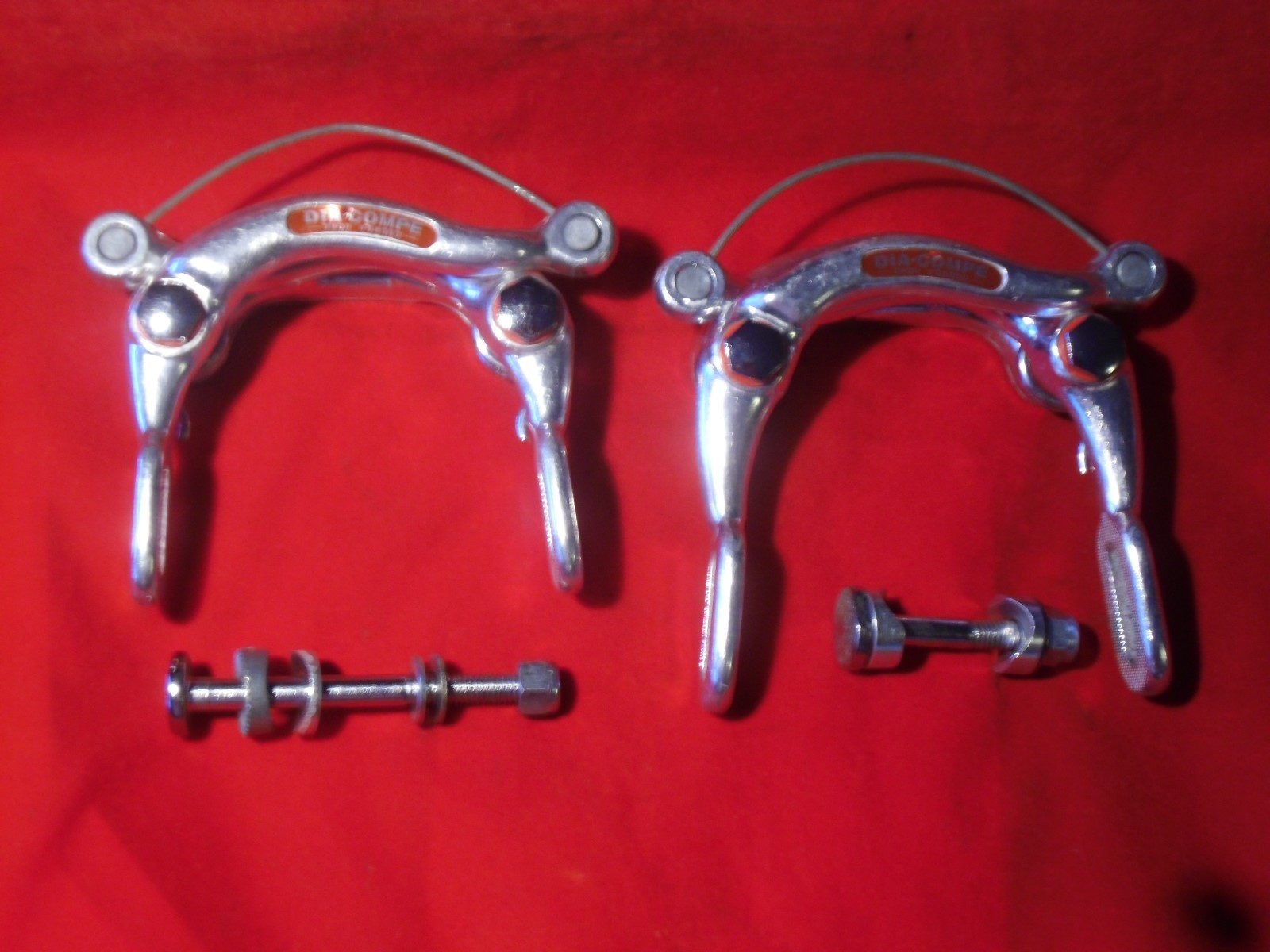
Vintage Dia Compe Center Pull Bicycle Brakes Schwinn Raleigh Vista Puch etc NOS | eBay
If you really want to save some money you can probably pic up a nice set used from your local bike coop for free or almost nothing and do tear down and cleanup your self which is fairly simple and buy some new straddle cables and pads for about $20.
Vintage Gran Compe Dia Compe Center Pull Bicycle Brake Calipers | eBay
Vintage Dia Compe Center Pull Bicycle Brakes Schwinn Raleigh Vista Puch etc NOS | eBay
If you really want to save some money you can probably pic up a nice set used from your local bike coop for free or almost nothing and do tear down and cleanup your self which is fairly simple and buy some new straddle cables and pads for about $20.
10-19-16 | 10:03 AM
#10
Senior Member
Joined: Oct 2015
Posts: 6,280
Likes: 612
From: Los Angeles
Bikes: 78 Masi Criterium, 68 PX10, 2016 Mercian King of Mercia, Rivendell Clem Smith Jr
The way I see it:
brake stopping power = [(pad friction x area) x (mechanical advantage)] - (cable flex + arm flex)
CP perform pretty similarly to modern brakes if you use modern pads and shorten the yokes to approximate the higher MA of dual pivots -- which are basically cockeyed centerpulls anyway.
The new reissue Gran Compe IMHO are an upgrade over the originals, which were good already. They are thicker and beefed up like modern brakes. Construction is CNC rather than forged, which isn't better or worse necessarily, but is worth a mention. But if cost is an issue, the vintage ones are much more bang for the buck.
I managed to get a pair plus the little ENE rack for $130 off ebay, but I was probably lucky. The current prices are still reasonable for a top quality brake. IIRC they cost more BITD.
brake stopping power = [(pad friction x area) x (mechanical advantage)] - (cable flex + arm flex)
CP perform pretty similarly to modern brakes if you use modern pads and shorten the yokes to approximate the higher MA of dual pivots -- which are basically cockeyed centerpulls anyway.
The new reissue Gran Compe IMHO are an upgrade over the originals, which were good already. They are thicker and beefed up like modern brakes. Construction is CNC rather than forged, which isn't better or worse necessarily, but is worth a mention. But if cost is an issue, the vintage ones are much more bang for the buck.
I managed to get a pair plus the little ENE rack for $130 off ebay, but I was probably lucky. The current prices are still reasonable for a top quality brake. IIRC they cost more BITD.
Last edited by Salamandrine; 10-19-16 at 10:22 AM.
10-19-16 | 10:47 AM
#11
Senior Member

Joined: Jan 2008
Posts: 15,105
Likes: 4,754
From: Beaverton, OR
Bikes: Yes
I know it's counter-intuitive, but the surface area of the brake pad actually doesn't matter. As you increase the surface area, it distributes the normal force (the pressure of the pad against the rim) and so twice as much surface area leads to half as much force at any given point. This exactly counteracts the increased drag of the larger surface area.

__________________
My Bikes
My Bikes
10-19-16 | 11:40 AM
#12

Senior Member
Joined: Feb 2005
Posts: 2,584
Likes: 107
From: Scranton, PA, USA
Bikes: '77 Centurion "Pro Tour"; '67 Carlton "The Flyer"; 1984 Ross MTB (stored at parents' house)
I hate to be the one to go all geek but...
I know it's counter-intuitive, but the surface area of the brake pad actually doesn't matter. As you increase the surface area, it distributes the normal force (the pressure of the pad against the rim) and so twice as much surface area leads to half as much force at any given point. This exactly counteracts the increased drag of the larger surface area.
I know it's counter-intuitive, but the surface area of the brake pad actually doesn't matter. As you increase the surface area, it distributes the normal force (the pressure of the pad against the rim) and so twice as much surface area leads to half as much force at any given point. This exactly counteracts the increased drag of the larger surface area.
It's not just because I work as a hands-on engineer in a technical field, but I often find that the practicality and formalism that one sees in the first two weeks of a high school physics class (and chemistry, for that matter) absolutely dwarf much of the rest of the education that I've gotten in terms of its value.
10-19-16 | 11:47 AM
#13
Senior Member
Joined: Oct 2015
Posts: 6,280
Likes: 612
From: Los Angeles
Bikes: 78 Masi Criterium, 68 PX10, 2016 Mercian King of Mercia, Rivendell Clem Smith Jr
I hate to be the one to go all geek but...
I know it's counter-intuitive, but the surface area of the brake pad actually doesn't matter. As you increase the surface area, it distributes the normal force (the pressure of the pad against the rim) and so twice as much surface area leads to half as much force at any given point. This exactly counteracts the increased drag of the larger surface area.
I know it's counter-intuitive, but the surface area of the brake pad actually doesn't matter. As you increase the surface area, it distributes the normal force (the pressure of the pad against the rim) and so twice as much surface area leads to half as much force at any given point. This exactly counteracts the increased drag of the larger surface area.
 Thanks. That make sense now that I think of it.
 Plus you have rationalized my decision to stick with road size kool stop pads rather than cramming the big silly mountain bike sized ones on there.
Still, I wonder if there is some practical limit. For example would a pad 1/4 the normal area have the same drag? Perhaps increased pressure would mean increased temperature and change the friction of the pad? Or perhaps it would have the same braking power and it is just a matter of pad wear?
Corrected?
brake stopping power = [(pad friction) x (mechanical advantage)] - (cable flex + arm flex)
10-19-16 | 12:00 PM
#14

aka Tom Reingold

Joined: Jan 2009
Posts: 44,302
Likes: 6,557
From: New York, NY, and High Falls, NY, USA
Bikes: 1962 Rudge Sports, 1971 Raleigh Super Course, 1971 Raleigh Pro Track, 1974 Raleigh International, 1975 Viscount Fixie, 1982 McLean, 1996 Lemond (Ti), 2002 Burley Zydeco tandem
Just about all center pull brakes work equally well. One exception for me was those Shimano 500 brakes, as they didn't work so well for me, but maybe I used bad pads with them. So the decision is pretty much down to esthetics and price.
[MENTION=61614]verktyg[/MENTION] mentions dual pivots, and if you don't mind the non-period-correct choice, they are a good suggestion. I've noticed that even cheap dual pivots work really well, and I wonder why that is. Perhaps good stiff aluminum is easier to use than it used to be. So if you decide to use dual pivots, use any brand, once again considering esthetics and price.
[MENTION=424205]Salamandrine[/MENTION], what do you mean MAFACs are not linear? You may be right, but I haven't noticed.
[MENTION=61614]verktyg[/MENTION] mentions dual pivots, and if you don't mind the non-period-correct choice, they are a good suggestion. I've noticed that even cheap dual pivots work really well, and I wonder why that is. Perhaps good stiff aluminum is easier to use than it used to be. So if you decide to use dual pivots, use any brand, once again considering esthetics and price.
[MENTION=424205]Salamandrine[/MENTION], what do you mean MAFACs are not linear? You may be right, but I haven't noticed.
__________________
Tom Reingold, tom@noglider.com
New York City and High Falls, NY
Blogs: The Experienced Cyclist; noglider's ride blog
“When man invented the bicycle he reached the peak of his attainments.” — Elizabeth West, US author
Please email me rather than PM'ing me. Thanks.
Tom Reingold, tom@noglider.com
New York City and High Falls, NY
Blogs: The Experienced Cyclist; noglider's ride blog
“When man invented the bicycle he reached the peak of his attainments.” — Elizabeth West, US author
Please email me rather than PM'ing me. Thanks.
 10-19-16 | 12:01 PM
#15

Senior Member
Joined: Apr 2007
Posts: 12,567
Likes: 2,740
From: Thunder Bay, Ontario, Canada - burrrrr!
Bikes: 1958 Rabeneick 120D, 1968 Legnano Gran Premio, 196? Torpado Professional, 2000 Marinoni Piuma
brake stopping power = [(pad friction x area) x (mechanical advantage)] - (cable flex + arm flex)
I learned a long time ago that my hands, those of a professional tradesman, are, usually, a heck of a lot stronger in grip than a small woman's hands (I am not trying to be a chauvinist with that comment). Many of the ladies that have purchased bikes from me or from B4H find the vintage brakes hard to reach and apply with force.
That's my two bits worth, eh.
__________________
"98% of the bikes I buy are projects".
"98% of the bikes I buy are projects".
10-19-16 | 12:38 PM
#16
Senior Member
Joined: May 2008
Posts: 10,106
Likes: 2,762
From: Fredericksburg, Va
Bikes: ? Proteous, '65 Frejus TDF, '73 Bottecchia Giro d'Italia, '83 Colnago Superissimo, '84 Trek 610, '84 Trek 760, '88 Pinarello Veneto, '88 De Rosa Pro, '89 Pinarello Montello, 'Litespeed Catalyst'94 Burley Duet, 97 Specialized RockHopper, 2010 Langster
It is interesting that nobody mentioned the old standard of Universal 61's. IIRC they were often the top of the line brake prior to Campy side pulls. At least in my world back in the late 60's and early 70's. They should be stiff enough as they are cast (don't attempt to bend them to adjust "toe"). I am not a good resource for adjudication but I think the weakness was not the caliper but the lever MA and most importantly, the hardward for the cabling.
Since they were not anodized, you can polish them to the point of blinding others in the sun.
IIRC, they all had deflection between the mount and the braking surface. Kool Stops do make a big difference in any case.
Since they were not anodized, you can polish them to the point of blinding others in the sun.
IIRC, they all had deflection between the mount and the braking surface. Kool Stops do make a big difference in any case.
__________________
Bikes don't stand alone. They are two tired.
Bikes don't stand alone. They are two tired.
10-19-16 | 01:01 PM
#17
aka Tom Reingold
Joined: Jan 2009
Posts: 44,302
Likes: 6,557
From: New York, NY, and High Falls, NY, USA
Bikes: 1962 Rudge Sports, 1971 Raleigh Super Course, 1971 Raleigh Pro Track, 1974 Raleigh International, 1975 Viscount Fixie, 1982 McLean, 1996 Lemond (Ti), 2002 Burley Zydeco tandem
[MENTION=84826]randyjawa[/MENTION], you're right about hands. I'm not a tradesman, but my hands are unusually large and strong for a guy my size. I didn't really think about it until [MENTION=148435]aixaix[/MENTION] pointed out that we large-handed guys do fine with single pivot brakes. A couple of people have ridden my bikes and told me that my brakes don't work. They are either unaccustomed or unable to apply the required force.
[MENTION=124730]SJX426[/MENTION], I think you're right. The problem with Universal brakes was in the levers, not the calipers. I wouldn't ever use their levers again.
[MENTION=124730]SJX426[/MENTION], I think you're right. The problem with Universal brakes was in the levers, not the calipers. I wouldn't ever use their levers again.
__________________
Tom Reingold, tom@noglider.com
New York City and High Falls, NY
Blogs: The Experienced Cyclist; noglider's ride blog
“When man invented the bicycle he reached the peak of his attainments.” — Elizabeth West, US author
Please email me rather than PM'ing me. Thanks.
Tom Reingold, tom@noglider.com
New York City and High Falls, NY
Blogs: The Experienced Cyclist; noglider's ride blog
“When man invented the bicycle he reached the peak of his attainments.” — Elizabeth West, US author
Please email me rather than PM'ing me. Thanks.
10-19-16 | 01:43 PM
#18
Senior Member
Joined: Jan 2008
Posts: 15,105
Likes: 4,754
From: Beaverton, OR
Bikes: Yes
Still, I wonder if there is some practical limit. For example would a pad 1/4 the normal area have the same drag? Perhaps increased pressure would mean increased temperature and change the friction of the pad? Or perhaps it would have the same braking power and it is just a matter of pad wear?
This issue also comes up with tires, which I think are more complicated because they deform a lot more. You just couldn't convince me that the size of the contact patch is never important in tire traction, especially over irregular road surfaces.
__________________
My Bikes
My Bikes
10-19-16 | 01:59 PM
#19
Banned
Joined: Aug 2013
Posts: 6,480
Likes: 450
Yeah, the problem with classroom physics is that the things that were simplified away in order to get a manageable model are actually important once in a while. In this case I was imaging a brake pad the shape and size of a pencil eraser, and I'm fairly certain that the lateral flex would have some impact. So I guess you need enough pad material to maintain structural integrity. You may be right that temperature could also come into play (though probably not for a small difference like switching from road the MTB pads).
This issue also comes up with tires, which I think are more complicated because they deform a lot more. You just couldn't convince me that the size of the contact patch is never important in tire traction, especially over irregular road surfaces.
This issue also comes up with tires, which I think are more complicated because they deform a lot more. You just couldn't convince me that the size of the contact patch is never important in tire traction, especially over irregular road surfaces.
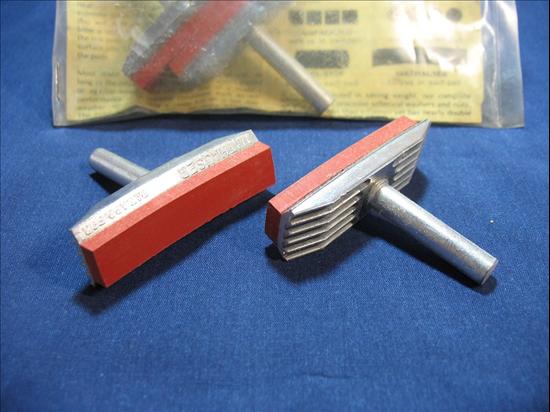
Anyways, for old school pads and from my experience these are a great improvement vs. the stock pads set-up on centerpulls. I don't know if the cooling fins are a gimmick but the thin rubber pad minimizes mushiness feel. The aluminum backing is far more rigid than a tin shell. BTW: The center post is hollow. Carry on
 10-19-16 | 03:32 PM
#20
Velominatus
Joined: Jul 2015
Posts: 375
Likes: 41
From: Lincolnshire Wolds, England
Bikes: 1986 SBDU Raleigh, 1984 Raleigh Corsa, 1980 Allin Stan Butler Special, 2 x late 1960s Roberts, 1978 Philbook, 1964 Allin Belgique, 1959 Allin Stan Butler Special, 1951 Higgins Plus Parfait, 1951 Hobbs of Barbican, 1913 Centaur Featherweight.
For ease of use and quality for cost I would go with some vintage made in Japan Diacompe 610, 720 or GS center pulls, with new modern pads. Better quality than most of the new stuff and much easier to work with than the Mafacs. You can pic sets up nos off ebay starting around $30.00.
Vintage Gran Compe Dia Compe Center Pull Bicycle Brake Calipers | eBay
Vintage Dia Compe Center Pull Bicycle Brakes Schwinn Raleigh Vista Puch etc NOS | eBay
If you really want to save some money you can probably pic up a nice set used from your local bike coop for free or almost nothing and do tear down and cleanup your self which is fairly simple and buy some new straddle cables and pads for about $20.
Vintage Gran Compe Dia Compe Center Pull Bicycle Brake Calipers | eBay
Vintage Dia Compe Center Pull Bicycle Brakes Schwinn Raleigh Vista Puch etc NOS | eBay
If you really want to save some money you can probably pic up a nice set used from your local bike coop for free or almost nothing and do tear down and cleanup your self which is fairly simple and buy some new straddle cables and pads for about $20.
*especially when directly mounted onto the frame (and centre pulls generally).
J.
10-19-16 | 05:07 PM
#21
Senior Member
Joined: Oct 2015
Posts: 6,280
Likes: 612
From: Los Angeles
Bikes: 78 Masi Criterium, 68 PX10, 2016 Mercian King of Mercia, Rivendell Clem Smith Jr
@Salamandrine, what do you mean MAFACs are not linear? You may be right, but I haven't noticed.
I wasn't trying to dis' MAFAC as I like them quite a bit. It was an attempt to describe the different feel. Perhaps I should just say MAFAC is like Ford, and Weinmann is like Chevy. Gran Compe is like Cadillac.
 10-19-16 | 06:51 PM
#22
aka Tom Reingold
Joined: Jan 2009
Posts: 44,302
Likes: 6,557
From: New York, NY, and High Falls, NY, USA
Bikes: 1962 Rudge Sports, 1971 Raleigh Super Course, 1971 Raleigh Pro Track, 1974 Raleigh International, 1975 Viscount Fixie, 1982 McLean, 1996 Lemond (Ti), 2002 Burley Zydeco tandem
Good analogy. If they really aren't linear, I guess I adapt unconsciously. And I like Ford's transmissions better than GM's.
__________________
Tom Reingold, tom@noglider.com
New York City and High Falls, NY
Blogs: The Experienced Cyclist; noglider's ride blog
“When man invented the bicycle he reached the peak of his attainments.” — Elizabeth West, US author
Please email me rather than PM'ing me. Thanks.
Tom Reingold, tom@noglider.com
New York City and High Falls, NY
Blogs: The Experienced Cyclist; noglider's ride blog
“When man invented the bicycle he reached the peak of his attainments.” — Elizabeth West, US author
Please email me rather than PM'ing me. Thanks.
10-19-16 | 10:06 PM
#23
verktyg
Joined: Jul 2006
Posts: 4,034
Likes: 1,271
From: SF Bay Area
Bikes: Current favorites: 1988 Peugeot Birraritz, 1984 Gitane Super Corsa, 1980s DeRosa, 1981 Bianchi Campione Del Mondo, 1992 Paramount OS, 1988 Colnago Technos, 1985 RalieghUSA SBDU Team Pro
Something that's been briefly touched on in this thread is the MA (mechanical advantage) of brake levers.
Over the years there's been a lot of "research" done comparing the MA of different brands of levers. I remember the "test results" published back in the 70's when there were only a few brands to compare: Weinmann, Dia-Compe, MAFAC, Universal and Campagnolo plus a few others like Zeus. Before 1976-77 Shimano brakes didn't get no respect amongst the cognoscenti.
The general opinion was that the Universal levers that came with Mod. 61 CP and Mod. 68 SP brakes had the worst mechanical advantage among those evaluated.
Most of data resulted from measuring pivot points, fulcrum points plus lever reach and length. I don't recall any of them taking into consideration real life issues like hand size! DOH!
@noglider mentioned that he has large hands... I have large hands too but with short fingers. Universal and MAFAC levers were designed for large hands and long fingers - their reach is almost too long for me. Weinmann and Dia-Compe levers were at the opposite end of the spectrum with Campy levers in the middle.
We sold a lot of better quality bikes to riders with smaller hands. We always kept the small Weinmann 158 levers and MAFAC Course Infant 611 Levers in stock. See Pictures.
To everyone... Over the years, Weinmann changed the dimensions of their CP brake stirrups but by the bike boom era Weinmann and Dia-Compe calipers were indentical. There was a technology exchange between the two companies which resulted in Weinmann being able to manufacture and sell the Dia-Compe designed "suicide levers". At the beginning of the insanity the levers Weinmann provided were made by Dia-Compe!
The Weinmann Vainqueur 999 brakes on my 1965 Tigra are substantially beefier than the Wienmann (and Dia-Compe) CPs from the 1970's. See picture.
@T-Mar "Part of the difference may be due to the material and method of manufacture. The Gran Compe series is cold forged out of high strength aluminum alloy, while the standard series is likely hot forged or possibly melt forged, using a lower strength aluminum alloy. This was the difference between the Dura-Ace and Tourney centre-pull brakes, which were otherwise identical."
Interesting about Dura-Ace vs. Tourney CP brakes, makes sense....
Small aluminum parts are generally cold forged. Hot forging aluminum is used on larger parts like BART wheels where there is a lot of offsetting of the material.
"Melt Forged" is a Japanese Jinglish euphemism for pressure cast or die cast aluminum. In true forging the material becomes denser and generally stronger. In pressure casting there is no compaction of the metal.
Special aluminum alloys are used for casting. A360 is one of the most common aluminum alloys for casting. It's properties are similar to pre-heat treated 6061 alloy.
https://www.dynacast.com/aluminum-die-casting.
@crank_addict The rubber (elastomer?) compound was what made the difference in Scott - Mathauser pads. The fins were decorative because rubber is an insulator and not good for heat transfer...
Last point, as someone mentioned, cables and housings make a BIG difference in brake performance. During the bike boom era most lower priced bikes came with cheap cables and housings (brakes and well as derailleurs).
We didn't like to work on cheap bikes because no amount of lube would allow those thin, rough cables to work properly. When a customer insisted we work on their bike, it was with the understanding that we would replace all of the cables (and charge them for the service which was maybe $15 back then including parts).
Here's Eddy Merckx riding a Peugeot (Masi) in 1967 with MAFAC brakes and Universal hoods.... see picture.
BTW, All MAFAC CP brake calipers were forged. From the beginning MAFAC made a point of stamping "Dural Forge" into the stirrup - Dural meaning Dur-aluminum alloy. See Picture
verktyg
Chas.
Over the years there's been a lot of "research" done comparing the MA of different brands of levers. I remember the "test results" published back in the 70's when there were only a few brands to compare: Weinmann, Dia-Compe, MAFAC, Universal and Campagnolo plus a few others like Zeus. Before 1976-77 Shimano brakes didn't get no respect amongst the cognoscenti.
The general opinion was that the Universal levers that came with Mod. 61 CP and Mod. 68 SP brakes had the worst mechanical advantage among those evaluated.
Most of data resulted from measuring pivot points, fulcrum points plus lever reach and length. I don't recall any of them taking into consideration real life issues like hand size! DOH!
@noglider mentioned that he has large hands... I have large hands too but with short fingers. Universal and MAFAC levers were designed for large hands and long fingers - their reach is almost too long for me. Weinmann and Dia-Compe levers were at the opposite end of the spectrum with Campy levers in the middle.
We sold a lot of better quality bikes to riders with smaller hands. We always kept the small Weinmann 158 levers and MAFAC Course Infant 611 Levers in stock. See Pictures.
To everyone... Over the years, Weinmann changed the dimensions of their CP brake stirrups but by the bike boom era Weinmann and Dia-Compe calipers were indentical. There was a technology exchange between the two companies which resulted in Weinmann being able to manufacture and sell the Dia-Compe designed "suicide levers". At the beginning of the insanity the levers Weinmann provided were made by Dia-Compe!
The Weinmann Vainqueur 999 brakes on my 1965 Tigra are substantially beefier than the Wienmann (and Dia-Compe) CPs from the 1970's. See picture.
@T-Mar "Part of the difference may be due to the material and method of manufacture. The Gran Compe series is cold forged out of high strength aluminum alloy, while the standard series is likely hot forged or possibly melt forged, using a lower strength aluminum alloy. This was the difference between the Dura-Ace and Tourney centre-pull brakes, which were otherwise identical."
Interesting about Dura-Ace vs. Tourney CP brakes, makes sense....
Small aluminum parts are generally cold forged. Hot forging aluminum is used on larger parts like BART wheels where there is a lot of offsetting of the material.
"Melt Forged" is a Japanese Jinglish euphemism for pressure cast or die cast aluminum. In true forging the material becomes denser and generally stronger. In pressure casting there is no compaction of the metal.
Special aluminum alloys are used for casting. A360 is one of the most common aluminum alloys for casting. It's properties are similar to pre-heat treated 6061 alloy.
https://www.dynacast.com/aluminum-die-casting.
@crank_addict The rubber (elastomer?) compound was what made the difference in Scott - Mathauser pads. The fins were decorative because rubber is an insulator and not good for heat transfer...
Last point, as someone mentioned, cables and housings make a BIG difference in brake performance. During the bike boom era most lower priced bikes came with cheap cables and housings (brakes and well as derailleurs).
We didn't like to work on cheap bikes because no amount of lube would allow those thin, rough cables to work properly. When a customer insisted we work on their bike, it was with the understanding that we would replace all of the cables (and charge them for the service which was maybe $15 back then including parts).
Here's Eddy Merckx riding a Peugeot (Masi) in 1967 with MAFAC brakes and Universal hoods.... see picture.
BTW, All MAFAC CP brake calipers were forged. From the beginning MAFAC made a point of stamping "Dural Forge" into the stirrup - Dural meaning Dur-aluminum alloy. See Picture
verktyg
Chas.
__________________
Don't believe everything you think! History is written by those who weren't there....
Chas. ;-)
Don't believe everything you think! History is written by those who weren't there....
Chas. ;-)
Last edited by verktyg; 10-21-16 at 01:25 AM.
10-20-16 | 07:17 AM
#24

feros ferio

Joined: Jul 2000
Posts: 22,411
Likes: 1,876
From: www.ci.encinitas.ca.us
Bikes: 1959 Capo Modell Campagnolo; 1960 Capo Sieger (2); 1962 Carlton Franco Suisse; 1970 Peugeot UO-8; 1982 Bianchi Campione d'Italia; 1988 Schwinn Project KOM-10;
Thank you for mentioning finger reach, Chas. Since my finger reach is average at best, I favor short-reach brake handles. Thus, I kept the original Weinmann Vainqueur 999 centerpulls, with their matching short-reach handles, on both Capos, albeit with modern high-friction KoolStop pads and low-compression brake cable housings. I replaced the Bianchi's original long-reach Modolo brake handles with short-reach Shimanos, whose aero cable routing provides an additional 10% in leverage.
__________________
"Far and away the best prize that life offers is the chance to work hard at work worth doing." --Theodore Roosevelt
Capo: 1959 Modell Campagnolo, S/N 40324; 1960 Sieger (2), S/N 42624, 42597
Carlton: 1962 Franco Suisse, S/N K7911
Peugeot: 1970 UO-8, S/N 0010468
Bianchi: 1982 Campione d'Italia, S/N 1.M9914
Schwinn: 1988 Project KOM-10, S/N F804069
"Far and away the best prize that life offers is the chance to work hard at work worth doing." --Theodore Roosevelt
Capo: 1959 Modell Campagnolo, S/N 40324; 1960 Sieger (2), S/N 42624, 42597
Carlton: 1962 Franco Suisse, S/N K7911
Peugeot: 1970 UO-8, S/N 0010468
Bianchi: 1982 Campione d'Italia, S/N 1.M9914
Schwinn: 1988 Project KOM-10, S/N F804069
10-20-16 | 07:30 AM
#25
feros ferio
Joined: Jul 2000
Posts: 22,411
Likes: 1,876
From: www.ci.encinitas.ca.us
Bikes: 1959 Capo Modell Campagnolo; 1960 Capo Sieger (2); 1962 Carlton Franco Suisse; 1970 Peugeot UO-8; 1982 Bianchi Campione d'Italia; 1988 Schwinn Project KOM-10;
I like Chrysler's and ZF's better than either of those.
__________________
"Far and away the best prize that life offers is the chance to work hard at work worth doing." --Theodore Roosevelt
Capo: 1959 Modell Campagnolo, S/N 40324; 1960 Sieger (2), S/N 42624, 42597
Carlton: 1962 Franco Suisse, S/N K7911
Peugeot: 1970 UO-8, S/N 0010468
Bianchi: 1982 Campione d'Italia, S/N 1.M9914
Schwinn: 1988 Project KOM-10, S/N F804069
"Far and away the best prize that life offers is the chance to work hard at work worth doing." --Theodore Roosevelt
Capo: 1959 Modell Campagnolo, S/N 40324; 1960 Sieger (2), S/N 42624, 42597
Carlton: 1962 Franco Suisse, S/N K7911
Peugeot: 1970 UO-8, S/N 0010468
Bianchi: 1982 Campione d'Italia, S/N 1.M9914
Schwinn: 1988 Project KOM-10, S/N F804069