The set up
 12-23-16 | 04:40 PM
#1

Thread Starter
Senior Member
Joined: Jul 2015
Posts: 1,814
Likes: 320
From: Seal Beach Ca. On the right , next to Long Beach
Bikes: 86' Centurion Ironman
The set up
https://bikeretrogrouch.blogspot.com/...ike-setup.html
I unknowingly got it all right except the brake levers are a inch to high .
I unknowingly got it all right except the brake levers are a inch to high .
Last edited by markwesti; 12-23-16 at 05:03 PM.
 12-23-16 | 07:53 PM
#3
Senior Member


Joined: Feb 2014
Posts: 2,129
Likes: 247
From: Midwest
Bikes: See the signature....
Ehh, my bar to saddle "drop" is typically 0, with more of a saddle to bar "rise" the older I get.
And yes, my levers seem to be 1/2-3/4" higher than they "should" be.
And yes, my levers seem to be 1/2-3/4" higher than they "should" be.
__________________
My bikes: '81 Trek 957, '83 Trek 720, '84 Trek 770, '85 Centurion Cinelli
My bikes: '81 Trek 957, '83 Trek 720, '84 Trek 770, '85 Centurion Cinelli
12-23-16 | 08:17 PM
#4

Senior Member
Joined: Sep 2009
Posts: 2,067
Likes: 73
From: USA
Bikes: 84 Pinarello Trevisio, 86 Guerciotti SLX, 96 Specialized Stumpjumper, 2010 Surly Cross Check, 88 Centurion Prestige, 73 Raleigh Sports, GT Force, Bridgestone MB4
Well, that is an opinion. Some of it seems about right, some of it not.
I do not size a frame by my fist on a seat post but by the top tube length and my saddle is set to be 109% of my cycling inseam. My bikes always have the same saddle height adjusted for shoes and peddle stack.
I like a good drop to the bars tops, usually two to as much as four inches depending on the bike.
I like my saddle slightly titled up but it depends upon the saddle.
I do not size a frame by my fist on a seat post but by the top tube length and my saddle is set to be 109% of my cycling inseam. My bikes always have the same saddle height adjusted for shoes and peddle stack.
I like a good drop to the bars tops, usually two to as much as four inches depending on the bike.
I like my saddle slightly titled up but it depends upon the saddle.
Last edited by Loose Chain; 12-23-16 at 08:20 PM.

 12-23-16 | 09:09 PM
#6

Freshman Member

Joined: Mar 2014
Posts: 5,867
Likes: 4,154
From: City of Angels
Bikes: A few too many
 I set my bike up the way it suits me..we are all a little different.
 12-23-16 | 11:34 PM
#9
Senior Member
Joined: Sep 2009
Posts: 2,067
Likes: 73
From: USA
Bikes: 84 Pinarello Trevisio, 86 Guerciotti SLX, 96 Specialized Stumpjumper, 2010 Surly Cross Check, 88 Centurion Prestige, 73 Raleigh Sports, GT Force, Bridgestone MB4
I actually set up similar, though prefer more aggressive set up slightly with a somewhat smaller frame. I like plenty of standover. But it is top tube I put my priority on as long as I can get my saddle to the correct height without exceeding the limit I am golden.
I do set my brakes even with the bottoms. I do point my bars to the rear brake. I was taught that by an old Italian bike racer turned mechanic.
But rules are rules and rules are to be broken because everybody is not the same, I get that. I especially loath slammed saddles and high bars but they are not my bikes and if the owner is enjoying it, then he/she is golden too.
J
I do set my brakes even with the bottoms. I do point my bars to the rear brake. I was taught that by an old Italian bike racer turned mechanic.
But rules are rules and rules are to be broken because everybody is not the same, I get that. I especially loath slammed saddles and high bars but they are not my bikes and if the owner is enjoying it, then he/she is golden too.
J
12-24-16 | 04:19 AM
#10
Senior Member

Joined: Jul 2008
Posts: 9,176
Likes: 653
From: Minas Ithil
You want to set your brake levers as high as possible while still being able to safely grab them with your hands in the hooks. Mine is about like in the pic but not everyone's fingers are the same length. But I know there's no way a lot people can grab the levers while in the drops with as high as I see some of them.
And telling everyone to have their bars pointed toward the rear brake is stupid because not everyone has the same bar height. You want them tilted to where your wrist isn't way bent and you can steer the bike out of the saddle while in the drops without wobbling, like you would if they were horizontal. Mine point close to the center of the seat stays.
And telling everyone to have their bars pointed toward the rear brake is stupid because not everyone has the same bar height. You want them tilted to where your wrist isn't way bent and you can steer the bike out of the saddle while in the drops without wobbling, like you would if they were horizontal. Mine point close to the center of the seat stays.
Last edited by Lazyass; 12-24-16 at 04:25 AM. Reason: 3rd grade spelling
12-24-16 | 05:28 AM
#11
Senior Member
Joined: Jun 2010
Posts: 7,579
Likes: 6
From: Pearland, Texas
Bikes: Cannondale, Trek, Raleigh, Santana
markwesti, If you are comfortable on the bike, you already have it completely right.
While there are some standards for the routing and length of cable housing, those are aesthetics they don't effect one's fit. Once you have the drops adjusted to your natural (intuitive?) grasp and angle, the hoods are then adjusted to their natural grasp location. My fit process starts with setting the KOPS to what is natural for me.
There are several 'set-up' recommendations and they often differ in one or more detail. One maybe perfect for you, but there really aren't any rules, just guidelines.
Brad
While there are some standards for the routing and length of cable housing, those are aesthetics they don't effect one's fit. Once you have the drops adjusted to your natural (intuitive?) grasp and angle, the hoods are then adjusted to their natural grasp location. My fit process starts with setting the KOPS to what is natural for me.
There are several 'set-up' recommendations and they often differ in one or more detail. One maybe perfect for you, but there really aren't any rules, just guidelines.
Brad
12-24-16 | 07:31 AM
#12


I don't think I've read it before, but my road bikes are set up as if I followed it to the letter. It's mostly common sense. Any deviation looks wrong to me, especially tilted saddles and brake cables routed in front of the bars.
12-24-16 | 09:52 AM
#13
Senior Member

Joined: Nov 2004
Posts: 23,212
Likes: 3,122
The "rules" are only a guide to get a statistically normal person within the ballpark. After that, it can be a long process of fine tuning based on rider feedback. However, the most important aspect is knowing the right questions to ask, to get the proper feedback. That comes from years of experience.
12-24-16 | 10:45 AM
#14
The "rules" are only a guide to get a statistically normal person within the ballpark. After that, it can be a long process of fine tuning based on rider feedback. However, the most important aspect is knowing the right questions to ask, to get the proper feedback. That comes from years of experience.
Very hard to observe this yourself. Riding along a line of store front windows, using those as a mirror can help, on an early Sunday morning say with low traffic and parked cars missing... But that will just show your basic position.
12-24-16 | 11:10 AM
#15

Senior Member
Joined: Apr 2007
Posts: 12,564
Likes: 2,739
From: Thunder Bay, Ontario, Canada - burrrrr!
Bikes: 1958 Rabeneick 120D, 1968 Legnano Gran Premio, 196? Torpado Professional, 2000 Marinoni Piuma
I go with T-Mar on this one.
These days I set my brake levers considerably lower on the handlebar. If I set to ride the hoods with comfort, then I can't reach the brake levers when in the drops(Carpal Tunnel in both hands). The bar is set about one inch lower than the saddle. The saddle is level and a few degrees to the right.
I don't know if this is right or wrong for you, but it works for a seventy year old man who puts stopping before going.
These days I set my brake levers considerably lower on the handlebar. If I set to ride the hoods with comfort, then I can't reach the brake levers when in the drops(Carpal Tunnel in both hands). The bar is set about one inch lower than the saddle. The saddle is level and a few degrees to the right.
I don't know if this is right or wrong for you, but it works for a seventy year old man who puts stopping before going.
__________________
"98% of the bikes I buy are projects".
"98% of the bikes I buy are projects".
12-24-16 | 11:15 AM
#16
Banned.
Joined: Jul 2016
Posts: 2,717
Likes: 10
From: downtown Bulverde, Texas
Bikes: '74 Raleigh International utility; '98 Moser Forma road; '92 Viner Pro CX upright
Yes, so often I see guys on bikes that claim they are comfortable, riding with their elbows locked, knees swinging out on one leg as they pedal, hips swaying side to side on the too high saddle...
Very hard to observe this yourself. Riding along a line of store front windows, using those as a mirror can help, on an early Sunday morning say with low traffic and parked cars missing... But that will just show your basic position.
Very hard to observe this yourself. Riding along a line of store front windows, using those as a mirror can help, on an early Sunday morning say with low traffic and parked cars missing... But that will just show your basic position.
I think about my form when I ride, especially my core muscles. My helmet mirror shows me if I'm lifting my shoulders and I remember to relax them. I even occasionally look at my shadow.
12-24-16 | 11:59 AM
#17

Senior Member
Joined: Jan 2013
Posts: 5,396
Likes: 1,140
From: Norman, Oklahoma
Bikes: Too many to list
My early training dictated keeping the knees close together - just shy of grazing the top tube ---- this is supported by the industry's attempts over the years to attain the narrowest Q factor possible as well
As others have said though, -- if they are out there on a bike enjoying themselves and are comfortable , who am i to argue
12-24-16 | 12:33 PM
#19

Senior Member
Joined: Apr 2013
Posts: 1,662
Likes: 46
From: Amsterdam
Bikes: 1980 Koga-Miyata Gentsluxe-S, 1998 Eddy Merckx Corsa 01, 1983 Tommasini Racing, 2012 Gulf Western CAAD10, 1980 Univega Gran Premio
A lot of these rules are things I've heard over the years, or read here. They seem to be a good starting point, and are definitely the 'classic look' for steel bikes. The one classic rule he seemed to miss was having the tire label lined up with the valve.
Curious if your saddle height is calculated from center of BB or pedal? I'm thinking with differing crank arm lengths, it has to be to the pedal. Also, I sit differently on different saddles, so sometimes that affects saddle height a bit. I agree that saddle tilt depends on the saddle, though I'm finding that fairly level generally works best for me.
I think the 'rule' that the drops should be parallel to the ground is the silly rule, though it's one I've seen stated here several times. For me, if I want to to be comfortable on the ramps, hoods, and drops, I need to find the sweet spot for that particular set of bars. The classic Cinelli 66 bars have so much slope to the ramps that I can't really find an angle where they work for me. The 64s are much better. But depending on the bars, I might need the drops aiming all the way down at the RD, or they might be aimed straight back at the seat post.
I do not size a frame by my fist on a seat post but by the top tube length and my saddle is set to be 109% of my cycling inseam. My bikes always have the same saddle height adjusted for shoes and peddle stack.
I like my saddle slightly titled up but it depends upon the saddle.
I like my saddle slightly titled up but it depends upon the saddle.
And telling everyone to have their bars pointed toward the rear brake is stupid because not everyone has the same bar height. You want them tilted to where your wrist isn't way bent and you can steer the bike out of the saddle while in the drops without wobbling, like you would if they were horizontal. Mine point close to the center of the seat stays.
12-24-16 | 12:43 PM
#21

Senior Member
Joined: Jun 2011
Posts: 2,219
Likes: 104
From: New York, NY
Bikes: Black Mountain Cycles Road and canti MX, Cannondale CAAD12, Bob Jackson Vigorelli
Curious if your saddle height is calculated from center of BB or pedal? I'm thinking with differing crank arm lengths, it has to be to the pedal. Also, I sit differently on different saddles, so sometimes that affects saddle height a bit. I agree that saddle tilt depends on the saddle, though I'm finding that fairly level generally works best for me.
The saddle, pedals, and shoes you wear will all affect the overall fit.
12-24-16 | 01:06 PM
#22

Cyclotouriste
Joined: Aug 2009
Posts: 11,784
Likes: 6,995
From: South Holland, NL
Bikes: Yes, please.
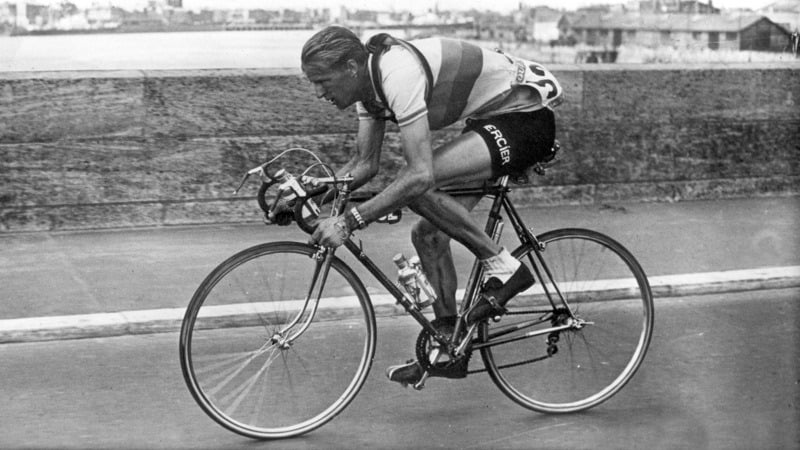
This thread badly needs pictures. This one for instance. Not every pro set up his bike like Eddy:
12-24-16 | 01:33 PM
#23
Senior Member
Joined: Sep 2009
Posts: 2,067
Likes: 73
From: USA
Bikes: 84 Pinarello Trevisio, 86 Guerciotti SLX, 96 Specialized Stumpjumper, 2010 Surly Cross Check, 88 Centurion Prestige, 73 Raleigh Sports, GT Force, Bridgestone MB4
A lot of these rules are things I've heard over the years, or read here. They seem to be a good starting point, and are definitely the 'classic look' for steel bikes. The one classic rule he seemed to miss was having the tire label lined up with the valve.
Curious if your saddle height is calculated from center of BB or pedal? I'm thinking with differing crank arm lengths, it has to be to the pedal. Also, I sit differently on different saddles, so sometimes that affects saddle height a bit. I agree that saddle tilt depends on the saddle, though I'm finding that fairly level generally works best for me.
I think the 'rule' that the drops should be parallel to the ground is the silly rule, though it's one I've seen stated here several times. For me, if I want to to be comfortable on the ramps, hoods, and drops, I need to find the sweet spot for that particular set of bars. The classic Cinelli 66 bars have so much slope to the ramps that I can't really find an angle where they work for me. The 64s are much better. But depending on the bars, I might need the drops aiming all the way down at the RD, or they might be aimed straight back at the seat post.
Curious if your saddle height is calculated from center of BB or pedal? I'm thinking with differing crank arm lengths, it has to be to the pedal. Also, I sit differently on different saddles, so sometimes that affects saddle height a bit. I agree that saddle tilt depends on the saddle, though I'm finding that fairly level generally works best for me.
I think the 'rule' that the drops should be parallel to the ground is the silly rule, though it's one I've seen stated here several times. For me, if I want to to be comfortable on the ramps, hoods, and drops, I need to find the sweet spot for that particular set of bars. The classic Cinelli 66 bars have so much slope to the ramps that I can't really find an angle where they work for me. The 64s are much better. But depending on the bars, I might need the drops aiming all the way down at the RD, or they might be aimed straight back at the seat post.
How to get your seat height right - BikeRadar USA
https://cyclingmath.wordpress.com/tag/saddle-height/
Anyone who is schooled in bike fit understands that formulas are starting points, but for most people, will be very close to optimal for best power, efficiency and comfort and less likely to damage knees etc.
Another interesting thing about the EM photos, notice how much knee and elbow overlap he has. I have had people tell me my bikes are wrong/too small/ not enough reach, because I have some knee and elbow overlap when on the drops like that. My opinion, they are wrong, EM is right, I think he knows a little about performance cycling.
One common mistake I see people do a lot is to set their saddle height as a function of bar height to achieve some sort of saddle position to bars preconceived notion. The saddle height, my opinion, the saddle hight is ALWAYS set to your inseam as above (and adjusted for variables) and the bars have to get where they get.
J
Last edited by Loose Chain; 12-24-16 at 01:55 PM.
12-24-16 | 02:11 PM
#24
Senior Member
Joined: Apr 2013
Posts: 1,662
Likes: 46
From: Amsterdam
Bikes: 1980 Koga-Miyata Gentsluxe-S, 1998 Eddy Merckx Corsa 01, 1983 Tommasini Racing, 2012 Gulf Western CAAD10, 1980 Univega Gran Premio
Ah, I looked mostly at his nice photos/diagrams, and didn't see that rule followed in any of the photos.
Yeah, I'm aware of the LeMonde formula (or I guess more correctly the Ginet formula); to me the defect in that system is that it ignores crank length, even though it's all about leg extension For me, saddle height depends on seat tube and crank length, and to a lesser extent the actual saddle (esp. if I need to adjust it forwards or back to any degree).
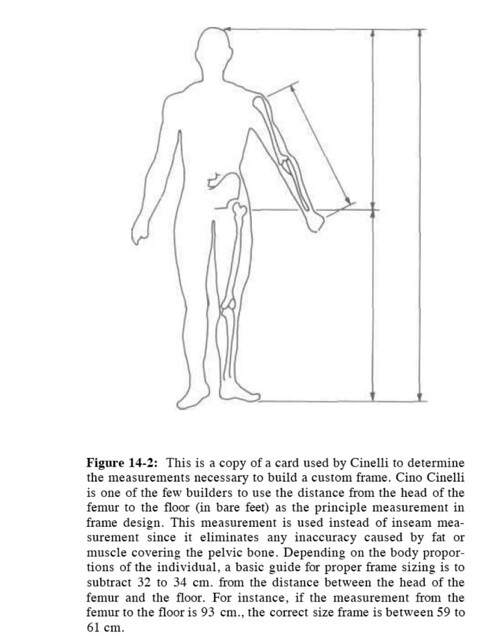
I recently was looking at the 'Cinelli method' for determining frames size, as described in 'The Custom Bicycle': subtract 32-34cm from the length of the head of the femur to the floor to find the correct frame range. This works surprisingly well for me. What it eliminates is the 'fuzziness' of determining an accurate inseam measure.
I agree with you about things like knee/elbow overlap. I see a lot of arguments about heel lift/flat foot when pedaling, or exact amount of optimal knee extension, and so on, but seeing the range of riding styles/body positions of very successful riders, there's clearly no exact formula or riding style that optimizes either comfort or performance across the board for all of us.
Kevin, the 109% Rule (or 0.883 Lemond value) is often known as the Lemond Formula. It only gets you to starting point and it is measured from spindle to saddle crown along the seat tube. The input is your true inseam in stocking feet. It is fashionable to run higher saddles now but the 109% is shown to be a good average and you can adjust up or down from there as needed for pedal stack, crank length or other physical variables.
Another interesting thing about the EM photos, notice how much knee and elbow overlap he has. I have had people tell me my bikes are wrong/too small/ not enough reach, because I have some knee and elbow overlap when on the drops like that. My opinion, they are wrong, EM is right, I think he knows a little about performance cycling.
J
Another interesting thing about the EM photos, notice how much knee and elbow overlap he has. I have had people tell me my bikes are wrong/too small/ not enough reach, because I have some knee and elbow overlap when on the drops like that. My opinion, they are wrong, EM is right, I think he knows a little about performance cycling.
J
I recently was looking at the 'Cinelli method' for determining frames size, as described in 'The Custom Bicycle': subtract 32-34cm from the length of the head of the femur to the floor to find the correct frame range. This works surprisingly well for me. What it eliminates is the 'fuzziness' of determining an accurate inseam measure.
I agree with you about things like knee/elbow overlap. I see a lot of arguments about heel lift/flat foot when pedaling, or exact amount of optimal knee extension, and so on, but seeing the range of riding styles/body positions of very successful riders, there's clearly no exact formula or riding style that optimizes either comfort or performance across the board for all of us.
12-24-16 | 02:19 PM
#25
Senior Member
Joined: Apr 2013
Posts: 1,662
Likes: 46
From: Amsterdam
Bikes: 1980 Koga-Miyata Gentsluxe-S, 1998 Eddy Merckx Corsa 01, 1983 Tommasini Racing, 2012 Gulf Western CAAD10, 1980 Univega Gran Premio