


B. Carré Randonneur
 03-27-17 | 12:12 PM
#26

Senior Member

Joined: Feb 2013
Posts: 15,369
Likes: 4,393
From: Alta California
-----
Thanks for the update and the shell height measurement. 290mm works out to ~11 3/8" which is on the high side, or high-ish, however one wishes to think of it...
As usual, the USS Enterprise was spot on!
-----
Thanks for the update and the shell height measurement. 290mm works out to ~11 3/8" which is on the high side, or high-ish, however one wishes to think of it...
As usual, the USS Enterprise was spot on!
-----
 03-27-17 | 12:59 PM
#27
Senior Member
Joined: Dec 2009
Posts: 8,343
Likes: 16
From: Louisville
Cool frame. Is the tubing metric or imperial?
Seat tube looks pretty slack to me. The steeper the HTA the lower the mechanical trail for a given fork offset and tire size. That said I don't see what implies that this bike was intended to have low trail or to otherwise be a randonneuring frame specifically.
It seems that the HTA was slack, TTs long and stems so short on older randonneuring frames was more a function of small riders on small frames (toe overlap) than anything else.
It seems that the HTA was slack, TTs long and stems so short on older randonneuring frames was more a function of small riders on small frames (toe overlap) than anything else.
03-27-17 | 01:19 PM
#28

Thread Starter
Senior Member

Joined: Aug 2010
Posts: 3,123
Likes: 98
From: Liberty, Missouri
Bikes: 1966 Paramount | 1971 Raleigh International | ca. 1970 Bernard Carre | 1989 Waterford Paramount | 2012 Boulder Brevet | 2019 Specialized Diverge
Cool frame. Is the tubing metric or imperial?
Seat tube looks pretty slack to me. The steeper the HTA the lower the mechanical trail for a given fork offset and tire size. That said I don't see what implies that this bike was intended to have low trail or to otherwise be a randonneuring frame specifically.
It seems that the HTA was slack, TTs long and stems so short on older randonneuring frames was more a function of small riders on small frames (toe overlap) than anything else.
Seat tube looks pretty slack to me. The steeper the HTA the lower the mechanical trail for a given fork offset and tire size. That said I don't see what implies that this bike was intended to have low trail or to otherwise be a randonneuring frame specifically.
It seems that the HTA was slack, TTs long and stems so short on older randonneuring frames was more a function of small riders on small frames (toe overlap) than anything else.
03-27-17 | 09:01 PM
#29

If I own it, I ride it


Joined: Nov 2005
Posts: 5,686
Likes: 821
From: Cardinal Country
Bikes: Lejeune(14), Raleigh, Raysport, Jan De Reus, Gazelle, Masi, B. Carré(4), Springfield, Greg Lemond, Andre Bertin, Schwinn Paramount
I can't take any credit. The CX idea was proposed by someone else on CR. I only thought of it after looking closer. Way cool. Some nice Carrés appearing lately.
 04-01-17 | 08:01 AM
#31
Thread Starter
Senior Member
Joined: Aug 2010
Posts: 3,123
Likes: 98
From: Liberty, Missouri
Bikes: 1966 Paramount | 1971 Raleigh International | ca. 1970 Bernard Carre | 1989 Waterford Paramount | 2012 Boulder Brevet | 2019 Specialized Diverge
While I play around with different options on the build I'll keep this thread alive with an update now and then. This is the latest. (By the way, every time I show a bike on this stand I get a warning about crimped tubes. I've got this clamp adjusted so that it is loose enough, and with enough play, that I normally have a chamois wrapped between the top tube and the clamp. All is good.)

I’ve been torn over staying true to the roots and going with a very French drive train vs. using period Campagnolo (because the Campy cable and housing guides that were on the frame lead me to believe that’s how the bike might have originally been built up.) So I dug through my parts bins and began to layout French stuff in one pile on the floor, and Campy stuff in another. As I pushed aside different Baggies of mechs, I realized I’d forgotten all about a Zeus kit I’ve been saving for.. well, for something.
Seems like a good time to put them to use.


I made one blunder right off the bat. I wanted to check to see if the spindle was long enough for a nice Stronglight crankset I have on hand (it wasn't.) Only after starting to snug things down did I recall that I loaned out my Stronglight and my TA pullers quite some time ago, and that I'd never gotten them back again (nor ever gotten an email response from the loan-ee.) That makes the second time in six months I've forgotten about this situation, and the second time I've had to rely on someone else to fix my goof. So a big shout out to Mark Pace at Pace Bicycle Haven in Independence, Missouri for his patience! Right now I've got a Japanese crank on there that fits, until I figure out exactly what I want to use for real.


This all French wheel set, with Maillard hubs and skewers, Atom FW, and Frenchie-French rims is quite a bit heavier than I'd like. I may switch them out with a lighter set with the same Maillard hubs and Nisi rims. That particular set currently has an Atom corn cob and I'm actually considering leaving it in place. Y'know...up until sanity kicks back in.
I managed to fit 32 Paselas without a hitch. I have yet to decide if wider tires look "right" on this bike, but personally I don't care for the ride of anything narrower than 28.
I'm still digging around for a 26.2 seat pin that I know I have. It's eluded me so far, which just means that my efforts to sell off/trade off parts these past few years have not been as successful as I (translation: my wife) had hoped.
That's all for now. More to come later.
I’ve been torn over staying true to the roots and going with a very French drive train vs. using period Campagnolo (because the Campy cable and housing guides that were on the frame lead me to believe that’s how the bike might have originally been built up.) So I dug through my parts bins and began to layout French stuff in one pile on the floor, and Campy stuff in another. As I pushed aside different Baggies of mechs, I realized I’d forgotten all about a Zeus kit I’ve been saving for.. well, for something.
Seems like a good time to put them to use.
I made one blunder right off the bat. I wanted to check to see if the spindle was long enough for a nice Stronglight crankset I have on hand (it wasn't.) Only after starting to snug things down did I recall that I loaned out my Stronglight and my TA pullers quite some time ago, and that I'd never gotten them back again (nor ever gotten an email response from the loan-ee.) That makes the second time in six months I've forgotten about this situation, and the second time I've had to rely on someone else to fix my goof. So a big shout out to Mark Pace at Pace Bicycle Haven in Independence, Missouri for his patience! Right now I've got a Japanese crank on there that fits, until I figure out exactly what I want to use for real.
This all French wheel set, with Maillard hubs and skewers, Atom FW, and Frenchie-French rims is quite a bit heavier than I'd like. I may switch them out with a lighter set with the same Maillard hubs and Nisi rims. That particular set currently has an Atom corn cob and I'm actually considering leaving it in place. Y'know...up until sanity kicks back in.
I managed to fit 32 Paselas without a hitch. I have yet to decide if wider tires look "right" on this bike, but personally I don't care for the ride of anything narrower than 28.
I'm still digging around for a 26.2 seat pin that I know I have. It's eluded me so far, which just means that my efforts to sell off/trade off parts these past few years have not been as successful as I (translation: my wife) had hoped.
That's all for now. More to come later.
04-01-17 | 12:27 PM
#32

Senior Member
Joined: Oct 2010
Posts: 9,479
Likes: 1,303
From: Jacksonville, NC
Bikes: A few
I think the Zeus group is a good selection.
My only problem, which I have noticed, is with the shape of the shifter strap. That pointy shape will dig into the stop or crumple up and ride over it.
Looking forward to the progress.
My only problem, which I have noticed, is with the shape of the shifter strap. That pointy shape will dig into the stop or crumple up and ride over it.
Looking forward to the progress.
04-09-17 | 06:50 AM
#34

Junior Member
Joined: Nov 2013
Posts: 108
Likes: 42
From: Aveyron, France
Bikes: Chiron
The cantilever brakes were used not only on CX bikes but also on ultralight time trial machines like this one made for Bernard Guyot in 1971:

During the 1971 TdF, Bernard Guyot was a teammate of the two famous Luciens, Aimar and Van Impe.
I can't resist showing this nice pic:

Source: Petite reine: Bernard Guyot
During the 1971 TdF, Bernard Guyot was a teammate of the two famous Luciens, Aimar and Van Impe.
I can't resist showing this nice pic:
Source: Petite reine: Bernard Guyot
Last edited by Filochard; 04-09-17 at 09:18 AM.
04-09-17 | 08:40 AM
#35
Thread Starter
Senior Member
Joined: Aug 2010
Posts: 3,123
Likes: 98
From: Liberty, Missouri
Bikes: 1966 Paramount | 1971 Raleigh International | ca. 1970 Bernard Carre | 1989 Waterford Paramount | 2012 Boulder Brevet | 2019 Specialized Diverge
The cantilever brakes were used not only on CX bikes but also on ultralight time trial machines like this one made for Bernard Guyot in 1971:
During the 1971 TdF, Bernard Guyot was a teammate of the two famous Luciens, Aimar and Van Impe.
I can't resist showing this nice pic:
During the 1971 TdF, Bernard Guyot was a teammate of the two famous Luciens, Aimar and Van Impe.
I can't resist showing this nice pic:
04-09-17 | 09:20 AM
#36
Senior Member
Joined: Feb 2013
Posts: 15,369
Likes: 4,393
From: Alta California
-----
Thanks so much for these great pictures Filochard!
Love that Citroen H van.
Here is one used as photo vehicle from the Tour of nineteen seventy-three:
Your chance to own a part of 1973 Tour de France history - Cycling Weekly
-----
Thanks so much for these great pictures Filochard!
Love that Citroen H van.
Here is one used as photo vehicle from the Tour of nineteen seventy-three:
Your chance to own a part of 1973 Tour de France history - Cycling Weekly
-----
04-09-17 | 09:50 AM
#37
Junior Member
Joined: Nov 2013
Posts: 108
Likes: 42
From: Aveyron, France
Bikes: Chiron
[MENTION=333224]juvela[/MENTION], that TUB Citroen, as it was casually called in France, was very versatile:
https://quatrecylindres.files.wordpr...pg?w=768&h=500
https://quatrecylindres.files.wordpr...pg?w=768&h=500
04-09-17 | 10:28 AM
#38
Senior Member
Joined: Feb 2013
Posts: 15,369
Likes: 4,393
From: Alta California
[MENTION=333224]juvela[/MENTION], that TUB Citroen, as it was casually called in France, was very versatile:
https://quatrecylindres.files.wordpr...pg?w=768&h=500
https://quatrecylindres.files.wordpr...pg?w=768&h=500

One figures prominently in the 1966 feature film "After The Fox" starring Peter Sellers:
After the Fox (1966) - Plot Summary - IMDb
His character pretends to be an auteur film director and the H van is the vehicle of the "film crew."
-----
02-13-26 | 12:32 PM
#39
Junior Member
Joined: Nov 2013
Posts: 108
Likes: 42
From: Aveyron, France
Bikes: Chiron
Hello again everyone!
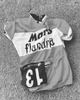
I'm reviving this discussion because I just came across a photo of Bernard Guyot taken in 1968 on his Sauvage-Lejeune-liveried bicycle, where you can see his initials engraved on the seatstay caps, the signature of a frame built by Bernard Carré for professionals of the time, such as Jan Janssen from the same team.


Jan Janssen, 1965
I'm reviving this discussion because I just came across a photo of Bernard Guyot taken in 1968 on his Sauvage-Lejeune-liveried bicycle, where you can see his initials engraved on the seatstay caps, the signature of a frame built by Bernard Carré for professionals of the time, such as Jan Janssen from the same team.
Jan Janssen, 1965



 02-13-26 | 01:12 PM
#40
Thread Starter
Senior Member
Joined: Aug 2010
Posts: 3,123
Likes: 98
From: Liberty, Missouri
Bikes: 1966 Paramount | 1971 Raleigh International | ca. 1970 Bernard Carre | 1989 Waterford Paramount | 2012 Boulder Brevet | 2019 Specialized Diverge
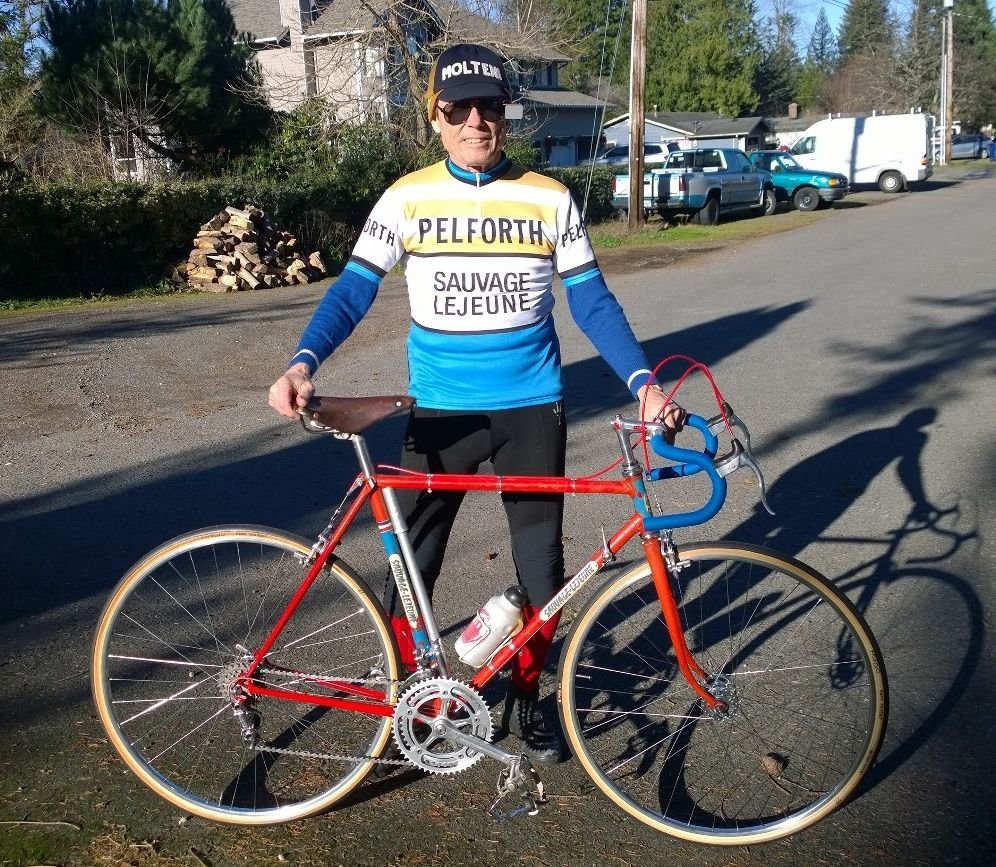
Wow, it's been almost nine years since I last responded to this thread I started. It was interesting to go back and re-read some of the early speculation, as well as the relevant information and photos that were shared along the way. In the beginning I tried several iterations with this frame. I eventually wound up building it entirely with French components (other than the Brooks Pro) - SLJ mechs, Stronglight crank, etc. It's been that way for several years now and I really don't anticipate further updates or mods, so here is my Carré for posterity:


 02-13-26 | 01:14 PM
#41
Full Member
Joined: Feb 2023
Posts: 241
Likes: 788
Bikes: Take a look, if you have the time, https://www.flickr.com/photos/8379107@N03/collections/72157603319548765/ time.
Could have been used for Randonnée, but really just a sport touring bike, as most were in the early 70s. To take wider tires and mudguards. Nothing specific about it to call it a Randonneur. Should be a nice all-around bike.
Here's a Carre bike I got a few years ago that was quite odd. The head angle was 70.5 and it only had 38mm of fork offset, producing a whopping 80mm of trail. I'm sure it was made this way, but I can't figure out why. All I can guess is, he wanted to give it some toe clearance, and it had a 54 cm top tube, but he didn't bother to pair it with the right fork. Steering was very heavy and I could not ride it down the road no hands. Too much "wheel flop". I added 17mm of offset to the fork, which shortened it, steepened the head angle, and also gave the top tube a slight slope, but now it has trail of 58-59 and handles perfectly, hands on or off the bars. I'm afraid I lost a bit of respect for this otherwise highly regarded builder, to have turned out a bike with such impossible front end geometry. Last pics show it after the modification.
P. JOZ by B. CARRE | Flickr

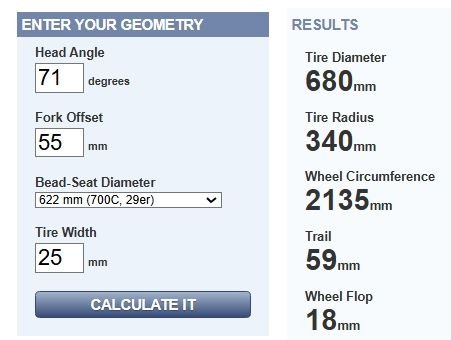
Here's a Carre bike I got a few years ago that was quite odd. The head angle was 70.5 and it only had 38mm of fork offset, producing a whopping 80mm of trail. I'm sure it was made this way, but I can't figure out why. All I can guess is, he wanted to give it some toe clearance, and it had a 54 cm top tube, but he didn't bother to pair it with the right fork. Steering was very heavy and I could not ride it down the road no hands. Too much "wheel flop". I added 17mm of offset to the fork, which shortened it, steepened the head angle, and also gave the top tube a slight slope, but now it has trail of 58-59 and handles perfectly, hands on or off the bars. I'm afraid I lost a bit of respect for this otherwise highly regarded builder, to have turned out a bike with such impossible front end geometry. Last pics show it after the modification.
P. JOZ by B. CARRE | Flickr
02-14-26 | 03:43 AM
#42

Senior Member


Joined: Jul 2020
Posts: 1,823
Likes: 1,492
From: Oakland, CA
La grande dame est belle!
Seriously, that's a really pretty bike.
Did you ever figure out what the original bike was all about?
Where / how / what for do you ride it, and how do she do on those rides?
Basically, just... more.
--Shannon
Seriously, that's a really pretty bike.
Did you ever figure out what the original bike was all about?
Where / how / what for do you ride it, and how do she do on those rides?
Basically, just... more.
--Shannon
02-14-26 | 04:44 AM
#43
Full Member
Joined: Feb 2023
Posts: 241
Likes: 788
Bikes: Take a look, if you have the time, https://www.flickr.com/photos/8379107@N03/collections/72157603319548765/ time.
Hello again everyone!
I'm reviving this discussion because I just came across a photo of Bernard Guyot taken in 1968 on his Sauvage-Lejeune-liveried bicycle, where you can see his initials engraved on the seatstay caps, the signature of a frame built by Bernard Carré for professionals of the time, such as Jan Janssen from the same team.
Jan Janssen, 1965
I'm reviving this discussion because I just came across a photo of Bernard Guyot taken in 1968 on his Sauvage-Lejeune-liveried bicycle, where you can see his initials engraved on the seatstay caps, the signature of a frame built by Bernard Carré for professionals of the time, such as Jan Janssen from the same team.
Jan Janssen, 1965

Bob Freeman
 02-14-26 | 05:12 AM
#44

Senior Member
Joined: Apr 2009
Posts: 3,808
Likes: 5,680
From: Seattle
The one thing that says not CX to me is the indent in the outside of the R chainstay is in the wrong place. It seems to be placed for a small chainring, like a touring bike.
When a CX bike had chain guards on both sides of the ring (though not all did of course), the indent had to clear the inner chain guard, which is bigger than the chainring. Needing a chainstay indent much further from the BB end.
Well, with fender eyes, make that two things.
When a CX bike had chain guards on both sides of the ring (though not all did of course), the indent had to clear the inner chain guard, which is bigger than the chainring. Needing a chainstay indent much further from the BB end.
Well, with fender eyes, make that two things.
02-14-26 | 06:56 AM
#45
Junior Member
Joined: Nov 2013
Posts: 108
Likes: 42
From: Aveyron, France
Bikes: Chiron
The one thing that says not CX to me is the indent in the outside of the R chainstay is in the wrong place. It seems to be placed for a small chainring, like a touring bike.
When a CX bike had chain guards on both sides of the ring (though not all did of course), the indent had to clear the inner chain guard, which is bigger than the chainring. Needing a chainstay indent much further from the BB end.
Well, with fender eyes, make that two things.
When a CX bike had chain guards on both sides of the ring (though not all did of course), the indent had to clear the inner chain guard, which is bigger than the chainring. Needing a chainstay indent much further from the BB end.
Well, with fender eyes, make that two things.
Why didn't B. Carré use his traditional finish, which is present here on the seatstay?
Along with the missing cable guide eyelet at the bottom of the seatstay, this might indicate that the frame has undergone modifications.
02-14-26 | 08:37 AM
#46
Thread Starter
Senior Member
Joined: Aug 2010
Posts: 3,123
Likes: 98
From: Liberty, Missouri
Bikes: 1966 Paramount | 1971 Raleigh International | ca. 1970 Bernard Carre | 1989 Waterford Paramount | 2012 Boulder Brevet | 2019 Specialized Diverge
@ShannonM, the short answer is nope. I never figured out what sort of bike this was intended to be, and as I've said before speculation runs rampant. Built her up in a way that suited my tastes and that I felt respected the heritage. It's fun to ride, and as I slowly passed along the vast majority of my collection over the years I've held on to this one. The gearing is a little tall for hills these days, but heck, that's just a reminder of what gearing used to be like in the olden days when I was a teenager.
02-14-26 | 09:56 AM
#47
If I own it, I ride it
Joined: Nov 2005
Posts: 5,686
Likes: 821
From: Cardinal Country
Bikes: Lejeune(14), Raleigh, Raysport, Jan De Reus, Gazelle, Masi, B. Carré(4), Springfield, Greg Lemond, Andre Bertin, Schwinn Paramount
The other unusual feature of this chainstay is that it corresponds to a standard domed and slotted version offered by Reynolds for an additional fee.
Why didn't B. Carré use his traditional finish, which is present here on the seatstay?
Along with the missing cable guide eyelet at the bottom of the seatstay, this might indicate that the frame has undergone modifications.
Why didn't B. Carré use his traditional finish, which is present here on the seatstay?
Along with the missing cable guide eyelet at the bottom of the seatstay, this might indicate that the frame has undergone modifications.

Thread
Thread Starter
Forum
Replies
Last Post
mapleleafs-13
Classic & Vintage
12
12-31-13 03:20 PM
