


For you Nerds
 03-04-18 | 11:55 AM
#26

Cyclotouriste


Joined: Aug 2009
Posts: 11,788
Likes: 7,008
From: South Holland, NL
Bikes: Yes, please.

 03-04-18 | 05:42 PM
#27

Thread Starter
What??? Only 2 wheels?
Joined: Apr 2010
Posts: 13,501
Likes: 994
From: Boston-ish, MA
Bikes: 72 Peugeot UO-8, 82 Peugeot TH8, 87 Bianchi Brava, 76? Masi Grand Criterium, 74 Motobecane Champion Team, 86 & 77 Gazelle champion mondial, 81? Grandis, 82? Tommasini, 83 Peugeot PF10
how much noise is there? what is the rms or peak value of the G readings while at rest?
Has the scale factor been checked in a basic way? i.e. place the sensor on a level surface in all 6 orientations (with the sensor's X, Y, and Z axes placed so that they are oriented with, and then against, the gravity vector), and verified that the reading is 1G in the selected axis, while the other axes read 0 G.
The size of the bumps encountered when these measurement were made wasn't disclosed, but I'm wondering if it makes sense that the longitudinal acceleration was nearly as great as the vertical acceleration.
Has the scale factor been checked in a basic way? i.e. place the sensor on a level surface in all 6 orientations (with the sensor's X, Y, and Z axes placed so that they are oriented with, and then against, the gravity vector), and verified that the reading is 1G in the selected axis, while the other axes read 0 G.
The size of the bumps encountered when these measurement were made wasn't disclosed, but I'm wondering if it makes sense that the longitudinal acceleration was nearly as great as the vertical acceleration.
The accelerometer really is very quiet, much quieter than the values in those graphs. If I rotate it 90deg the values on the non-vertical axes really do zero out as expected. In other words, to well within the precision shown in those measurements it is quite accurate, or at least sufficiently precise, non-noisy, and accurate. The basic scale can be seen by the fact that it reads 1 in the vertical direction, and the claimed resolution is .008g IIRC.
The limitation for this kind of work seems to be the sampling rate 50Hz. (The spec says "200 samples/sec burst mode" but I don't yet know how to do that or how to record it.)
The bumps I encountered were mostly small, under, say, two inches because I don't like abusing my wheels. It does make sense that the longitudinal variation was so large, for just the same reason a well-sailed catamaran can go much faster than the wind when sailing obliquely to it. Until the comparatively massive rider and bike begin to move upward at a bump the wheel is constrained to move in whatever arc the flexing of the fork allows it to move. With a large angle between thrust and movement arc the wheel must move significantly more horizontally to accommodate any vertical movement.
The question of whether the added mass of the sensor on the DO affected the response is a valid one. I assumed that it was so light and the mount so rigid that its mass had no effect. I checked that today with two experiments. First I mounted the sensor and flicked it with my finger. The recorded result was just a single pulse in all cases. That tells me that if it resonates at all then it is at a frequency and decay rate too high to be seen in the 50Hz sampling rate. Then I mounted my Galaxy phone to the top of the stem, started Kewlsoft's accelerometer program, lifted the bike by the stem and thumped the tire with a rubber mallet. Kewlsoft's program (or the accelerometer in the phone) seems to have a sampling rate about 410 samples/sec, so there should be no Nyquist Frequency interference for this experiment. I measured the Bianchi's fork with and without the sensor, then swapped the wheel for a sew-up wheel that normally lives on my Motobecane. The three results are shown here, a sloppily thrown together composite of three graphs:
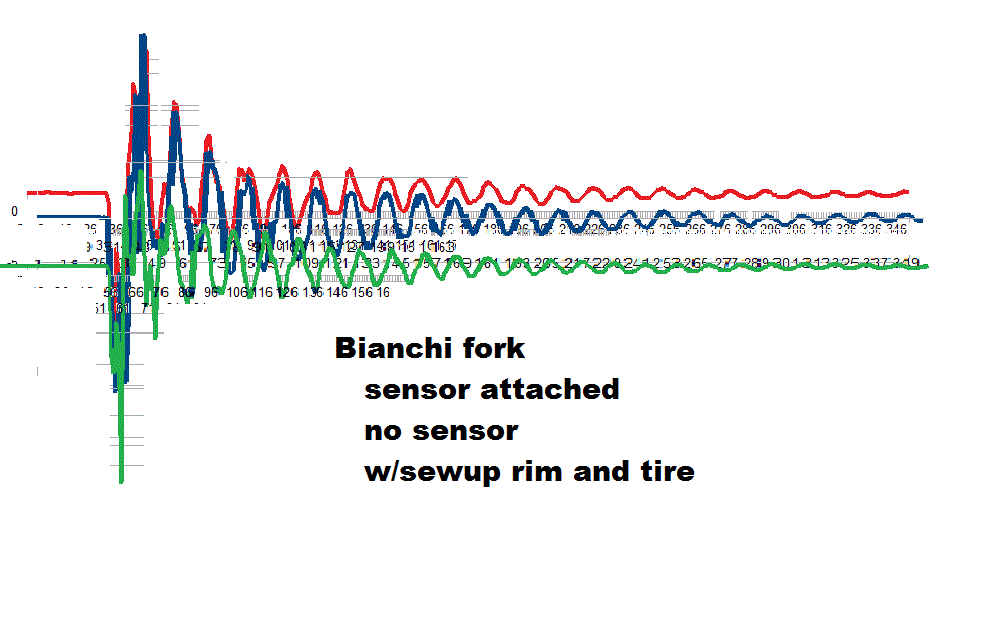
The oscillation frequency and decay rate are essentially identical with or without the sensor. With the lighter sew-up wheel the frequency is slightly but observably higher, not a surprise.
Then I did the same test for several other bikes in the basement. It is a flawed experiment in that mounting the phone firmly to the stem is not easy. All (I think) of the bikes have a handlebar bag attached which could have affected how the front end resonates, though the effect should be minimal because the bags are light and empty and not solidly attached. The results are shown here:

The Grandis with slightly heavier clincher wheels has a slight lower frequency than the Bianch, Moto, or Masi with sew-ups. (The Masi fork is stamped Reynolds; I don't know what the others are.) The curious one is the Peugeot PFN-10, Vitus 181 tubing and a seamed fork. The behavior seems to be bimodal and decays much faster, but I have no measurement value to prove that and the starting amplitudes are not normalized. (I wonder, is the headset loose? Have to check!)
It appears that the Bianchi's frequency is more like 29Hz, not the 17Hz I posted yesterday. I had tried to read that 17Hz from a decaying frequency response graph but obviously misjudged the point on the graph. It is above the Nyquist frequency of the Pocketlab (in non-burst mode) so any behavior above about 20 Hz can't be judged from the Pocketlab data.
I'd like to investigate the shape of bump response with more data by riding slower tomorrow, but dang they are predicting 1-2 inches of snow tonight.
__________________
Real cyclists use toe clips.
With great bikes comes great responsibility.
jimmuller
Real cyclists use toe clips.
With great bikes comes great responsibility.
jimmuller
Last edited by jimmuller; 03-05-18 at 05:40 AM.
 03-04-18 | 06:53 PM
#29
Thread Starter
What??? Only 2 wheels?
Joined: Apr 2010
Posts: 13,501
Likes: 994
From: Boston-ish, MA
Bikes: 72 Peugeot UO-8, 82 Peugeot TH8, 87 Bianchi Brava, 76? Masi Grand Criterium, 74 Motobecane Champion Team, 86 & 77 Gazelle champion mondial, 81? Grandis, 82? Tommasini, 83 Peugeot PF10

__________________
Real cyclists use toe clips.
With great bikes comes great responsibility.
jimmuller
Real cyclists use toe clips.
With great bikes comes great responsibility.
jimmuller
03-05-18 | 12:37 AM
#30

Master Parts Rearranger

Joined: Mar 2015
Posts: 4,846
Likes: 2,800
From: Portlandia's Kuiper Belt, OR
Bikes: 1987 Woodrup Competition - 2025 Trek Checkpoint SL 6 Gen 3 - 1987 Lotus Legend - 2024 Trek Emonda ALR Rim Brake - 1980 Trek 510 - 1988 Cannondale SR500 - 1985 Trek 670 - 1982 Trek 730
Why am I thinking rim type (clincher, tubular) and/or design (box,semi-aero, deep V) plus tire type could also be a significant factor in this???
03-05-18 | 02:01 AM
#31

Full Member

Joined: Mar 2017
Posts: 242
Likes: 89
From: Arnhem NL
Bikes: Might as well, now that I am here...
Nice experiments, and nice device.
In fact, I immediately looked up the PocketLab and might purchase one for school. You know, for kids! ehm, science! :-)
I will try and follow this thread. Like!
In fact, I immediately looked up the PocketLab and might purchase one for school. You know, for kids! ehm, science! :-)
I will try and follow this thread. Like!
03-05-18 | 04:55 AM
#32

Senior Member
Joined: Jan 2015
Posts: 3,241
Likes: 106
I've noticed that some bikes are more comfortable to ride than others. In that they seem to transmit less shock and vibration through the handlebars than others. While the science of measuring all this does make my head spin a bit, it would be interesting for me to know why this is. I'm afraid I would need a more common man brake down to make sense of it though.
03-05-18 | 07:13 AM
#33

tantum vehi
Joined: Jul 2008
Posts: 4,621
Likes: 1,316
From: Flathead Valley, MT
Bikes: More than I care to admit
+1. I was also thinking of comparing different forks and their flex characteristics.
__________________
Regular rides:
1977 Austro-Daimler Inter-10 (an experiment in valley-floor road riding)
1979 Trek 710 (first frame-up build)
1984 Specialized Stumpjumper Sport (daily driver)
1984 Peugeot Urban Express (funky rando-esque 26" gravel grinder)
2014 Salsa Mukluk (daily winter driver)
2015 Elephant NFE (Gugiefied gravel grinder)
2019 Electric Queen (first "real" MTB)
2024 Salsa Blackthorn (summer slayer of trails)
2024 Farley 9.6 (winter slayer of trails)
1977 Austro-Daimler Inter-10 (an experiment in valley-floor road riding)
1979 Trek 710 (first frame-up build)
1984 Specialized Stumpjumper Sport (daily driver)
1984 Peugeot Urban Express (funky rando-esque 26" gravel grinder)
2014 Salsa Mukluk (daily winter driver)
2015 Elephant NFE (Gugiefied gravel grinder)
2019 Electric Queen (first "real" MTB)
2024 Salsa Blackthorn (summer slayer of trails)
2024 Farley 9.6 (winter slayer of trails)
03-05-18 | 08:22 PM
#34


Could we please get this investigation properly focused: on "planing"?


 03-05-18 | 09:09 PM
#37
If the front axle is being accelerated forward, what would happen to a straight fork with little to no rake?
03-05-18 | 10:04 PM
#38

Senior Member
Joined: May 2012
Posts: 5,050
Likes: 4,905
From: Point Reyes Station, California
Bikes: Indeed!
Interesting. I presume you’ve heard of the International Roughness Index pertaining to roadways?
https://en.m.wikipedia.org/wiki/Inte...oughness_Index
https://en.m.wikipedia.org/wiki/Inte...oughness_Index
The automobile index "is based on the concept of a 'golden car' whose suspension properties are known." I'm sure we can all have some fine battles over which is the "golden" bicycle!
Brent
03-05-18 | 10:37 PM
#39
tantum vehi
Joined: Jul 2008
Posts: 4,621
Likes: 1,316
From: Flathead Valley, MT
Bikes: More than I care to admit
Unless the head tube is 90 deg., you will still get some forward acceleration when hitting a bump. If I understood the words above, it reduces the maximum size of the bump that will still produce forward acceleration versus transferring the energy directly to the headset.
__________________
Regular rides:
1977 Austro-Daimler Inter-10 (an experiment in valley-floor road riding)
1979 Trek 710 (first frame-up build)
1984 Specialized Stumpjumper Sport (daily driver)
1984 Peugeot Urban Express (funky rando-esque 26" gravel grinder)
2014 Salsa Mukluk (daily winter driver)
2015 Elephant NFE (Gugiefied gravel grinder)
2019 Electric Queen (first "real" MTB)
2024 Salsa Blackthorn (summer slayer of trails)
2024 Farley 9.6 (winter slayer of trails)
1977 Austro-Daimler Inter-10 (an experiment in valley-floor road riding)
1979 Trek 710 (first frame-up build)
1984 Specialized Stumpjumper Sport (daily driver)
1984 Peugeot Urban Express (funky rando-esque 26" gravel grinder)
2014 Salsa Mukluk (daily winter driver)
2015 Elephant NFE (Gugiefied gravel grinder)
2019 Electric Queen (first "real" MTB)
2024 Salsa Blackthorn (summer slayer of trails)
2024 Farley 9.6 (winter slayer of trails)
03-05-18 | 10:42 PM
#40
Master Parts Rearranger
Joined: Mar 2015
Posts: 4,846
Likes: 2,800
From: Portlandia's Kuiper Belt, OR
Bikes: 1987 Woodrup Competition - 2025 Trek Checkpoint SL 6 Gen 3 - 1987 Lotus Legend - 2024 Trek Emonda ALR Rim Brake - 1980 Trek 510 - 1988 Cannondale SR500 - 1985 Trek 670 - 1982 Trek 730
I've noticed that some bikes are more comfortable to ride than others. In that they seem to transmit less shock and vibration through the handlebars than others. While the science of measuring all this does make my head spin a bit, it would be interesting for me to know why this is. I'm afraid I would need a more common man brake down to make sense of it though.
Big waves/spikes = big shocks, small waves = small shocks.
The lessening, or dissipation, of those waves from big to small, is the damping ability of the fork, hub, spokes, rim, tube, tire and tire pressure in totality.
Some things we know through experience or through intuition, what dampens vibration better than others. Whether that be fork angle, offset/rake, and type of bend (from straight blade to hockey stick to "Masi"). Whether that be box section rims, Weinmann cconcaves, or deep V. Many spokes or few, straight gauge or double butted. Tubular or clincher tires. Large volume Compass 42s or pumped up 23mm Specialized Armadillos.
As with many of us here on C&V, we may know what works better or what we like, but we love breaking it down to "origin points" of why. If we can chart it on a graph with a curve, then we can find the "true" "on paper" "most ideal" solution, given that such a result is possible for a given bicycle or component purpose. It isn't full finite element analysis, but it's a lot better than guessing. And something in me says that this level of data collection and analysis is plenty good "resolution" compared to a potentially fun-killing FEA with exhaustive results. We shall see!

Though, seriously, I would think a potentially helpful enough test could be (this is a rough draft here):
1) Take rider size. Height, weight, leg geometry, possible force exertion (do a leg press at the gym to find out)
2) Take rider's favorite bike that planes, with a description of when it does (spinning, grinding, out-of-saddle climbing or accelerating)
3) Record said bike's angles, lengths, components, tire pressures, tubing type, weight, crank length and Q-factor
4) a) Install crankset with power meter b) place bike on pressure-reading surface c) stabilize rider, cranks at 9:00/3:00, brakes clamped hard (no movement) d) right crank arm forward, press hard on it with foot, repeating with the left crank arm forward
OR
Have the front wheel in a cradle to disallow forward movement (while still able to rock from side to side) and have the rear wheel on rollers (bike level). In-saddle or out-of-saddle testing. Record the energy put into the bike frame and then record that 'rebound' (speed, severity). See if there is a rider weight
 ower:frame type correlation.
 Hahaha, ok. That's a million variables. I might as well be trying to catch clouds in a wicker basket, but I'm trying.
03-05-18 | 10:49 PM
#41
tantum vehi
Joined: Jul 2008
Posts: 4,621
Likes: 1,316
From: Flathead Valley, MT
Bikes: More than I care to admit

__________________
Regular rides:
1977 Austro-Daimler Inter-10 (an experiment in valley-floor road riding)
1979 Trek 710 (first frame-up build)
1984 Specialized Stumpjumper Sport (daily driver)
1984 Peugeot Urban Express (funky rando-esque 26" gravel grinder)
2014 Salsa Mukluk (daily winter driver)
2015 Elephant NFE (Gugiefied gravel grinder)
2019 Electric Queen (first "real" MTB)
2024 Salsa Blackthorn (summer slayer of trails)
2024 Farley 9.6 (winter slayer of trails)
1977 Austro-Daimler Inter-10 (an experiment in valley-floor road riding)
1979 Trek 710 (first frame-up build)
1984 Specialized Stumpjumper Sport (daily driver)
1984 Peugeot Urban Express (funky rando-esque 26" gravel grinder)
2014 Salsa Mukluk (daily winter driver)
2015 Elephant NFE (Gugiefied gravel grinder)
2019 Electric Queen (first "real" MTB)
2024 Salsa Blackthorn (summer slayer of trails)
2024 Farley 9.6 (winter slayer of trails)
03-06-18 | 06:22 AM
#42
Thread Starter
What??? Only 2 wheels?
Joined: Apr 2010
Posts: 13,501
Likes: 994
From: Boston-ish, MA
Bikes: 72 Peugeot UO-8, 82 Peugeot TH8, 87 Bianchi Brava, 76? Masi Grand Criterium, 74 Motobecane Champion Team, 86 & 77 Gazelle champion mondial, 81? Grandis, 82? Tommasini, 83 Peugeot PF10
Thank you all for showing interest. It does motivate me to continue. @SJX426 asked about the difficulty of data collection. The answer is yes. One thing I discovered is that recording most of my commute generates LOTS of data which is tedious to sort through. But I do have a few ideas to enhance the result. Also my sweetie (Sharon) has gotten interested and wants to help, so tasks requiring more than two hands will be easier! In a previous computer-life I would have written a data analysis program but I'm not sure MSVC++ will run on my current machine. I've never mastered formulas in Excel but I guess this is as good a time as any.
So here is what I am "planing" to do. First I need to replicate the first experiments and check the math to make sure I didn't do stipud thingsome. Then I'd like to take measurements that can be related directly to bike behavior. For example, vary the tire pressure, measure some nearby bump(s) and try them on different bikes, compare HT (or stem) accelerations to axle accelerations, compare clinchers to sew-ups on the same bike, measure fork and frame oscillations while it is carrying my weight instead of unweighted.
A different set of measurements would be on the BB under various conditions. Not sure how I'd do that yet. An interesting result might be if BB resonance frequency is close to the fork/frame longitudinal frequency.
Several of you have raised good questions about differences in forks. [MENTION=65634]leftthread[/MENTION], regarding a straight fork, the geometry diagram shown in my initial post is valid regardless of the shape of the fork between HT and axle. Bump height still creates a thrust angle the same way. Zero rake would lessen the effect but not make it go away because the head angle still makes the contact patch be behind a line from axle to the bottom of the HT. What is different with fork shape is where or how it could flex. A conventional tapered fork would seem to have progressive stiffness, softer further down. So the effective flex point would seem to be lower than the HT, meaning the quasi-center of whatever arc the wheel can move in is lower and the fork itself would feel softer. A straight fork would seemingly bend mostly at the crown and force the frame to deform (and oscillate) in a shifting-trapezoidal mode, probably quite stiff. At the other extreme of thought experiment you can imagine a fork with an exaggerated S-shape bend between HT and axle, essentially a large spring. More length would give it a lower spring rate. The geometry of thrust angle would still be the same, but the wheel would not be as constrained to travel in an arc. Since I don't own a straight-fork bike I don't "plane" to check that.
One thing I discovered is that recording most of my commute generates LOTS of data which is tedious to sort through. But I do have a few ideas to enhance the result. Also my sweetie (Sharon) has gotten interested and wants to help, so tasks requiring more than two hands will be easier! In a previous computer-life I would have written a data analysis program but I'm not sure MSVC++ will run on my current machine. I've never mastered formulas in Excel but I guess this is as good a time as any.So here is what I am "planing" to do. First I need to replicate the first experiments and check the math to make sure I didn't do stipud thingsome. Then I'd like to take measurements that can be related directly to bike behavior. For example, vary the tire pressure, measure some nearby bump(s) and try them on different bikes, compare HT (or stem) accelerations to axle accelerations, compare clinchers to sew-ups on the same bike, measure fork and frame oscillations while it is carrying my weight instead of unweighted.
A different set of measurements would be on the BB under various conditions. Not sure how I'd do that yet. An interesting result might be if BB resonance frequency is close to the fork/frame longitudinal frequency.
Several of you have raised good questions about differences in forks. [MENTION=65634]leftthread[/MENTION], regarding a straight fork, the geometry diagram shown in my initial post is valid regardless of the shape of the fork between HT and axle. Bump height still creates a thrust angle the same way. Zero rake would lessen the effect but not make it go away because the head angle still makes the contact patch be behind a line from axle to the bottom of the HT. What is different with fork shape is where or how it could flex. A conventional tapered fork would seem to have progressive stiffness, softer further down. So the effective flex point would seem to be lower than the HT, meaning the quasi-center of whatever arc the wheel can move in is lower and the fork itself would feel softer. A straight fork would seemingly bend mostly at the crown and force the frame to deform (and oscillate) in a shifting-trapezoidal mode, probably quite stiff. At the other extreme of thought experiment you can imagine a fork with an exaggerated S-shape bend between HT and axle, essentially a large spring. More length would give it a lower spring rate. The geometry of thrust angle would still be the same, but the wheel would not be as constrained to travel in an arc. Since I don't own a straight-fork bike I don't "plane" to check that.
__________________
Real cyclists use toe clips.
With great bikes comes great responsibility.
jimmuller
Real cyclists use toe clips.
With great bikes comes great responsibility.
jimmuller
03-06-18 | 08:20 AM
#43
Senior Member
Joined: May 2008
Posts: 10,106
Likes: 2,760
From: Fredericksburg, Va
Bikes: ? Proteous, '65 Frejus TDF, '73 Bottecchia Giro d'Italia, '83 Colnago Superissimo, '84 Trek 610, '84 Trek 760, '88 Pinarello Veneto, '88 De Rosa Pro, '89 Pinarello Montello, 'Litespeed Catalyst'94 Burley Duet, 97 Specialized RockHopper, 2010 Langster
03-06-18 | 12:57 PM
#45

Senior Member

Joined: Jul 2008
Posts: 30,484
Likes: 4,563
From: 25 miles northwest of Boston
Bikes: Bottecchia Sprint, GT Timberline 29r, Marin Muirwoods 29er, Trek FX Alpha 7.0
can this thing confirm that a mountain bike w slicks can accelerate faster than a 700c wheeled bike?
 03-06-18 | 06:05 PM
#47
Thread Starter
What??? Only 2 wheels?
Joined: Apr 2010
Posts: 13,501
Likes: 994
From: Boston-ish, MA
Bikes: 72 Peugeot UO-8, 82 Peugeot TH8, 87 Bianchi Brava, 76? Masi Grand Criterium, 74 Motobecane Champion Team, 86 & 77 Gazelle champion mondial, 81? Grandis, 82? Tommasini, 83 Peugeot PF10
What I really need is some free time and a round tuit. I ordered a crate of free time and the special offer included an additional free 15 minutes absolutely free. But so far it hasn't been shipped yet.
__________________
Real cyclists use toe clips.
With great bikes comes great responsibility.
jimmuller
Real cyclists use toe clips.
With great bikes comes great responsibility.
jimmuller
03-06-18 | 08:01 PM
#48
Senior Member


Joined: Dec 2005
Posts: 18,793
Likes: 11,573
I would guess your shipper is waiting for some free time to complete that job.
03-07-18 | 02:31 AM
#50
Master Parts Rearranger
Joined: Mar 2015
Posts: 4,846
Likes: 2,800
From: Portlandia's Kuiper Belt, OR
Bikes: 1987 Woodrup Competition - 2025 Trek Checkpoint SL 6 Gen 3 - 1987 Lotus Legend - 2024 Trek Emonda ALR Rim Brake - 1980 Trek 510 - 1988 Cannondale SR500 - 1985 Trek 670 - 1982 Trek 730