


Thoughts on respacing/aligning a Miyata Two Ten
 12-29-18 | 07:34 PM
#1

Thread Starter
Eccentric Old Man


Joined: Jan 2014
Posts: 727
Likes: 177
From: BelleVegas, IL
Bikes: 1986 Trek 520 Cirrus, 1979 Schwinn Traveler III, Trek T100, 1995 Trek 970, Fuji America
Thoughts on respacing/aligning a Miyata Two Ten
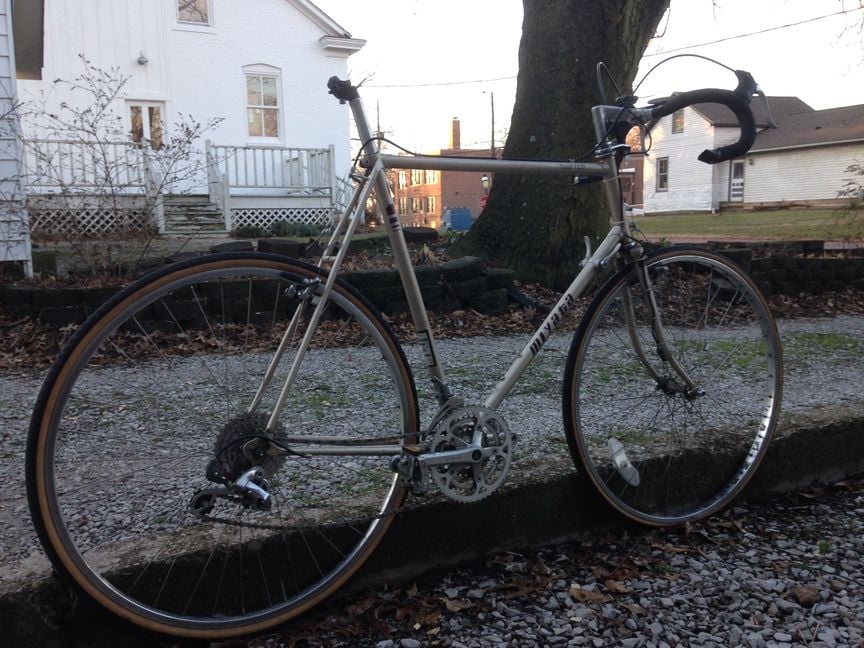
Bike in question.
A Two Ten I picked up on Craigslist 3 or so years ago. Serial # 0A 38005 so 1986?
Rear wheel is 630 bsd Sun CR18 rim with a Deore XT hub spaced at 135. 7 speed loose cog cassette, 13-15-17-20-24-29-34. Chainrings, 50-38-24. UN-53 bottom bracket.
Previous owner remade the bike for his use, as well he should have.
Rear is 135 wide but not straight. I have never cold set a frame. Time to learn. Per St. Sheldon I have my string & 2x4 ready.
I assume frame was 126 to start. Going to 135 seems a stretch to me. Was it too far?
Back to 130? (I realize need different rear wheel if I reduce the width.)
Make it straight at 135 and declare success?
Thanks
 12-29-18 | 07:47 PM
#2

Senior Member
Joined: Sep 2012
Posts: 3,699
Likes: 581
From: Toronto, ON, Canada
Are you keeping the rear wheel or do you want to go for a 130mm road wheel? Depends on your plans for the bike and what level of groupset. Freebub cassette starts at 7 speed and 130mm. In general 126mm constrains you to 6 and 7 speed freewheel (although there are 126mm cassette hubs).
Since it is already 135 i would make it a straight 130 and make a wheelset around some road spaced 130mm hubs.
Since it is already 135 i would make it a straight 130 and make a wheelset around some road spaced 130mm hubs.
12-29-18 | 08:43 PM
#4

Phyllo-buster

Joined: Jan 2010
Posts: 9,271
Likes: 2,696
From: Nova Scotia
Bikes: roadsters, club bikes, fixed and classic
12-30-18 | 12:58 PM
#5
Senior Member

Joined: Nov 2004
Posts: 23,212
Likes: 3,123
I cringe every time somebody mentions the Sheldon 2x4 method. I find that the shaft from a broken wooden hockey stick is far more efficient as a tool for cold setting bicycle frames. A 2x4 is unwieldy. The ergonomically sized hockey stick shaft makes it far easier to modulate force, resulting in less trial and error. At this time of year, there is typically a ready supply available for free, around the dumpster area outside ice skating rinks.
12-30-18 | 01:55 PM
#6
Thread Starter
Eccentric Old Man
Joined: Jan 2014
Posts: 727
Likes: 177
From: BelleVegas, IL
Bikes: 1986 Trek 520 Cirrus, 1979 Schwinn Traveler III, Trek T100, 1995 Trek 970, Fuji America
I cringe every time somebody mentions the Sheldon 2x4 method. I find that the shaft from a broken wooden hockey stick is far more efficient as a tool for cold setting bicycle frames. A 2x4 is unwieldy. The ergonomically sized hockey stick shaft makes it far easier to modulate force, resulting in less trial and error. At this time of year, there is typically a ready supply available for free, around the dumpster area outside ice skating rinks.
Will keep an eye out for a hockey stick but not common I my life.
Can I do this with the frame in a repair stand or do I have to lay it on the floor?
12-30-18 | 03:22 PM
#7

Senior Member

Joined: Jan 2015
Posts: 5,825
Likes: 3,404
From: Los Angeles
Bikes: 82 Medici, 85 Ironman, 2011 Richard Sachs
Maybe it is not straight to avoid the crankset. If you keep it 135, will the dropouts need to move to the drive side? Make sure you have clearance.
12-30-18 | 03:57 PM
#8
Thread Starter
Eccentric Old Man
Joined: Jan 2014
Posts: 727
Likes: 177
From: BelleVegas, IL
Bikes: 1986 Trek 520 Cirrus, 1979 Schwinn Traveler III, Trek T100, 1995 Trek 970, Fuji America
Thanks for the heads up.
I am going to wait a little longer to see if any more things I didn't know or consider are pointed out. Don't want to hear from Red Forman
Thanks again
12-31-18 | 10:39 AM
#9

Senior Member
Joined: Apr 2007
Posts: 12,565
Likes: 2,740
From: Thunder Bay, Ontario, Canada - burrrrr!
Bikes: 1958 Rabeneick 120D, 1968 Legnano Gran Premio, 196? Torpado Professional, 2000 Marinoni Piuma
I have cold set stays many times using the String Method to ensure center line symmetry...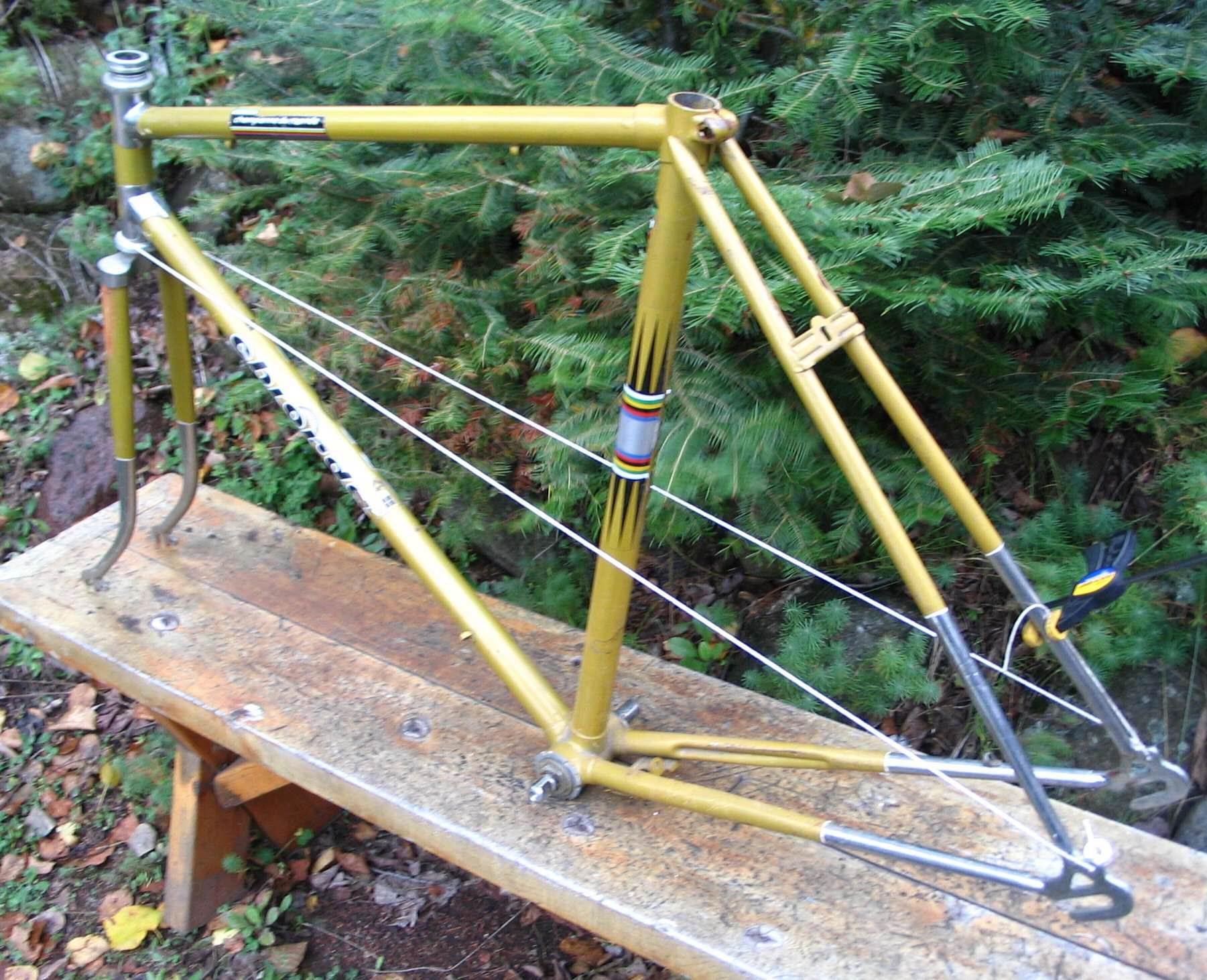
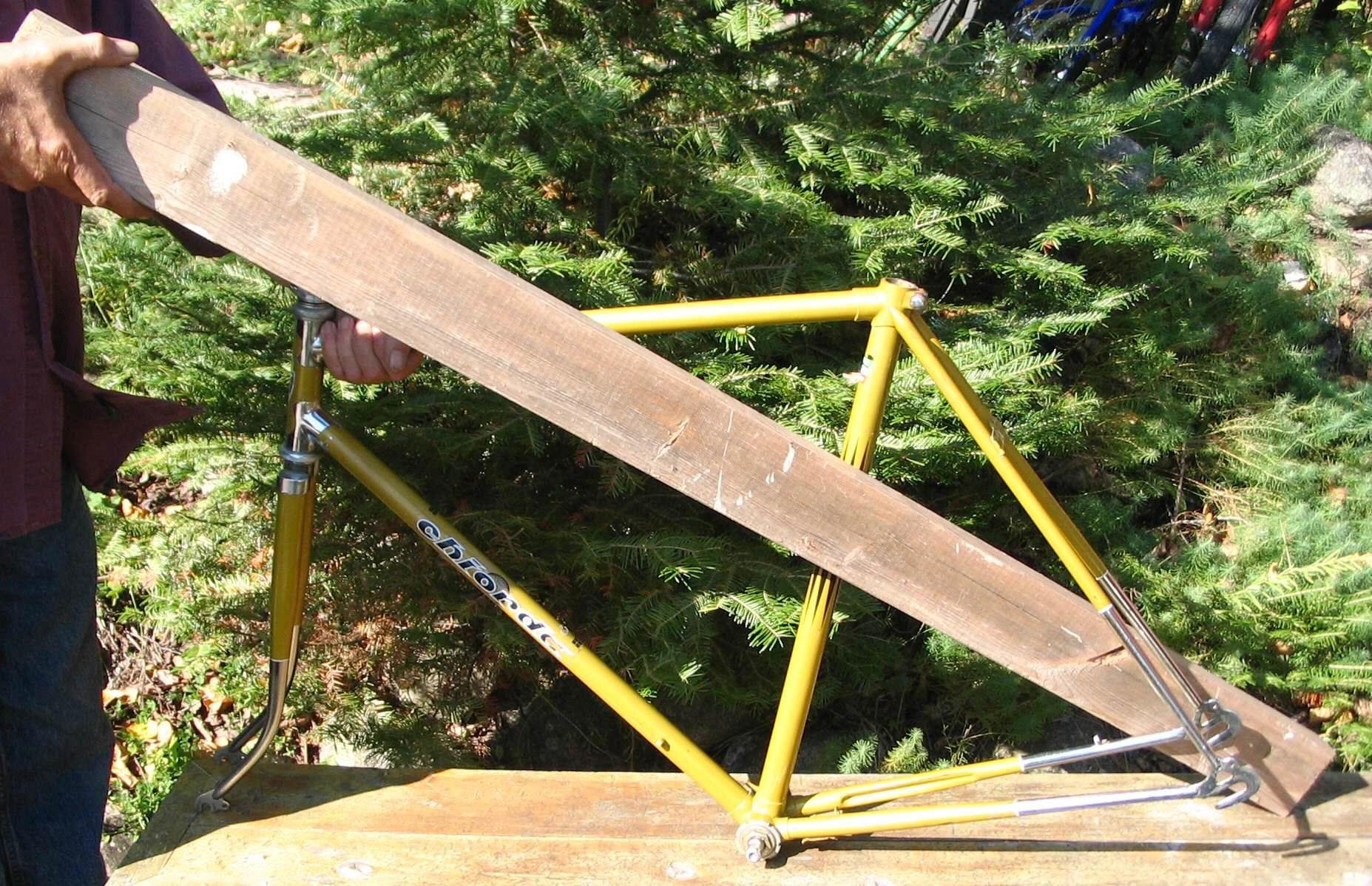
And the two by four is the perfect tool for the job...
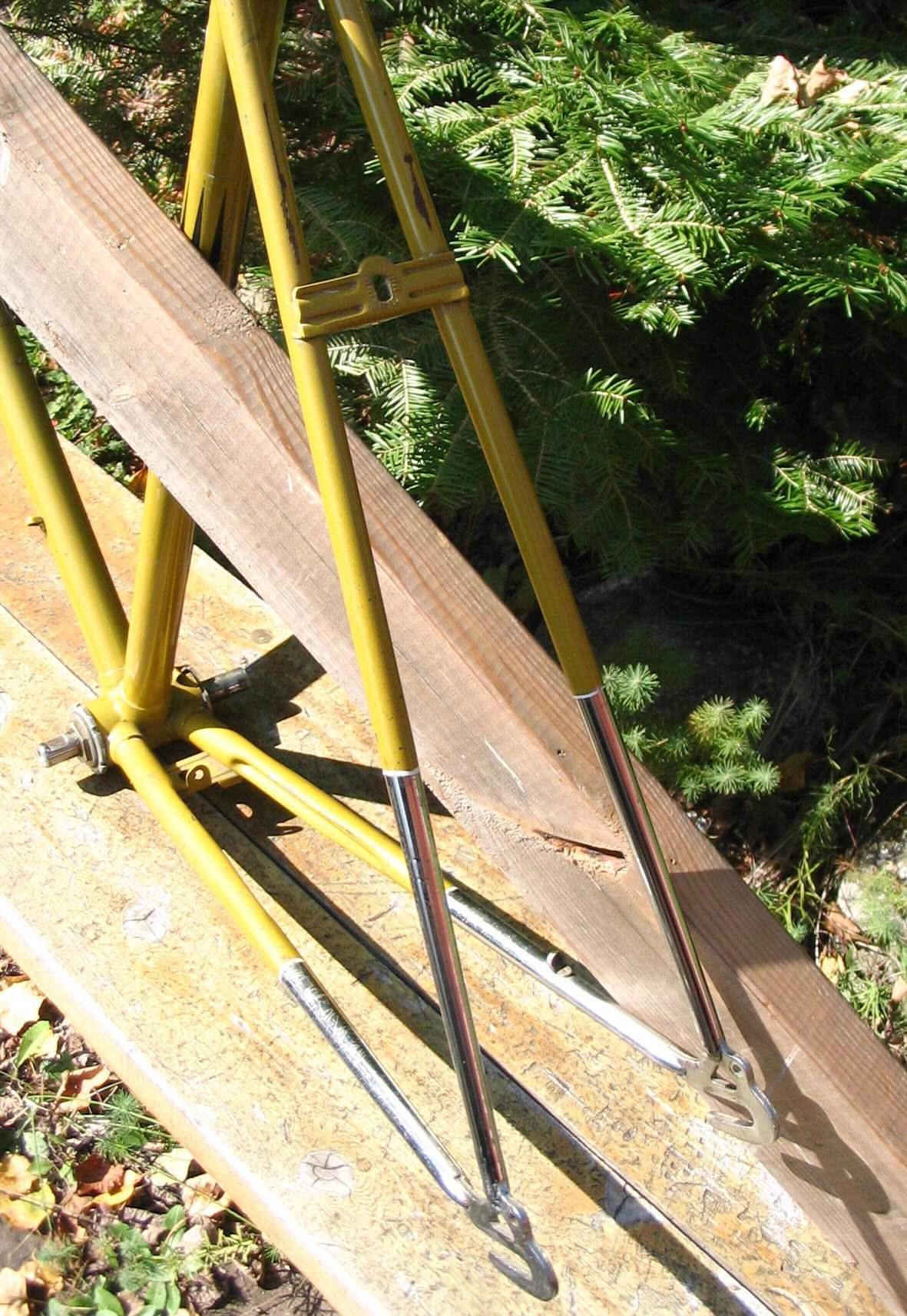
And the two by four is the perfect tool for the job...
__________________
"98% of the bikes I buy are projects".
"98% of the bikes I buy are projects".
12-31-18 | 10:56 AM
#10

Senior Member
Joined: Nov 2010
Posts: 22,994
Likes: 10,498
From: Sacramento, CA
Bikes: old ones
In this way, you can have the stays pointing out toward you as you face the workbench. This makes it easier to see what's going on with the dropouts, and you can measure the width/ align them for parallel with ease. The place where you measure the string distance from the seat tube is right over the vise, so easily measured on each side. As a bonus, you can often respace a frame simply by grabbing both stays on one side or the other with your hands, and pushing hard against them for a small nudge either outward or inward.
Anyway, if you have access to a solid bench vise, try it. It doesn't have to be all that big a vise, but it does need to be mounted to something that will stay put and not slide around, which is the problem trying to do this in a workstand.
12-31-18 | 11:20 AM
#11
Senior Member
Joined: Apr 2007
Posts: 12,565
Likes: 2,740
From: Thunder Bay, Ontario, Canada - burrrrr!
Bikes: 1958 Rabeneick 120D, 1968 Legnano Gran Premio, 196? Torpado Professional, 2000 Marinoni Piuma
Can I do this with the frame in a repair stand or do I have to lay it on the floor?
__________________
"98% of the bikes I buy are projects".
"98% of the bikes I buy are projects".

