


Snakes Under The Paint - Cause for Concern?
 01-11-19 | 03:53 PM
#1

Thread Starter
Full Member


Joined: Jun 2017
Posts: 219
Likes: 68
From: Northern CA
Bikes: 1971 Gitane TDF, 1974 Gitane Interclub, 2001 Serotta Rapid Tour CS3, 1986 Bruce Gordon touring bike, 1972 Gitane Super Corsa, 1978 Michal Johnson, 1972 Lambert Professional Grand Prix, 1983 Vitus (resto project), 1972 Raleigh Professional (resto)
Snakes Under The Paint - Cause for Concern?
Am overhauling an early 70s road bike that has some corrosion in the usual places. However, there are some "snakes under the paint" on the underside of the downtube with no obvious entry or exit points. My question is should this be a cause for concern or just a minor cosmetic issue? I'm addressing rust that has surfaced with judicious use of a trusty Dremel tool and sandpaper so I could go after the biggest offending snakes if they will pose a major problem in the future.
Advice sought and appreciated!
Advice sought and appreciated!
 01-11-19 | 04:57 PM
#2
framebuilder

Joined: Dec 2009
Posts: 1,790
Likes: 2,712
From: Niles, Michigan
I'm a builder and painter and when I've seen this before, it's usually because the tube is rusting from the inside out. So most likely it is not just a cosmetic issue but a serious cancer. That doesn't mean it will die soon and if you ride it, it will break catastrophically and you will die too. What happens is that there is not uniform rusting so the whole tube is thin. Rather after awhile small holes will appear (and maybe they have already) along the worm areas. However it only makes sense to start planing now for its replacement and keep a close eye and any developments. There are options to fix it but not cheaply.
Sometimes when it is painted they haven't used a primer 1st as a base so the paint is not sticking tight to the steel and water gets in there to start the damage. This is more often true with powder coating.
Sometimes when it is painted they haven't used a primer 1st as a base so the paint is not sticking tight to the steel and water gets in there to start the damage. This is more often true with powder coating.
01-11-19 | 05:05 PM
#3

Senior Member

Joined: Oct 2005
Posts: 1,885
Likes: 843
From: Santa Barbara Calif.
I'm a builder and painter and when I've seen this before, it's usually because the tube is rusting from the inside out. So most likely it is not just a cosmetic issue but a serious cancer. That doesn't mean it will die soon and if you ride it, it will break catastrophically and you will die too. What happens is that there is not uniform rusting so the whole tube is thin. Rather after awhile small holes will appear (and maybe they have already) along the worm areas. However it only makes sense to start planing now for its replacement and keep a close eye and any developments. There are options to fix it but not cheaply.
Sometimes when it is painted they haven't used a primer 1st as a base so the paint is not sticking tight to the steel and water gets in there to start the damage. This is more often true with powder coating.
Sometimes when it is painted they haven't used a primer 1st as a base so the paint is not sticking tight to the steel and water gets in there to start the damage. This is more often true with powder coating.
01-11-19 | 05:11 PM
#4
Car free since 2018
Joined: Aug 2017
Posts: 778
Likes: 346
From: Vancouver, BC
Bikes: Mostly japanese ones
Any chance of a picture? I googled "snakes under the paint" and I got a lot of pictures of snakes. Also tried "rust worms" and got lots of pictures of worms.
I have a frame with a few thread like marks on it and I was wondering if this is the same thing.
I have a frame with a few thread like marks on it and I was wondering if this is the same thing.
01-11-19 | 05:24 PM
#5

Senior Member


Joined: Oct 2015
Posts: 16,142
Likes: 9,516
From: PDX
Bikes: Merz x 5 + Specialized Merz Allez x 2, Strawberry/Newlands/DiNucci/Ti x3, Gordon, Fuso/Moulton x2, Bornstein, Paisley,1958-74 Paramounts x3, 3rensho, 74 Moto TC, 73-78 Raleigh Pro's x5, Marinoni x2, 1960 Cinelli SC, 1980 Bianchi SC, PX-10 X 2
As Doug points out, it's not good. As a frame builder they see more than their share and often have to break the bad news to folks that don't want to hear it.
I have seen the worms find a weak spot that remains undetected until it was really bad. It can go inward and not seem bad, then the pinholes show up.
There's usually more than you think once you start looking for it, way more.
I have seen the worms find a weak spot that remains undetected until it was really bad. It can go inward and not seem bad, then the pinholes show up.
There's usually more than you think once you start looking for it, way more.
 01-11-19 | 05:37 PM
#6
Senior Member
Joined: Oct 2015
Posts: 16,142
Likes: 9,516
From: PDX
Bikes: Merz x 5 + Specialized Merz Allez x 2, Strawberry/Newlands/DiNucci/Ti x3, Gordon, Fuso/Moulton x2, Bornstein, Paisley,1958-74 Paramounts x3, 3rensho, 74 Moto TC, 73-78 Raleigh Pro's x5, Marinoni x2, 1960 Cinelli SC, 1980 Bianchi SC, PX-10 X 2
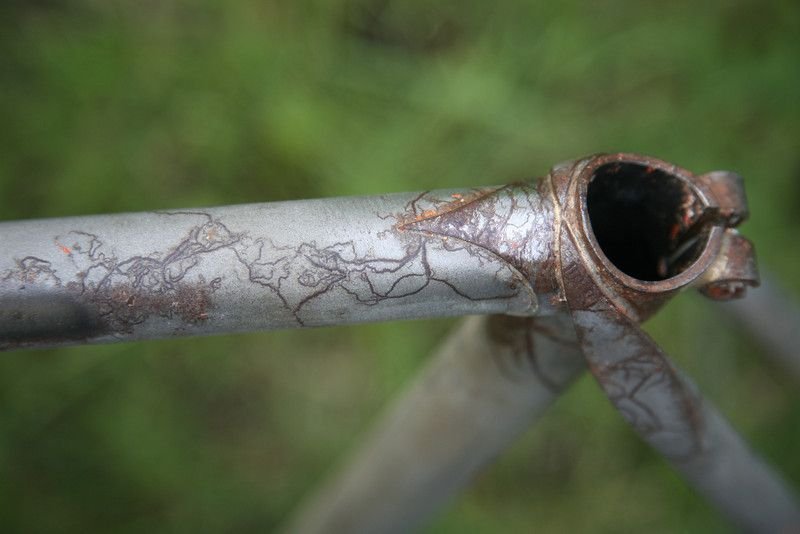
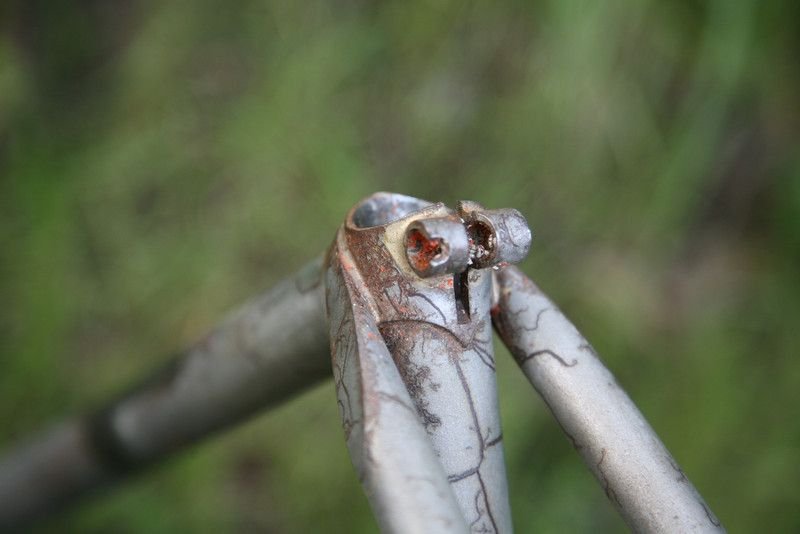
.https://obrentharris.smugmug.com/phot...-w2KTxQq-L.jpg
https://obrentharris.smugmug.com/phot...-gSSCkGP-L.jpg
Last edited by merziac; 01-11-19 at 05:49 PM.
01-11-19 | 05:44 PM
#7
Senior Member
Joined: Dec 2014
Posts: 5,359
Likes: 5,217
From: Central Virginia
Bikes: Numerous
All I can say is snakes under anything can’t be good.
__________________
N = '96 Colnago C40, '04 Wilier Alpe D'Huez, '10 Colnago EPS, '85 Merckx Pro, '89 Merckx Century, '86 Tommasini Professional, '04 Teschner Aero FX Pro, '05 Alan Carbon Cross, '86 De Rosa Professional, '95 Gios Compact Pro, '95 Carrera Zeus, ‘81 Masi Gran Criterium, ‘81 Merckx Pro, ‘89 Cinelli Supercorsa, ‘83 Bianchi Specialissima, ‘VO Randonneur, Ritchey Breakaway Steel, Rivendell Rambouillet, Heron Randonneur, ‘92 Ciöcc Columbus EL
N = '96 Colnago C40, '04 Wilier Alpe D'Huez, '10 Colnago EPS, '85 Merckx Pro, '89 Merckx Century, '86 Tommasini Professional, '04 Teschner Aero FX Pro, '05 Alan Carbon Cross, '86 De Rosa Professional, '95 Gios Compact Pro, '95 Carrera Zeus, ‘81 Masi Gran Criterium, ‘81 Merckx Pro, ‘89 Cinelli Supercorsa, ‘83 Bianchi Specialissima, ‘VO Randonneur, Ritchey Breakaway Steel, Rivendell Rambouillet, Heron Randonneur, ‘92 Ciöcc Columbus EL
01-11-19 | 05:46 PM
#8
Senior Member
Joined: Oct 2015
Posts: 16,142
Likes: 9,516
From: PDX
Bikes: Merz x 5 + Specialized Merz Allez x 2, Strawberry/Newlands/DiNucci/Ti x3, Gordon, Fuso/Moulton x2, Bornstein, Paisley,1958-74 Paramounts x3, 3rensho, 74 Moto TC, 73-78 Raleigh Pro's x5, Marinoni x2, 1960 Cinelli SC, 1980 Bianchi SC, PX-10 X 2
 01-11-19 | 05:54 PM
#9
Senior Member
Joined: Oct 2015
Posts: 16,142
Likes: 9,516
From: PDX
Bikes: Merz x 5 + Specialized Merz Allez x 2, Strawberry/Newlands/DiNucci/Ti x3, Gordon, Fuso/Moulton x2, Bornstein, Paisley,1958-74 Paramounts x3, 3rensho, 74 Moto TC, 73-78 Raleigh Pro's x5, Marinoni x2, 1960 Cinelli SC, 1980 Bianchi SC, PX-10 X 2
 01-11-19 | 06:14 PM
#10

mycocyclist
Joined: Dec 2016
Posts: 1,319
Likes: 994
From: Monkey Junction, Wilmington, NC
Bikes: 1964 Schwinn Paramount P-13 DeLuxe, 1964 Schwinn Sport Super Sport, 1972 Falcon San Remo, 1974 Maserati MT-1, 1974 Raleigh International, 1984 Lotus Odyssey, 198? Rossin Ghibli, 1990 LeMond Le Vanquer (sic), 1991 Specialized Allez Transition Pro, +
Let's Get Technical?
Filiform corrosion aka "filamentary corrosion" or "underfilm corrosion".
I politely beg to differ with the dire prognosis suggested previously, as I've generally found filiform corrosion to be readily checkable with an acid bath, I prefer phosphoric. though I suppose oxalic would work. In my experience filiform has been superficial. I'm not saying it can't erupt from within the tube, but I haven't seen that often. Mostly it's sweat spawned.
I politely beg to differ with the dire prognosis suggested previously, as I've generally found filiform corrosion to be readily checkable with an acid bath, I prefer phosphoric. though I suppose oxalic would work. In my experience filiform has been superficial. I'm not saying it can't erupt from within the tube, but I haven't seen that often. Mostly it's sweat spawned.
01-11-19 | 06:41 PM
#12

Senior Member
Joined: May 2012
Posts: 5,050
Likes: 4,905
From: Point Reyes Station, California
Bikes: Indeed!
Here is a photo of "worms" on the bottom bracket of the same bike posted by [MENTION=425004]merziac[/MENTION] before paint removal.

In this case the rust was only under the film as described by [MENTION=452523]machinist42[/MENTION] above. As you can see by the photos posted by merziac some of the heaviest rust was at the top of the seat lug, an area where it was easy to see that they had not propagated from the inside out. I see these fairly often in the coastal environment where I live.
Brent
In this case the rust was only under the film as described by [MENTION=452523]machinist42[/MENTION] above. As you can see by the photos posted by merziac some of the heaviest rust was at the top of the seat lug, an area where it was easy to see that they had not propagated from the inside out. I see these fairly often in the coastal environment where I live.
Brent
01-11-19 | 06:58 PM
#13
Senior Member
Joined: Oct 2015
Posts: 16,142
Likes: 9,516
From: PDX
Bikes: Merz x 5 + Specialized Merz Allez x 2, Strawberry/Newlands/DiNucci/Ti x3, Gordon, Fuso/Moulton x2, Bornstein, Paisley,1958-74 Paramounts x3, 3rensho, 74 Moto TC, 73-78 Raleigh Pro's x5, Marinoni x2, 1960 Cinelli SC, 1980 Bianchi SC, PX-10 X 2
Filiform corrosion aka "filamentary corrosion" or "underfilm corrosion".
I politely beg to differ with the dire prognosis suggested previously, as I've generally found filiform corrosion to be readily checkable with an acid bath, I prefer phosphoric. though I suppose oxalic would work. In my experience filiform has been superficial. I'm not saying it can't erupt from within the tube, but I haven't seen that often. Mostly it's sweat spawned.
I politely beg to differ with the dire prognosis suggested previously, as I've generally found filiform corrosion to be readily checkable with an acid bath, I prefer phosphoric. though I suppose oxalic would work. In my experience filiform has been superficial. I'm not saying it can't erupt from within the tube, but I haven't seen that often. Mostly it's sweat spawned.
Again as Doug alluded to it can most certainly be a scourge and kiss of death albeit maybe a slow one. Caught in time, not that big of a deal, left unchecked it can screw up a lot of paint which I would think a good idea to avoid.
Jim Merz treated his frames by complete contaminate removal and zinc chromate? primer before Imron paint was applied by Virginia for the infamous PDX rain. He is adamant that frames be stripped, treated and repainted when this is found, Between him, Mr. Fattic and many others, I'll go with the Master framebuilder's on this.
01-11-19 | 07:33 PM
#14
Senior Member
Joined: Oct 2015
Posts: 16,142
Likes: 9,516
From: PDX
Bikes: Merz x 5 + Specialized Merz Allez x 2, Strawberry/Newlands/DiNucci/Ti x3, Gordon, Fuso/Moulton x2, Bornstein, Paisley,1958-74 Paramounts x3, 3rensho, 74 Moto TC, 73-78 Raleigh Pro's x5, Marinoni x2, 1960 Cinelli SC, 1980 Bianchi SC, PX-10 X 2
Filiform corrosion aka "filamentary corrosion" or "underfilm corrosion".
I politely beg to differ with the dire prognosis suggested previously, as I've generally found filiform corrosion to be readily checkable with an acid bath, I prefer phosphoric. though I suppose oxalic would work. In my experience filiform has been superficial. I'm not saying it can't erupt from within the tube, but I haven't seen that often. Mostly it's sweat spawned.
I politely beg to differ with the dire prognosis suggested previously, as I've generally found filiform corrosion to be readily checkable with an acid bath, I prefer phosphoric. though I suppose oxalic would work. In my experience filiform has been superficial. I'm not saying it can't erupt from within the tube, but I haven't seen that often. Mostly it's sweat spawned.
I also always like to learn all I can about new to me problems which always includes worst case scenario so it can be walked back from as necessary.
"'Plan for the worst, hope for the best"
01-11-19 | 09:44 PM
#15
Thread Starter
Full Member
Joined: Jun 2017
Posts: 219
Likes: 68
From: Northern CA
Bikes: 1971 Gitane TDF, 1974 Gitane Interclub, 2001 Serotta Rapid Tour CS3, 1986 Bruce Gordon touring bike, 1972 Gitane Super Corsa, 1978 Michal Johnson, 1972 Lambert Professional Grand Prix, 1983 Vitus (resto project), 1972 Raleigh Professional (resto)
Thx to all for this really valuable information. While working on the frame this afternoon, I tackled two of the offending "filamentary spots" and sanded the areas clean - each was roughly half the size of a dime. After sanding carefully, all that I encountered was clean bright 531 metal which was a relief at the time. There are some other filamentary spots on the underside of the downtube that can be tackled as well.
I'll take some photos of the "before and after treatments" for these spots and trust that you folks can steer me the right direction.
During the process of purchasing this bike, I learned that it had most likely had been ridden in the 1970s and possibly early 80s and then it ended up in the basement until last fall. The owner passed away in 2006 and his children were uncertain what to do with the bike. Although they were cyclists, a French road bike from 1971 was beyond their comfort level. I don't think that the bike was cleaned up before it was placed in storage as I'm finding that the corrosion on the frame is where road grime and sweat would have accumulated and over time, attract moisture and attack the paint. It is rare to find a large, vintage frame in my size, 64cm, so when I find one of these bikes, it becomes a mission to restore it to it's former glory and ride it in the CA Eroica event.
More info to follow tomorrow when there is better light for photos. Thx again to everyone on this thread!
I'll take some photos of the "before and after treatments" for these spots and trust that you folks can steer me the right direction.
During the process of purchasing this bike, I learned that it had most likely had been ridden in the 1970s and possibly early 80s and then it ended up in the basement until last fall. The owner passed away in 2006 and his children were uncertain what to do with the bike. Although they were cyclists, a French road bike from 1971 was beyond their comfort level. I don't think that the bike was cleaned up before it was placed in storage as I'm finding that the corrosion on the frame is where road grime and sweat would have accumulated and over time, attract moisture and attack the paint. It is rare to find a large, vintage frame in my size, 64cm, so when I find one of these bikes, it becomes a mission to restore it to it's former glory and ride it in the CA Eroica event.
More info to follow tomorrow when there is better light for photos. Thx again to everyone on this thread!
01-11-19 | 10:05 PM
#16

Shimano Certified
Joined: Dec 2004
Posts: 1,849
Likes: 6
From: PA
Bikes: 92 Giant Sedona ATX Custom
Definitely agree with the latter assertions about the filiform being surface. On a car, it is usually from within but I have yet to see a bike frame come from within. Usually it is the result of a bad primer adhesion or a pinhole nick in the paint protection that allows the moisture or corosion process to wick along under sub par finish.
01-11-19 | 10:07 PM
#17
framebuilder
Joined: Dec 2009
Posts: 1,790
Likes: 2,712
From: Niles, Michigan
The situations I was referring to looks just like the yellow frame Merziac posted. Where the rusting-from-the-inside-out is most common is the very underside of top and down tubes and chain stays. If a person doesn't clean their bikes often the problem can go unnoticed. Sweat induced rust is usually found on the top of the top tube - especially around top mounted brake cable guides. I've done many repaints where that was the only issue. In these cases because the rust is starting on the outside early damage is visible and not as likely to be as destructive before corrective measures are taken.
Where inside rust creates holes is most common is when lighter heat treated steels (like Tange Prestige) began to be used. I don't remember seeing this nearly so often on heavier Reynolds or Columbus tubes from the 80's and before. Partly this is due to older frames having thicker walls. However different steels rust at different rates. One of my framebuilding class students had his shop flooded with hurricane Sandy so his inventory of various brands of tubes were immersed in a salty sewage brine. Some of some of those tubes rusted a lot and others not at all. Of course what kind of oily protection played a part too.
I made myself a fancy lugged frame back in the 80's. It was for a contest that Bicycling magazine did in conjunction with Shimano to market their Sante brand of components so I kind of went all out doing extra stuff. For the seat post binder I used the concept of a Cinelli 1R stem that had a push plate to secure the seat post so the seat lug did not have a visible binder bolt and the whole lug could be carved. While the concept worked okay to hold the seat post it also let moisture in the crack between the lug and post allowing water into the top tube. Eventually because I rode the bike a lot and sometimes in the rain, rust with small pin holes developed on the very underside of the top tube. When I repainted the frame to save it I used a kind of stuff that turns rust into primer (inside the top tube). After that I used a combination of silver and body putty to patch the holes and it still is working fine today. I remember rushing like crazy to get the bicycle together so it could meet the contest deadline and I didn't spray the insides with rust preventative.
Where inside rust creates holes is most common is when lighter heat treated steels (like Tange Prestige) began to be used. I don't remember seeing this nearly so often on heavier Reynolds or Columbus tubes from the 80's and before. Partly this is due to older frames having thicker walls. However different steels rust at different rates. One of my framebuilding class students had his shop flooded with hurricane Sandy so his inventory of various brands of tubes were immersed in a salty sewage brine. Some of some of those tubes rusted a lot and others not at all. Of course what kind of oily protection played a part too.
I made myself a fancy lugged frame back in the 80's. It was for a contest that Bicycling magazine did in conjunction with Shimano to market their Sante brand of components so I kind of went all out doing extra stuff. For the seat post binder I used the concept of a Cinelli 1R stem that had a push plate to secure the seat post so the seat lug did not have a visible binder bolt and the whole lug could be carved. While the concept worked okay to hold the seat post it also let moisture in the crack between the lug and post allowing water into the top tube. Eventually because I rode the bike a lot and sometimes in the rain, rust with small pin holes developed on the very underside of the top tube. When I repainted the frame to save it I used a kind of stuff that turns rust into primer (inside the top tube). After that I used a combination of silver and body putty to patch the holes and it still is working fine today. I remember rushing like crazy to get the bicycle together so it could meet the contest deadline and I didn't spray the insides with rust preventative.
Last edited by Doug Fattic; 01-11-19 at 10:53 PM.
01-11-19 | 11:02 PM
#18

Filiform corrosion aka "filamentary corrosion" or "underfilm corrosion".
I politely beg to differ with the dire prognosis suggested previously, as I've generally found filiform corrosion to be readily checkable with an acid bath, I prefer phosphoric. though I suppose oxalic would work. In my experience filiform has been superficial. I'm not saying it can't erupt from within the tube, but I haven't seen that often. Mostly it's sweat spawned.
I politely beg to differ with the dire prognosis suggested previously, as I've generally found filiform corrosion to be readily checkable with an acid bath, I prefer phosphoric. though I suppose oxalic would work. In my experience filiform has been superficial. I'm not saying it can't erupt from within the tube, but I haven't seen that often. Mostly it's sweat spawned.
The start is often at a thin film (as in paint film) condition that starts adjacent to a sharp turn of shape, lug point, cable guide, etc.
I agree that when addressed in a reasonable time it is of no big problem.
Every powdercoated frame I have bought has had this rust issue to correct. All of them.
01-11-19 | 11:06 PM
#19
The situations I was referring to looks just like the yellow frame Merziac posted. Where the rusting-from-the-inside-out is most common is the very underside of top and down tubes and chain stays. If a person doesn't clean their bikes often the problem can go unnoticed. Sweat induced rust is usually found on the top of the top tube - especially around top mounted brake cable guides. I've done many repaints where that was the only issue. In these cases because the rust is starting on the outside early damage is visible and not as likely to be as destructive before corrective measures are taken.
Where inside rust creates holes is most common is when lighter heat treated steels (like Tange Prestige) began to be used. I don't remember seeing this nearly so often on heavier Reynolds or Columbus tubes from the 80's and before. Partly this is due to older frames having thicker walls. However different steels rust at different rates. One of my framebuilding class students had his shop flooded with hurricane Sandy so his inventory of various brands of tubes were immersed in a salty sewage brine. Some of some of those tubes rusted a lot and others not at all. Of course what kind of oily protection played a part too.
I made myself a fancy lugged frame back in the 80's. It was for a contest that Bicycling magazine did in conjunction with Shimano to market their Sante brand of components so I kind of went all out doing extra stuff. For the seat post binder I used the concept of a Cinelli 1R stem that had a push plate to secure the seat post so the seat lug did not have a visible binder bolt and the whole lug could be carved. While the concept worked okay to hold the seat post it also let moisture in the crack between the lug and post allowing water into the top tube. Eventually because I rode the bike a lot and sometimes in the rain, rust with small pin holes developed on the very underside of the top tube. When I repainted the frame to save it I used a kind of stuff that turns rust into primer (inside the top tube). After that I used a combination of silver and body putty to patch the holes and it still is working fine today. I remember rushing like crazy to get the bicycle together so it could meet the contest deadline and I didn't spray the insides with rust preventative.
Where inside rust creates holes is most common is when lighter heat treated steels (like Tange Prestige) began to be used. I don't remember seeing this nearly so often on heavier Reynolds or Columbus tubes from the 80's and before. Partly this is due to older frames having thicker walls. However different steels rust at different rates. One of my framebuilding class students had his shop flooded with hurricane Sandy so his inventory of various brands of tubes were immersed in a salty sewage brine. Some of some of those tubes rusted a lot and others not at all. Of course what kind of oily protection played a part too.
I made myself a fancy lugged frame back in the 80's. It was for a contest that Bicycling magazine did in conjunction with Shimano to market their Sante brand of components so I kind of went all out doing extra stuff. For the seat post binder I used the concept of a Cinelli 1R stem that had a push plate to secure the seat post so the seat lug did not have a visible binder bolt and the whole lug could be carved. While the concept worked okay to hold the seat post it also let moisture in the crack between the lug and post allowing water into the top tube. Eventually because I rode the bike a lot and sometimes in the rain, rust with small pin holes developed on the very underside of the top tube. When I repainted the frame to save it I used a kind of stuff that turns rust into primer (inside the top tube). After that I used a combination of silver and body putty to patch the holes and it still is working fine today. I remember rushing like crazy to get the bicycle together so it could meet the contest deadline and I didn't spray the insides with rust preventative.
01-11-19 | 11:33 PM
#20
Senior Member
Joined: Jul 2013
Posts: 2,599
Likes: 914
From: So Cal, for now
Bikes: 1974 Bob Jackson - Nuovo Record, Brooks Pro, Clips & Straps
My contributions - the technical term is "filiform corrosion" and is informally known as "worm tracks". You can find these terms in the technical literature. Snakes under the paint seems just as good as worm tracks.
The times I've seen it, the cause was traced to chlorine ions, caused by failure to properly clean a plated part.
Rust never sleeps. My bike has some under the paint. I'm too lazy and too stupid to do anything about it.
The times I've seen it, the cause was traced to chlorine ions, caused by failure to properly clean a plated part.
Rust never sleeps. My bike has some under the paint. I'm too lazy and too stupid to do anything about it.
01-12-19 | 08:13 AM
#22
Senior Member
Joined: May 2008
Posts: 10,106
Likes: 2,760
From: Fredericksburg, Va
Bikes: ? Proteous, '65 Frejus TDF, '73 Bottecchia Giro d'Italia, '83 Colnago Superissimo, '84 Trek 610, '84 Trek 760, '88 Pinarello Veneto, '88 De Rosa Pro, '89 Pinarello Montello, 'Litespeed Catalyst'94 Burley Duet, 97 Specialized RockHopper, 2010 Langster
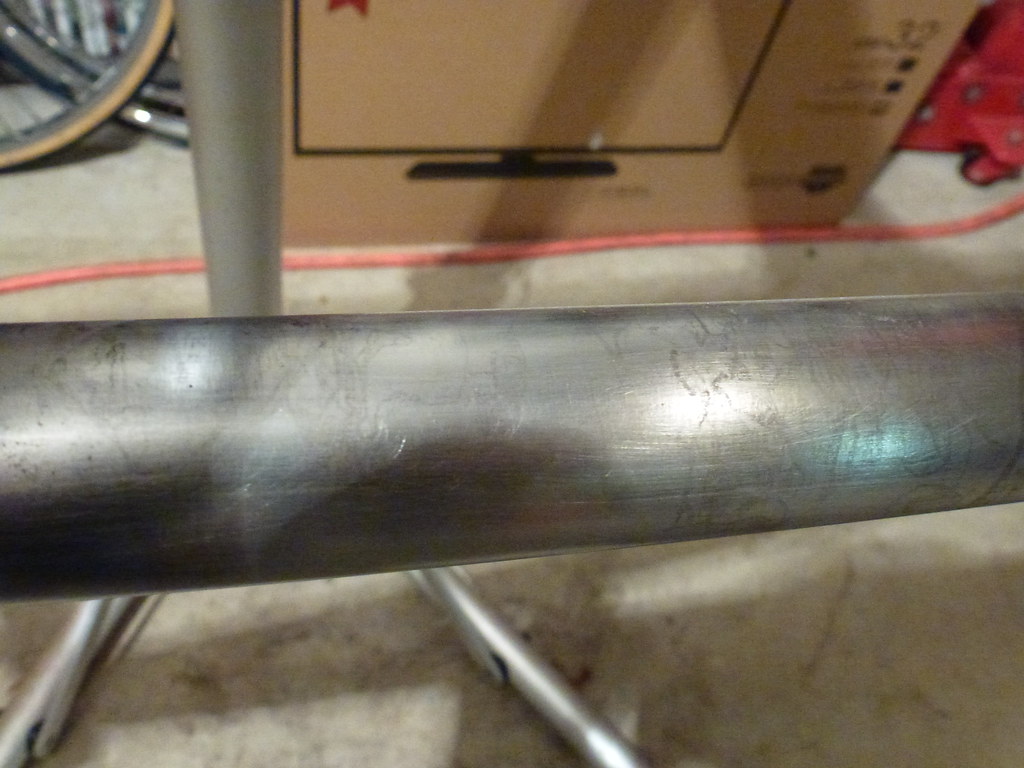
My experience is that they are surface inhabitants.
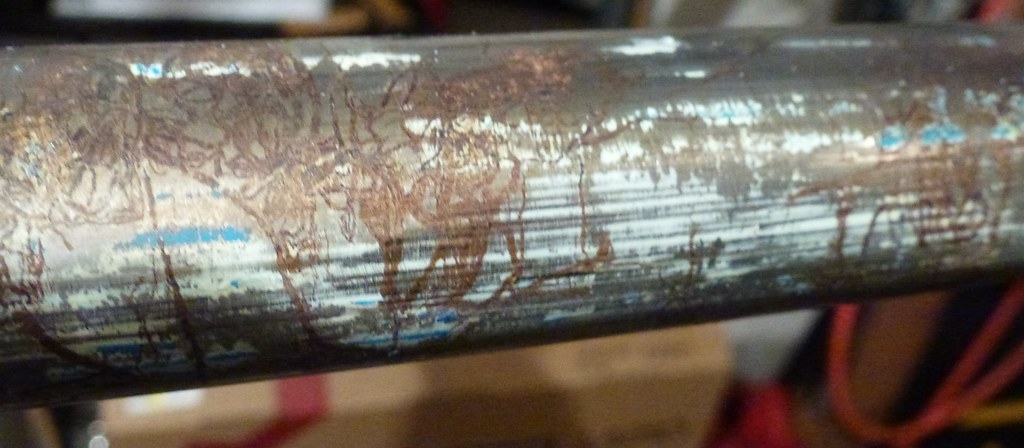
P1010140, on Flickr

P1010167, on Flickr
P1010141, on Flickr
I am sure they will buff right out!

P1010183, on Flickr

P1010442, on Flickr
both sides are drive sides on a tandem.
P1010140, on Flickr
P1010167, on Flickr
P1010141, on Flickr
I am sure they will buff right out!
P1010183, on Flickr
P1010442, on Flickr
both sides are drive sides on a tandem.
__________________
Bikes don't stand alone. They are two tired.
Bikes don't stand alone. They are two tired.
Last edited by SJX426; 01-12-19 at 08:17 AM.
01-12-19 | 12:20 PM
#23
Thread Starter
Full Member
Joined: Jun 2017
Posts: 219
Likes: 68
From: Northern CA
Bikes: 1971 Gitane TDF, 1974 Gitane Interclub, 2001 Serotta Rapid Tour CS3, 1986 Bruce Gordon touring bike, 1972 Gitane Super Corsa, 1978 Michal Johnson, 1972 Lambert Professional Grand Prix, 1983 Vitus (resto project), 1972 Raleigh Professional (resto)
Took 3 quick photos this morning to further show the story. Last photo shows what a little sanding revealed.
SJX426, I think that my frame is showing "surface inhabitants" similar to what your tandem experienced.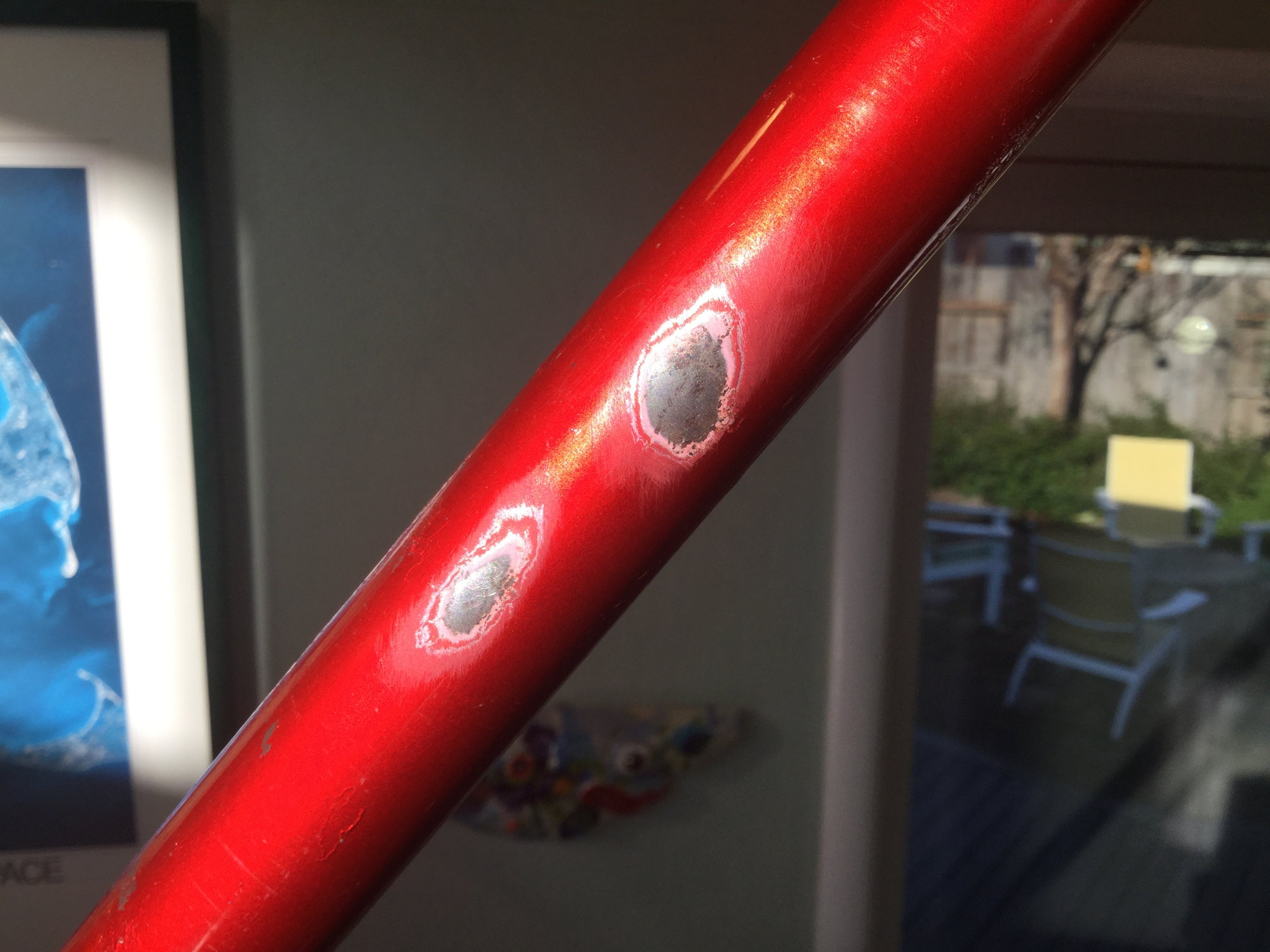
After a slight sanding.
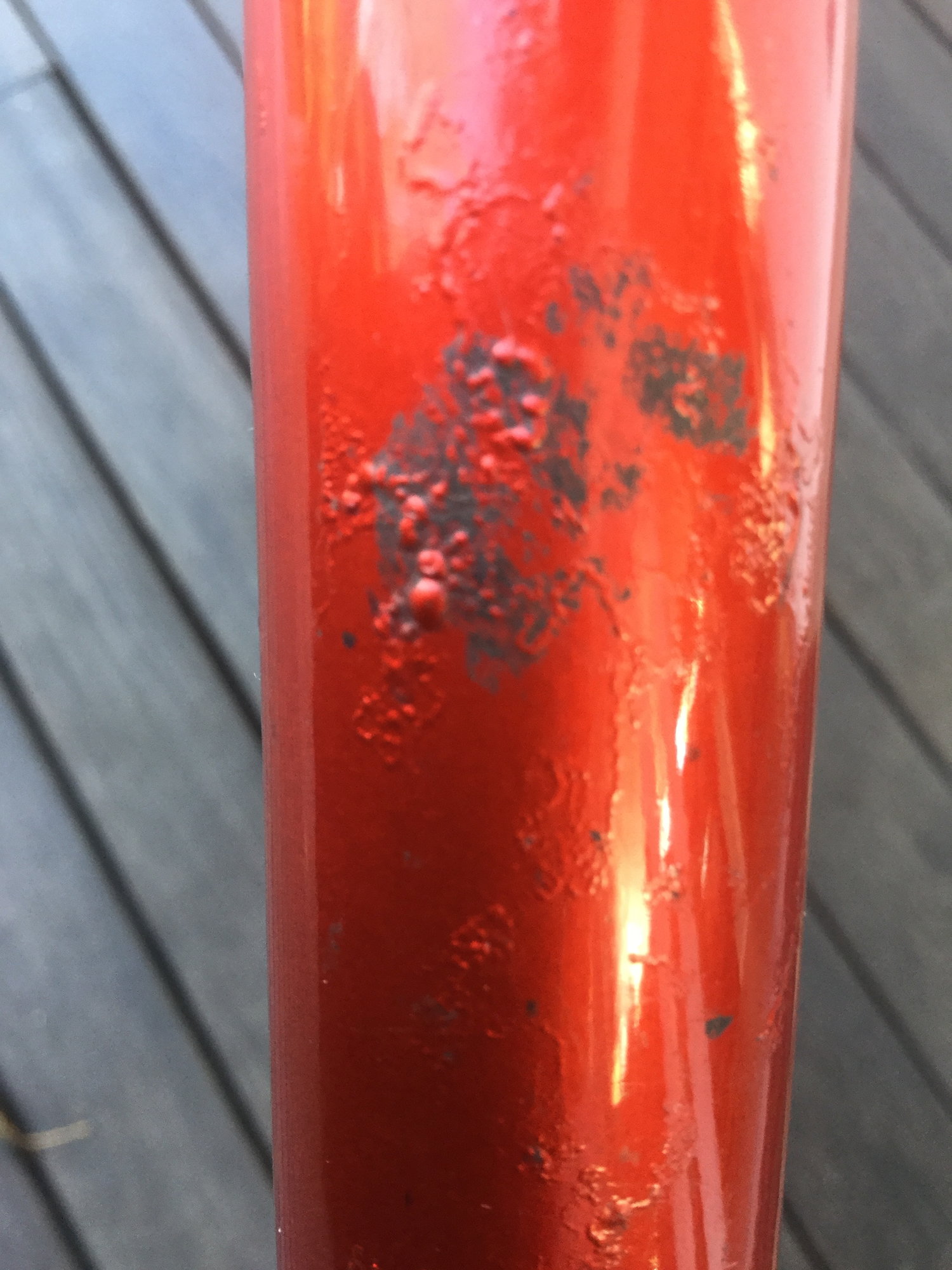
The questionable area.
SJX426, I think that my frame is showing "surface inhabitants" similar to what your tandem experienced.
After a slight sanding.
The questionable area.


