


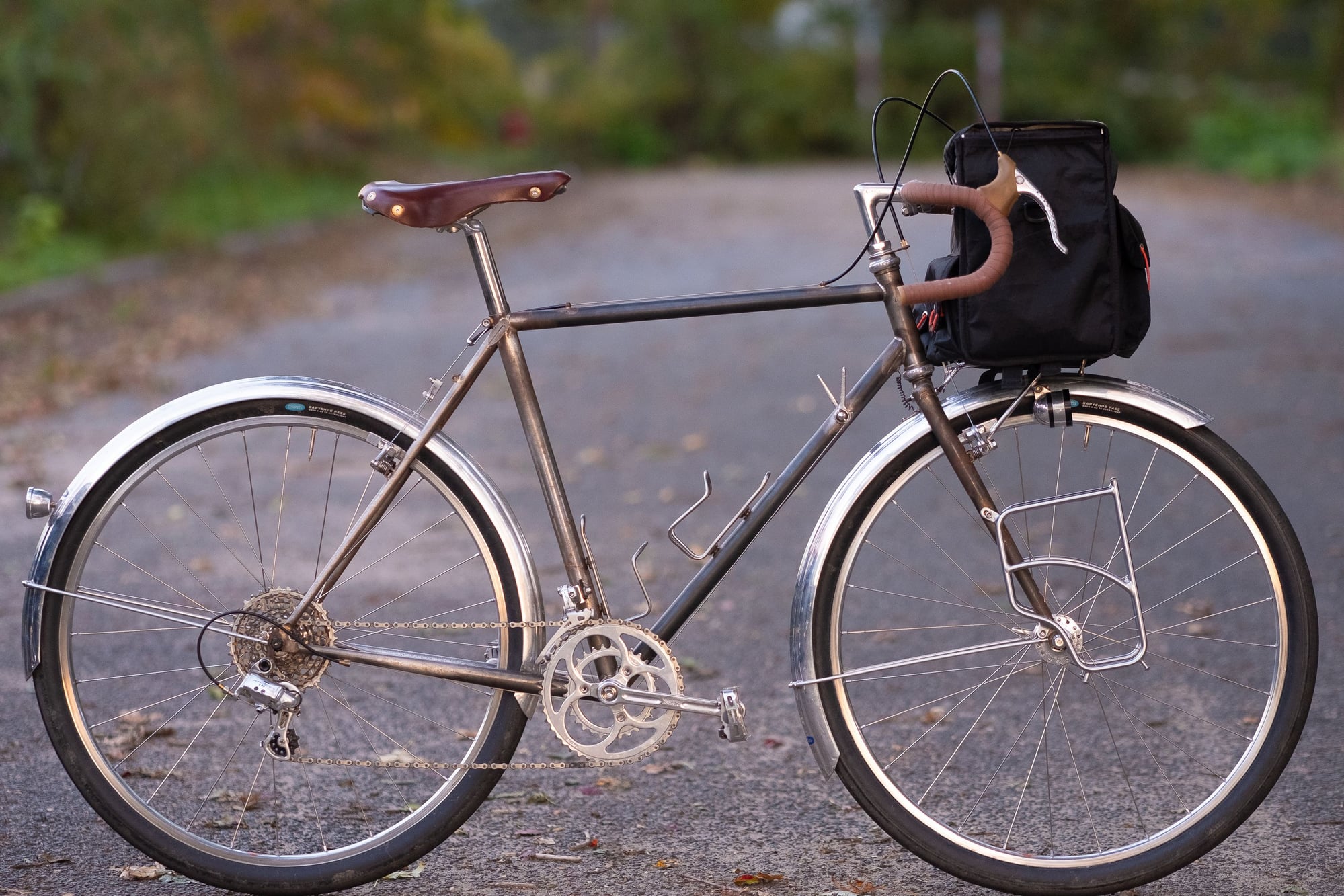
Check out the forks on this ride
 03-04-19 | 09:57 PM
#1
Thread Starter
Senior Member
Joined: Mar 2015
Posts: 1,858
Likes: 46
From: Connecticut
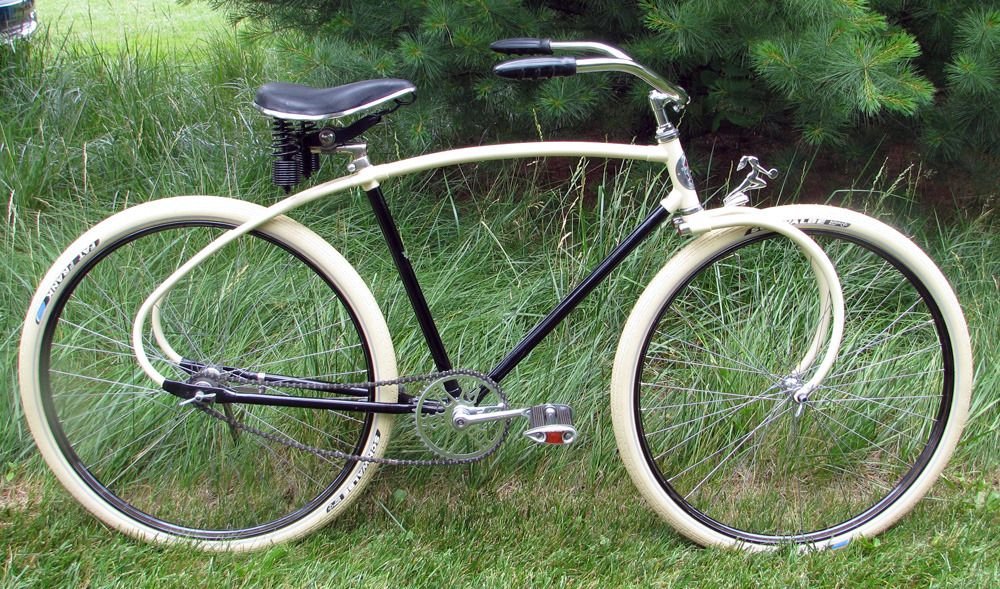
Check out the forks on this ride
How the heck do they get an angle like that to work? The frame/fork is by Crust Bikes of Belmar, NJ.
Last edited by vintagerando; 03-04-19 at 09:59 PM. Reason: spelling
 03-05-19 | 12:17 AM
#3

Senior Member


Joined: Oct 2014
Posts: 14,180
Likes: 5,312
From: Portland, OR
Bikes: (2) ti TiCycles, 2007 w/ triple and 2011 fixed, 1979 Peter Mooney, ~1983 Trek 420 now fixed and ~1973 Raleigh Carlton Competition gravel grinder
What matters in fork geometry is where the hub sits relative to the axis of the steerer (and head) tube(s). How the tubing gets from the crown to the hub doesn't matter. Traditionally, fork blades continued down the steerer line, then were bent forward to place the hub the proper distance from the line for the desired handling. But that is just tradition. Look at the Pinarellos of the past 10-15 years, Their trademark was a fork that swooped forward, then back to the hub.
That fork looks like roughly the same geometry as my old Competition, just executed very differently.
Ben
That fork looks like roughly the same geometry as my old Competition, just executed very differently.
Ben
03-05-19 | 12:46 AM
#4

Senior Member

Joined: Nov 2011
Posts: 7,955
Likes: 702
From: Port Angeles, WA
Bikes: A green one, "Ragleigh," or something.
It looks weird. As do the recent Pinnys. 
__________________
● 1971 Grandis SL ● 1972 Lambert Grand Prix frankenbike ● 1972 Raleigh Super Course fixie ● 1973 Nishiki Semi-Pro ● 1979 Motobecane Grand Jubile ●1980 Apollo "Legnano" ● 1984 Peugeot Vagabond ● 1985 Shogun Prairie Breaker ● 1986 Merckx Super Corsa ● 1987 Schwinn Tempo ● 1988 Schwinn Voyageur ● 1989 Bottechia Team ADR replica ● 1990 Cannondale ST600 ● 1993 Technium RT600 ● 1996 Kona Lava Dome ●
● 1971 Grandis SL ● 1972 Lambert Grand Prix frankenbike ● 1972 Raleigh Super Course fixie ● 1973 Nishiki Semi-Pro ● 1979 Motobecane Grand Jubile ●1980 Apollo "Legnano" ● 1984 Peugeot Vagabond ● 1985 Shogun Prairie Breaker ● 1986 Merckx Super Corsa ● 1987 Schwinn Tempo ● 1988 Schwinn Voyageur ● 1989 Bottechia Team ADR replica ● 1990 Cannondale ST600 ● 1993 Technium RT600 ● 1996 Kona Lava Dome ●
03-05-19 | 01:15 AM
#5

Senior Member
Joined: Nov 2015
Posts: 4,900
Likes: 1,125
It's a straight legged fork.....that's not???
__________________
72 Line Seeker
83 Davidson Signature
84 Peugeot PSV
84 Peugeot PY10FC
84 Gitane Tour de France.
85 Vitus Plus Carbone 7
86 ALAN Record Carbonio
86 Medici Aerodynamic (Project)
88 Pinarello Montello
89 Bottecchia Professional Chorus SL
95 Trek 5500 OCLV (Project)
72 Line Seeker
83 Davidson Signature
84 Peugeot PSV
84 Peugeot PY10FC
84 Gitane Tour de France.
85 Vitus Plus Carbone 7
86 ALAN Record Carbonio
86 Medici Aerodynamic (Project)
88 Pinarello Montello
89 Bottecchia Professional Chorus SL
95 Trek 5500 OCLV (Project)
03-05-19 | 05:53 AM
#6
Senior Member
Joined: Feb 2011
Posts: 807
Likes: 10
It looks to be a very low trail design. That means the steering will be very quick. However, when you add a load in the handle bar bag and panniers, the steering slows. The two cancel each other out and you have a bike that handles nicely when loaded up for touring.
03-05-19 | 08:36 AM
#7

Overdoing projects
Joined: Oct 2011
Posts: 2,464
Likes: 1,370
From: Rotterdam, former republic of the Netherlands
Bikes: Batavus Randonneur GL, Gazelle Orange Excellent, Gazelle Super Licht, Gazelle Grand Tourist, Gazelle Lausanne, Gazelle Tandem, Koga-Miyata SilverAce, Koga-Miyata WorldTraveller
Most modern bikes use a straight legged fork like that, though often its because it is carbon. It's still a low trail design so pretty comfortable for longer distances.
 03-05-19 | 09:16 AM
#9

Old fart

Joined: Nov 2004
Posts: 26,401
Likes: 5,333
From: Appleton WI
Bikes: Several, mostly not name brands.
 03-05-19 | 09:27 AM
#10
Thread Starter
Senior Member
Joined: Mar 2015
Posts: 1,858
Likes: 46
From: Connecticut
Yeah.....just seems like, if you were out of the saddle and pushing down, all your mass would be on that crown/blade area.
This bike was posted on The Radavist. The caption mentions that the rider this bike was made for is a "lighter rider".
Last edited by vintagerando; 03-05-19 at 09:28 AM. Reason: add
03-05-19 | 09:40 AM
#11
Senior Member
Joined: Jun 2003
Posts: 18,138
Likes: 324
Bikes: 2 many
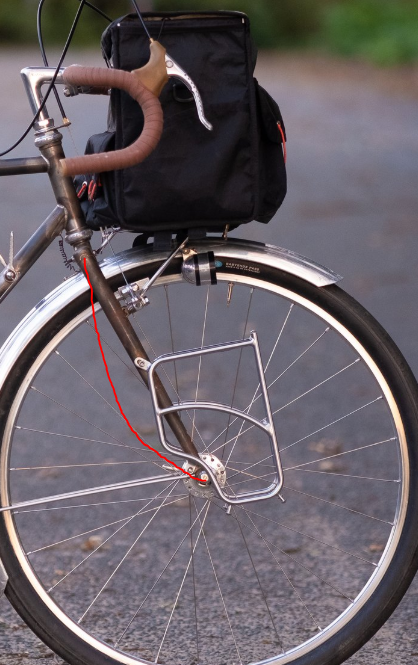
The fork legs are straight, but they fasten to the fork crown at an angle. Imagine, or use a straight edge against your screen, and make a line straight through the head tube and extend the line down to the level of the wheel axle height from the ground. You'll see the geometry is normal. The leg is just made differently. It's not new.
 03-05-19 | 10:04 AM
#13
Randomhead
Joined: Aug 2008
Posts: 25,930
Likes: 4,825
From: Happy Valley, Pennsylvania
I can't tell if that fork has a crown or if it's segmented construction. The blades still do most of the deflecting, but segmented construction can have issues if the "crown" tubes are underbuilt.
They also have a 1" steerer disc fork.
They also have a 1" steerer disc fork.
03-05-19 | 10:52 AM
#14
Senior Member

Joined: May 2008
Posts: 10,106
Likes: 2,762
From: Fredericksburg, Va
Bikes: ? Proteous, '65 Frejus TDF, '73 Bottecchia Giro d'Italia, '83 Colnago Superissimo, '84 Trek 610, '84 Trek 760, '88 Pinarello Veneto, '88 De Rosa Pro, '89 Pinarello Montello, 'Litespeed Catalyst'94 Burley Duet, 97 Specialized RockHopper, 2010 Langster
__________________
Bikes don't stand alone. They are two tired.
Bikes don't stand alone. They are two tired.
03-05-19 | 11:05 AM
#15

Senior Member
Joined: Jul 2006
Posts: 11,495
Likes: 4,912
From: San Jose (Willow Glen) Ca
Bikes: Kirk Custom JK Special, 86 De Rosa Pro, '84 Team Miyata,(dura ace old school) 80?? SR Semi-Pro 600 Arabesque
excuse the poor graphics, but this may help visualize
__________________
Life is too short not to ride the best bike you have, as much as you can.
Life is too short not to ride the best bike you have, as much as you can.
03-05-19 | 11:12 AM
#16
Senior Member
Joined: Oct 2014
Posts: 14,180
Likes: 5,312
From: Portland, OR
Bikes: (2) ti TiCycles, 2007 w/ triple and 2011 fixed, 1979 Peter Mooney, ~1983 Trek 420 now fixed and ~1973 Raleigh Carlton Competition gravel grinder
Ben
03-05-19 | 11:14 AM
#17
Senior Member
Joined: Nov 2004
Posts: 23,212
Likes: 3,123
As in post #14 , my immediate thought was to Colnago and their Precisa fork, which they introduced circa 1987. Though there were early examples, they popularized the concept for road bicycles. BMX bicycles adapted straight leg forks the motorcycle industry. From the very late 1970s onward, straight blades were the dominant style in BMX.

 03-05-19 | 11:54 AM
#19
Senior Member
Joined: May 2008
Posts: 10,106
Likes: 2,762
From: Fredericksburg, Va
Bikes: ? Proteous, '65 Frejus TDF, '73 Bottecchia Giro d'Italia, '83 Colnago Superissimo, '84 Trek 610, '84 Trek 760, '88 Pinarello Veneto, '88 De Rosa Pro, '89 Pinarello Montello, 'Litespeed Catalyst'94 Burley Duet, 97 Specialized RockHopper, 2010 Langster
Once could argue that the curve in the blade not only positioned the wheel for steering performance but also provided some suspension. If you think about it, the crown always was subjected to forces associated with suspension as well. Maybe that is part of the reason for dual or triple plate crowns, to provide strength against the moment arm. there were some pretty extreme "bent" forks BITD. I always thought the following was a bit more than most but have seen others more extreme.
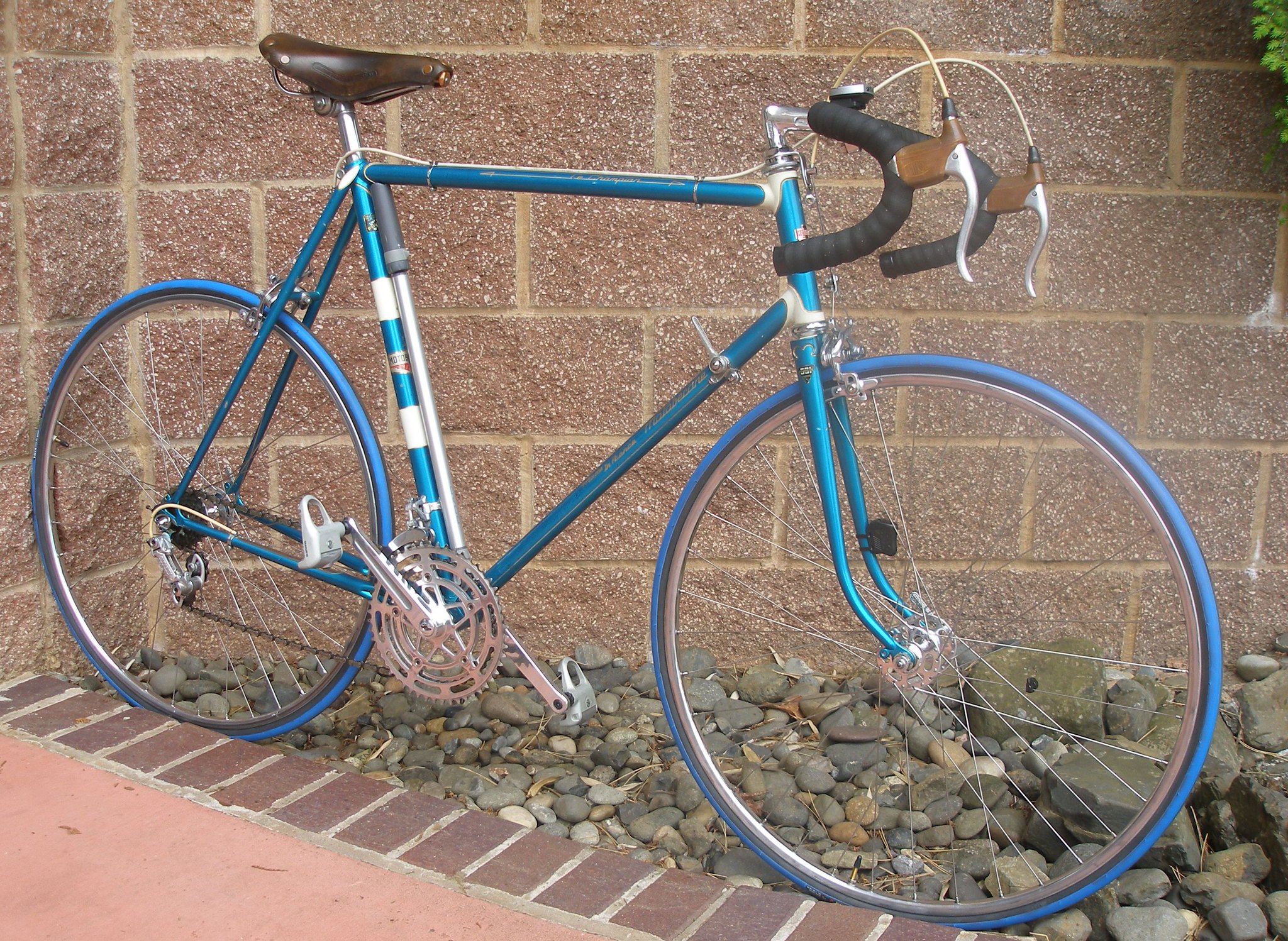
2008-06-01 15.25.53, on Flickr
There was a thread a couple of years ago of the Trek fork failures as a result of the moment arm forces, IIRC 1982 420"s?
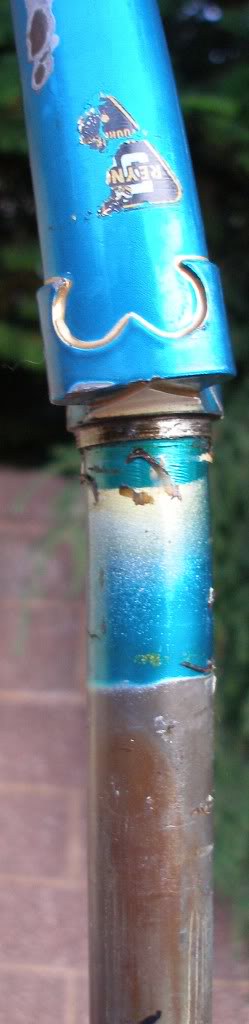
And yes the crowns will deform (from the same bike):
P9051190, on Flickr
2008-06-01 15.25.53, on Flickr
There was a thread a couple of years ago of the Trek fork failures as a result of the moment arm forces, IIRC 1982 420"s?
And yes the crowns will deform (from the same bike):
P9051190, on Flickr
__________________
Bikes don't stand alone. They are two tired.
Bikes don't stand alone. They are two tired.
Last edited by SJX426; 03-05-19 at 12:00 PM.
03-05-19 | 12:50 PM
#20
Randomhead
Joined: Aug 2008
Posts: 25,930
Likes: 4,825
From: Happy Valley, Pennsylvania
I'm curious how long the finish will last before rust takes over. Unless it's oiled, which is something some builders do on their own bikes.
03-05-19 | 12:52 PM
#21

Bike Butcher of Portland
Joined: Jul 2014
Posts: 12,486
Likes: 8,054
From: Portland, OR
Bikes: It's complicated.
^This
__________________
If someone tells you that you have enough bicycles and you don't need any more, stop talking to them. You don't need that kind of negativity in your life.
If someone tells you that you have enough bicycles and you don't need any more, stop talking to them. You don't need that kind of negativity in your life.
03-05-19 | 01:04 PM
#22
Senior Member
Joined: May 2008
Posts: 10,106
Likes: 2,762
From: Fredericksburg, Va
Bikes: ? Proteous, '65 Frejus TDF, '73 Bottecchia Giro d'Italia, '83 Colnago Superissimo, '84 Trek 610, '84 Trek 760, '88 Pinarello Veneto, '88 De Rosa Pro, '89 Pinarello Montello, 'Litespeed Catalyst'94 Burley Duet, 97 Specialized RockHopper, 2010 Langster
Any Mech Engr with lots of dynamic FEA want to opine?
__________________
Bikes don't stand alone. They are two tired.
Bikes don't stand alone. They are two tired.
 03-05-19 | 03:34 PM
#24
Randomhead
Joined: Aug 2008
Posts: 25,930
Likes: 4,825
From: Happy Valley, Pennsylvania
Apparently someone made an angled crown, because Eric Estlund posted this fork recently https://www.instagram.com/p/BuZIGmil...on_share_sheet
I am a mechanical engineer with a sufficient background in FEA to have an opinion about this, but I'm not going to build a fork model to test this hypothesis. I don't think crowns can contribute much to the compliance, they are a lot thicker section than fork blades. You wouldn't want dynamic FEA anyway. A bent fork will have more compliance down in the bend, but the rest of the blade will probably not bend quite as much. I had a straight bladed fork for quite a while, it didn't seem any different to me than any raked fork I ever rode. It had about 55mm of rake. I have never ridden a bike with more rake than that for very long though. Working on changing that.
I am a mechanical engineer with a sufficient background in FEA to have an opinion about this, but I'm not going to build a fork model to test this hypothesis. I don't think crowns can contribute much to the compliance, they are a lot thicker section than fork blades. You wouldn't want dynamic FEA anyway. A bent fork will have more compliance down in the bend, but the rest of the blade will probably not bend quite as much. I had a straight bladed fork for quite a while, it didn't seem any different to me than any raked fork I ever rode. It had about 55mm of rake. I have never ridden a bike with more rake than that for very long though. Working on changing that.
03-05-19 | 03:48 PM
#25
Senior Member
Joined: Nov 2004
Posts: 23,212
Likes: 3,123
When Colnago introduced their straight blade Precisa fork in the very late 1980s, they had Ferrari perform testing on it and their traditional, curved rake fork. Reportedly, the Precisa fork had superior vibration absorption and better stability on uneven surfaces. They claimed this improved headset life expectancy and resulted in greater comfort, control and safety. I would have suspected some weight savings but none was mentioned. Of course, they didn't mention the cost savings afforded by eliminating one process from the blade manufacturing operation. This would initially have been offset by the tooling costs for a new crown but there would have been long term savings.