


Frame size question
 03-24-21 | 09:30 AM
#1

Thread Starter
Senior Member


Joined: Jun 2018
Posts: 1,168
Likes: 516
From: NW Ohio
Bikes: 1983 Univega Super Strada, 1986 Panasonic DX5000, 1984 Fuji Team 85 Univega Gran Turismo, 1984 Lotus Unique, 1987 Centurion Expert, 1987 Centurion Ironman Master,
Frame size question
As a general rule are manufacturer's stated frame sizes measured from the center of
the crank up to the top of the seat tube or up to the center of the top tube?
the crank up to the top of the seat tube or up to the center of the top tube?
 03-24-21 | 09:45 AM
#2

Senior Member
Joined: Feb 2017
Posts: 872
Likes: 601
From: Concord, NC
Bikes: 1984 Bianchi Tipo Corsa, 1985 Cannondale SM600 (24/26)
03-24-21 | 09:46 AM
#3
Senior Member
Joined: May 2010
Posts: 2,864
Likes: 2,467
From: Snohomish, WA.
It depends on which manufacturer. Some go for center to top, and others went with c-c. I d prefer if they all went with c-c. They all do top tube c-c, so why not stick with that...
But then again, I would like to stick with inches OR mm, not both.
But then again, I would like to stick with inches OR mm, not both.
03-24-21 | 10:01 AM
#4
Go Ride!
Joined: May 2019
Posts: 292
Likes: 173
From: Minnesota—55346
Bikes: Klein Quantum Pro, Klein Attitude, Azuki SS, Merckx AXM, Klein Quantum Race, Klein Quantum
...to add a bit of complexity...sometimes (on frames with sloping top tubes) the measurement is to where the top tube ‘would have’ met the seat tube had it been level....


 03-24-21 | 10:44 AM
#6
framebuilder

Joined: Dec 2009
Posts: 1,786
Likes: 2,703
From: Niles, Michigan
Since you are in the Classic and Vintage forum, that implies that you are looking at understanding frame sizes made in a former era. In America right after the bike boom of 1970, many of our best frames came from England. Those frames were typically sized in inches and were measured from the center of the bottom bracket to the top of the seat tube. The problem is that "the top of the seat tube" is not a very specific defined point that can be identified clearly on any English made frame. It is usually where the seat lug ends right at the very side/center of the seat tube. A frame builder when he is finish filing the seat tube may scalp it a bit more or less. American bicycles like Schwinn and Trek of the same era followed the British example. For example steel Trek frames from the early 80's were 21", 22 1/2", 24", etc. Chicago made Schwinn frames had the added confusion of measuring to the very top of the end of the seat tube while at the same time the top tube came in quite a bit lower than where it would be on a lugged frame. I just measured a 24" 1973 fillet brazed Schwinn Super Sport. From the center of the BB to the very top of the seat tube (cut straight off and not scalloped) is exactly 24". To the top of the top tube is about 23". That is approximately where a British frame would be measured. The distance from the center of the BB to the center of its level top tube is around 58cm. The schwinn way of measuring threw Americans off about frame sizing back then because they might think they needed a bigger frame than what they really needed.
The Italian way to measure a frame was from the center of the BB to the center of a level top tube. This is the way that makes the most sense to a frame builder (like myself) because it is to an exact point that can be precisely replicated in another frame. Most other European frames that are described in centimeters are measured this same way. However there are exceptions like my Italian Masi I got in Italy in 1972. Faliero described his frames in centimeters (and he punched that number on the BB shell) and he measured them center to the very top. My frame is stamped a 58 cm model and he measured to the very tip of the seat lug. When I put it on my fixture and could read exactly what the c-c measurement was, it measured 55.9cm.
Modern sloping top tubes follow different rules and distances in a seat or top tube can be described as "actual" or "effective".
The Italian way to measure a frame was from the center of the BB to the center of a level top tube. This is the way that makes the most sense to a frame builder (like myself) because it is to an exact point that can be precisely replicated in another frame. Most other European frames that are described in centimeters are measured this same way. However there are exceptions like my Italian Masi I got in Italy in 1972. Faliero described his frames in centimeters (and he punched that number on the BB shell) and he measured them center to the very top. My frame is stamped a 58 cm model and he measured to the very tip of the seat lug. When I put it on my fixture and could read exactly what the c-c measurement was, it measured 55.9cm.
Modern sloping top tubes follow different rules and distances in a seat or top tube can be described as "actual" or "effective".
03-24-21 | 11:20 AM
#7

Senior Member


Joined: Oct 2015
Posts: 16,080
Likes: 9,439
From: PDX
Bikes: Merz x 5 + Specialized Merz Allez x 2, Strawberry/Newlands/DiNucci/Ti x3, Gordon, Fuso/Moulton x2, Bornstein, Paisley,1958-74 Paramounts x3, 3rensho, 74 Moto TC, 73-78 Raleigh Pro's x5, Marinoni x2, 1960 Cinelli SC, 1980 Bianchi SC, PX-10 X 2
Dave Moulton has a take on the British way he was taught that I always thought actually demystifies this a bit. 
Dave Moulton's Blog - Dave Moulton's Bike Blog - Measuring Frames
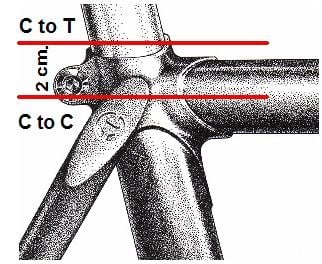
Dave Moulton's Blog - Dave Moulton's Bike Blog - Measuring Frames
03-24-21 | 12:12 PM
#9
Thread Starter
Senior Member
Joined: Jun 2018
Posts: 1,168
Likes: 516
From: NW Ohio
Bikes: 1983 Univega Super Strada, 1986 Panasonic DX5000, 1984 Fuji Team 85 Univega Gran Turismo, 1984 Lotus Unique, 1987 Centurion Expert, 1987 Centurion Ironman Master,
03-24-21 | 12:19 PM
#10

Senior Member
Joined: May 2008
Posts: 10,106
Likes: 2,757
From: Fredericksburg, Va
Bikes: ? Proteous, '65 Frejus TDF, '73 Bottecchia Giro d'Italia, '83 Colnago Superissimo, '84 Trek 610, '84 Trek 760, '88 Pinarello Veneto, '88 De Rosa Pro, '89 Pinarello Montello, 'Litespeed Catalyst'94 Burley Duet, 97 Specialized RockHopper, 2010 Langster
The Italian way, as described by Doug, is what makes the most sense to me. I guess it is my engineering background. I like to know the reference point and it should be reasonably stable! Hard to know what you are getting without the ctc or ctt or what ever reference, not to mention the inaccuracies as a result of people who don't know how to measure.
__________________
Bikes don't stand alone. They are two tired.
Bikes don't stand alone. They are two tired.
03-24-21 | 02:19 PM
#11
framebuilder
Joined: Dec 2009
Posts: 1,786
Likes: 2,703
From: Niles, Michigan
Dave Moulton has a take on the British way he was taught that I always thought actually demystifies this a bit.
Dave Moulton's Blog - Dave Moulton's Bike Blog - Measuring Frames
Dave Moulton's Blog - Dave Moulton's Bike Blog - Measuring Frames
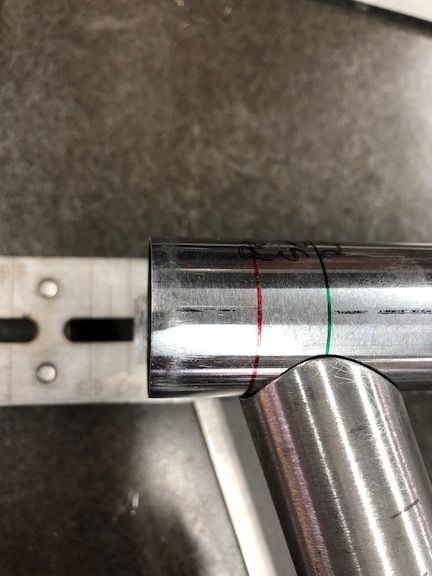
Where I decided the center to top measuring point should be way back when I did touring or sport touring frames for recreational cyclists (because back then that is how everyone that wasn't a racer understood frame size) was to the crease at the top of the top tube right where it touches the seat tube. This was a fixed and exact spot on every frame. In the picture below, my point of reference is the red line for center to top and green line is for center to center. The difference in distance between the two lines is around 13mm for a 1" top tube and 15mm on a 28.6 top tube.
Last edited by Doug Fattic; 03-24-21 at 02:24 PM.
03-24-21 | 02:55 PM
#12

Senior Member
Joined: May 2013
Posts: 2,036
Likes: 549
From: Pacific Northwest
Bikes: ‘87 Marinoni SLX Sports Tourer, ‘79 Miyata 912 by Gugificazione
Doug Fattic, Love your thorough, but always clear and understandable responses! Thank you for being a frequent contributor here.
