


Cold setting risks
 06-21-21 | 02:00 PM
#1
Thread Starter
Newbie
Joined: Jun 2021
Posts: 68
Likes: 35
From: Brooklyn by way of Syracuse
Bikes: 1973 Moto Grand Record restomod; 1990s Moser Leader AX; 1989 Specialized Rockhopper Comp;90s Fisher Tassajara project (turning gravel); No name single speed steel daily rider..
Cold setting risks
I would like to turn my first bike, a 1972ish Moto Grand Record, into a 1 x (10?). Right now it's a beater, so I stripped it down and want it to be something I will actually enjoy using, probably including a powder coat new look and hand-paint the lugs. The rear dropouts measure at 120. I know a modern wheel with cassette needs 130. I've watched RJ Bike guy's videos about cold setting. I'm guessing the real risk is the brazed brake bridge and chainstay bridge? As well as general alignment? Any additional warnings/advice about trying this? Thanks.
 06-21-21 | 02:37 PM
#2

Senior Member


Joined: Jun 2010
Posts: 2,132
Likes: 1,522
From: Medford MA
Bikes: Ron Cooper touring, 1959 Jack Taylor 650b ladyback touring tandem, Vitus 979, Joe Bell painted Claud Butler Dalesman, Colin Laing curved tube tandem, heavily-Dilberted 1982 Trek 6xx, René Herse tandem
The bridges won't break unless they were either badly brazed in the first place or developed cracks during use. If it breaks, in my opinion that means you already had problems. The high-end Motos from that era that I have seen are pretty well-built, displaying none of the quality control issues prevalent on their British contemporaries.
It is pretty easy to align a frame with string and a ruler. Having calipers and a large adjustable wrench to align the dropouts and a properly dished wheel to put in and check things also helps.
A Grand Record, as far as I know, should be all Reynolds 531, so it will be harder to spread the rear triangle than the lower-end "hi-tensile" frames, but won't offer nearly as much resistance as more modern bikes would. You can do it incrementally with a threaded rod between the dropouts, but I prefer putting 2x4s or other lumber between the seat tube and the dropout and prying them apart with my arms. This allows you to more easily make adjustments independently on either side, especially if you can fix the bottom bracket in a vise or clamped to a bench. Plus the lumber is easier to remove in order to insert a wheel or whatnot.
It is pretty easy to align a frame with string and a ruler. Having calipers and a large adjustable wrench to align the dropouts and a properly dished wheel to put in and check things also helps.
A Grand Record, as far as I know, should be all Reynolds 531, so it will be harder to spread the rear triangle than the lower-end "hi-tensile" frames, but won't offer nearly as much resistance as more modern bikes would. You can do it incrementally with a threaded rod between the dropouts, but I prefer putting 2x4s or other lumber between the seat tube and the dropout and prying them apart with my arms. This allows you to more easily make adjustments independently on either side, especially if you can fix the bottom bracket in a vise or clamped to a bench. Plus the lumber is easier to remove in order to insert a wheel or whatnot.
__________________
Owner & co-founder, Cycles René Hubris. Unfortunately attaching questionable braze-ons to perfectly good frames since about 2015. With style.
Owner & co-founder, Cycles René Hubris. Unfortunately attaching questionable braze-ons to perfectly good frames since about 2015. With style.
 06-21-21 | 02:44 PM
#3
Thread Starter
Newbie
Joined: Jun 2021
Posts: 68
Likes: 35
From: Brooklyn by way of Syracuse
Bikes: 1973 Moto Grand Record restomod; 1990s Moser Leader AX; 1989 Specialized Rockhopper Comp;90s Fisher Tassajara project (turning gravel); No name single speed steel daily rider..
The bridges won't break unless they were either badly brazed in the first place or developed cracks during use. If it breaks, in my opinion that means you already had problems. The high-end Motos from that era that I have seen are pretty well-built, displaying none of the quality control issues prevalent on their British contemporaries.
It is pretty easy to align a frame with string and a ruler. Having calipers and a large adjustable wrench to align the dropouts and a properly dished wheel to put in and check things also helps.
A Grand Record, as far as I know, should be all Reynolds 531, so it will be harder to spread the rear triangle than the lower-end "hi-tensile" frames, but won't offer nearly as much resistance as more modern bikes would. You can do it incrementally with a threaded rod between the dropouts, but I prefer putting 2x4s or other lumber between the seat tube and the dropout and prying them apart with my arms. This allows you to more easily make adjustments independently on either side, especially if you can fix the bottom bracket in a vise or clamped to a bench. Plus the lumber is easier to remove in order to insert a wheel or whatnot.
It is pretty easy to align a frame with string and a ruler. Having calipers and a large adjustable wrench to align the dropouts and a properly dished wheel to put in and check things also helps.
A Grand Record, as far as I know, should be all Reynolds 531, so it will be harder to spread the rear triangle than the lower-end "hi-tensile" frames, but won't offer nearly as much resistance as more modern bikes would. You can do it incrementally with a threaded rod between the dropouts, but I prefer putting 2x4s or other lumber between the seat tube and the dropout and prying them apart with my arms. This allows you to more easily make adjustments independently on either side, especially if you can fix the bottom bracket in a vise or clamped to a bench. Plus the lumber is easier to remove in order to insert a wheel or whatnot.

 06-21-21 | 02:56 PM
#5

Senior Member


Joined: Apr 2012
Posts: 21,777
Likes: 5,689
From: Middle Earth (aka IA)
Bikes: A bunch of old bikes and a few new ones
snip . . .
A Grand Record, as far as I know, should be all Reynolds 531, so it will be harder to spread the rear triangle than the lower-end "hi-tensile" frames, but won't offer nearly as much resistance as more modern bikes would. You can do it incrementally with a threaded rod between the dropouts, but I prefer putting 2x4s or other lumber between the seat tube and the dropout and prying them apart with my arms. This allows you to more easily make adjustments independently on either side, especially if you can fix the bottom bracket in a vise or clamped to a bench. Plus the lumber is easier to remove in order to insert a wheel or whatnot.
A Grand Record, as far as I know, should be all Reynolds 531, so it will be harder to spread the rear triangle than the lower-end "hi-tensile" frames, but won't offer nearly as much resistance as more modern bikes would. You can do it incrementally with a threaded rod between the dropouts, but I prefer putting 2x4s or other lumber between the seat tube and the dropout and prying them apart with my arms. This allows you to more easily make adjustments independently on either side, especially if you can fix the bottom bracket in a vise or clamped to a bench. Plus the lumber is easier to remove in order to insert a wheel or whatnot.
06-21-21 | 02:57 PM
#6
Senior Member
Joined: Apr 2012
Posts: 21,777
Likes: 5,689
From: Middle Earth (aka IA)
Bikes: A bunch of old bikes and a few new ones
By the way, you can fit a pretty fat tire if running 700c. I'm running 700 x 35c Schwalbe Mondial tires on my '73 Motobecane Grand Record.
06-21-21 | 03:05 PM
#7
Thread Starter
Newbie
Joined: Jun 2021
Posts: 68
Likes: 35
From: Brooklyn by way of Syracuse
Bikes: 1973 Moto Grand Record restomod; 1990s Moser Leader AX; 1989 Specialized Rockhopper Comp;90s Fisher Tassajara project (turning gravel); No name single speed steel daily rider..
Thanks, and honestly I'm not sure the exact year. The components based on the catalogs place it somewhere in there. But I'll assume the rear is not anyway. I bought it around '74 from the original owner.
06-21-21 | 03:06 PM
#8
Thread Starter
Newbie
Joined: Jun 2021
Posts: 68
Likes: 35
From: Brooklyn by way of Syracuse
Bikes: 1973 Moto Grand Record restomod; 1990s Moser Leader AX; 1989 Specialized Rockhopper Comp;90s Fisher Tassajara project (turning gravel); No name single speed steel daily rider..
531 main tubes if a '72; main tubes and fork by '73. Who knows what the rear triangle was made of but it wouldn't surprise me if it were hi tensile steel.
By the way, you can fit a pretty fat tire if running 700c. I'm running 700 x 35c Schwalbe Mondial tires on my '73 Motobecane Grand Record.
By the way, you can fit a pretty fat tire if running 700c. I'm running 700 x 35c Schwalbe Mondial tires on my '73 Motobecane Grand Record.
06-21-21 | 03:10 PM
#9
Senior Member
Joined: Apr 2012
Posts: 21,777
Likes: 5,689
From: Middle Earth (aka IA)
Bikes: A bunch of old bikes and a few new ones

 06-21-21 | 03:21 PM
#10

Senior Member
Joined: May 2009
Posts: 1,906
Likes: 1,466
From: A different place and time.
I've cold set 4 frames, all Columbus tubing. I haven't broken a bridge yet. I tried the threaded rod method on a TSX frame . Every time I spread it with the rod, the frame just went back to 126 mm when the rod was removed. I probably got it up to 145 mm with the rod and left it for a day, It just went back to 126 mm. I use the 2 x 4 method, but slightly different than what is seen on the web. I lay the frame on a blanket, put the 2 x 4 under the top drop out and against the bottom chain stay as close the the bridge as it can go ( if you cut the end of the 2 x4 at an angle, you can get it right up against the bridge). I hold the bottom drop out down with my foot and lift the 2 x 4. It doesn't take much to cold set. I then flip the frame and do the other side. I constantly check alignment with the string method and work both sides gradually. Then I check the dropout alignment and derailleur hanger alignment.
Last edited by gearbasher; 06-21-21 at 03:28 PM.
 06-21-21 | 03:31 PM
#11
Senior Member

Joined: Feb 2020
Posts: 4,003
Likes: 2,317
If it's 120 and has to be 130, bend one side until it's 125, then bend the other to 130. Sorted - and straight.
06-21-21 | 04:47 PM
#12
Senior Member
Joined: Jun 2010
Posts: 2,132
Likes: 1,522
From: Medford MA
Bikes: Ron Cooper touring, 1959 Jack Taylor 650b ladyback touring tandem, Vitus 979, Joe Bell painted Claud Butler Dalesman, Colin Laing curved tube tandem, heavily-Dilberted 1982 Trek 6xx, René Herse tandem
Since then, I think I've done 20 or so frames, none with clamps. There may be certain use-cases for a clamp, but I have never used one since my first.
__________________
Owner & co-founder, Cycles René Hubris. Unfortunately attaching questionable braze-ons to perfectly good frames since about 2015. With style.
Owner & co-founder, Cycles René Hubris. Unfortunately attaching questionable braze-ons to perfectly good frames since about 2015. With style.
06-21-21 | 05:08 PM
#13

Senior Member

Joined: Sep 2005
Posts: 3,487
Likes: 1,552
From: Oakland, CA
Bikes: '82 Univega Competizione, '72 Motobecane Grand Record, '83 Mercian KOM Touring, '85 Univega Alpina Uno, '76 Eisentraut Limited
I cold set my 72 Moto Grand Record with the 2x4 method and no clamp, and it went fine. I spread it to 128mm so I could use a 126mm wheel and move to a 130mm wheel later if I wanted to. Little moves, check it constantly...
Mine has the last remnant of a decal with a "3" on it, so it is definitely Reynolds main tubes only, not chainstays or seatstays.
Mine has the last remnant of a decal with a "3" on it, so it is definitely Reynolds main tubes only, not chainstays or seatstays.
06-21-21 | 06:04 PM
#14

Senior Member
Joined: Apr 2007
Posts: 12,565
Likes: 2,739
From: Thunder Bay, Ontario, Canada - burrrrr!
Bikes: 1958 Rabeneick 120D, 1968 Legnano Gran Premio, 196? Torpado Professional, 2000 Marinoni Piuma
The clamp is absolutely necessary, in my opinion. The second concern is over bend and needing to bend back. Care and careful measuring after each bend attempt will help to guard against this. Finally, equal bends on both sides are important to keep things running true to the centerline of the bicycle. Once drop to drop distance is achieved, you must align the drops, ensuring that they are bang on parallel to one another. Fingers crossed is a rarely mentioned part of this procedure.
__________________
"98% of the bikes I buy are projects".
"98% of the bikes I buy are projects".
06-21-21 | 06:22 PM
#15
Senior Member
Joined: Nov 2004
Posts: 23,212
Likes: 3,122
I never use a 2 x 4. They are too unwieldy. making it more difficult to modulate the force being applied. My ideal cold setting tool is the shaft from a broken, wooden, hockey stick. Pre-Covid there was a ready supply for free, in the garbage bins outside ice rinks.
06-21-21 | 06:50 PM
#16

Senior Member
Joined: Nov 2010
Posts: 22,994
Likes: 10,496
From: Sacramento, CA
Bikes: old ones
I can think of no real good reason to make this modification...
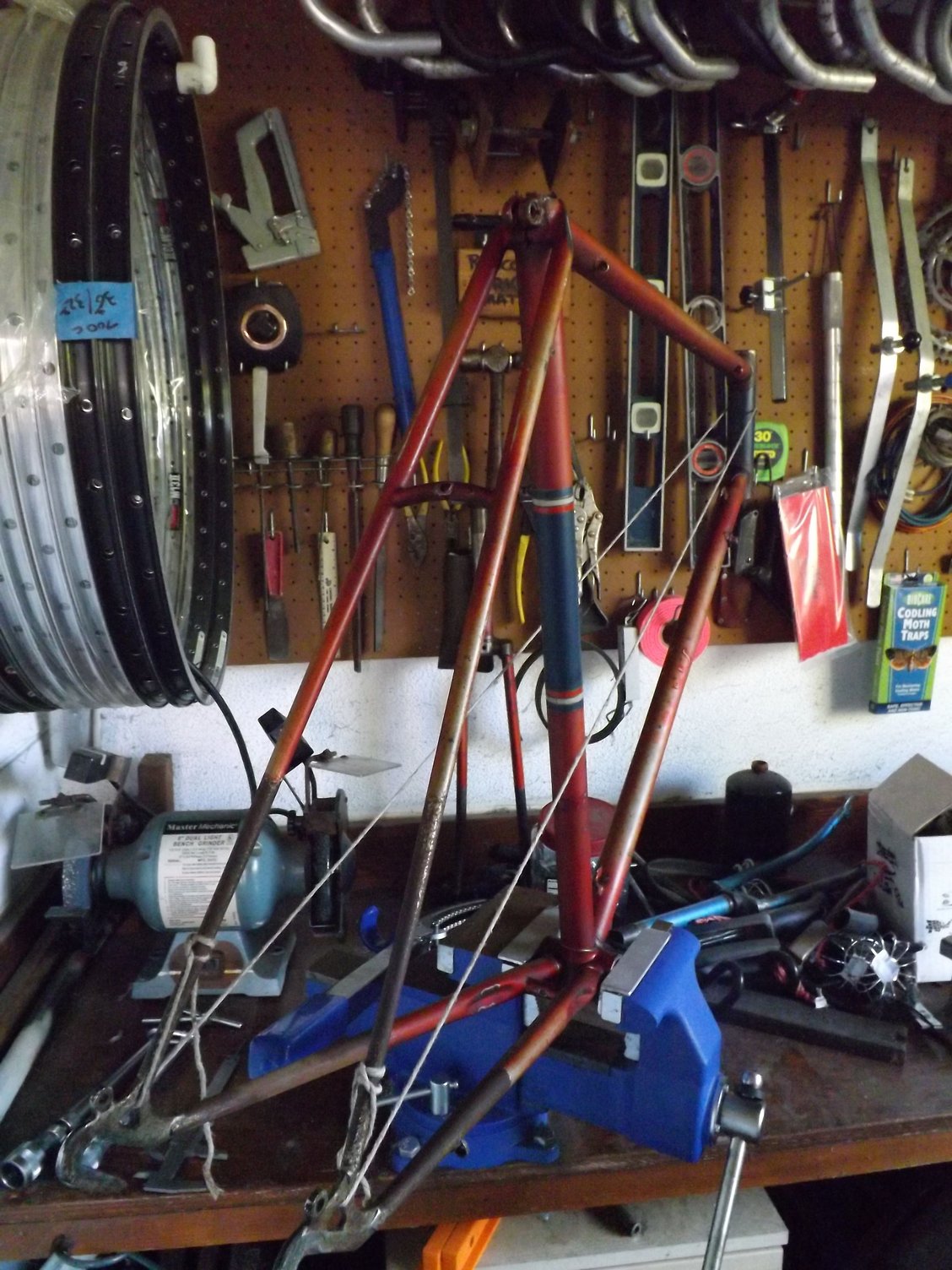
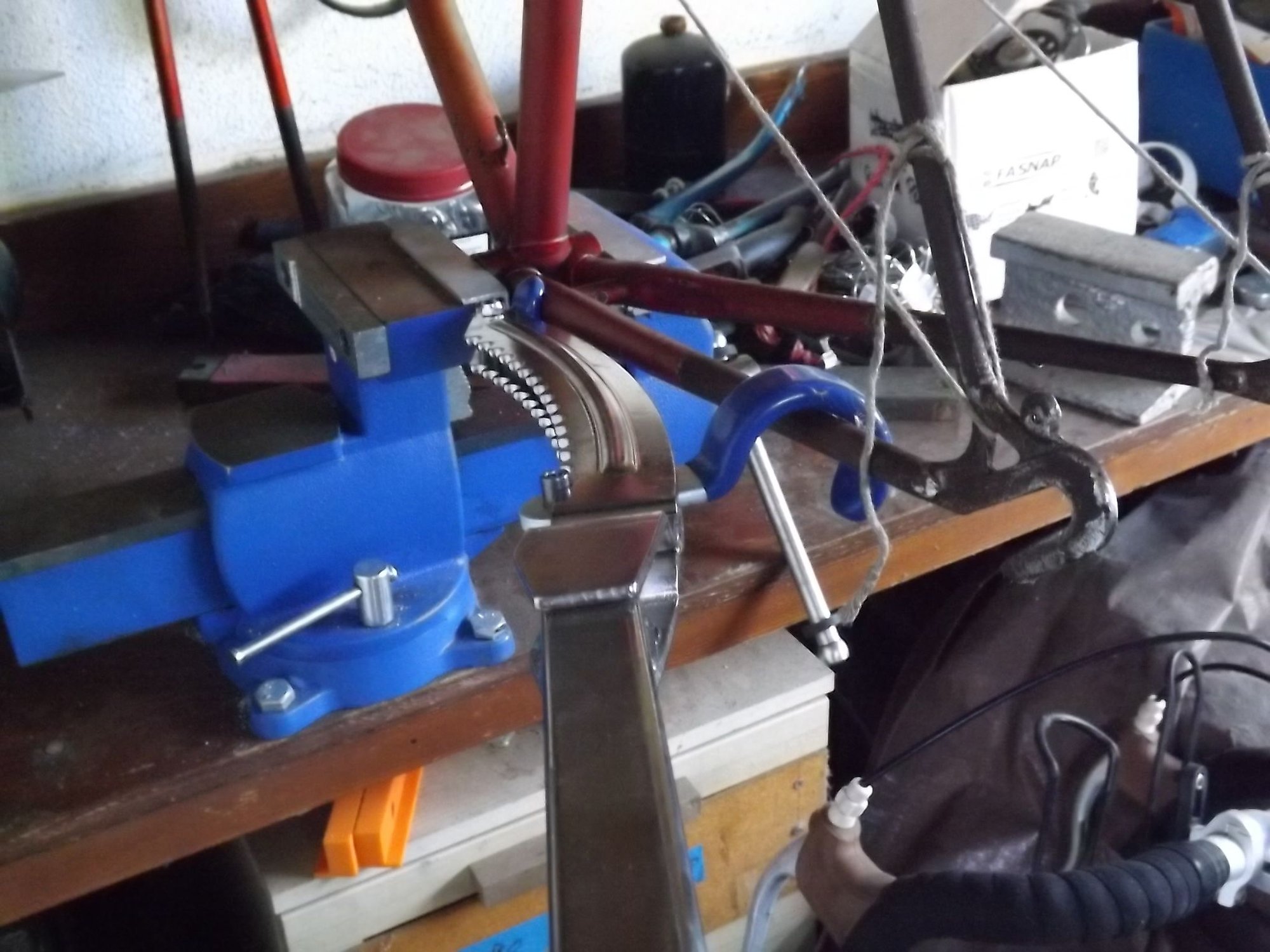
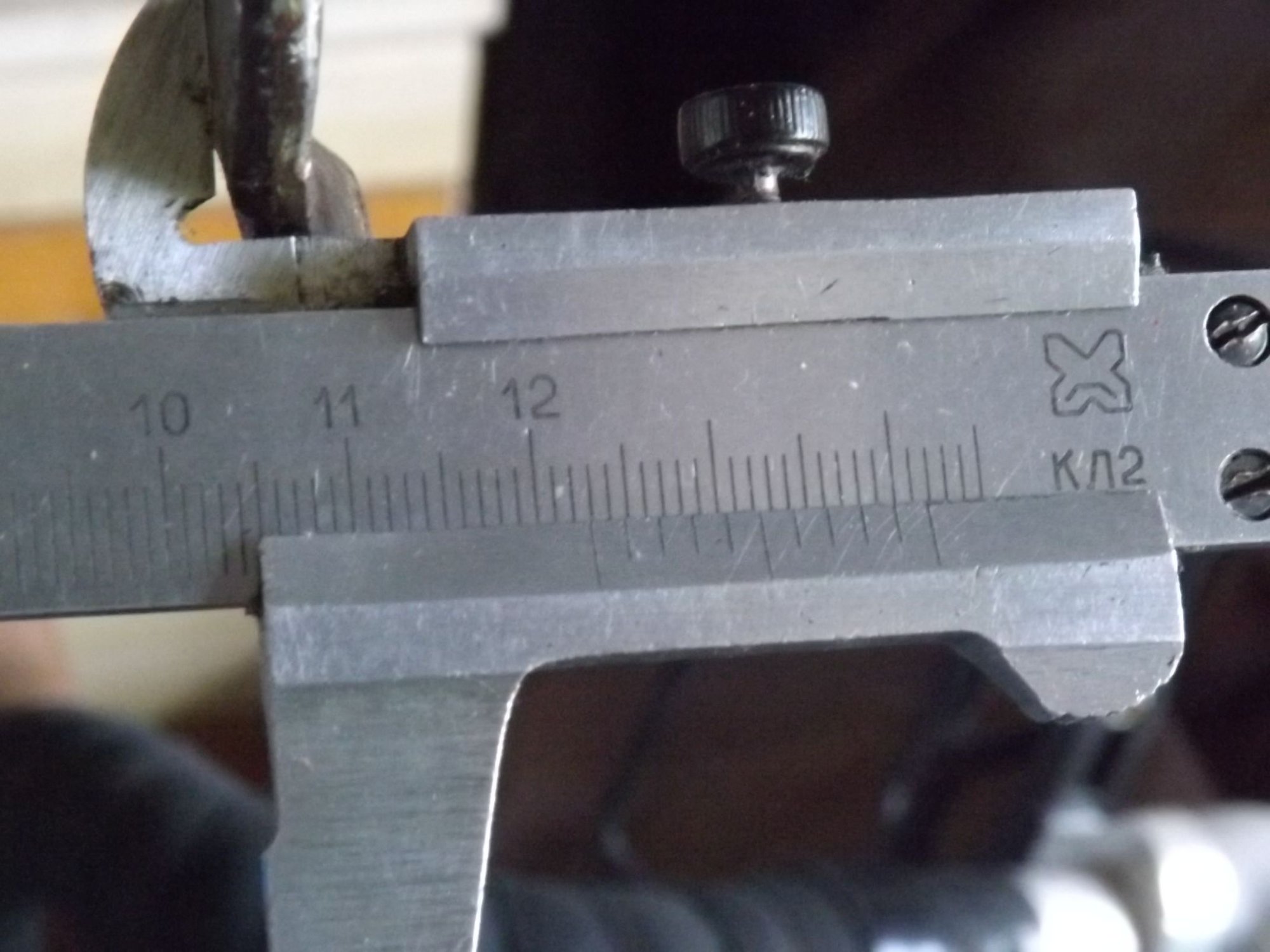
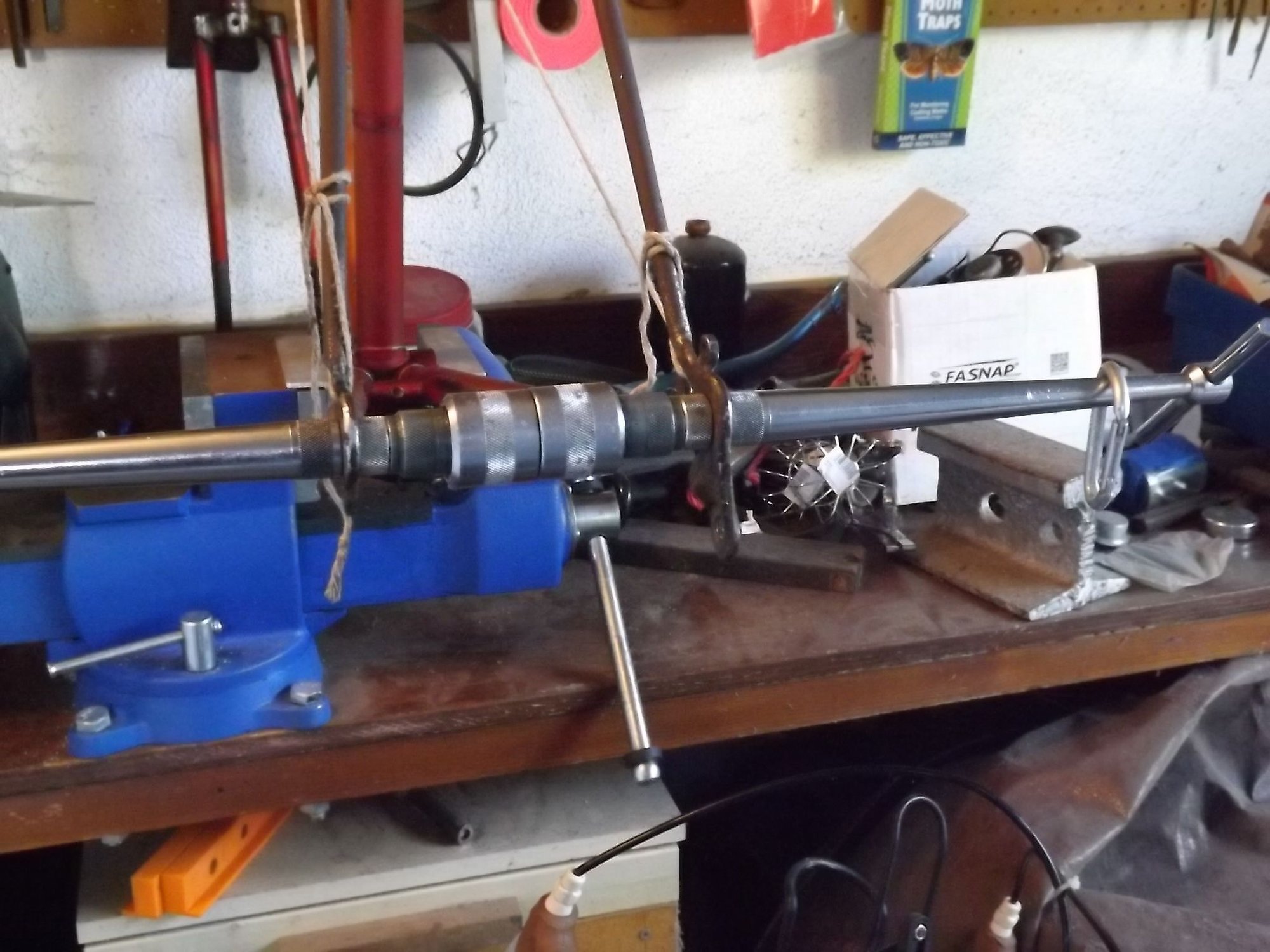
...but this is more or less how I do it. I don't worry too much about the bridges, but I don't usually make adjustments that go to 10 either.
I guess I can see some valid reasons for going to 126, if for no other reason than the freewheels are easier to find. But unless I had some set of 130mm hubbed wheels lying around, and I was desperate to use them, the switch from 5 cogs in the back to ten has little to offer in the way of improved gear range and some definite disadvantages if your ten speed chain has some trouble on your old chainwheels, because they're cut a little wider at the tooth, and are spaced far enough apart for that chain to drop down in between them some time when it is inconvenient.
And I find it problematic friction shifting a ten cog rear, quickly and by feel. I'm sure there are people who do it, just not me.
06-21-21 | 07:20 PM
#18

Senior Member
Joined: Jul 2006
Posts: 11,478
Likes: 4,884
From: San Jose (Willow Glen) Ca
Bikes: Kirk Custom JK Special, 86 De Rosa Pro, '84 Team Miyata,(dura ace old school) 80?? SR Semi-Pro 600 Arabesque
fwiw, I have cold set once, from 126 to 135 on a 82 nishki. I used the sheldon brown 2x4 method.... bit scary but work out well. https://www.sheldonbrown.com/frame-spacing.html
__________________
Life is too short not to ride the best bike you have, as much as you can.
Life is too short not to ride the best bike you have, as much as you can.
06-21-21 | 07:29 PM
#19
framebuilder
Joined: Dec 2009
Posts: 1,788
Likes: 2,710
From: Niles, Michigan
Just thought a thread on frame alignment should include a picture of professional tools. I didn't have dropout alignment tools (Campy H tools) in this picture but 3Alarmer has those covered. I'm not a proponent of the string method because it assumes the front triangle is correctly aligned. More often than not it is not. I've aligned thousands of frames over my long career and especially classic era frames are out. Many of the best Japanese ones are spot on. The Park Frame Alignment Gauge is not that expensive and a much better option than using string.
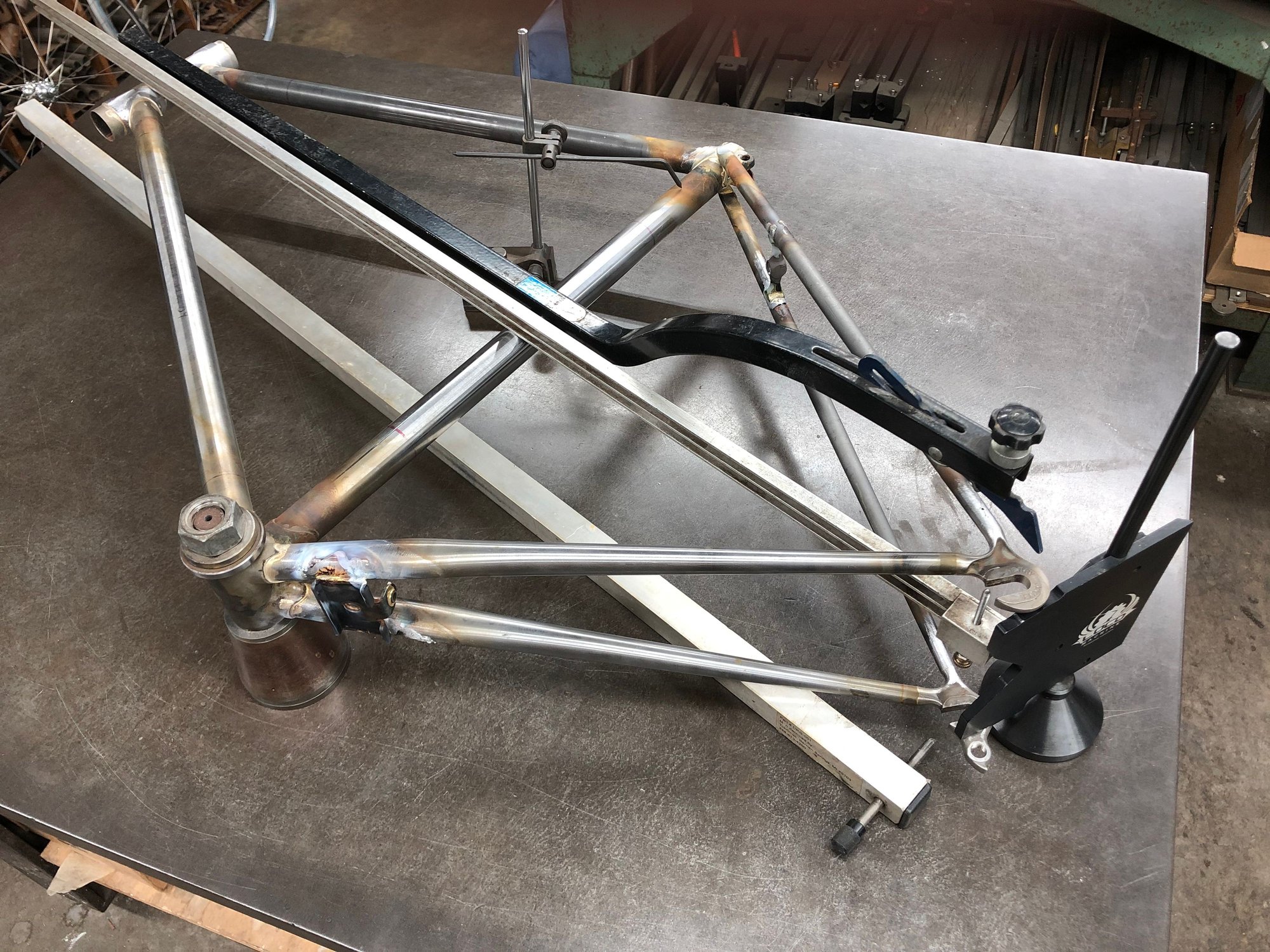
In this picture you will see a surface gauge with a bent point to check that the tubes are parallel to the cast iron surface. There is also a black V step gauge that lets me know the dropouts are equidistant from the frame's centerline. The unit is adjusted up and down by placing the V into the seat tube. The the inside of the dropouts should match one set of steps. The Park tool is there as well as 2 of my own versions. Mine could be used instead of the table by placing it against the face of the BB shell and adjusting the end of the screw to just touch the tube near the BB and then again out on the other end to see if it matches. If not, bending begins.
In this picture you will see a surface gauge with a bent point to check that the tubes are parallel to the cast iron surface. There is also a black V step gauge that lets me know the dropouts are equidistant from the frame's centerline. The unit is adjusted up and down by placing the V into the seat tube. The the inside of the dropouts should match one set of steps. The Park tool is there as well as 2 of my own versions. Mine could be used instead of the table by placing it against the face of the BB shell and adjusting the end of the screw to just touch the tube near the BB and then again out on the other end to see if it matches. If not, bending begins.

 06-22-21 | 06:51 AM
#20
Senior Member
Joined: Apr 2012
Posts: 21,777
Likes: 5,689
From: Middle Earth (aka IA)
Bikes: A bunch of old bikes and a few new ones
If the rear triangle is hi tensile steel on your '72 Motobecane Grand Record, you should be able to spread that rear triangle by hand. I did that on a 70s Peugeot PR 10 (531 main frame, hi tensile steel rear triangle and fork).
06-22-21 | 07:00 AM
#21
Senior Member
Joined: Dec 2014
Posts: 5,352
Likes: 5,166
From: Central Virginia
Bikes: Numerous
For a little perspective, a couple years ago I cold set a decent quality Ross frame (Ishiwata tubing?) for my wife’s use as a city bike, by laying on the floor and levering with a shovel handle. She’s very happy with it.
__________________
N = '96 Colnago C40, '04 Wilier Alpe D'Huez, '10 Colnago EPS, '85 Merckx Pro, '89 Merckx Century, '86 Tommasini Professional, '04 Teschner Aero FX Pro, '05 Alan Carbon Cross, '86 De Rosa Professional, '95 Gios Compact Pro, '95 Carrera Zeus, ‘81 Masi Gran Criterium, ‘81 Merckx Pro, ‘89 Cinelli Supercorsa, ‘83 Bianchi Specialissima, ‘VO Randonneur, Ritchey Breakaway Steel, Rivendell Rambouillet, Heron Randonneur, ‘92 Ciöcc Columbus EL
N = '96 Colnago C40, '04 Wilier Alpe D'Huez, '10 Colnago EPS, '85 Merckx Pro, '89 Merckx Century, '86 Tommasini Professional, '04 Teschner Aero FX Pro, '05 Alan Carbon Cross, '86 De Rosa Professional, '95 Gios Compact Pro, '95 Carrera Zeus, ‘81 Masi Gran Criterium, ‘81 Merckx Pro, ‘89 Cinelli Supercorsa, ‘83 Bianchi Specialissima, ‘VO Randonneur, Ritchey Breakaway Steel, Rivendell Rambouillet, Heron Randonneur, ‘92 Ciöcc Columbus EL
06-25-21 | 07:22 AM
#22
Thread Starter
Newbie
Joined: Jun 2021
Posts: 68
Likes: 35
From: Brooklyn by way of Syracuse
Bikes: 1973 Moto Grand Record restomod; 1990s Moser Leader AX; 1989 Specialized Rockhopper Comp;90s Fisher Tassajara project (turning gravel); No name single speed steel daily rider..
Your bike is gorgeous. Mine is almost down to bare metal after years of neglect so I'm not restoring it, but repurposing.
06-25-21 | 07:33 AM
#23
Thread Starter
Newbie
Joined: Jun 2021
Posts: 68
Likes: 35
From: Brooklyn by way of Syracuse
Bikes: 1973 Moto Grand Record restomod; 1990s Moser Leader AX; 1989 Specialized Rockhopper Comp;90s Fisher Tassajara project (turning gravel); No name single speed steel daily rider..
06-25-21 | 07:37 AM
#24
Thread Starter
Newbie
Joined: Jun 2021
Posts: 68
Likes: 35
From: Brooklyn by way of Syracuse
Bikes: 1973 Moto Grand Record restomod; 1990s Moser Leader AX; 1989 Specialized Rockhopper Comp;90s Fisher Tassajara project (turning gravel); No name single speed steel daily rider..
Yeah, I started out thinking a single speed, but my terrain and riding style, age and fitness wouldn't get much use out of that. So I focused on the 1 x 10 with tubeless wider tires, which I think I will use a lot and I'm not interested in a bike hanging on the wall. Thanks for your feedback, all great info.
06-25-21 | 07:53 AM
#25
Thread Starter
Newbie
Joined: Jun 2021
Posts: 68
Likes: 35
From: Brooklyn by way of Syracuse
Bikes: 1973 Moto Grand Record restomod; 1990s Moser Leader AX; 1989 Specialized Rockhopper Comp;90s Fisher Tassajara project (turning gravel); No name single speed steel daily rider..
I'm not 100% certain on the original year. I bought it around 74 from a guy who raced a year or two (don't remember). I know the original equipment (still have most of it) and that puts it in around that year. (FWIW: Campy Nuovo Record der/levers; Mafac racer brakes; Normandy Competition Luxe hubs/Weinman rims; Pivo stem; Brooks pro saddle (lost in a move, damn!); Stronglight bb/crank/headset. Atom pedals). I'm not clear on the steel differences: if it happens to be 531 rear will it not take kindly to cold setting?