


Explain Old Drop Bar Brake Levers
 06-26-21 | 06:28 AM
#1
Thread Starter
Senior Member


Joined: Aug 2017
Posts: 574
Likes: 78
From: Wisconsin
Bikes: 1973 Schwinn Paramount, 2017 Raleigh Clubman Carbon, 2015 Felt Z75 Disc, 2008 Fuji Cross Comp, 2010 Trek Navigator 1.0, 1974 Raleigh Sports, 1974 Schwinn Le Tour, 2017 Giant Anyroad 2, Surly Cross Check, 2021 Giant Talon 2
Explain Old Drop Bar Brake Levers
So I recently bought what I believe is a 1981 Schwinn Super Le Tour. Really nice riding bike, but it is making me wonder about the old brake levers. I have a 1974 Le Tour and it has the levers I'm familiar with where it has the brakes for in the drops and the safety lever for on the straight bar. Now I think the Super has the original brakes, but these have no safety bar.
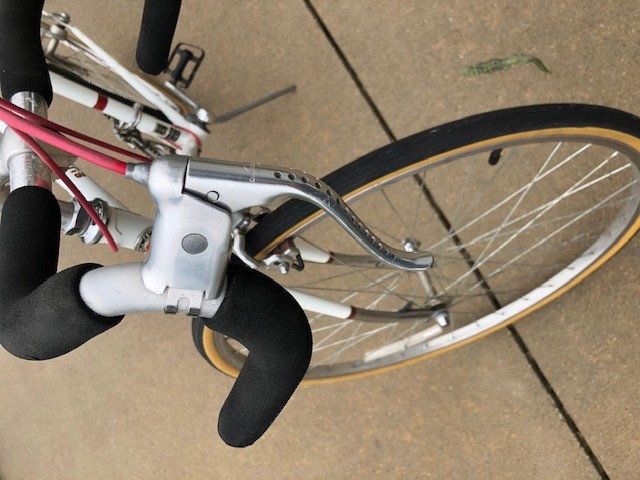
In the catalog they are described as having lever hoods. The ones I have look like the right age, but not sure they look like the same brakes pictured in the catalog. Did these originally have rubber hoods? Pretty sure I've seen other supers for sale with these same brakes. As best as I can tell, even with rubber hoods you couldn't ride on them and still brake. Later there are brakes that you ride on the hood and can still brake like modern brifters I believe? So I guess I'm just hoping for a rundown on how the brake evolved and insight into what ones I have on this super. I think I'm going to replace them with some Tektro ones you can ride on.
In the catalog they are described as having lever hoods. The ones I have look like the right age, but not sure they look like the same brakes pictured in the catalog. Did these originally have rubber hoods? Pretty sure I've seen other supers for sale with these same brakes. As best as I can tell, even with rubber hoods you couldn't ride on them and still brake. Later there are brakes that you ride on the hood and can still brake like modern brifters I believe? So I guess I'm just hoping for a rundown on how the brake evolved and insight into what ones I have on this super. I think I'm going to replace them with some Tektro ones you can ride on.
__________________
check out the Frugal Average Bicyclist
Frugal Average Bicyclist – The goal here is to help you keep cycling on a budget.
check out the Frugal Average Bicyclist
Frugal Average Bicyclist – The goal here is to help you keep cycling on a budget.
 06-26-21 | 07:20 AM
#2

Freewheel Medic


Joined: Oct 2005
Posts: 13,567
Likes: 3,313
From: An Island on the Coast of GA!
Bikes: Snazzy* Schwinns, Classy Cannondales & a Super Pro Aero Lotus (* Ed.)
Hoods were made for the DiaCompe and Weinmann levers (Weinmann licensed the design to DiaCompe). They are exceptionally hard to come by and as best I know, no one makes a replacement. I've made ones from leather as replacements and others have had success with fitting current Cane Creek hoods.
I'd post some pictures of my leather creations and the originals but Photo Bucket seems to be going through an upgrade at the moment. This listing on Ebay for A'ME replacement hoods is about as close as I can find at the moment (and the price is reasonable as well).
The safety levers were an add on to the same model lever and were used on many Schwinn road models in the 1970s. However, you can ride with your hands on the hoods (thumb on the inside and fingers on the outside) and brake using your fingers. Try moving the levers up on your bars about an inch. Some don't care for this look, but I find I can brake well from this position and from the drops.
I'd post some pictures of my leather creations and the originals but Photo Bucket seems to be going through an upgrade at the moment. This listing on Ebay for A'ME replacement hoods is about as close as I can find at the moment (and the price is reasonable as well).
The safety levers were an add on to the same model lever and were used on many Schwinn road models in the 1970s. However, you can ride with your hands on the hoods (thumb on the inside and fingers on the outside) and brake using your fingers. Try moving the levers up on your bars about an inch. Some don't care for this look, but I find I can brake well from this position and from the drops.
__________________
Bob
Enjoying the GA coast all year long!
Thanks for visiting my website: www.freewheelspa.com
Bob
Enjoying the GA coast all year long!
Thanks for visiting my website: www.freewheelspa.com

 06-26-21 | 08:16 AM
#4
Thread Starter
Senior Member
Joined: Aug 2017
Posts: 574
Likes: 78
From: Wisconsin
Bikes: 1973 Schwinn Paramount, 2017 Raleigh Clubman Carbon, 2015 Felt Z75 Disc, 2008 Fuji Cross Comp, 2010 Trek Navigator 1.0, 1974 Raleigh Sports, 1974 Schwinn Le Tour, 2017 Giant Anyroad 2, Surly Cross Check, 2021 Giant Talon 2
Hoods were made for the DiaCompe and Weinmann levers (Weinmann licensed the design to DiaCompe). They are exceptionally hard to come by and as best I know, no one makes a replacement. I've made ones from leather as replacements and others have had success with fitting current Cane Creek hoods.
I'd post some pictures of my leather creations and the originals but Photo Bucket seems to be going through an upgrade at the moment. This listing on Ebay for A'ME replacement hoods is about as close as I can find at the moment (and the price is reasonable as well).
The safety levers were an add on to the same model lever and were used on many Schwinn road models in the 1970s. However, you can ride with your hands on the hoods (thumb on the inside and fingers on the outside) and brake using your fingers. Try moving the levers up on your bars about an inch. Some don't care for this look, but I find I can brake well from this position and from the drops.
I'd post some pictures of my leather creations and the originals but Photo Bucket seems to be going through an upgrade at the moment. This listing on Ebay for A'ME replacement hoods is about as close as I can find at the moment (and the price is reasonable as well).
The safety levers were an add on to the same model lever and were used on many Schwinn road models in the 1970s. However, you can ride with your hands on the hoods (thumb on the inside and fingers on the outside) and brake using your fingers. Try moving the levers up on your bars about an inch. Some don't care for this look, but I find I can brake well from this position and from the drops.
__________________
check out the Frugal Average Bicyclist
Frugal Average Bicyclist – The goal here is to help you keep cycling on a budget.
check out the Frugal Average Bicyclist
Frugal Average Bicyclist – The goal here is to help you keep cycling on a budget.
06-26-21 | 08:18 AM
#5
Thread Starter
Senior Member
Joined: Aug 2017
Posts: 574
Likes: 78
From: Wisconsin
Bikes: 1973 Schwinn Paramount, 2017 Raleigh Clubman Carbon, 2015 Felt Z75 Disc, 2008 Fuji Cross Comp, 2010 Trek Navigator 1.0, 1974 Raleigh Sports, 1974 Schwinn Le Tour, 2017 Giant Anyroad 2, Surly Cross Check, 2021 Giant Talon 2
thanks. Is it likely those would work for these levers? Not sure how many non aero styles dia compe had.
__________________
check out the Frugal Average Bicyclist
Frugal Average Bicyclist – The goal here is to help you keep cycling on a budget.
check out the Frugal Average Bicyclist
Frugal Average Bicyclist – The goal here is to help you keep cycling on a budget.
 06-26-21 | 10:51 AM
#7
Senior Member
Joined: Jan 2004
Posts: 6,169
Likes: 1,797
From: Madison, WI USA
The '81 Super LeTour catalog appears to depict adjusting barrels on the brake levers. 'Course, catalog specs are subject to change, blah blah.... But since yours do not have adjusters -- would anyone know if these hoods would fit?
06-26-21 | 11:16 AM
#8

Ride, Wrench, Swap, Race

Joined: Jan 2010
Posts: 9,826
Likes: 1,805
From: Northern California
Bikes: Cheltenham-Pedersen racer, Boulder F/S Paris-Roubaix, Varsity racer, '52 Christophe, '62 Continental, '92 Merckx, '75 Limongi, '76 Presto, '72 Gitane SC, '71 Schwinn SS, etc.
I've stretched the Cane Creek hoods over the fat adjusters and it fits and looks good. The ones that I cut off looked terrible.
There will be a lot of friction created by the tight-fitting rubber when you try to turn the adjusters, but a tiny bit of silicone grease (Shimano/SRAM cable grease or faucet/dielectric grease) goes a long way toward easing the torque required. Just don't use petroleum grease is my recommendation. Also, the tight fit eases over time.
Schwinn levers from this era almost always had adjusters, so the originals may have been swapped out for a pair without aux levers(?).
There will be a lot of friction created by the tight-fitting rubber when you try to turn the adjusters, but a tiny bit of silicone grease (Shimano/SRAM cable grease or faucet/dielectric grease) goes a long way toward easing the torque required. Just don't use petroleum grease is my recommendation. Also, the tight fit eases over time.
Schwinn levers from this era almost always had adjusters, so the originals may have been swapped out for a pair without aux levers(?).
06-26-21 | 11:21 AM
#9

Phyllo-buster
Joined: Jan 2010
Posts: 9,270
Likes: 2,693
From: Nova Scotia
Bikes: roadsters, club bikes, fixed and classic
 06-26-21 | 11:58 AM
#10

Klaatu..Verata..Necktie?


Joined: May 2007
Posts: 23,678
Likes: 17,148
From: SF Bay Area
Bikes: Litespeed Ultimate, Ultegra; Canyon Endurace, 105; Battaglin MAX, Chorus; Bianchi 928 Veloce; Ritchey Road Logic, Dura Ace; Cannondale R500 RX100; Schwinn Circuit, Sante; Lotus Supreme, Dura Ace
I'm using a pair of Dia Compe's current hoods on old Shimano 7200 levers, and they fit reasonably well.
You CAN brake from the hoods, but the leverage just isn't all that great. Most of your braking was expected to be done from the drops. In looking at non-aero vs aero levers, the pivot and cable stop are placed differently, and I think that's why it's no problem to brake from the hoods with aero levers, compared to the non-aero.
I believe that riders spent a lot less time on the hoods back then, compared to now when MOST of the time your hands are there.
You CAN brake from the hoods, but the leverage just isn't all that great. Most of your braking was expected to be done from the drops. In looking at non-aero vs aero levers, the pivot and cable stop are placed differently, and I think that's why it's no problem to brake from the hoods with aero levers, compared to the non-aero.
I believe that riders spent a lot less time on the hoods back then, compared to now when MOST of the time your hands are there.
__________________
"Don't take life so serious-it ain't nohow permanent."
"Everybody's gotta be somewhere." - Eccles
"Don't take life so serious-it ain't nohow permanent."
"Everybody's gotta be somewhere." - Eccles
06-26-21 | 12:29 PM
#11
Thread Starter
Senior Member
Joined: Aug 2017
Posts: 574
Likes: 78
From: Wisconsin
Bikes: 1973 Schwinn Paramount, 2017 Raleigh Clubman Carbon, 2015 Felt Z75 Disc, 2008 Fuji Cross Comp, 2010 Trek Navigator 1.0, 1974 Raleigh Sports, 1974 Schwinn Le Tour, 2017 Giant Anyroad 2, Surly Cross Check, 2021 Giant Talon 2
I'm using a pair of Dia Compe's current hoods on old Shimano 7200 levers, and they fit reasonably well.
You CAN brake from the hoods, but the leverage just isn't all that great. Most of your braking was expected to be done from the drops. In looking at non-aero vs aero levers, the pivot and cable stop are placed differently, and I think that's why it's no problem to brake from the hoods with aero levers, compared to the non-aero.
I believe that riders spent a lot less time on the hoods back then, compared to now when MOST of the time your hands are there.
You CAN brake from the hoods, but the leverage just isn't all that great. Most of your braking was expected to be done from the drops. In looking at non-aero vs aero levers, the pivot and cable stop are placed differently, and I think that's why it's no problem to brake from the hoods with aero levers, compared to the non-aero.
I believe that riders spent a lot less time on the hoods back then, compared to now when MOST of the time your hands are there.
__________________
check out the Frugal Average Bicyclist
Frugal Average Bicyclist – The goal here is to help you keep cycling on a budget.
check out the Frugal Average Bicyclist
Frugal Average Bicyclist – The goal here is to help you keep cycling on a budget.
06-26-21 | 12:39 PM
#12

señor miembro
Joined: Dec 2018
Posts: 3,512
Likes: 8,899
From: Pac NW
Bikes: '70s - '80s Campagnolo
06-26-21 | 12:53 PM
#13
Klaatu..Verata..Necktie?
Joined: May 2007
Posts: 23,678
Likes: 17,148
From: SF Bay Area
Bikes: Litespeed Ultimate, Ultegra; Canyon Endurace, 105; Battaglin MAX, Chorus; Bianchi 928 Veloce; Ritchey Road Logic, Dura Ace; Cannondale R500 RX100; Schwinn Circuit, Sante; Lotus Supreme, Dura Ace
Well, you CAN ride on them, and brake from them, but it's not very comfortable and not very effective, respectively.
__________________
"Don't take life so serious-it ain't nohow permanent."
"Everybody's gotta be somewhere." - Eccles
"Don't take life so serious-it ain't nohow permanent."
"Everybody's gotta be somewhere." - Eccles
06-26-21 | 01:04 PM
#14
Klaatu..Verata..Necktie?
Joined: May 2007
Posts: 23,678
Likes: 17,148
From: SF Bay Area
Bikes: Litespeed Ultimate, Ultegra; Canyon Endurace, 105; Battaglin MAX, Chorus; Bianchi 928 Veloce; Ritchey Road Logic, Dura Ace; Cannondale R500 RX100; Schwinn Circuit, Sante; Lotus Supreme, Dura Ace
Personally, on my C&V bikes I like to keep them as original as possible, though I'll make exceptions for fit and efficiency. And I like to keep groupsets together as much as I can, so I leave the original brakes and levers on, but I upgrade the pads, and I've taken to using modern brake cable housing, in colors matching the original.
__________________
"Don't take life so serious-it ain't nohow permanent."
"Everybody's gotta be somewhere." - Eccles
"Don't take life so serious-it ain't nohow permanent."
"Everybody's gotta be somewhere." - Eccles
06-26-21 | 04:03 PM
#15
Thread Starter
Senior Member
Joined: Aug 2017
Posts: 574
Likes: 78
From: Wisconsin
Bikes: 1973 Schwinn Paramount, 2017 Raleigh Clubman Carbon, 2015 Felt Z75 Disc, 2008 Fuji Cross Comp, 2010 Trek Navigator 1.0, 1974 Raleigh Sports, 1974 Schwinn Le Tour, 2017 Giant Anyroad 2, Surly Cross Check, 2021 Giant Talon 2
You should try them. The ones I'm used to - Shimano Sante and RX100 - are more comfortable to ride on, and easier to brake from than non-aero levers. The other thing is both are connected to better brakes. The Sante single pivot brakes are Shimano's last generation of single pivot brakes and they're really good, especially compared to the older, flexier single pivots. The RX100's are the first generation of dual pivots and they're even better. People will tell you if you can't lock up the wheels with two from the hoods with non-aero levers and single-pivot calipers, you're doing something wrong, but they will never be as effective as modern brakes.
Personally, on my C&V bikes I like to keep them as original as possible, though I'll make exceptions for fit and efficiency. And I like to keep groupsets together as much as I can, so I leave the original brakes and levers on, but I upgrade the pads, and I've taken to using modern brake cable housing, in colors matching the original.
Personally, on my C&V bikes I like to keep them as original as possible, though I'll make exceptions for fit and efficiency. And I like to keep groupsets together as much as I can, so I leave the original brakes and levers on, but I upgrade the pads, and I've taken to using modern brake cable housing, in colors matching the original.
so that made the decision easier. But the Tektro brakes aren’t too expensive so I should probably give them a try.
06-26-21 | 04:35 PM
#16

Senior Member


Joined: Nov 2014
Posts: 27,576
Likes: 5,465
From: Eugene, Oregon, USA
I do like the more "modern" aero levers.
Various Tektro models.
Origin8 Classique
TRP
Cane Creek???
etc.
Origin8 Classique
TRP
Cane Creek???
etc.
06-26-21 | 05:34 PM
#17

Senior Member
Joined: Oct 2014
Posts: 14,171
Likes: 5,299
From: Portland, OR
Bikes: (2) ti TiCycles, 2007 w/ triple and 2011 fixed, 1979 Peter Mooney, ~1983 Trek 420 now fixed and ~1973 Raleigh Carlton Competition gravel grinder
Yeah, Tektro levers are the simple upgrade. Cheap. Good levers. Comfortable and they stop well. I have used them with Mafac; both the Racers and cantis, Schwinn approved centerpulls (probably Weinmann though maybe Diacompe), Shimano dual pivots, Superbe sidepulls. Thought went into the design. I believe they make the Cane Creek levers and probably a few other brands as well.
They are powerful levers and work well from the top. I'm old-school. I learned to race back when we were taught to ride the drops anytime the going got iffy and certainly if we needed to do a serious stop. So I "de-tune" my brakes on the bikes I'll take in to the hills and mountains by using the less powerful Tektro V-brake levers. Not what you, BikingViking want but it works really well for me.
They are powerful levers and work well from the top. I'm old-school. I learned to race back when we were taught to ride the drops anytime the going got iffy and certainly if we needed to do a serious stop. So I "de-tune" my brakes on the bikes I'll take in to the hills and mountains by using the less powerful Tektro V-brake levers. Not what you, BikingViking want but it works really well for me.
06-26-21 | 08:27 PM
#18
Junior Member
Joined: Jun 2021
Posts: 16
Likes: 4
These were designed so you had two breaking positions: with your thumb over the hood, or from the drop position. Neither were comfortable. And, yes, Aero brakes refer to the housing and cables coming out of the bottom of the hoods, along the handlebar.
06-26-21 | 10:52 PM
#19

Me duelen las nalgas
Joined: Aug 2015
Posts: 13,519
Likes: 2,832
From: Texas
Bikes: Centurion Ironman, Trek 5900, Univega Via Carisma, Globe Carmel
If you preferred the "turkey leg" safety levers of the 1970s bikes (I did when I commuted back then), check out the more effective in-line interrupter brake levers.
06-26-21 | 11:09 PM
#20
Ride, Wrench, Swap, Race
Joined: Jan 2010
Posts: 9,826
Likes: 1,805
From: Northern California
Bikes: Cheltenham-Pedersen racer, Boulder F/S Paris-Roubaix, Varsity racer, '52 Christophe, '62 Continental, '92 Merckx, '75 Limongi, '76 Presto, '72 Gitane SC, '71 Schwinn SS, etc.
If you preferred the "turkey leg" safety levers of the 1970s bikes (I did when I commuted back then), check out the more effective in-line interrupter brake levers.
The turkey-leg levers work very well on well-tuned systems, but should have a few millimeters of the front edge of the lever body trimmed upward to restore the lost lever travel caused by the tang on the levers.
Some lever bodies came pre-trimmed toward the end of the lever-tang era.
Some of the later turkey-leg levers socket into the side of the main levers, so the above does not apply.
Shimano Dura-Ace and Tourney turkey levers actually were the main levers, and the regular downward levers acted on those! No surprise then that those models work the best of all, as there are no additional bushings or mechanical connections coming into play:

Last edited by dddd; 06-26-21 at 11:13 PM.
06-26-21 | 11:30 PM
#21
Ride, Wrench, Swap, Race
Joined: Jan 2010
Posts: 9,826
Likes: 1,805
From: Northern California
Bikes: Cheltenham-Pedersen racer, Boulder F/S Paris-Roubaix, Varsity racer, '52 Christophe, '62 Continental, '92 Merckx, '75 Limongi, '76 Presto, '72 Gitane SC, '71 Schwinn SS, etc.
The current trend of riding on the hoods is because the shifting functions are there. The bike ends up being set up shorter so that the hood position isn't so far-reaching (forward).
Traditional bikes had longer reach to the handlebar, both forward and downward. The hoods were used mainly for climbing or sprinting when the rider was off of the saddle! The first rubber hoods were thus called "honking rubbers".
What today's bikes lose by having brifters is the extra forward reach that one might want to use while "honking" off of the saddle.
And the "short and shallow" sort of handlebar bend that fits with the brifter approach has less total range of drop and reach that would allow both a recovery position and an aggressive aero or sprinting position. This is significant because without the big range of hand position the rider is less able to sit up and recover their abdominal and arm muscles, and the chosen stem length/height becomes more of a compromise. With use of a higher stem clamp, the deeper-drop, longer-reach handlebar gives a more comfortable recovery position than modern bars without compromising the racing position.
I find that I can adjust to riding both modern and vintage bikes, but I do not position my hands so often on the hoods of the older bikes.
And I can brake hard from the hoods using Weinmann-style levers as long as the braking system is well-tuned with good pads and not too much return spring tension (why Dia-Compe centerpull calipers work better than Weinmann centerpull calipers, different springs).
06-27-21 | 05:54 AM
#22
Blamester
Joined: Dec 2011
Posts: 1,067
Likes: 138
From: Ireland
Bikes: Peugeot teamline
I think the reason we have non aero and dual pivots ( expensive, heavy and complicated to manufacture) are because shimano knew shifting was going in the levers and brakeing would be compromised because of the cable entry.
It wasn't like engineers and manufacturers couldn't figure out a good lever ratio before 1985.
There are benefits to it but braking is not one of them.
It wasn't like engineers and manufacturers couldn't figure out a good lever ratio before 1985.
There are benefits to it but braking is not one of them.
Last edited by blamester; 06-27-21 at 07:17 AM.
 06-27-21 | 11:17 AM
#23
Klaatu..Verata..Necktie?
Joined: May 2007
Posts: 23,678
Likes: 17,148
From: SF Bay Area
Bikes: Litespeed Ultimate, Ultegra; Canyon Endurace, 105; Battaglin MAX, Chorus; Bianchi 928 Veloce; Ritchey Road Logic, Dura Ace; Cannondale R500 RX100; Schwinn Circuit, Sante; Lotus Supreme, Dura Ace
I think this deserves discussion, since older non-aero levers do make more sense when riding using DT shifters.
The current trend of riding on the hoods is because the shifting functions are there. The bike ends up being set up shorter so that the hood position isn't so far-reaching (forward).
Traditional bikes had longer reach to the handlebar, both forward and downward. The hoods were used mainly for climbing or sprinting when the rider was off of the saddle! The first rubber hoods were thus called "honking rubbers".
What today's bikes lose by having brifters is the extra forward reach that one might want to use while "honking" off of the saddle.
The current trend of riding on the hoods is because the shifting functions are there. The bike ends up being set up shorter so that the hood position isn't so far-reaching (forward).
Traditional bikes had longer reach to the handlebar, both forward and downward. The hoods were used mainly for climbing or sprinting when the rider was off of the saddle! The first rubber hoods were thus called "honking rubbers".
What today's bikes lose by having brifters is the extra forward reach that one might want to use while "honking" off of the saddle.
Also, I disagree that the bike ends up being shorter, since any loss in reach of the handlebar is more than compensated by longer stems AND the greater reach out to the brifters. For example, my two non-aero bikes have 80 cm stems and 95mm reach bars, whereas my brifter bikes have 110-130mm stems and generally 75mm reach. I also measured the location of the 'notch' where the base of your thumb falls on my non-aero bikes last night - 1cm forward of the furthest reach of the handlebars. Compare that with brifters, where it's 2.5 cm forward. So, I don't see how you're not farther forward, standing up grabbing the hoods on a brifter bike than a non-aero.
Add to that the fact that non-aero hoods are not big enough to accommodate your entire hand, so I end up with one finger in front of the lever, two fingers gripping the body of the lever and the fourth behind the bar. On brfter bikes, my whole hand fits on the lever body when riding out of the saddle, which I find much more comfortable and gives me a better, more stable and powerful grip for levering the bike side to side.
Further, the last 15 years of brifters generally include extended tops that allow even further forward extension, allowing riders a more aerodynamic position than the drops
And the "short and shallow" sort of handlebar bend that fits with the brifter approach has less total range of drop and reach that would allow both a recovery position and an aggressive aero or sprinting position. This is significant because without the big range of hand position the rider is less able to sit up and recover their abdominal and arm muscles, and the chosen stem length/height becomes more of a compromise. With use of a higher stem clamp, the deeper-drop, longer-reach handlebar gives a more comfortable recovery position than modern bars without compromising the racing position.
I find that I can adjust to riding both modern and vintage bikes, but I do not position my hands so often on the hoods of the older bikes.
And I can brake hard from the hoods using Weinmann-style levers as long as the braking system is well-tuned with good pads and not too much return spring tension (why Dia-Compe centerpull calipers work better than Weinmann centerpull calipers, different springs).
My other, barely related observation would be that I am much more comfortable using DT shifters after thousands of miles on bikes with brifters, because I've gotten so much more comfortable on the bike that removing one hand from the bars to shift is no big deal, whereas when I was a teen on my first 'Ten Speed', back in the 1970s, I hated taking my hands off the bars. I ended up installing stem-mounted shifters for that reason.
__________________
"Don't take life so serious-it ain't nohow permanent."
"Everybody's gotta be somewhere." - Eccles
"Don't take life so serious-it ain't nohow permanent."
"Everybody's gotta be somewhere." - Eccles
06-27-21 | 04:41 PM
#24
Phyllo-buster
Joined: Jan 2010
Posts: 9,270
Likes: 2,693
From: Nova Scotia
Bikes: roadsters, club bikes, fixed and classic
[QUOTE=genejockey;22119746Further, the last 15 years of brifters generally include extended tops that allow even further forward extension, allowing riders a more aerodynamic position than the drops
[/QUOTE]
The pro peleton still spends most of it's fast time in the drops. When you need to go hard, whether it be it time trialling, sprinting, leading out, chasing, or descending, you do it in the drops. Climbing may be an exception.
I like to re-watch 60 Cycles once in awhile to remind myself of what traditional road racing was like before the tech revolution. There's a lot of nuance to bike fit beyond what we've touched on in our discussion of brakes levers.
[/QUOTE]
The pro peleton still spends most of it's fast time in the drops. When you need to go hard, whether it be it time trialling, sprinting, leading out, chasing, or descending, you do it in the drops. Climbing may be an exception.
I like to re-watch 60 Cycles once in awhile to remind myself of what traditional road racing was like before the tech revolution. There's a lot of nuance to bike fit beyond what we've touched on in our discussion of brakes levers.
06-27-21 | 05:06 PM
#25
Klaatu..Verata..Necktie?
Joined: May 2007
Posts: 23,678
Likes: 17,148
From: SF Bay Area
Bikes: Litespeed Ultimate, Ultegra; Canyon Endurace, 105; Battaglin MAX, Chorus; Bianchi 928 Veloce; Ritchey Road Logic, Dura Ace; Cannondale R500 RX100; Schwinn Circuit, Sante; Lotus Supreme, Dura Ace
The pro peleton still spends most of it's fast time in the drops. When you need to go hard, whether it be it time trialling, sprinting, leading out, chasing, or descending, you do it in the drops. Climbing may be an exception.
I like to re-watch 60 Cycles once in awhile to remind myself of what traditional road racing was like before the tech revolution. There's a lot of nuance to bike fit beyond what we've touched on in our discussion of brakes levers.
I like to re-watch 60 Cycles once in awhile to remind myself of what traditional road racing was like before the tech revolution. There's a lot of nuance to bike fit beyond what we've touched on in our discussion of brakes levers.
Even more aerodynamic, and recently banned by the UCI, is the 'imaginary TT bar' position, where you rest your forearms on the tops with your hands out front, holding onto absolutely nothing. I believe, back before Dura Ace 7900 was introduced, they'd sometimes hold onto the shifter cables coming ouf the sides of the STIs.
__________________
"Don't take life so serious-it ain't nohow permanent."
"Everybody's gotta be somewhere." - Eccles
"Don't take life so serious-it ain't nohow permanent."
"Everybody's gotta be somewhere." - Eccles