


Square taper spindle steel differences?.
 11-30-22 | 06:42 PM
#1
Thread Starter
Senior Member


Joined: Jan 2019
Posts: 2,040
Likes: 1,073
From: Toledo Ohio
Bikes: 1964 Huffy Sportsman, 1972 Fuji Newest, 1973 Schwinn Super Sport (3), 1982 Trek 412, 1983 Trek 700, 1989 Miyata 1000LT, 1991 Bianchi Boardwalk, plus others
Square taper spindle steel differences?.
I am occupying myself in the cold weather by building up another bike I don’t really need, but.. Anyhow, I will probably use a nice cromoly Shimano spindle and bb. That got me to wondering about the difference between those pretty silver cromoly spindles and the black ones. I did a minor search but didn’t see much.
I would guess harder steel? More durability? It may just be cosmetic, but it seems the cranks spin better too on the prettier ones. Is it also a combination of better cups too? Cheap spindles are available for maybe $10, so the premium older used ones must have something more going for them.
I would guess harder steel? More durability? It may just be cosmetic, but it seems the cranks spin better too on the prettier ones. Is it also a combination of better cups too? Cheap spindles are available for maybe $10, so the premium older used ones must have something more going for them.
 11-30-22 | 08:27 PM
#2
Senior Member
Joined: Oct 2022
Posts: 1,378
Likes: 876
Bikes: a couple
The black is probably carbon steel and the shiny one is chromoly.
There are so many types, grades, and specialty mixes of steel out there, you'd probably be better off just reading about it.
https://makeitfrommetal.com/alloy-st...-carbon-steel/
There are so many types, grades, and specialty mixes of steel out there, you'd probably be better off just reading about it.
https://makeitfrommetal.com/alloy-st...-carbon-steel/
11-30-22 | 08:39 PM
#3

Senior Member

Joined: Feb 2008
Posts: 5,321
Likes: 4,834
From: Peoria, IL
I am occupying myself in the cold weather by building up another bike I don’t really need, but.. Anyhow, I will probably use a nice cromoly Shimano spindle and bb. That got me to wondering about the difference between those pretty silver cromoly spindles and the black ones. I did a minor search but didn’t see much.
I would guess harder steel? More durability? It may just be cosmetic, but it seems the cranks spin better too on the prettier ones. Is it also a combination of better cups too? Cheap spindles are available for maybe $10, so the premium older used ones must have something more going for them.
I would guess harder steel? More durability? It may just be cosmetic, but it seems the cranks spin better too on the prettier ones. Is it also a combination of better cups too? Cheap spindles are available for maybe $10, so the premium older used ones must have something more going for them.
My only recollection of black spindles/axles were the ones that came with Sugino Maxy cranks. These had the threaded studs that accepted a nut, as opposed to the standard axle that takes a bolt. These were not high quality and the cones would pit fairly quickly. Probably good enough for most folks, though?
The only other cup and cone BB's that I've got now are a Specialized and a few Campy Records. Both have silver axles and the Campy ones are good for many thousands of miles. Still waiting to find out how good the Specialized one is.
Since every thread needs photos, here's a shot of the Specialized axle...
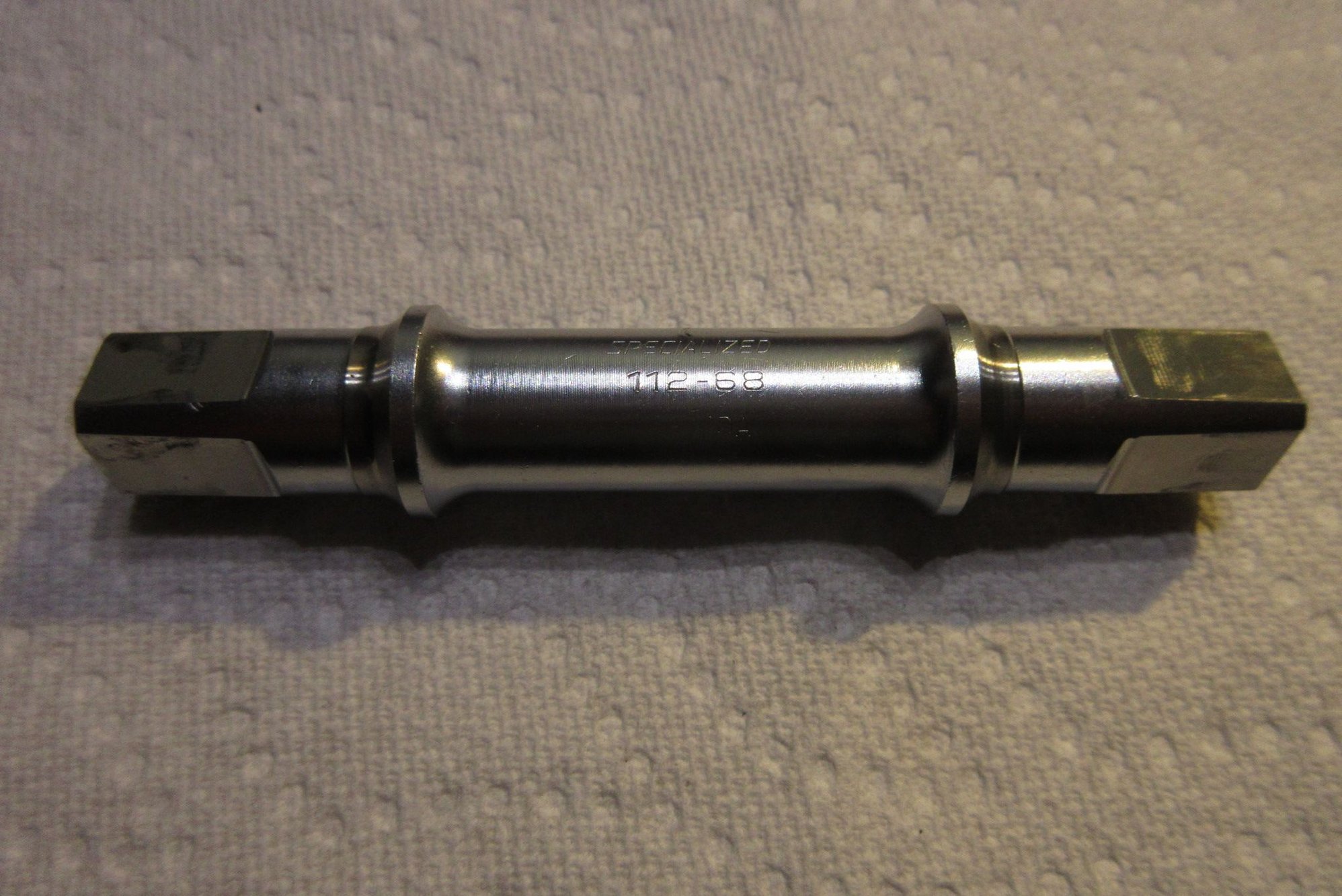
and a shot of the axle from my Olmo....

Steve in Peoria
11-30-22 | 09:05 PM
#4

Senior Member
Joined: Nov 2010
Posts: 22,994
Likes: 10,499
From: Sacramento, CA
Bikes: old ones
.
...the better loose bearing BB spindles and cups are case hardened. This allows the use of a low carbon steel that is easily machined, and remains somewhat resistant to surface wear, while still not failing in use due to brittleness. If you wear them down past this exterior layer of case hardening (for example by trying to resurface a pitted bearing race on the spindle or in the cups), they wear out again pretty quickly. So it's a bad idea to try to resurface them by grinding and polishing.
...the better loose bearing BB spindles and cups are case hardened. This allows the use of a low carbon steel that is easily machined, and remains somewhat resistant to surface wear, while still not failing in use due to brittleness. If you wear them down past this exterior layer of case hardening (for example by trying to resurface a pitted bearing race on the spindle or in the cups), they wear out again pretty quickly. So it's a bad idea to try to resurface them by grinding and polishing.
12-01-22 | 07:32 AM
#5
Thread Starter
Senior Member
Joined: Jan 2019
Posts: 2,040
Likes: 1,073
From: Toledo Ohio
Bikes: 1964 Huffy Sportsman, 1972 Fuji Newest, 1973 Schwinn Super Sport (3), 1982 Trek 412, 1983 Trek 700, 1989 Miyata 1000LT, 1991 Bianchi Boardwalk, plus others
Pics
Pics are needed for this group. Looking at the post on steel alloys is interesting. Some spindles I have show some cromoly spindles are silver, and some not. Some are hollow and some not. Then there is the plain cheap ones. Quality counts of course, but I was looking for an education on the quality, and also the mechanical and riding qualities it imparts.
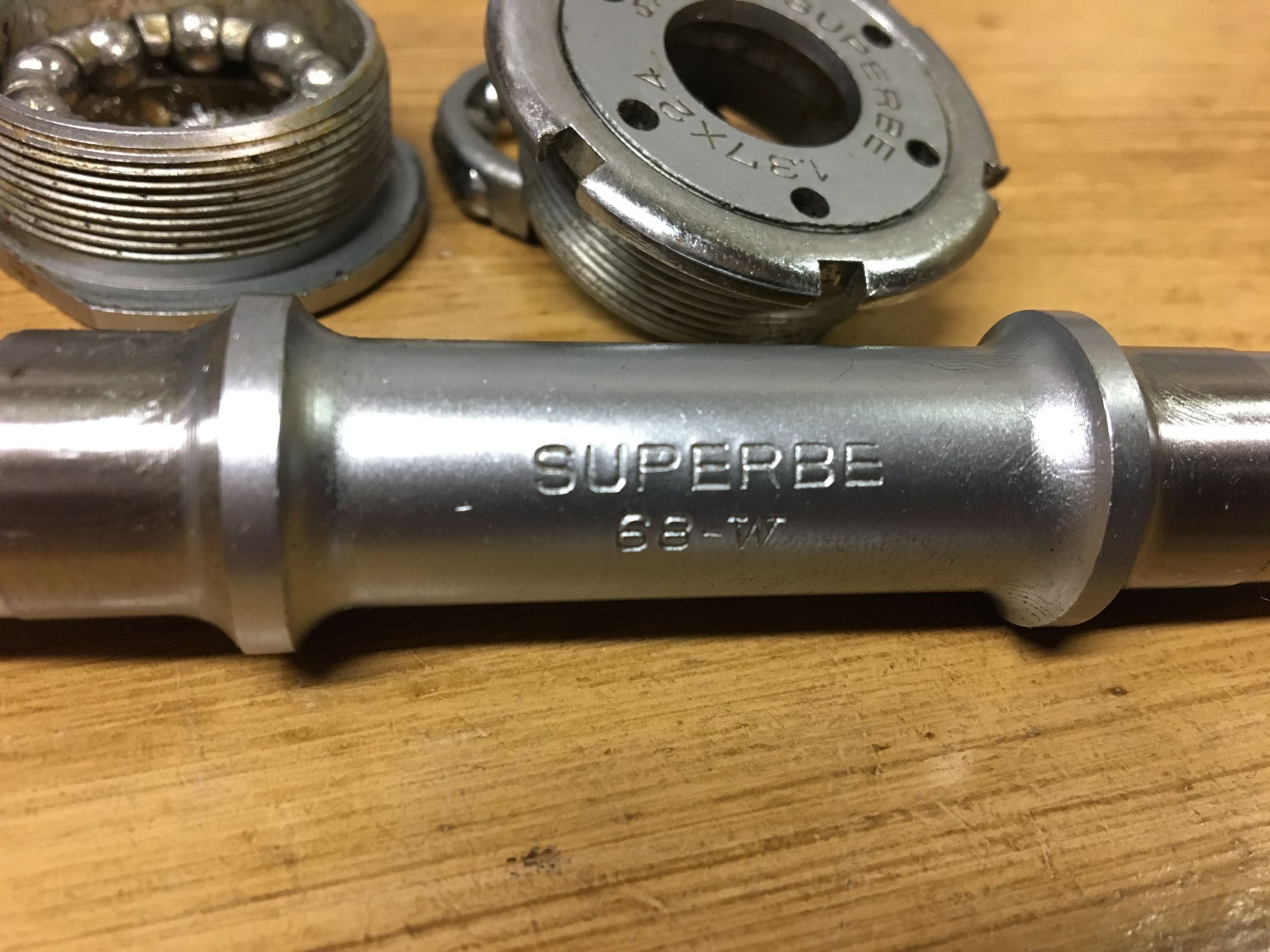
Superbe—Smooth and pretty
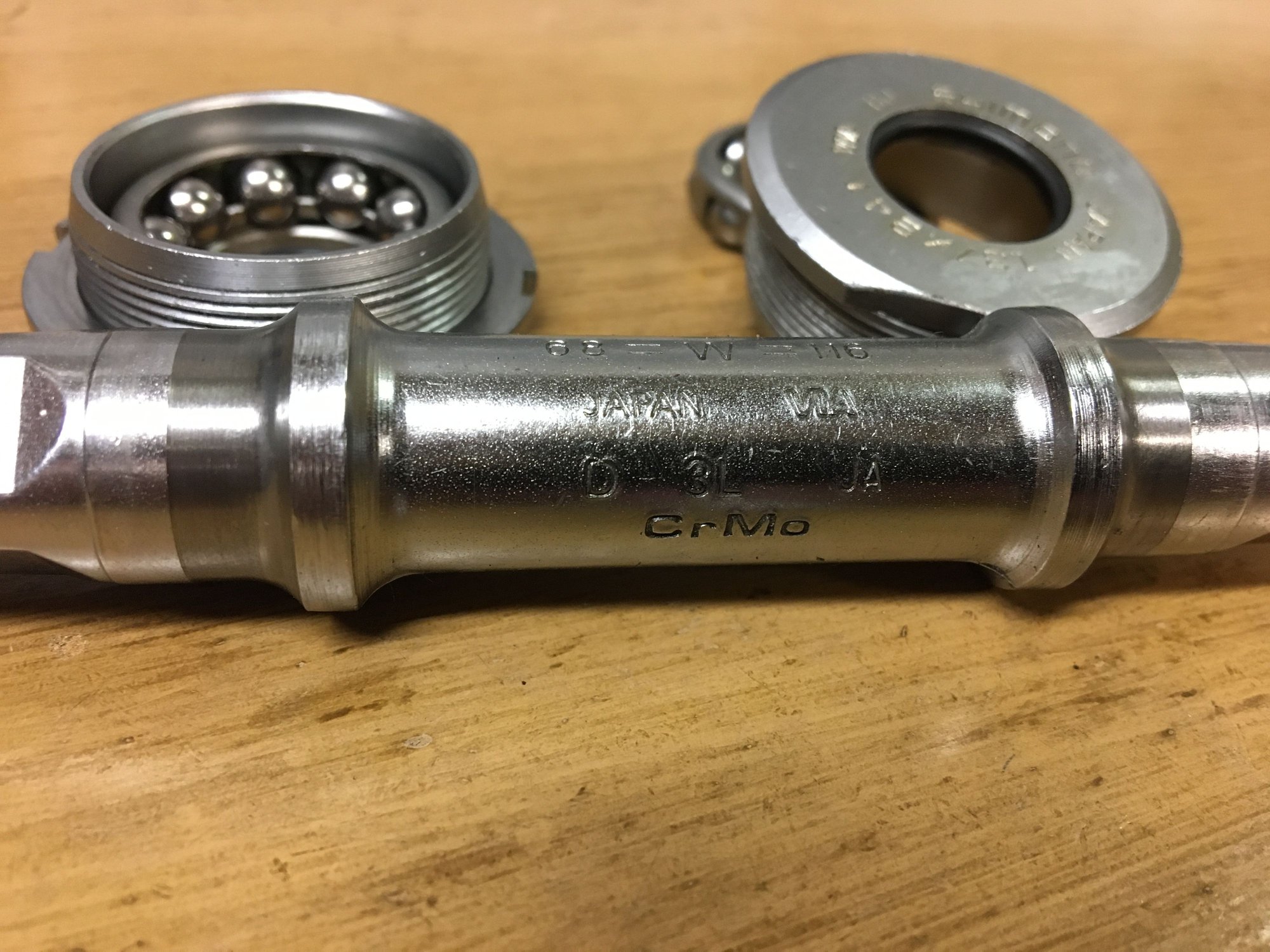
Shimano with beautiful finish

One hollow, one not, both cromoly

Cheap generic, but looks acceptable
Superbe—Smooth and pretty
Shimano with beautiful finish
One hollow, one not, both cromoly
Cheap generic, but looks acceptable

 12-01-22 | 02:19 PM
#7
Senior Member
Joined: Sep 2021
Posts: 1,596
Likes: 865
From: SW Florida, USA
Bikes: Yes
The black is probably carbon steel and the shiny one is chromoly.
There are so many types, grades, and specialty mixes of steel out there, you'd probably be better off just reading about it.
https://makeitfrommetal.com/alloy-st...-carbon-steel/
There are so many types, grades, and specialty mixes of steel out there, you'd probably be better off just reading about it.
https://makeitfrommetal.com/alloy-st...-carbon-steel/
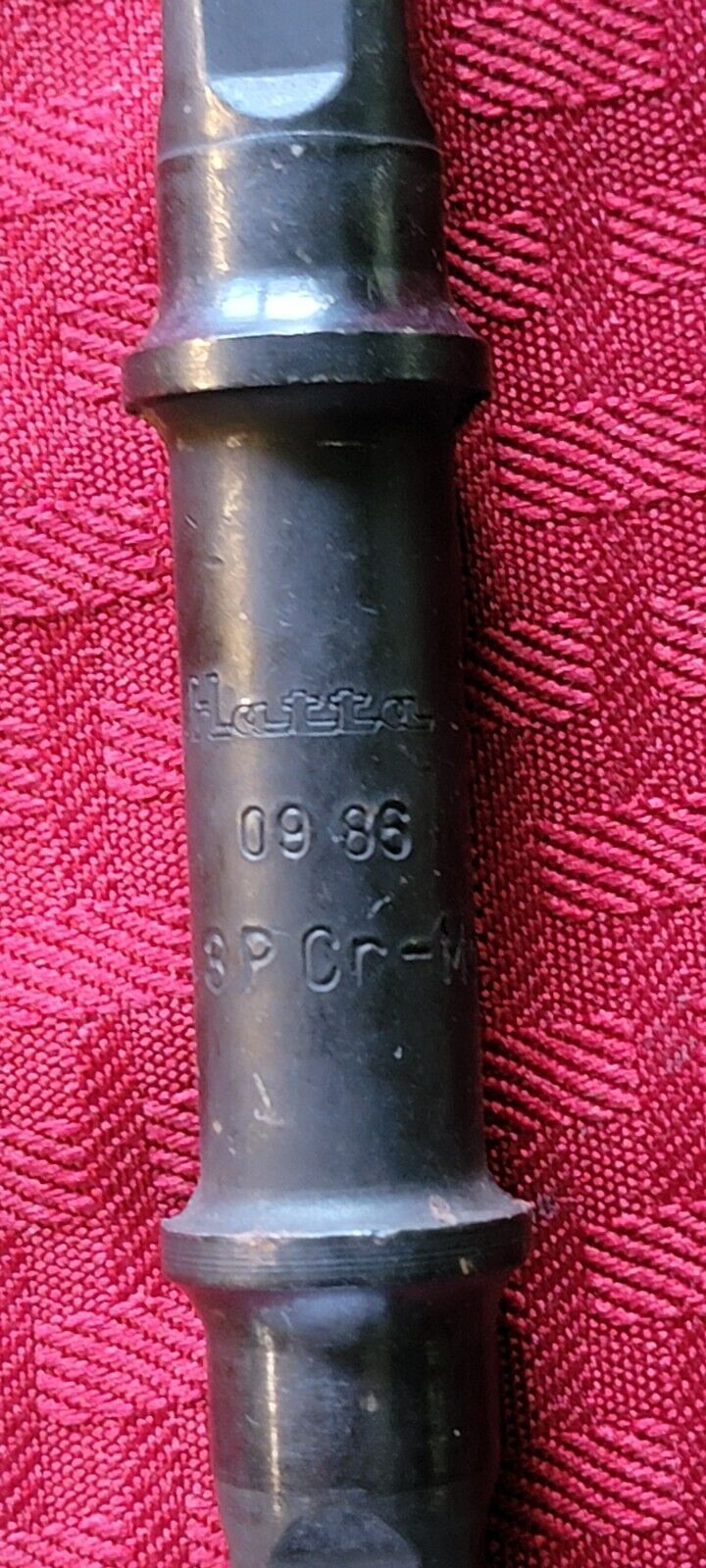
And here's another example, this one from Shimano:

I suspect the shiny ones are plated. I've seen photos of higher-end shiny spindles (Dura Ace, if I remember correctly) where the plating is peeling at the taper.
OP: I strongly suspect that the smoothness of operation of a new cup and cone bottom bracket is more related to the smoothness of cup races and spindle cones, along with the grade of the bearing balls used. Higher end spindles tend to be better ground and polished, and also tend to be plated. The type and hardness of the steel used in the cups/spindle cones would almost certainly have far more impact on longevity than on smoothness of rotation.
Last edited by Hondo6; 12-01-22 at 02:27 PM. Reason: Add 2nd photo and additional info.
 12-01-22 | 03:13 PM
#8
Thread Starter
Senior Member
Joined: Jan 2019
Posts: 2,040
Likes: 1,073
From: Toledo Ohio
Bikes: 1964 Huffy Sportsman, 1972 Fuji Newest, 1973 Schwinn Super Sport (3), 1982 Trek 412, 1983 Trek 700, 1989 Miyata 1000LT, 1991 Bianchi Boardwalk, plus others
Interesting, as I wouldn’t have thought plating would hold up. I was guessing that the shiner finish was the actual metal, at least on the Superbe. I know little about these though. On my Miyata 1000 the darker colored cromoly spindle did have some small pits at the bearing area, sit it has been retired.
12-01-22 | 04:03 PM
#9
Senior Member
Joined: Oct 2022
Posts: 1,378
Likes: 876
Bikes: a couple
The color of a spindle isn't a reliable indicator of the type of steel from which it's made. Both Shimano and Hatta produced some CroMo spindles with a black finish. Here's one example, from Hatta:
I suspect the shiny ones are plated. I've seen photos of higher-end shiny spindles (Dura Ace, if I remember correctly) where the plating is peeling at the taper.
OP: I strongly suspect that the smoothness of operation of a new cup and cone bottom bracket is more related to the smoothness of cup races and spindle cones, along with the grade of the bearing balls used. Higher end spindles tend to be better ground and polished, and also tend to be plated. The type and hardness of the steel used in the cups/spindle cones would almost certainly have far more impact on longevity than on smoothness of rotation.
I suspect the shiny ones are plated. I've seen photos of higher-end shiny spindles (Dura Ace, if I remember correctly) where the plating is peeling at the taper.
OP: I strongly suspect that the smoothness of operation of a new cup and cone bottom bracket is more related to the smoothness of cup races and spindle cones, along with the grade of the bearing balls used. Higher end spindles tend to be better ground and polished, and also tend to be plated. The type and hardness of the steel used in the cups/spindle cones would almost certainly have far more impact on longevity than on smoothness of rotation.
The lower the chromium content, the less shiny it is. About 11% is where you start to see the chromium color in the metal, but it doesn't get really tangible until it's a bit higher.
They have plated lesser metals with chrome because chrome is incredibly hard along with corrosion and wear resistance.
12-01-22 | 05:31 PM
#10
Senior Member
Joined: Sep 2021
Posts: 1,596
Likes: 865
From: SW Florida, USA
Bikes: Yes
It really just depends on the chromium content. For instance stainless, it's shiny because a large amount chromium is in it as well as vanadium and molybdenum in small amounts as well as boron.
The lower the chromium content, the less shiny it is. About 11% is where you start to see the chromium color in the metal, but it doesn't get really tangible until it's a bit higher.
They have plated lesser metals with chrome because chrome is incredibly hard along with corrosion and wear resistance.
The lower the chromium content, the less shiny it is. About 11% is where you start to see the chromium color in the metal, but it doesn't get really tangible until it's a bit higher.
They have plated lesser metals with chrome because chrome is incredibly hard along with corrosion and wear resistance.
https://matmatch.com/learn/material/4130-steel
Unless coated with a preservative or provided with some form of corrosion-resistant coating - like nickel or chromium plating, Parkerizing, or bluing - untreated bare CroMo will definitely rust.
Last edited by Hondo6; 12-01-22 at 05:34 PM.
12-01-22 | 06:07 PM
#11
Senior Member
Joined: Oct 2022
Posts: 1,378
Likes: 876
Bikes: a couple
4130 CroMo steel is typically between 0.8% and 1.1% chromium and between 0.15% and 0.25% molybdenum. That amount of chromium in a steel alloy does effectively nada to provide corrosion resistance. Both elements are added to improve the strength of the resulting alloy, not for corrosion resistance.
https://matmatch.com/learn/material/4130-steel
Unless coated with a preservative or provided with some form of corrosion-resistant coating - like nickel or chromium plating, Parkerizing, or bluing - untreated bare CroMo will definitely rust.
https://matmatch.com/learn/material/4130-steel
Unless coated with a preservative or provided with some form of corrosion-resistant coating - like nickel or chromium plating, Parkerizing, or bluing - untreated bare CroMo will definitely rust.
12-01-22 | 06:49 PM
#12
Thread Starter
Senior Member
Joined: Jan 2019
Posts: 2,040
Likes: 1,073
From: Toledo Ohio
Bikes: 1964 Huffy Sportsman, 1972 Fuji Newest, 1973 Schwinn Super Sport (3), 1982 Trek 412, 1983 Trek 700, 1989 Miyata 1000LT, 1991 Bianchi Boardwalk, plus others
So is the cromoly just preferable to heat treat to a better finish and the cheaper carbon steel in the last pic is just ”cheaper” all the way around with durability and smoothness?
12-01-22 | 07:01 PM
#13
Senior Member
Joined: Nov 2019
Posts: 529
Likes: 359
From: SF Bay Area
Bikes: Raleigh Super Course, Raleigh International, Raleigh Gran Sport
I think it comes down to the manufacturing technique. Machine to shape and then harden (accepting that the machined shape will deviate slightly with the hardening process) or machine, harden, then finish grind to a precise shape. Option one is lower cost and more common and option 2 is how you will see that Campagnolo and the other the higher end parts are made. Look for the ground surface in the bearing race area in contrast to the balance of the part regardless of the plating, etc.
12-01-22 | 07:30 PM
#14

Senior Member
Joined: May 2010
Posts: 5,634
Likes: 2,504
From: Bastrop Texas
Bikes: Univega, Peu P6, Peu PR-10, Ted Williams, Peu UO-8, Peu UO-18 Mixte, Peu Dolomites
Back in the day... Ha... Well, in the 70s I went into an Italian bike shop for some parts. There was a large array of boxes spilling parts inside of a glass cabinet without prices because most likely the price was set at the time of the buy. Typical Italian hardware sales I guess. Any way, there was a box of spindles with matching cups and cotters that were brown in color. It was obviously they had been Parkerized. Go Figure...
__________________
 No matter where you're at... There you are... Δf:=f(1/2)-f(-1/2)
12-02-22 | 08:07 AM
#15

Old fart


Joined: Nov 2004
Posts: 26,411
Likes: 5,350
From: Appleton WI
Bikes: Several, mostly not name brands.
I think it comes down to the manufacturing technique. Machine to shape and then harden (accepting that the machined shape will deviate slightly with the hardening process) or machine, harden, then finish grind to a precise shape. Option one is lower cost and more common and option 2 is how you will see that Campagnolo and the other the higher end parts are made. Look for the ground surface in the bearing race area in contrast to the balance of the part regardless of the plating, etc.

