


Replacement chain needed 1973 Raleigh Supercourse
 04-21-24 | 04:20 AM
#1
Thread Starter
Junior Member
Joined: Jun 2020
Posts: 76
Likes: 21
From: Orlando, FL
Bikes: 1973 Raleigh Supercourse TT, 1997 Specialized Rockhopper FS
Replacement chain needed 1973 Raleigh Supercourse
I recently had my bike serviced, and found that I needed a new chain. I don't think they put on quite the right one. It works well for the most part but it skips in 10th gear. Does anyone know the size of a compatible chain, and where to get one?
Last edited by jblackmd; 04-21-24 at 04:24 AM. Reason: spelling error
 04-21-24 | 05:10 AM
#2

Insane Bicycle Mechanic


Joined: Mar 2008
Posts: 10,167
Likes: 1,134
From: other Vancouver
Since it only skips on one cog, was that cog inspected for wear?
__________________
Jeff Wills
Comcast nuked my web page. It will return soon..
Jeff Wills
Comcast nuked my web page. It will return soon..



 04-21-24 | 09:19 AM
#3

Senior Member


Joined: Jan 2015
Posts: 5,854
Likes: 3,434
From: Los Angeles
Bikes: 82 Medici, 85 Ironman, 2011 Richard Sachs
REI if one is near, usually has a PC758 for 6,7,8 speed bikes.
__________________
I don't do: disks, tubeless, e-shifting, or bead head nymphs. But I do hate all e-bikes.
I don't do: disks, tubeless, e-shifting, or bead head nymphs. But I do hate all e-bikes.
04-21-24 | 10:10 AM
#4

Senior Member
Joined: Dec 2008
Posts: 2,742
Likes: 2,803
From: Pioneer Valley
Agreed, wrong chain is probably not the culprit. When you say 10th gear, do you mean easiest or hardest gear? If hardest, it’s likely your smallest freewheel cog is worn, or rear derailleur high limit needs a slight adjustment.
04-21-24 | 02:24 PM
#5
Thread Starter
Junior Member
Joined: Jun 2020
Posts: 76
Likes: 21
From: Orlando, FL
Bikes: 1973 Raleigh Supercourse TT, 1997 Specialized Rockhopper FS
Yes, it is the smallest cog in the cassette, and it does look more worn than the others. I was thinking along those line myself. When I think about it, I do spend more time in 10th gear (the hardest) when on a flat when I have my pedal speed going where I like it. I was thinking that the cassette needs replacing.
04-21-24 | 02:54 PM
#6

Ride, Wrench, Swap, Race
Joined: Jan 2010
Posts: 9,835
Likes: 1,816
From: Northern California
Bikes: Cheltenham-Pedersen racer, Boulder F/S Paris-Roubaix, Varsity racer, '52 Christophe, '62 Continental, '92 Merckx, '75 Limongi, '76 Presto, '72 Gitane SC, '71 Schwinn SS, etc.
This is usually an easy fix to the worn teeth on the smallest cog(s).
What is causing slippage isn't so intuitive.
The new chain isn't worn, so the rollers (the parts that actually contact the sprocket teeth) are slightly closer together than on your old chain.
The wear on the "driven" side edge of each tooth (where the roller contacts with driving force) is allowing the chain to travel in a slightly more-advanced position relative to the sprocket.
However, the wear to this same driven-side edge of the tooth, up near the tip of the tooth, is more like non-existent, leaving the driven-side corner near the tip of the tooth protruding rearward relative to where the roller contacts the tooth.
So, with the chain running in it's "advanced" position, the rollers will contact the unworn, rearward-protruding corners of the teeth as each roller is trying to mesh between adjacent teeth. This contact causes the rollers to fail to engage between the teeth momentarily, until the driving force momentarily eases off following gross slippage of the chain on the sprocket.
The slippage occurs at higher pedaling force because the chain roller and tooth both flex slightly under load, enough to pull the rollers forward to where they start contacting the protruding tip corners of the teeth with enough force to prevent engagement of the rollers between the teeth.
The cure is to grind a 1mm bevel at each protruding corner of the teeth of the affected sprocket, so the rollers of the new chain can engage between the teeth even as high tension force is forcing the sprocket to turn.
I use a Dremel tool for this with a 3/8" diameter stone, no need to remove it from the bike.
One could also remove the sprocket from the freewheel and then dress the corners on a bench grinder, which is a lot more work.
Do not remove too much metal from those corners or this may cause the chain to slip (even the old chain would still slip).
Below is an exaggerated cut made to a single tooth at roughly the 12-O'clock position.
Ideally, the cut would be more vertical, more like only 30 degrees away from the driven edge of the tooth.
Start with a lighter cut, then only cut more if the slippage persists.
As the chain wears, any tendency to slip will very slowly go away.
They aren't making these old freewheels like these any more, so it seems wasteful to replace such high-quality freewheels just because of such slight wear.
Note that severely-worn, "tombstoned" sprocket teeth can slip due to a completely different mechanism, and that such teeth cannot be restored using my method.
But a bike shop would have discarded your freewheel if the teeth looked like that.
And as far as the chain length, the shop would have likely matched the link count of your old chain. So unless the chain sags while on the smallest front and rear sprockets, your problem likely isn't due to chain length.
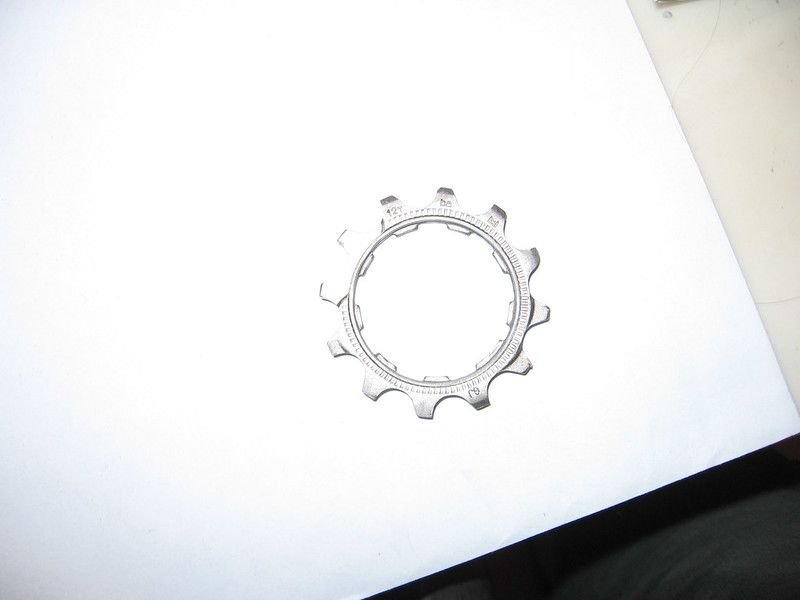
Can you post a photo of your freewheel?
What is causing slippage isn't so intuitive.
The new chain isn't worn, so the rollers (the parts that actually contact the sprocket teeth) are slightly closer together than on your old chain.
The wear on the "driven" side edge of each tooth (where the roller contacts with driving force) is allowing the chain to travel in a slightly more-advanced position relative to the sprocket.
However, the wear to this same driven-side edge of the tooth, up near the tip of the tooth, is more like non-existent, leaving the driven-side corner near the tip of the tooth protruding rearward relative to where the roller contacts the tooth.
So, with the chain running in it's "advanced" position, the rollers will contact the unworn, rearward-protruding corners of the teeth as each roller is trying to mesh between adjacent teeth. This contact causes the rollers to fail to engage between the teeth momentarily, until the driving force momentarily eases off following gross slippage of the chain on the sprocket.
The slippage occurs at higher pedaling force because the chain roller and tooth both flex slightly under load, enough to pull the rollers forward to where they start contacting the protruding tip corners of the teeth with enough force to prevent engagement of the rollers between the teeth.
The cure is to grind a 1mm bevel at each protruding corner of the teeth of the affected sprocket, so the rollers of the new chain can engage between the teeth even as high tension force is forcing the sprocket to turn.
I use a Dremel tool for this with a 3/8" diameter stone, no need to remove it from the bike.
One could also remove the sprocket from the freewheel and then dress the corners on a bench grinder, which is a lot more work.
Do not remove too much metal from those corners or this may cause the chain to slip (even the old chain would still slip).
Below is an exaggerated cut made to a single tooth at roughly the 12-O'clock position.
Ideally, the cut would be more vertical, more like only 30 degrees away from the driven edge of the tooth.
Start with a lighter cut, then only cut more if the slippage persists.
As the chain wears, any tendency to slip will very slowly go away.
They aren't making these old freewheels like these any more, so it seems wasteful to replace such high-quality freewheels just because of such slight wear.
Note that severely-worn, "tombstoned" sprocket teeth can slip due to a completely different mechanism, and that such teeth cannot be restored using my method.
But a bike shop would have discarded your freewheel if the teeth looked like that.
And as far as the chain length, the shop would have likely matched the link count of your old chain. So unless the chain sags while on the smallest front and rear sprockets, your problem likely isn't due to chain length.
Can you post a photo of your freewheel?
04-21-24 | 03:08 PM
#7
Newbie
Joined: Jan 2009
Posts: 37
Likes: 10
While I understand the need/desire to have every component of a bicycle working perfectly, I would have to say that in the last 40+ years of cycling I have not spent much time in my absolute highest gear. How often do you pedal in the 10th gear?
04-21-24 | 04:06 PM
#8
Ride, Wrench, Swap, Race
Joined: Jan 2010
Posts: 9,835
Likes: 1,816
From: Northern California
Bikes: Cheltenham-Pedersen racer, Boulder F/S Paris-Roubaix, Varsity racer, '52 Christophe, '62 Continental, '92 Merckx, '75 Limongi, '76 Presto, '72 Gitane SC, '71 Schwinn SS, etc.
Around here (Sierra Foothills), one frequently uses both lowest and highest gears, with want for more on both ends!
A super Course might have only a 14t small cog, which might find lot's of use on descending and even near-flat riding.
A skip in the drive can be dangerous at times as it occurs unexpectedly. I stubbed the toe of my brand-new Sidi shoes about ten years ago when my Ergolever over-shifted due to worn G-springs, ...I felt lucky to have stayed upright and not taken anybody out.
04-22-24 | 05:26 AM
#9
WellAged

Joined: Aug 2017
Posts: 65
Likes: 50
From: Cleveland, Ohio
Bikes: '59 Rory O'Brien, 49/72 Holdsworth Trike, '66 Bates BAR, '74 Bob Jackson
Go back to where you had this serviced and ask them to check the freewheel for wear. Most likely the skipping is because the freewheel cog is worn out and you need a new freewheel.
 04-22-24 | 03:08 PM
#10

Senior Member

Joined: Apr 2009
Posts: 3,809
Likes: 5,682
From: Seattle
 04-22-24 | 03:26 PM
#11

Edumacator

Joined: Jan 2018
Posts: 9,705
Likes: 5,195
From: Goose Creek, SC
Bikes: More than the people who ride them...oy.
By skipping in 10th gear, do you mean you have 5 cogs in the back and two chainrings one the front, (which would make 10th “big chainring-smallest cog”)? I assume you don’t mean you have an updated 10 cog cassette in the back.
And Pastor Bob will have the entire freewheel humming healthily.
And Pastor Bob will have the entire freewheel humming healthily.
04-28-24 | 06:34 AM
#12
Thread Starter
Junior Member
Joined: Jun 2020
Posts: 76
Likes: 21
From: Orlando, FL
Bikes: 1973 Raleigh Supercourse TT, 1997 Specialized Rockhopper FS
Yes, two front chain rings and 5 rear cogs.
Historically I have spent much time in 10th gear. I've lived in mostly flat Florida since 2005, and I do like to get it going. The shop I'm working with had to order a replacement freewheel, which came in this past Thursday so I was pretty excited about that. I loaded up the bike and took it to the shop, which said it could swap it out in about 10 minutes. That didn't happen, because they have to now order a removal tool for the old one! They ordered that, and think it will be delivered in about 2 weeks. I guess that's to be expected. My bike bears little if any resemblance to the very pricey bikes in the shop, so I get that they don't have the right tool on hand. The only similarity is that it has two wheels.
Attached is an image of the freewheel

Historically I have spent much time in 10th gear. I've lived in mostly flat Florida since 2005, and I do like to get it going. The shop I'm working with had to order a replacement freewheel, which came in this past Thursday so I was pretty excited about that. I loaded up the bike and took it to the shop, which said it could swap it out in about 10 minutes. That didn't happen, because they have to now order a removal tool for the old one! They ordered that, and think it will be delivered in about 2 weeks. I guess that's to be expected. My bike bears little if any resemblance to the very pricey bikes in the shop, so I get that they don't have the right tool on hand. The only similarity is that it has two wheels.
Attached is an image of the freewheel
04-28-24 | 08:02 AM
#13

Old fart

Joined: Nov 2004
Posts: 26,411
Likes: 5,350
From: Appleton WI
Bikes: Several, mostly not name brands.
Yes, it is the smallest cog in the cassette, and it does look more worn than the others. I was thinking along those line myself. When I think about it, I do spend more time in 10th gear (the hardest) when on a flat when I have my pedal speed going where I like it. I was thinking that the cassette needs replacing.
04-28-24 | 08:12 AM
#14
Thread Starter
Junior Member
Joined: Jun 2020
Posts: 76
Likes: 21
From: Orlando, FL
Bikes: 1973 Raleigh Supercourse TT, 1997 Specialized Rockhopper FS
It's likely a mismatch between new chain and worn sprocket. If the wheel is original to the bike, it will have a freewheel, not a modern freehub/cassette, and probably only five sprockets. Individual sprockets will be hard to source and not worth the effort. Such freewheels are still available, and not expensive, and will have modern tooth profiles for better shifting performance than the OEM freewheel.
