


Stuck freewheel
 07-20-24 | 09:50 AM
#1
Thread Starter
Senior Member


Joined: Jan 2015
Posts: 1,190
Likes: 727
Stuck freewheel
A wheel followed me home yesterday. Plan was to save the rim, decent quality, no wear. But then I saw the FW is a Shimano Z012 with zero wear in a ratio I like. But of course It’s stuck to the hub. Hub is Malliard with a bent axle, so that can be sacrificed. Beyond the wrench longer than my arm, any tricks you’ve used to deal with this stuck FW situation ? Or do I just consider the rim a gift, and toss the rest?
 07-20-24 | 10:03 AM
#2

Full Member

Joined: Feb 2020
Posts: 371
Likes: 533
From: Boise, Idaho
Bikes: I have a few
Spray inside the FW with an upside down can of spray duster followed by a few drops of penetrating oil. A sturdy bench vise can help and an inflated tire will allow you to apply a little more leverage.
Last edited by Nwvlvtnr; 07-20-24 at 12:30 PM.
07-20-24 | 10:34 AM
#3

Freewheel Medic


Joined: Oct 2005
Posts: 13,578
Likes: 3,329
From: An Island on the Coast of GA!
Bikes: Snazzy* Schwinns, Classy Cannondales & a Super Pro Aero Lotus (* Ed.)
... also let the hub and freewheel soak in the penetrating oil overnight.
My other suggestion is to heat the hub with a torch and let it cool. Repeat several times and add more penetrating oil. This will help the oil do it's job and the expansion and contraction will help break the bond.
My other suggestion is to heat the hub with a torch and let it cool. Repeat several times and add more penetrating oil. This will help the oil do it's job and the expansion and contraction will help break the bond.
__________________
Bob
Enjoying the GA coast all year long!
Thanks for visiting my website: www.freewheelspa.com
Bob
Enjoying the GA coast all year long!
Thanks for visiting my website: www.freewheelspa.com
07-20-24 | 11:25 AM
#4

Extraordinary Magnitude

Joined: Aug 2009
Posts: 14,087
Likes: 2,146
From: Waukesha WI
Bikes: 1978 Trek TX700; 1978/79 Trek 736; 1984 Specialized Stumpjumper Sport; 1984 Schwinn Voyageur SP; 1985 Trek 620; 1985 Trek 720; 1986 Trek 400 Elance; 1987 Schwinn High Sierra; 1990 Miyata 1000LT
Put the freewheel tool on, put the QR skewer through so it holds the tool on. Put the tool in a vise, tighten it up, the use the wheel like a big steering wheel.
This video shows some methods of freewheel removal- but the vise trick is around 3:00.
This video shows some methods of freewheel removal- but the vise trick is around 3:00.
__________________
*Recipient of the 2006 Time Magazine "Person Of The Year" Award*
Commence to jigglin’ huh?!?!
"But hey, always love to hear from opinionated amateurs." -says some guy to Mr. Marshall.
Commence to jigglin’ huh?!?!
"But hey, always love to hear from opinionated amateurs." -says some guy to Mr. Marshall.
 07-20-24 | 11:44 AM
#5
Senior Member

Joined: Dec 2005
Posts: 18,841
Likes: 11,752
Put the freewheel tool on, put the QR skewer through so it holds the tool on. Put the tool in a vise, tighten it up, the use the wheel like a big steering wheel.
This video shows some methods of freewheel removal- but the vise trick is around 3:00.
https://www.youtube.com/watch?v=8Se6a5A4sJY
This video shows some methods of freewheel removal- but the vise trick is around 3:00.
https://www.youtube.com/watch?v=8Se6a5A4sJY
07-20-24 | 12:04 PM
#6

Senior Member
Joined: Jun 2019
Posts: 1,680
Likes: 1,994
From: Michigan USA
Bikes: A bunch of old bikes.
07-20-24 | 12:15 PM
#7
Senior Member
Joined: Jul 2010
Posts: 1,788
Likes: 722
The vise method gives you maximum control and leverage. You still have to exercise common sense if you don't want to destroy something. Doing it correctly, you stand a much smaller chance of something slipping and damaging either the tool, freewheel, or wheel.
07-20-24 | 12:21 PM
#8
Senior Member
Joined: Jun 2019
Posts: 1,680
Likes: 1,994
From: Michigan USA
Bikes: A bunch of old bikes.
It seems to me that the stress on the tool is better spread to more surfaces.
07-20-24 | 12:37 PM
#9

The Wheezing Geezer
Joined: Oct 2021
Posts: 1,862
Likes: 1,974
From: Española, NM
Bikes: 1976 Fredo Speciale, Rivendell Clem Smith Jr., Libertas mixte, Raleigh Super Record mixte
After trying the vise trick and having it move my bench instead, I used a four-foot pipe slipped over the wrench with the wheel braced upright on the floor to get the last stubborn one off.
__________________
Beneath the valley of the underbikers.
Beneath the valley of the underbikers.
07-20-24 | 12:42 PM
#10
Thread Starter
Senior Member
Joined: Jan 2015
Posts: 1,190
Likes: 727
... also let the hub and freewheel soak in the penetrating oil overnight.
My other suggestion is to heat the hub with a torch and let it cool. Repeat several times and add more penetrating oil. This will help the oil do it's job and the expansion and contraction will help break the bond.
My other suggestion is to heat the hub with a torch and let it cool. Repeat several times and add more penetrating oil. This will help the oil do it's job and the expansion and contraction will help break the bond.
07-20-24 | 12:49 PM
#11

I once watched a bike mechanic break two freewheel tools, one after the other, while he laughed, obviously not realizing that he was the problem, not the tools. I took over, grabbed our last remaining compatible freewheel tool from the display case out front, and tightened a quick-release skewer onto the tool -- with enough force that the other guy protested that there was no way the freewheel was going to budge.
Placed the tool and wheel onto the shop vise, turned the wheel just enough to break the freewheel free, loosened the QR skewer a bit, and turned the wheel a little farther. By that point, the freewheel was loose enough to back it all the way off by hand.
Placed the tool and wheel onto the shop vise, turned the wheel just enough to break the freewheel free, loosened the QR skewer a bit, and turned the wheel a little farther. By that point, the freewheel was loose enough to back it all the way off by hand.


 07-20-24 | 02:45 PM
#13

Edumacator

Joined: Jan 2018
Posts: 9,706
Likes: 5,200
From: Goose Creek, SC
Bikes: More than the people who ride them...oy.
__________________
1987 Crest C'dale, 1987 Basso Gap, 1992 Rossin EL, 1990 Van Tuyl, 1985 Trek 670, 2003 Pinarello Surprise, 1990ish MBK Atlantique, 1987 Peugeot Isoard, 1987 Nishiki Tri-A, 1981 Faggin, 1996 C'dale M500, 1984 Mercian Pro, 1982 AD SuperLeicht, 1985 Massi ?, 1988 Daccordi Griffe , 1989 Fauxsin MTB, 1981 Ciocc Mockba, 1992 Bianchi Giro, 1977 Colnago Super, 1971 Raleigh Internat'l, 1998 Corratec U+D, 1991 Peugeot Slimestone, 1987 Bianchi Volpe, 1995 Trek 750
1987 Crest C'dale, 1987 Basso Gap, 1992 Rossin EL, 1990 Van Tuyl, 1985 Trek 670, 2003 Pinarello Surprise, 1990ish MBK Atlantique, 1987 Peugeot Isoard, 1987 Nishiki Tri-A, 1981 Faggin, 1996 C'dale M500, 1984 Mercian Pro, 1982 AD SuperLeicht, 1985 Massi ?, 1988 Daccordi Griffe , 1989 Fauxsin MTB, 1981 Ciocc Mockba, 1992 Bianchi Giro, 1977 Colnago Super, 1971 Raleigh Internat'l, 1998 Corratec U+D, 1991 Peugeot Slimestone, 1987 Bianchi Volpe, 1995 Trek 750
 07-20-24 | 04:03 PM
#14

Senior Member
Joined: Feb 2008
Posts: 5,321
Likes: 4,834
From: Peoria, IL
Steve in Peoria
(most recently had to soak a SunTour front derailleur in penetrating oil to get a limit screw to budge. well... I also had to heat up the aluminum body until the oil began to smoke a bit)
07-20-24 | 04:14 PM
#15

Senior Member
Joined: Oct 2014
Posts: 14,192
Likes: 5,328
From: Portland, OR
Bikes: (2) ti TiCycles, 2007 w/ triple and 2011 fixed, 1979 Peter Mooney, ~1983 Trek 420 now fixed and ~1973 Raleigh Carlton Competition gravel grinder
Put the freewheel tool on, put the QR skewer through so it holds the tool on. Put the tool in a vise, tighten it up, the use the wheel like a big steering wheel.
This video shows some methods of freewheel removal- but the vise trick is around 3:00.
https://www.youtube.com/watch?v=8Se6a5A4sJY
This video shows some methods of freewheel removal- but the vise trick is around 3:00.
https://www.youtube.com/watch?v=8Se6a5A4sJY
07-20-24 | 10:14 PM
#16

Senior Member

Joined: Apr 2009
Posts: 3,812
Likes: 5,701
From: Seattle
That tool used to come with each hubset, but most mechanics didn't know what it was for, and many were thrown away. You don't need one necessarily, if you're careful, but it's safer if you use it.
 07-21-24 | 04:31 AM
#17
Senior Member
Joined: Aug 2007
Posts: 6,000
Likes: 2,191
From: Evanston, IL
Bikes: many
I'd be surprised if the relevant tool would break in this case. Shimano freewheels have deep splines. Lots of contact area, unlike the old two-prong Regina and SunTour interfaces.
__________________
My bikes
My bikes
07-21-24 | 05:08 AM
#18

Senior Member
Joined: Apr 2007
Posts: 12,570
Likes: 2,740
From: Thunder Bay, Ontario, Canada - burrrrr!
Bikes: 1958 Rabeneick 120D, 1968 Legnano Gran Premio, 196? Torpado Professional, 2000 Marinoni Piuma
Some good advice here and I can add one more method that I had to go to years ago. I pulled the cogs and used a big pipe wrench on the freewheel hub. Got it off. That said...
Something to watch out for is breaking the freewheel tool. The two prong ones can slip or snap far more easier than any of the other styles. So be careful with the two pronger...
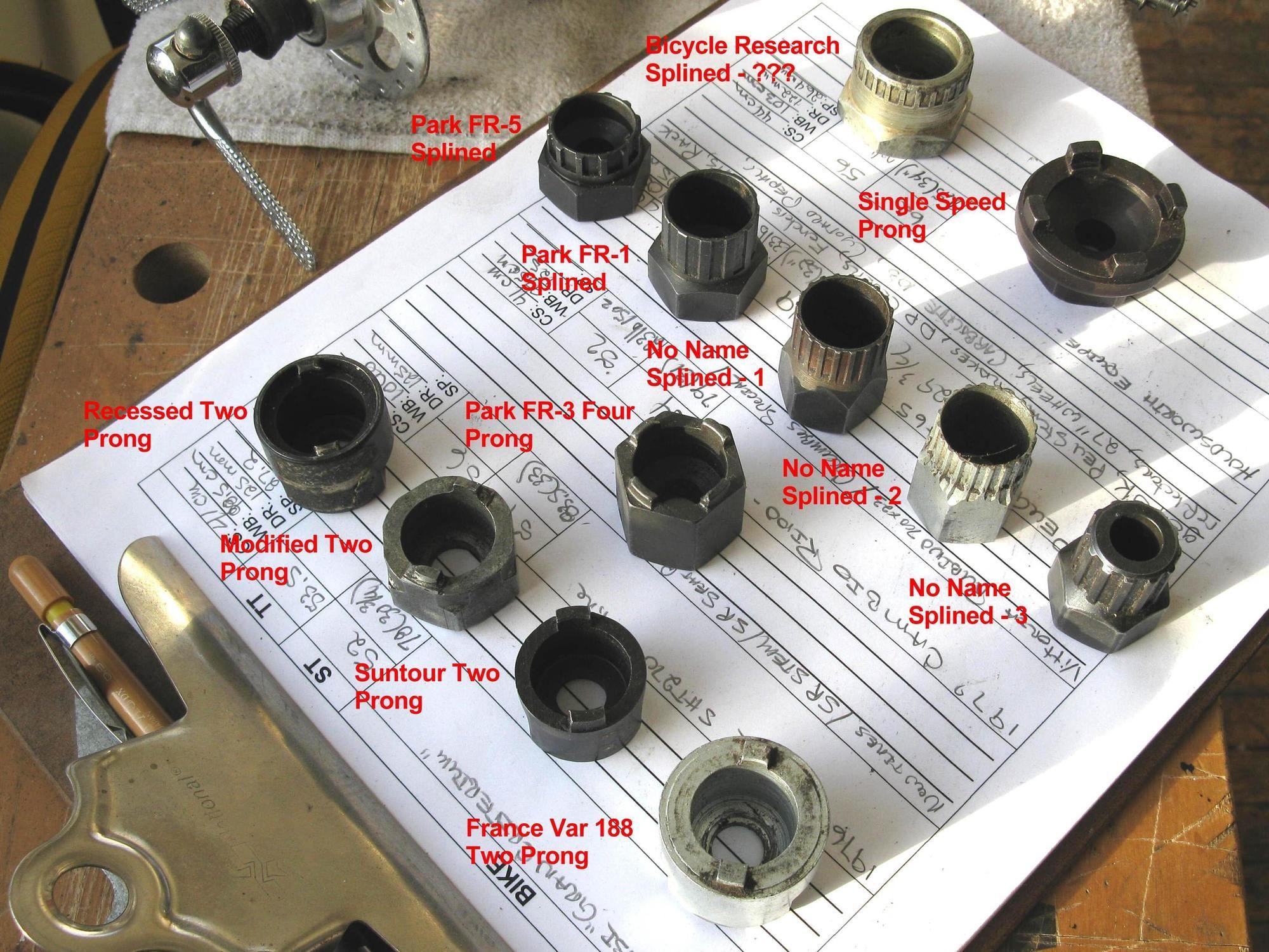
Something to watch out for is breaking the freewheel tool. The two prong ones can slip or snap far more easier than any of the other styles. So be careful with the two pronger...
__________________
"98% of the bikes I buy are projects".
"98% of the bikes I buy are projects".
 07-21-24 | 05:14 AM
#19

Senior Member
Joined: Apr 2012
Posts: 21,850
Likes: 5,823
From: Middle Earth (aka IA)
Bikes: A bunch of old bikes and a few new ones
Not all old Shimano freewheels but yes most do (and I think the OP's freewheel is one with that interface) and it's a good system. I have a stuck Shimano freewheel that takes a different tool that was original equipment on a 1985 Cannondale. I have a 15 inch crescent that usually does the trick along with a tightened down freewheel remover but not this time. I may need to bring it to the collective to have access to a vice.
Last edited by bikemig; 07-21-24 at 05:23 AM.
07-21-24 | 06:34 AM
#20
Freewheel Medic
Joined: Oct 2005
Posts: 13,578
Likes: 3,329
From: An Island on the Coast of GA!
Bikes: Snazzy* Schwinns, Classy Cannondales & a Super Pro Aero Lotus (* Ed.)
OA does not play well with the internals of the freewheel. It will ruin the bearings and the pawls.
__________________
Bob
Enjoying the GA coast all year long!
Thanks for visiting my website: www.freewheelspa.com
Bob
Enjoying the GA coast all year long!
Thanks for visiting my website: www.freewheelspa.com
07-21-24 | 06:41 AM
#21
Senior Member
Joined: Apr 2009
Posts: 3,812
Likes: 5,701
From: Seattle
And if you have an older Dura Ace freewheel with the two-notch remover style, be sure to use a real Shimano TL-FW10 remover, not a generic one.

What the TL-FW10 has that generics don't is that ring around the prongs. It strengthens them immensely.
There was another one with the ring that also works, I forget, by Bicycle Research maybe? But the TL-FW10 is a safe bet, never known one to fail.
The prong type (whether 2-, 3- or 4-prong) are the ones where it's most important to use the skewer. Splined removers are much safer to use without a skewer, but prong-type? Don't even think of it.
The TL-FW10 is also the best tool to use on old Regina FWs with the two-notch body. That Shimano tool fits a Regina better than a Regina tool does. So it's a super-valuable tool for a C&V kinda guy to own.
What the TL-FW10 has that generics don't is that ring around the prongs. It strengthens them immensely.
There was another one with the ring that also works, I forget, by Bicycle Research maybe? But the TL-FW10 is a safe bet, never known one to fail.
The prong type (whether 2-, 3- or 4-prong) are the ones where it's most important to use the skewer. Splined removers are much safer to use without a skewer, but prong-type? Don't even think of it.
The TL-FW10 is also the best tool to use on old Regina FWs with the two-notch body. That Shimano tool fits a Regina better than a Regina tool does. So it's a super-valuable tool for a C&V kinda guy to own.
07-21-24 | 09:22 AM
#22
Thread Starter
Senior Member
Joined: Jan 2015
Posts: 1,190
Likes: 727
I guess I should have been more specific. I only meant that you should drip penetrating oil (WD40, Liquid Wrench, etc.) into the threaded area between the hub and inner body on the freewheel.
OA does not play well with the internals of the freewheel. It will ruin the bearings and the pawls.
OA does not play well with the internals of the freewheel. It will ruin the bearings and the pawls.
I’ll keep the OA away from the FW. Maybe someday it will actually get used.
Meanwhile, I’m waiting for the neighbor to dig out the impact wrench that will be applied to the Park FW tool that fits this splined Shimano FW.
07-21-24 | 11:55 AM
#23
Senior Member
Joined: Feb 2020
Posts: 4,050
Likes: 2,362
If you have a vice on a rotating base (or on a corner or post) there is a trick.
You need a suitable bar, something about 3-4 feet long.
You slip it between the jaws, in the wider part below, after you have the freewheel tool in good and tight.
(After it's tight you do hold it on with a skewer/nut.)
The vice, if not on a corner or post, has to be turned anti-clockwise so that the bar is outboard of whatever the vice is mounted on.
Stand so the bar rests against your left ribcage, and so brace it as you turn.
I use one of these vices for many tasks, and the clamp-down bolts are usually loose enough that a good tug on the vice handle will move it to where I want it for holding whatever.
Unless a freewheel is extremely tight I don't bother tightening the clamp bolts, I just lean a bit on the bar.
07-21-24 | 12:59 PM
#24

ambulatory senior
Joined: Dec 2016
Posts: 6,451
Likes: 4,519
From: Peoria Il
Bikes: Austro Daimler modified by Gugie! Raleigh Professional and lots of other bikes.
Just a note hear on something I recently did. I put a French freewheel, (English thread) on an early phil wood freewheel hub. Once in place I realized the two smallest cogs were skipping and worn. Let me just say removal was exceedingly difficult. The removal tool would not fit over the phil wood axle. It required complete axle removal with my makeshift tools. Fortunately I seemed to not have ruined anything and it was cool to see how it all went back together but I will never put a French freewheel on it again.
07-21-24 | 02:28 PM
#25
Senior Member
Joined: Aug 2007
Posts: 6,000
Likes: 2,191
From: Evanston, IL
Bikes: many
For future reference, I believe Phil made thin wall tools for a couple freewheel types. I'm not sure which ones, but I have one for splined Shimano freewheels.
__________________
My bikes
My bikes