


Raleigh International Geometry
 10-13-24 | 08:12 AM
#1
Thread Starter
Voyager
Joined: May 2024
Posts: 14
Likes: 1
From: Overland Park KS
Bikes: 1971 Raleigh international, 1974 Raleigh International, 1973 Raleigh Professional,1975 Raleigh Professional
Raleigh International Geometry
I have two Raleigh Internationals, 24 ½” size, one is a 1971, the other a 1974. They have different geometry. The 74 is frame only so I can't ride it and see the difference. I have read of a geometry change during the 1970’s production run of this model. Does anyone have information on why this change was made, and the resulting effect on the ride and handling?
Here are the differences between the two bikes. All other measurements are the same between the two.
Top tube:
1971–23” 1974–22”
Wheelbase:
1971--41 ½” 1974–41”
Chainstay:
1971–18” 1974–17”
Fork offset appears the same on both, about 2 ½”. Fork curvature is less pronounced on the 74 and starts higher.
Here are the differences between the two bikes. All other measurements are the same between the two.
Top tube:
1971–23” 1974–22”
Wheelbase:
1971--41 ½” 1974–41”
Chainstay:
1971–18” 1974–17”
Fork offset appears the same on both, about 2 ½”. Fork curvature is less pronounced on the 74 and starts higher.
 10-13-24 | 08:29 AM
#2

Consider marketing.
consider manufacturing efficiency
a 22” top tube used for maybe three seat tube sizes say, one common tube useable, less to track.
thinking a bit more, the downtube might be cut the same as well with an equal length top tube.
consider manufacturing efficiency
a 22” top tube used for maybe three seat tube sizes say, one common tube useable, less to track.
thinking a bit more, the downtube might be cut the same as well with an equal length top tube.
Last edited by repechage; 10-13-24 at 09:44 AM.
10-13-24 | 09:08 AM
#3

Señor Member


Joined: Oct 2004
Posts: 18,481
Likes: 1,565
From: Hardy, VA
Bikes: Mostly English - predominantly Raleighs
1972/73 were years when quite a number of changes were made at Raleigh's Worksop facility. It was the bike boom and that made it difficult to keep up with demand.
When you're able to, would love to see pictures (especially the 1971, as there aren't that many of those).
When you're able to, would love to see pictures (especially the 1971, as there aren't that many of those).
__________________
In search of what to search for.
In search of what to search for.
10-13-24 | 09:11 AM
#4

Senior Member


Joined: Oct 2014
Posts: 14,180
Likes: 5,312
From: Portland, OR
Bikes: (2) ti TiCycles, 2007 w/ triple and 2011 fixed, 1979 Peter Mooney, ~1983 Trek 420 now fixed and ~1973 Raleigh Carlton Competition gravel grinder
That '74 was built at the height of the bike boom. I would consider nothing on that bike sacred or a standard or even carefully thought out. (Says the owner of a '73 Competition that missed the braze stage.)
10-13-24 | 10:22 AM
#5

Senior Member

Joined: Aug 2016
Posts: 2,937
Likes: 3,623
From: Carmichael, CA
I sold a fellow here a '73 International that I'd built up as a fixed gear after purchasing the frameset at Eroica California in 2022 or so. I hardly rode it since I needed to move it along for mundane reasons, but after he received it he commented on the steep head tube angle. It looked as if they had used a down tube that was somewhat shorter than usual and with the standard 23" top tube to create an unusually steep head tube angle - I think the gentleman measured it at around a shocking 77 degrees.
Carlton was literally throwing these things together already by the time the "bike boom" picked up its pace in the early-'70s. As another member stated, nothing was sacred...
-Gregory
Carlton was literally throwing these things together already by the time the "bike boom" picked up its pace in the early-'70s. As another member stated, nothing was sacred...
-Gregory
10-13-24 | 10:23 AM
#6

Ron_s I have a 24-1/2" '74 frame that pretty much matches the numbers above (haven't measured the head and seat tube angles), and I believe that gugie's '71 does too (respectively). The top tube on these did seem to be somewhat shorter than the standard 22-1/2" (but not by too much, 22-1/4" on mine) -- not sure why that is. You might be interested in this thread, where some geometry issues are discussed: Show me your 70's vintage Raleigh International
Last edited by Charles Wahl; 10-13-24 at 10:29 AM.
10-13-24 | 11:15 AM
#7

Senior Member


Joined: Apr 2011
Posts: 12,752
Likes: 4,866
Stated in modern terms, the '71 is a 62cm bike with an enormous 61cm TT, and the '74 has a crazy short 56cm TT. The shorter '74 TT would be easier to sit upright upon.
Wheelbase wise, the International is supposed to have big tire clearance, and went from 46cm chainstays to 43cm. Either should be capable of decent tire size and fenders, but the '71s long stays might make the handling pokey and add unnecessary weight.
It sounds like the International got a little sportier, lighter and easier to fit between '71 and '74. Which seems like the way road bikes (other than touring) continued to trend into the '80s. You can argue the merits of the change, but that 24" top tube wasn't doing most people any favors.
Wheelbase wise, the International is supposed to have big tire clearance, and went from 46cm chainstays to 43cm. Either should be capable of decent tire size and fenders, but the '71s long stays might make the handling pokey and add unnecessary weight.
It sounds like the International got a little sportier, lighter and easier to fit between '71 and '74. Which seems like the way road bikes (other than touring) continued to trend into the '80s. You can argue the merits of the change, but that 24" top tube wasn't doing most people any favors.
10-13-24 | 11:15 AM
#8

Senior Member
Joined: Feb 2008
Posts: 5,319
Likes: 4,828
From: Peoria, IL
What is the C&V forum coming to?!
How are there no photos in this thread? Well, let me correct that oversight!
I used to own a '71 International, in the 24 1/2" size. Brown.
This was the early 2000's, so it was legally required to be set up as a fixed gear.

At the same time, roughly, I also owned (and still own) a shiny copper '74 International, also a 24 1/2" version.
It came with all of the original gear (even tires), so I kept it that way.

The big(?) difference between them is probably the longer chainstays on the '71. I think the '71 had seatstays with a smaller outer diameter too, but can't confirm.
I have memories of the rear end feeling like it had a bit more lateral flex, but maybe that was partly due to being used as a fixed gear??
Compared to my other vintage road bikes, the Internationals do have more fork rake, and that does cause the steering to feel a bit different. I get used to it, but generally prefer a bit less rake.
Steve in Peoria
How are there no photos in this thread? Well, let me correct that oversight!
I used to own a '71 International, in the 24 1/2" size. Brown.
This was the early 2000's, so it was legally required to be set up as a fixed gear.
At the same time, roughly, I also owned (and still own) a shiny copper '74 International, also a 24 1/2" version.
It came with all of the original gear (even tires), so I kept it that way.
The big(?) difference between them is probably the longer chainstays on the '71. I think the '71 had seatstays with a smaller outer diameter too, but can't confirm.
I have memories of the rear end feeling like it had a bit more lateral flex, but maybe that was partly due to being used as a fixed gear??
Compared to my other vintage road bikes, the Internationals do have more fork rake, and that does cause the steering to feel a bit different. I get used to it, but generally prefer a bit less rake.
Steve in Peoria


 10-13-24 | 11:44 AM
#9
Senior Member
Joined: Aug 2016
Posts: 2,937
Likes: 3,623
From: Carmichael, CA
The stock measurement for the top tube on many taller English frames was 23" all the way back to the '30s, but they shortened them up on many bikes beginning in the '50s through to the end of the bike boom, which is a trend that French and Italian frames did not follow. I come across a lot of 24" to 25.5" British frames with relatively short 22.5" top tubes.
EDIT: The reason, I believe, for the British beginning to sell taller frames with shorter top tubes was the introduction of longer stems into the British market. Until the mid-50s if someone wanted alloy stems they rarely exceeded 3" (or 7.5cm) in length, but as GB and other imported brands began to release 4" and longer stems, it became possible for taller riders to get better control from the additional stem length and they shortened the top tubes to accommodate the changes. Most photos of British time trialists from the '30s-50s show a pretty tight fit over the handlebars, as opposed to the more stretched out arm position that continental racers were getting used to. Those British riders that did want to stretch out during an earlier era either needed longer top tubes (with 24" top tubes being unusual but not out of the question) or else they continued to use stronger steel stems that could be made longer.
Last edited by Kilroy1988; 10-13-24 at 11:52 AM.
10-13-24 | 12:42 PM
#10
Senior Member
Joined: Feb 2008
Posts: 5,319
Likes: 4,828
From: Peoria, IL
My '74 has a top tube of 22 1/2", or 57cm. These were measured center to center.
Steve in Peoria
10-13-24 | 01:00 PM
#11
Senior Member
Joined: Apr 2011
Posts: 12,752
Likes: 4,866
I took some notes when I owned the '71 International: top tube was 23 1/2", or 59cm.
My '74 has a top tube of 22 1/2", or 57cm. These were measured center to center.
The main limitation on tire size is probably the width between the chainstays. Mine is about 37mm where the tire passes between them.
If your legs were too long for your torso, a long TT would be an even greater problem. If you like a long TT, it would indicate a longish torso or arms.
There are a lot of weirdnesses in traditional road bike geometry, but it is usually the case that small bike have TTs longer than the ST, medium bikes are square and large bikes have shorter TTs than STs - which suggests to me that tall people are generally legier.
That may be true, but I'm not in that group of "most". One of the things I like about these Raleighs is the top tube length. Maybe my legs are too long for my torso?
Steve in Peoria
My '74 has a top tube of 22 1/2", or 57cm. These were measured center to center.
The main limitation on tire size is probably the width between the chainstays. Mine is about 37mm where the tire passes between them.
If your legs were too long for your torso, a long TT would be an even greater problem. If you like a long TT, it would indicate a longish torso or arms.
There are a lot of weirdnesses in traditional road bike geometry, but it is usually the case that small bike have TTs longer than the ST, medium bikes are square and large bikes have shorter TTs than STs - which suggests to me that tall people are generally legier.
That may be true, but I'm not in that group of "most". One of the things I like about these Raleighs is the top tube length. Maybe my legs are too long for my torso?
Steve in Peoria
The width between the chainstays is limited by the chainrings, so you have to move the wheel back to make more lateral clearance.
10-13-24 | 01:30 PM
#12

Senior Member
Joined: Jul 2007
Posts: 3,773
Likes: 6,142
From: Manhattan & Woodstock NY
Bikes: 2024 A Homer Hilsen, 1992 Paramount PDG Series, 1991 Mercian King of Mercia, 1987 Mercian Pro, 1985 Shogun 500, 1969? Falcon San Remo, 1972 Peugeot PX-10, 1972 Schwinn Paramount P13-9, 1971 Peugeot PX-10, 1970 Raleigh Pro Mk I
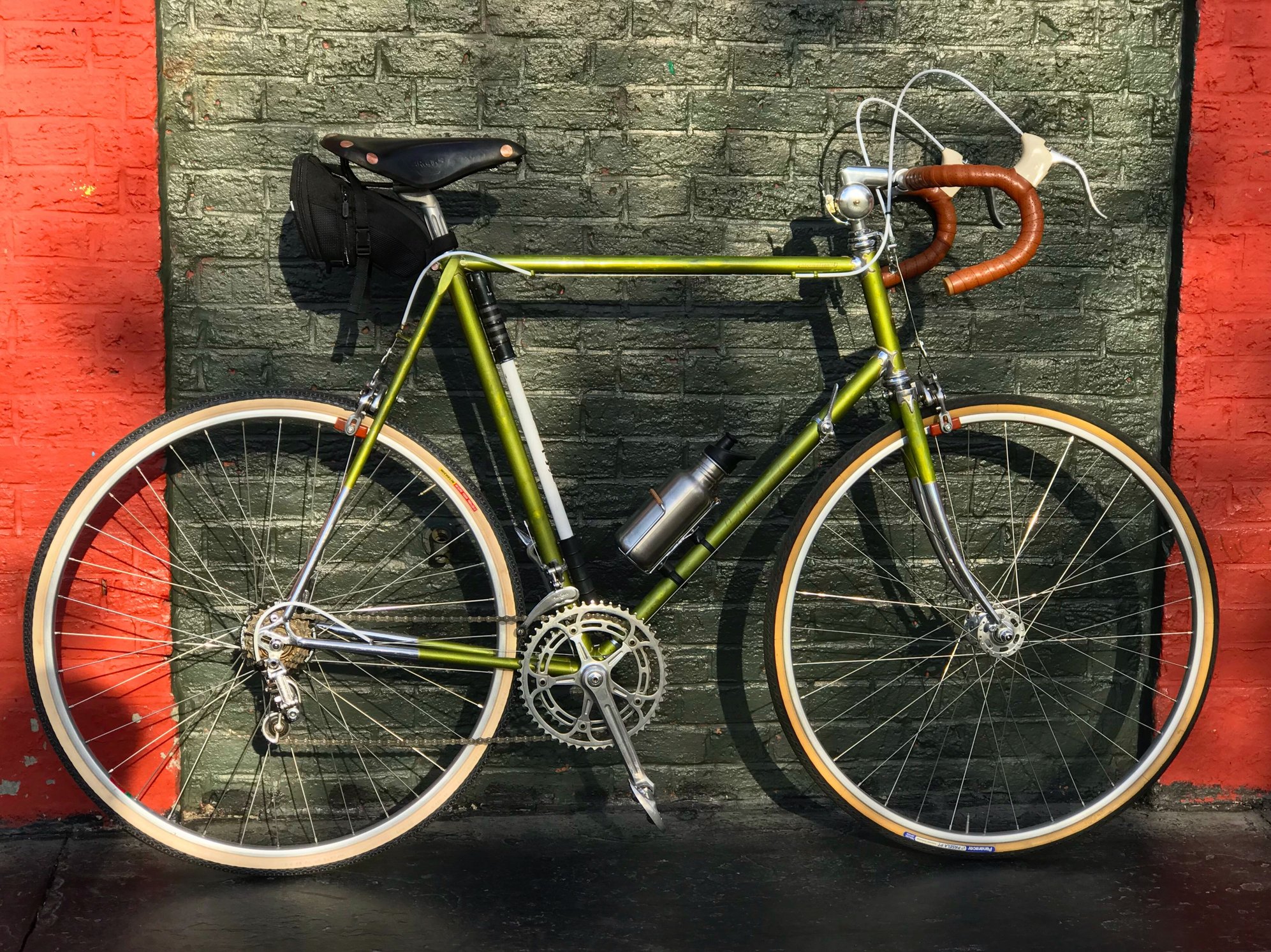
My 1971 measures:
24.5" Seat CTT
23" Top CTC
17.25" chainstays
41.5 wheelbase
Currently a bare frame, here it is in an earlier configuration:
24.5" Seat CTT
23" Top CTC
17.25" chainstays
41.5 wheelbase
Currently a bare frame, here it is in an earlier configuration:
__________________
2024 A Homer Hilsen, 1992 Paramount PDG Series, 1991 Mercian King of Mercia, 1987 Mercian Pro, 1985 Shogun 500, 1972 Peugeot PX-10, 1972 Schwinn Paramount P13-9, 1971 Peugeot PX-10, 1970 Raleigh Pro Mk I, 1969? Falcon San Remo
Curator/Team Mechanic: 2016 Dawes Streetfighter, 1984 Lotus Eclair, 1975 Motobecane Jubile Mixte, 1974 Raleigh Sports, 1973 Free Spirit Ted Williams, 1972 Raleigh Super Course, 1971 Philips Sport
2024 A Homer Hilsen, 1992 Paramount PDG Series, 1991 Mercian King of Mercia, 1987 Mercian Pro, 1985 Shogun 500, 1972 Peugeot PX-10, 1972 Schwinn Paramount P13-9, 1971 Peugeot PX-10, 1970 Raleigh Pro Mk I, 1969? Falcon San Remo
Curator/Team Mechanic: 2016 Dawes Streetfighter, 1984 Lotus Eclair, 1975 Motobecane Jubile Mixte, 1974 Raleigh Sports, 1973 Free Spirit Ted Williams, 1972 Raleigh Super Course, 1971 Philips Sport
 10-13-24 | 02:20 PM
#13
Thread Starter
Voyager
Joined: May 2024
Posts: 14
Likes: 1
From: Overland Park KS
Bikes: 1971 Raleigh international, 1974 Raleigh International, 1973 Raleigh Professional,1975 Raleigh Professional
How did you like the ride of the '71 International? Slower speeds, like on a bike trail, faster speeds like on a road, modest front load like with a Rando type bag (less than 10 pounds)?
Sheldon wrote that the International had an excellent ride, which is why I have been looking for one and acquired one. There is a difference between the 71 and the 74 geometry. The one Sheldon had was a 74. I am trying to decide which to keep. Happy enough with the 71 but I like the Champagne color of the 74. Looking for ride information and handling characteristics of the two bikes.
Sheldon wrote that the International had an excellent ride, which is why I have been looking for one and acquired one. There is a difference between the 71 and the 74 geometry. The one Sheldon had was a 74. I am trying to decide which to keep. Happy enough with the 71 but I like the Champagne color of the 74. Looking for ride information and handling characteristics of the two bikes.
Last edited by Ron_s; 10-13-24 at 02:21 PM. Reason: Adding comment
10-13-24 | 02:52 PM
#14
As the bike should be fit to you, the differences will be very subjective.
all else equal the weighting of the front end will be more on the later bike, the reduced chainstay length is less change than the front center.
Richard Sachs wrote he targeted the use of an 11cm stem. This was no doubt during the era of Cinelli bars being dominant. One has to go to the model 66 for the most forward throw. The others were less and very close to each other.
all else equal the weighting of the front end will be more on the later bike, the reduced chainstay length is less change than the front center.
Richard Sachs wrote he targeted the use of an 11cm stem. This was no doubt during the era of Cinelli bars being dominant. One has to go to the model 66 for the most forward throw. The others were less and very close to each other.
10-13-24 | 03:24 PM
#15
Senior Member
Joined: Dec 2005
Posts: 18,822
Likes: 11,673
If you own both, build them up and ride them and decide for yourself which riding characteristics you prefer. Or build one up, ride it, take some notes, swap those parts to the other one, ride it, and compare your notes. Someone else's ride feel will likely not be useful. Fwiw, I've own both years Int'l and didn't feel much of a difference, likely because the frame angles and fork rake were about the same.
10-13-24 | 03:30 PM
#16
Thread Starter
Voyager
Joined: May 2024
Posts: 14
Likes: 1
From: Overland Park KS
Bikes: 1971 Raleigh international, 1974 Raleigh International, 1973 Raleigh Professional,1975 Raleigh Professional
Thanks. That is what I suspected. The change in the top tube length for whatever reason was offset by other factors to keep the handling similar to the original. I have been riding the 71 for about 4-5 months. I have enough of everything except garage space to build up the 74 also. f anything the top tube and reach of the 71 has felt a bit long for some reason although certain measurements like seat to handlbars are identical to my 75 Professional, which is a perfect fit.
10-13-24 | 04:58 PM
#17
Senior Member
Joined: Apr 2011
Posts: 12,752
Likes: 4,866
Thanks. That is what I suspected. The change in the top tube length for whatever reason was offset by other factors to keep the handling similar to the original. I have been riding the 71 for about 4-5 months. I have enough of everything except garage space to build up the 74 also. f anything the top tube and reach of the 71 has felt a bit long for some reason although certain measurements like seat to handlbars are identical to my 75 Professional, which is a perfect fit.
10-13-24 | 05:41 PM
#18
Thread Starter
Voyager
Joined: May 2024
Posts: 14
Likes: 1
From: Overland Park KS
Bikes: 1971 Raleigh international, 1974 Raleigh International, 1973 Raleigh Professional,1975 Raleigh Professional
In this case it changes the head tube angle. I have not measured the angles, but since all other tube lengths in the front are the same length in both the 71 and the 74, then since the TT length of the 74 is an inch shorter the head tube angle would have to change also.
10-13-24 | 05:47 PM
#19
Thread Starter
Voyager
Joined: May 2024
Posts: 14
Likes: 1
From: Overland Park KS
Bikes: 1971 Raleigh international, 1974 Raleigh International, 1973 Raleigh Professional,1975 Raleigh Professional
What I am looking for is not are there subtle changes between the versions, but was there a major change in handling and performance like there was in the Professional? The Pro was changed in 75 from a criterium racer geometry to a stage racer geometry. Significantly different handling.
I have read one post that the International was designed for a front load. That poster said using a rear load on that version of the International was dangerous. Was one version designed for one purpose, ie, light touring and fun around town, and the other designed as an all purpose bike that could be used for meandering one day and club racing the next?
I have read one post that the International was designed for a front load. That poster said using a rear load on that version of the International was dangerous. Was one version designed for one purpose, ie, light touring and fun around town, and the other designed as an all purpose bike that could be used for meandering one day and club racing the next?
10-13-24 | 05:50 PM
#20
Senior Member
Joined: Apr 2011
Posts: 12,752
Likes: 4,866
Certainly, but changing the rake fixes the change in head tube angle to make them ride similarly. And head tube angle is generally changed to vary the wheelbase or reach. It's what prevents massive toe overlap on small bikes and huge wheelbases on tall bikes. But HTAs and TTs aren't changed for handling.
10-13-24 | 06:21 PM
#21
Senior Member
Joined: Feb 2008
Posts: 5,319
Likes: 4,828
From: Peoria, IL
.....
I have read one post that the International was designed for a front load. That poster said using a rear load on that version of the International was dangerous. Was one version designed for one purpose, ie, light touring and fun around town, and the other designed as an all purpose bike that could be used for meandering one day and club racing the next?
I have read one post that the International was designed for a front load. That poster said using a rear load on that version of the International was dangerous. Was one version designed for one purpose, ie, light touring and fun around town, and the other designed as an all purpose bike that could be used for meandering one day and club racing the next?

Steve in Peoria
10-13-24 | 07:09 PM
#22
What I am looking for is not are there subtle changes between the versions, but was there a major change in handling and performance like there was in the Professional? The Pro was changed in 75 from a criterium racer geometry to a stage racer geometry. Significantly different handling.
I have read one post that the International was designed for a front load. That poster said using a rear load on that version of the International was dangerous. Was one version designed for one purpose, ie, light touring and fun around town, and the other designed as an all purpose bike that could be used for meandering one day and club racing the next?
I have read one post that the International was designed for a front load. That poster said using a rear load on that version of the International was dangerous. Was one version designed for one purpose, ie, light touring and fun around town, and the other designed as an all purpose bike that could be used for meandering one day and club racing the next?
that the professional was a criterium bike
ever is in my opinion a big mischaraterization.
10-14-24 | 12:04 PM
#23

aka Tom Reingold
Joined: Jan 2009
Posts: 44,299
Likes: 6,556
From: New York, NY, and High Falls, NY, USA
Bikes: 1962 Rudge Sports, 1971 Raleigh Super Course, 1971 Raleigh Pro Track, 1974 Raleigh International, 1975 Viscount Fixie, 1982 McLean, 1996 Lemond (Ti), 2002 Burley Zydeco tandem
I measured my 1974 International using an English tape measure and then converted with a factor of 2.54:
seat tube: 21-1/2" (54.6 cm)
top tube: 22" (55.88 cm)
wheelbase: 40-1/8" (101.9 cm)
chain stay: 17" (43.2 cm)
My rear wheel is far back, giving a long chain stay measurement.
seat tube: 21-1/2" (54.6 cm)
top tube: 22" (55.88 cm)
wheelbase: 40-1/8" (101.9 cm)
chain stay: 17" (43.2 cm)
My rear wheel is far back, giving a long chain stay measurement.
__________________
Tom Reingold, tom@noglider.com
New York City and High Falls, NY
Blogs: The Experienced Cyclist; noglider's ride blog
“When man invented the bicycle he reached the peak of his attainments.” — Elizabeth West, US author
Please email me rather than PM'ing me. Thanks.
Tom Reingold, tom@noglider.com
New York City and High Falls, NY
Blogs: The Experienced Cyclist; noglider's ride blog
“When man invented the bicycle he reached the peak of his attainments.” — Elizabeth West, US author
Please email me rather than PM'ing me. Thanks.
