


How do I remove paint, but save anodizing?
 06-02-25 | 01:42 PM
#1
Thread Starter
Senior Member


Joined: Jul 2022
Posts: 3,975
Likes: 3,995
From: Pac NW
Bikes: several Eddy Merz (ride like Eddy, braze like Jim!)
How do I remove paint, but save anodizing?
That old chestnut, you stand on a box to grab an item off your top shelf, a different box crashes down lands perfectly on a can of blue spray paint, lid off.
the paint sprays on some gold anodized brake levers that you just bought on eBay.
paint also got all over tools, but I’m not worried about blue paint on the blue handles of park tools.
what’s the secret to removing the paint but saving the gold?

Gosh darn. Of all the colors in the world.

the paint sprays on some gold anodized brake levers that you just bought on eBay.
paint also got all over tools, but I’m not worried about blue paint on the blue handles of park tools.
what’s the secret to removing the paint but saving the gold?
Gosh darn. Of all the colors in the world.
__________________
"Leave the gun. Take the Colnagos."
"Leave the gun. Take the Colnagos."
 06-02-25 | 01:47 PM
#2
Vintage Trek Black Hole

Joined: Sep 2013
Posts: 1,426
Likes: 1,393
From: Portland, Cascadia
Bikes: 1976 Merz' Tourer, 1984 Strawberry, 1978 Trek 910, 1982 Trek 950, 1982 Trek 720, 1981 Trek 510
I wouldn't think acetone would harm anodization, but best to do a test first.
I'm shocked you even own blue spray paint.
I'm shocked you even own blue spray paint.


 06-03-25 | 11:56 AM
#7


all good advice^ and to state what may be obvious: resist using something abrasive (such as a 3M scratchy pad or steel wool) to apply solvents and wipe off that paint.
"Anodizing" is simply (artificially "thickened" and colored) aluminum oxide which forms on pure aluminum surfaces naturally when exposed to air (but much thinner and with no rainbow colors).
Anything harder than aluminum oxide WILL scratch an anodized finish if abraded...don't ask how I know... and don't reach for the newest version of a household dishwashing pad (green) which now come "reinforced" with hard metal bits!
The dyes used to color AL-oxide anodized finishes are nearly all affected by exposure to the UV in sunlight, so will fade. Black anodizing is especially susceptible to fading and it happens the quickest of all colors. Interesting to see what color dye was the "basis" for a particular "black" dye: it can be purple, brown, gold or sometimes green, all made as dark as possible so when fresh it appears to be black
"Anodizing" is simply (artificially "thickened" and colored) aluminum oxide which forms on pure aluminum surfaces naturally when exposed to air (but much thinner and with no rainbow colors).
Anything harder than aluminum oxide WILL scratch an anodized finish if abraded...don't ask how I know... and don't reach for the newest version of a household dishwashing pad (green) which now come "reinforced" with hard metal bits!
The dyes used to color AL-oxide anodized finishes are nearly all affected by exposure to the UV in sunlight, so will fade. Black anodizing is especially susceptible to fading and it happens the quickest of all colors. Interesting to see what color dye was the "basis" for a particular "black" dye: it can be purple, brown, gold or sometimes green, all made as dark as possible so when fresh it appears to be black
06-03-25 | 07:47 PM
#8

Senior Member

Joined: Apr 2009
Posts: 3,811
Likes: 5,689
From: Seattle
Yeah though some black ano lasts longer than others. I've seen some Art Stump ano parts from the 70s that are still nice and dark to this day. These '70s Universal 68 brakes were still fairly dark when I sold the bike ~10 years ago.
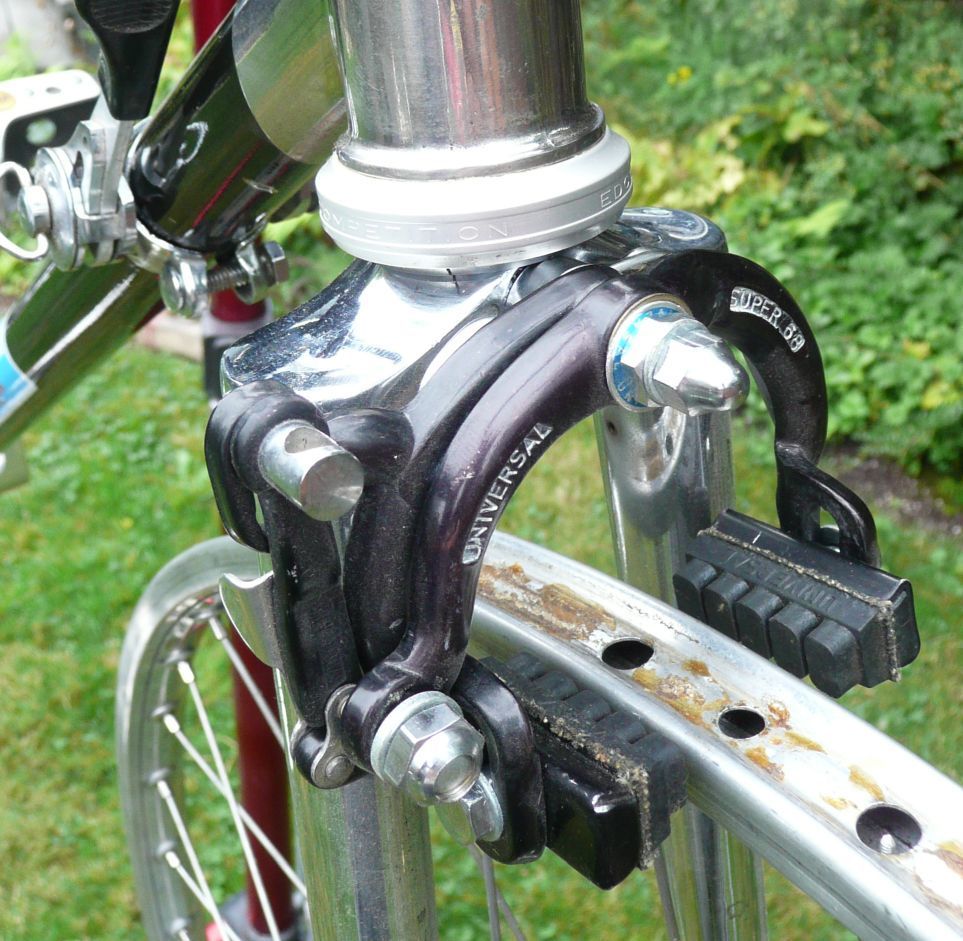

Maybe starting to look a little purple?
I'm guessing there are differences in the actual dye used, but also in the thickness of the ano and how it was sealed after the dye job. Just guessing though.
Red also seems especially prone to fading in sunlight. My blue Modolo Professional brakes from 1980 appear to be as rich and dark a blue 45 years later as on day one. I'm not normally a fan of color ano because it looks terrible when scratched or worn thru to the alu below, but I am fond of those Modolo brakes for sentimental reasons.
Maybe starting to look a little purple?
I'm guessing there are differences in the actual dye used, but also in the thickness of the ano and how it was sealed after the dye job. Just guessing though.
Red also seems especially prone to fading in sunlight. My blue Modolo Professional brakes from 1980 appear to be as rich and dark a blue 45 years later as on day one. I'm not normally a fan of color ano because it looks terrible when scratched or worn thru to the alu below, but I am fond of those Modolo brakes for sentimental reasons.
06-04-25 | 03:50 AM
#9

Senior Member
Joined: Oct 2015
Posts: 16,198
Likes: 9,581
From: PDX
Bikes: Merz x 5 + Specialized Merz Allez x 2, Strawberry/Newlands/DiNucci/Ti x3, Gordon, Fuso/Moulton x2, Bornstein, Paisley,1958-74 Paramounts x3, 3rensho, 74 Moto TC, 73-78 Raleigh Pro's x5, Marinoni x2, 1960 Cinelli SC, 1980 Bianchi SC, PX-10 X 2
Just strip the gold and have them anodized blue, problem solved. 
06-04-25 | 12:09 PM
#10
Yeah though some black ano lasts longer than others. I've seen some Art Stump ano parts from the 70s that are still nice and dark to this day. These '70s Universal 68 brakes were still fairly dark when I sold the bike ~10 years ago.
Maybe starting to look a little purple?
I'm guessing there are differences in the actual dye used, but also in the thickness of the ano and how it was sealed after the dye job. Just guessing though.
Red also seems especially prone to fading in sunlight. My blue Modolo Professional brakes from 1980 appear to be as rich and dark a blue 45 years later as on day one. I'm not normally a fan of color ano because it looks terrible when scratched or worn thru to the alu below, but I am fond of those Modolo brakes for sentimental reasons.
Maybe starting to look a little purple?
I'm guessing there are differences in the actual dye used, but also in the thickness of the ano and how it was sealed after the dye job. Just guessing though.
Red also seems especially prone to fading in sunlight. My blue Modolo Professional brakes from 1980 appear to be as rich and dark a blue 45 years later as on day one. I'm not normally a fan of color ano because it looks terrible when scratched or worn thru to the alu below, but I am fond of those Modolo brakes for sentimental reasons.
Could be there were different (maybe more toxic?) dyes available back then or they just spent more time than typical these days (my turn to make guesses).
