


Slippy Horizontal Dropouts-One Solution I found and a Query About Your Solutions
 01-24-26 | 07:42 PM
#1

Thread Starter
Senior Member


Joined: Sep 2020
Posts: 830
Likes: 1,621
From: Sacramento, CA
Bikes: 2017 Sage Skyline, 2015 Co-Motion Periscope Tandem, 2006 Kona Jake, 1978 Richard Sachs, 1977 Peugeot PRN10, 1974 Allegro Schweitzermeister Model 76, 1972 Hugo Rickert Spezial, 1971 Fuji Finest
Slippy Horizontal Dropouts-One Solution I found and a Query About Your Solutions
Have had some issues with the horizontal dropouts allowing the rear wheel to drift into the non-drive side chainstay. In the BF Bike Mechanics section, I found a helpful thread here that dramatically improved my success rate at getting this problem to stop.
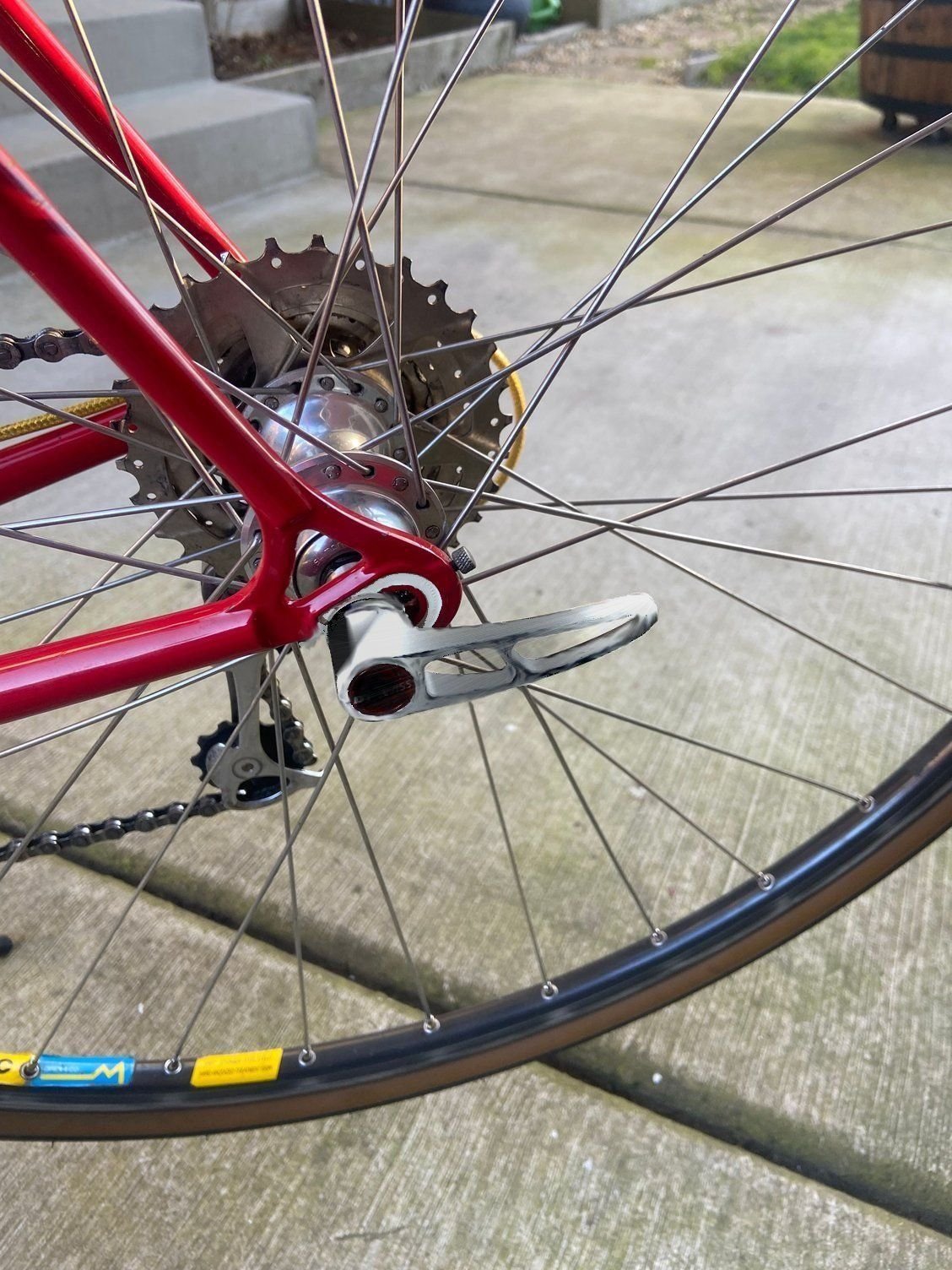
However, on the Richard Sachs that I restomodded with a 3/9 Ultegra gruppo, this problem reared its ugly head until I finally solved it with a good pair of DT Swiss ratcheting skewers. With these skewers (picture below), I have not had a single instance of slipping even when I purposely ride hard uphill out of the saddle, which was one of the major things that caused slippage.
The skewers are handsome and fit well with a restomod, but, from an appearance standpoint, I don’t see them as a good solution on a bike that you are trying to keep period appropriate.
Which leads me to my question. What period appropriate solutions have people come up with? For example, are there particular period skewers that look right on a period bike and clamp particularly well?
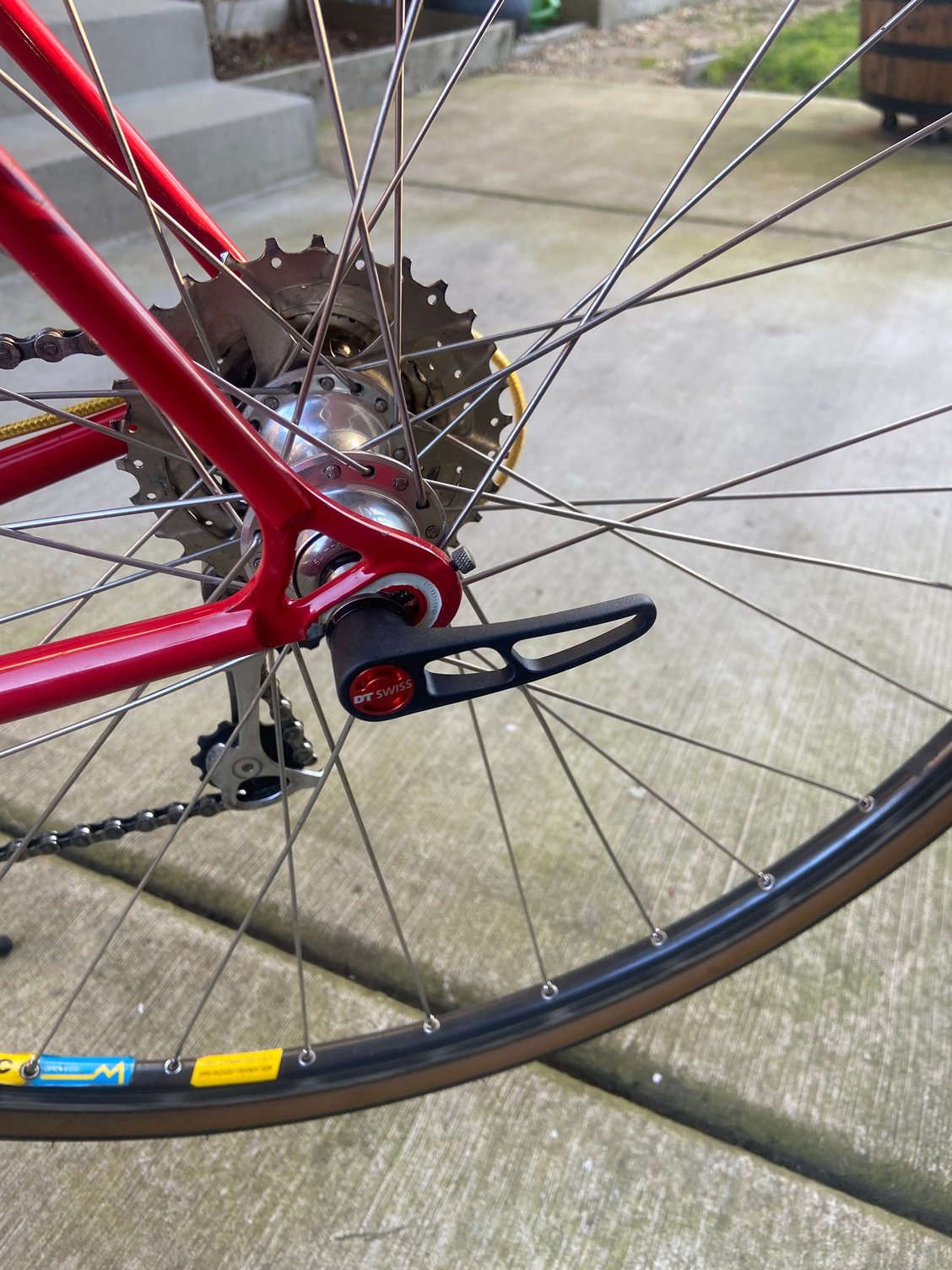
However, on the Richard Sachs that I restomodded with a 3/9 Ultegra gruppo, this problem reared its ugly head until I finally solved it with a good pair of DT Swiss ratcheting skewers. With these skewers (picture below), I have not had a single instance of slipping even when I purposely ride hard uphill out of the saddle, which was one of the major things that caused slippage.
The skewers are handsome and fit well with a restomod, but, from an appearance standpoint, I don’t see them as a good solution on a bike that you are trying to keep period appropriate.
Which leads me to my question. What period appropriate solutions have people come up with? For example, are there particular period skewers that look right on a period bike and clamp particularly well?


 01-24-26 | 07:57 PM
#3

Master Parts Rearranger

Joined: Mar 2015
Posts: 4,842
Likes: 2,788
From: Portlandia's Kuiper Belt, OR
Bikes: 1987 Woodrup Competition - 2025 Trek Checkpoint SL 6 Gen 3 - 1987 Lotus Legend - 2024 Trek Emonda ALR Rim Brake - 1980 Trek 510 - 1988 Cannondale SR500 - 1985 Trek 670 - 1982 Trek 730
I think you just find a smooth-looking internally-cammed QR skewer/lever in a high polish or anodized silver finish and call it a day. Shimano made a ton of them, especially as the late-'80s came around and into the early-'00s with then still-silver groupsets. Externally-cammed QR's with that cupped washer are garbage at holding a wheel into a horizontal dropout, so avoid those. They were made when the world had moved on from horizontal dropouts, so it's not the QR's fault as they didn't need to account for those forces.
01-24-26 | 08:08 PM
#4
Senior Member

Joined: Jan 2015
Posts: 5,777
Likes: 3,338
From: Los Angeles
Bikes: 82 Medici, 85 Ironman, 2011 Richard Sachs
My RS (horizontal dropouts) did fine with 7700, 7900, and 6800 hubs and matching skewers.
__________________
I don't do: disks, tubeless, e-shifting, or bead head nymphs. But I do hate all e-bikes.
I don't do: disks, tubeless, e-shifting, or bead head nymphs. But I do hate all e-bikes.
01-24-26 | 08:10 PM
#5
Francophile
Joined: Nov 2015
Posts: 4,784
Likes: 2,094
From: Seattle
Bikes: Lots
I don't have a slippage issue with forged dropouts, which are thicker than stamped steel ones (And as everyone says, I use internal cam skewers.) But on some of the stamped dropouts, I need to use one of the screw-down theft preventative skewers to get the skewer tight enough to hold the wheel in place.
__________________
Keeping Seattle’s bike shops in business since 1978
Keeping Seattle’s bike shops in business since 1978
01-24-26 | 08:32 PM
#7
Thread Starter
Senior Member
Joined: Sep 2020
Posts: 830
Likes: 1,621
From: Sacramento, CA
Bikes: 2017 Sage Skyline, 2015 Co-Motion Periscope Tandem, 2006 Kona Jake, 1978 Richard Sachs, 1977 Peugeot PRN10, 1974 Allegro Schweitzermeister Model 76, 1972 Hugo Rickert Spezial, 1971 Fuji Finest
Internal Cam vs. exposed Cam
I think you just find a smooth-looking internally-cammed QR skewer/lever in a high polish or anodized silver finish and call it a day. Shimano made a ton of them, especially as the late-'80s came around and into the early-'00s with then still-silver groupsets. Externally-cammed QR's with that cupped washer are garbage at holding a wheel into a horizontal dropout, so avoid those. They were made when the world had moved on from horizontal dropouts, so it's not the QR's fault as they didn't need to account for those forces.
01-24-26 | 08:51 PM
#8

aka: Dr. Cannondale


Joined: Jul 2009
Posts: 8,656
Likes: 6,293
Another vote for the older internal cam skewers,but paired with an all-metal Shimano early threaded end.
Much better than the plastic ones with a metal insert.
Much better than the plastic ones with a metal insert.
__________________
Hard at work in the Secret Underground Laboratory...
Hard at work in the Secret Underground Laboratory...
01-24-26 | 08:56 PM
#9

Senior Member
Joined: Oct 2014
Posts: 14,153
Likes: 5,275
From: Portland, OR
Bikes: (2) ti TiCycles, 2007 w/ triple and 2011 fixed, 1979 Peter Mooney, ~1983 Trek 420 now fixed and ~1973 Raleigh Carlton Competition gravel grinder
Yes to internally cammed QRs. Ones with gripping surfaces still in good condition (ie the ridges sharp) are reputed to be better on chromed dropouts I couldn't say. I don't pull any decent internal cam QRs out with my less than massive legs.
Now, chromed dropouts are for vanity and chasing off a demon that very rarely shows its face. (That demon - dropout destroying rust. I've ridden snow and ice bikes into the ground and I could have taken those dropout off, as lousy as they looked, then brazed then into the next bike that was going to lead the same life and they would have served just fine.)
On internal cam skewers - in the '80s or '90s (I don't know the timeline) the design of the cam changed from the shape Campy invented in the 1920s to one that closes the skewer with considerably more force and better resistance to opening accidentally. Well worth having. To my knowledge, Shimano was the first. Campy and most others followed later. I still have a few old Campy NR skewers. I won't use them because 20 year old el cheapo Shimanos keep wheels in place far better. Likewise any all steel Shimano or Quality Bike Parts no-name purchased now. (The nice skewers by both Shimano and Campy of this millennia are sweet to look an and use and hold wonderfully but for the simple job of keeping your wheel where it belongs, those (modern) steel cheapos from reputable companies work just as well.
Edit: Keep the internals of the skewer "head" well greased or oiled. Less friction = more clamping force.
Now, chromed dropouts are for vanity and chasing off a demon that very rarely shows its face. (That demon - dropout destroying rust. I've ridden snow and ice bikes into the ground and I could have taken those dropout off, as lousy as they looked, then brazed then into the next bike that was going to lead the same life and they would have served just fine.)
On internal cam skewers - in the '80s or '90s (I don't know the timeline) the design of the cam changed from the shape Campy invented in the 1920s to one that closes the skewer with considerably more force and better resistance to opening accidentally. Well worth having. To my knowledge, Shimano was the first. Campy and most others followed later. I still have a few old Campy NR skewers. I won't use them because 20 year old el cheapo Shimanos keep wheels in place far better. Likewise any all steel Shimano or Quality Bike Parts no-name purchased now. (The nice skewers by both Shimano and Campy of this millennia are sweet to look an and use and hold wonderfully but for the simple job of keeping your wheel where it belongs, those (modern) steel cheapos from reputable companies work just as well.
Edit: Keep the internals of the skewer "head" well greased or oiled. Less friction = more clamping force.
 01-24-26 | 08:59 PM
#10
Thread Starter
Senior Member
Joined: Sep 2020
Posts: 830
Likes: 1,621
From: Sacramento, CA
Bikes: 2017 Sage Skyline, 2015 Co-Motion Periscope Tandem, 2006 Kona Jake, 1978 Richard Sachs, 1977 Peugeot PRN10, 1974 Allegro Schweitzermeister Model 76, 1972 Hugo Rickert Spezial, 1971 Fuji Finest
Yup
From the SB article, he pointed out that the best interfaces were the ones with steel, rather than aluminum, in the contact points because the aluminum is softer than the steel dropout and won’t bite in properly.
01-24-26 | 09:03 PM
#11

Senior Member

Joined: Apr 2011
Posts: 12,629
Likes: 4,783
That's a theory, but it ignores how aluminum has a sticky quality.
01-24-26 | 09:51 PM
#12
Senior Member
Joined: Jan 2014
Posts: 511
Likes: 411
From: San Francisco - it used to be nice
Bikes: 1970 Alex Singer, 63 Hetchins, 75 Motobecane Townie, more . . .
IME 70's and 1980's chrome steel Campy or Dura Ace 7400 -7402 QR's both did the job admirably. There isn't any need to overthink it, IMO.
In a related vein - do people realize that the peak deflection and chain tension is when you're grunting up a hill in a Granny Gear. Not when you are sprinting in a large or moderate gear
Freddy Maertens has nothing on us geezers.
In a related vein - do people realize that the peak deflection and chain tension is when you're grunting up a hill in a Granny Gear. Not when you are sprinting in a large or moderate gear
Freddy Maertens has nothing on us geezers.

 01-25-26 | 04:00 AM
#13
Senior Member
Joined: Feb 2020
Posts: 3,993
Likes: 2,311

 01-25-26 | 08:50 AM
#15

Senior Member
Joined: Jun 2019
Posts: 1,666
Likes: 1,968
From: Michigan USA
Bikes: A bunch of old bikes.
The only slipping dropout problems I've had were due to too much axle outside of the locknut and spacers. Quick release bottoms out before secure. Much more likely on stamped dropouts.
01-25-26 | 09:01 AM
#16

image shows a milled face dropout.
the reduced contact surface area is not helping obviously.
way back Harlan of Hi-E made a spot mill to help create a mechanical engagement for the hub/ dropout contact region.
yes, cuts through the paint.
the reduced contact surface area is not helping obviously.
way back Harlan of Hi-E made a spot mill to help create a mechanical engagement for the hub/ dropout contact region.
yes, cuts through the paint.
01-25-26 | 09:16 AM
#17
Vintage Trek Black Hole
Joined: Sep 2013
Posts: 1,391
Likes: 1,329
From: Portland, Cascadia
Bikes: 1976 Merz' Tourer, 1984 Strawberry, 1978 Trek 910, 1982 Trek 950, 1982 Trek 720, 1981 Trek 510
I don't have a slippage issue with forged dropouts, which are thicker than stamped steel ones (And as everyone says, I use internal cam skewers.) But on some of the stamped dropouts, I need to use one of the screw-down theft preventative skewers to get the skewer tight enough to hold the wheel in place.
But this is all anecdotal evidence, and now that I think about it, maybe there's some bias at play because a slipped QR in the middle of a ride is an easy fix while a slipped security skewer (without the proper tool in hand) is sure to be a much more memorable experience.
01-25-26 | 10:20 AM
#18
Senior Member
Joined: Apr 2011
Posts: 12,629
Likes: 4,783
No, I am referencing the existing engineering concept known as "stiction". Aluminum deforms on the surface when compressed into another surface and doesn't like to release. I don't know how that interacts with coefficients of friction since we aren't talking about stuff moving but the threshold that has to be reached first before they can move. Aluminum generally has more stiction, while materials like brass and bronze are known for being "self lubricating". This is probably related to galling as well.
Last edited by Kontact; 01-25-26 at 11:10 AM.
 01-25-26 | 10:37 AM
#20
Senior Member
Joined: Apr 2011
Posts: 12,629
Likes: 4,783
That reduced contact area means that the same skewer torque has higher force per square inch, causing that red ridge of steel to deform more than more surface area would. The net result is that skewer digs in more and deforms the dropout permanently.
01-25-26 | 10:56 AM
#21
Francophile
Joined: Nov 2015
Posts: 4,784
Likes: 2,094
From: Seattle
Bikes: Lots
I've said this in another thread, but I have had yh opposite experience. Never had a QR skewer slip, but have had many security skewers slip and a few track hubs too. The track hubs were certainly user error; I was newer to bikes and wasn't sure how tight was "too tight." But the security skewers have been a real problem for me, mostly because the small tools (nothing more than an Allen key) don't provide a ton of leverage.
__________________
Keeping Seattle’s bike shops in business since 1978
Keeping Seattle’s bike shops in business since 1978
01-25-26 | 11:24 AM
#22
Senior Member
Joined: Oct 2014
Posts: 1,079
Likes: 534
From: Reno nevada
Bikes: a few that I can't recall
No, I am referencing the existing engineering concept known as "stiction". Aluminum deforms on the surface when compressed into another surface and doesn't like to release. I don't know how that interacts with coefficients of friction since we aren't talking about stuff moving but the threshold that has to be reached first before they can move. Aluminum generally has more stiction, while materials like brass and bronze are known for being "self lubricating".

(original art by the way because its 32 here)
Last edited by Reynolds 531; 01-25-26 at 11:29 AM.
01-25-26 | 12:14 PM
#23
Sure, then why did the wheel slip?
01-25-26 | 01:54 PM
#24

Passista

Joined: Jul 2005
Posts: 8,244
Likes: 1,211
Bikes: 1998 Pinarello Asolo, 1992 KHS Montaña pro, 1980 Raleigh DL-1, IGH Hybrid, IGH Utility
IME 70's and 1980's chrome steel Campy or Dura Ace 7400 -7402 QR's both did the job admirably. There isn't any need to overthink it, IMO.
In a related vein - do people realize that the peak deflection and chain tension is when you're grunting up a hill in a Granny Gear. Not when you are sprinting in a large or moderate gear
Freddy Maertens has nothing on us geezers.
In a related vein - do people realize that the peak deflection and chain tension is when you're grunting up a hill in a Granny Gear. Not when you are sprinting in a large or moderate gear
Freddy Maertens has nothing on us geezers.
01-25-26 | 02:13 PM
#25
Senior Member
Joined: Apr 2011
Posts: 12,629
Likes: 4,783
Because the QR was so weak it didn't deform the steel.