


Weight of "Typical" Steel Racing Frame ?
 06-20-09 | 03:16 PM
#1


Thread Starter
Super Moderator

Joined: Jul 2004
Posts: 21,987
Likes: 1,169
From: Ffld Cnty Connecticut
Bikes: Old Steelies I made, Old Cannondales
Weight of "Typical" Steel Racing Frame ?
Any idea how much a typical or standard 1980s old-school race frame would weigh ? Something like a 56 cm, full 531 tubes, Campy dropouts etc ??
I have such a beast with 1980s components (Campy, Modolo, Cinelli etc.., but don't want to strip it down just to weigh it. It's noticably heavier than my CAAD8, running part Campy, Kyserium wheels, and other un-interesting parts.
I have such a beast with 1980s components (Campy, Modolo, Cinelli etc.., but don't want to strip it down just to weigh it. It's noticably heavier than my CAAD8, running part Campy, Kyserium wheels, and other un-interesting parts.
__________________
Bikes: Old steel race bikes, old Cannondale race bikes, less old Cannondale race bike, crappy old mtn bike.
FYI: https://www.bikeforums.net/forum-sugg...ad-please.html
Bikes: Old steel race bikes, old Cannondale race bikes, less old Cannondale race bike, crappy old mtn bike.
FYI: https://www.bikeforums.net/forum-sugg...ad-please.html
 06-20-09 | 03:26 PM
#3


Senior Member
Joined: Apr 2005
Posts: 17,196
Likes: 761
From: Ann Arbor, MI
Bikes: 1980 Masi, 1984 Mondonico, 1984 Trek 610, 1980 Woodrup Giro, 2005 Mondonico Futura Leggera ELOS, 1967 PX10E, 1971 Peugeot UO-8
I agree it shouldn't matter, but if you really want the numbers, go to the weightweenie site, where there are tables of weights for all manner of bike stuff. See if you can look up a Raleigh Professional from maybe 1974 or a Colnago from around 1980. They'll be a good indication of what you can expect. Don't be surprised if your frame does not match what you find out there, and if it is around 2 pounds heavier than an aluminum Cannondale. Just google weightweenie, it'll pop up.
If it might make you unhappy, or make us unhappy if you start a thread crying about vintage bike weight , don't go there. We already expect vintage steel, even the lightest of the day, to weigh more than aggressively light aluminum (no, we are not considering mid-30s constructeur machines here), but we don't care. Some modern steel can give modern "other" a run for their money! Otherwise, knock yourself out and have fun with bike geek numbers!
If it might make you unhappy, or make us unhappy if you start a thread crying about vintage bike weight
, don't go there. We already expect vintage steel, even the lightest of the day, to weigh more than aggressively light aluminum (no, we are not considering mid-30s constructeur machines here), but we don't care. Some modern steel can give modern "other" a run for their money! Otherwise, knock yourself out and have fun with bike geek numbers!
Last edited by Road Fan; 06-20-09 at 03:30 PM.
06-20-09 | 03:30 PM
#4
Thread Starter
Super Moderator
Joined: Jul 2004
Posts: 21,987
Likes: 1,169
From: Ffld Cnty Connecticut
Bikes: Old Steelies I made, Old Cannondales
__________________
Bikes: Old steel race bikes, old Cannondale race bikes, less old Cannondale race bike, crappy old mtn bike.
FYI: https://www.bikeforums.net/forum-sugg...ad-please.html
Bikes: Old steel race bikes, old Cannondale race bikes, less old Cannondale race bike, crappy old mtn bike.
FYI: https://www.bikeforums.net/forum-sugg...ad-please.html
06-20-09 | 03:36 PM
#5

Senior Member
Joined: Jul 2002
Posts: 40,863
Likes: 3,116
From: Sacramento, California, USA
Bikes: Specialized Tarmac, Canyon Exceed, Specialized Transition, Ellsworth Roots, Ridley Excalibur
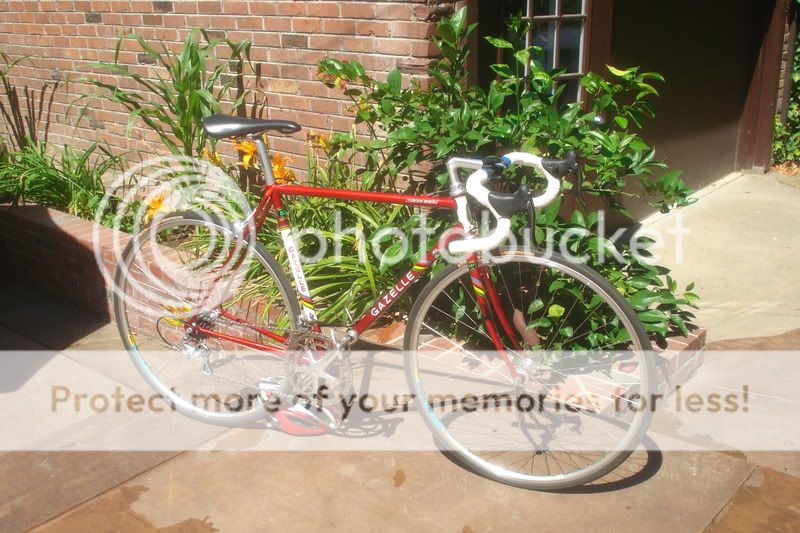
My '86 Gazelle, with a modern 10-speed Campy group and 32 spoke Open Pros, weighs about 21.5 pounds. It could easily lose 3 pounds with a carbon fork and tubulars. But it's no beast. It wants to roll forever, is solid in a cross wind but nimble over crappy pavement. A bike for the Classics!
06-20-09 | 03:38 PM
#6
Banned
Joined: Jan 2007
Posts: 5,258
Likes: 14
My non weight weenie, 1980's steel bikes weigh in just under 21 lbs, less if they are the TI component versions.
With two full water bottles, a multitool, a spare tubular, pump and Pit Stop, cell phone, snack and my fat @ss, it might be slightly more.
With two full water bottles, a multitool, a spare tubular, pump and Pit Stop, cell phone, snack and my fat @ss, it might be slightly more.
06-20-09 | 03:40 PM
#7
Senior Member
Joined: Jun 2008
Posts: 265
Likes: 1
From: Hamilton, Ontario, Canada
Bought a Raleigh Team USA racing on eBay last year (along with a few others, but the Raleigh was the only one I thought to weigh because it was the only one that didn't have a headset already installed.)
52 cm, 531C tubing, Campy dropouts, steel fork. I forget what the two came out to together -- 'cos really, it doesn't matter -- but I know it was possible to weigh at least the frame without fork on my wife's kitchen scale that maxes out at 2.2 kg. It's quite easy (with non-super-light parts of the era) to build a 19-20 lb bike in a frame that size, and that's with a leather Brooks saddle.
52 cm, 531C tubing, Campy dropouts, steel fork. I forget what the two came out to together -- 'cos really, it doesn't matter -- but I know it was possible to weigh at least the frame without fork on my wife's kitchen scale that maxes out at 2.2 kg. It's quite easy (with non-super-light parts of the era) to build a 19-20 lb bike in a frame that size, and that's with a leather Brooks saddle.
06-20-09 | 05:03 PM
#8

Senior Member


Joined: Apr 2007
Posts: 12,567
Likes: 2,740
From: Thunder Bay, Ontario, Canada - burrrrr!
Bikes: 1958 Rabeneick 120D, 1968 Legnano Gran Premio, 196? Torpado Professional, 2000 Marinoni Piuma
Weight issues...
I recently purchased a digital scale to hang and weigh my bicycles with. I was surprised at the results and all of my bikes were weighed with pedals installed. What did I find?
Not very many vintage road bicycles come in under 20 pounds (I ride 54-56cm bikes). The top dogs in my collection weigh between 21 and 23 pounds. The mid level rides between 24 and 26 and the entry level Bike Shop bikes between 27 and 30 pounds. Department store offerings always come in over the 3o pound mark and I have weighed about fifty bikes so far.
As for frame set, I haven't taken the time to break the bikes down to check and will not do so unless I have a reason. Weight of a bicycle is dependent on both the frame type, make-up and size plus the components used. In closing, if you want a light old road bike, you must be prepared to sacrifice user friendliness and install tubulars at the very least. The question is, why are we so worried about this factor?
The lighter the bike the lighter the rider must be. I have let great bikes go simply because I am too big to ride them safely. By safely, I refer to damaging the frame set itself due to over loading of the bike.
For those of you who want to understand the weight issue a bit better, check out the engineering specifications of the different high end tube sets. You just might be surprised.
Not very many vintage road bicycles come in under 20 pounds (I ride 54-56cm bikes). The top dogs in my collection weigh between 21 and 23 pounds. The mid level rides between 24 and 26 and the entry level Bike Shop bikes between 27 and 30 pounds. Department store offerings always come in over the 3o pound mark and I have weighed about fifty bikes so far.
As for frame set, I haven't taken the time to break the bikes down to check and will not do so unless I have a reason. Weight of a bicycle is dependent on both the frame type, make-up and size plus the components used. In closing, if you want a light old road bike, you must be prepared to sacrifice user friendliness and install tubulars at the very least. The question is, why are we so worried about this factor?
The lighter the bike the lighter the rider must be. I have let great bikes go simply because I am too big to ride them safely. By safely, I refer to damaging the frame set itself due to over loading of the bike.
For those of you who want to understand the weight issue a bit better, check out the engineering specifications of the different high end tube sets. You just might be surprised.
06-20-09 | 05:47 PM
#10
Member
Joined: Oct 2007
Posts: 29
Likes: 0
From: Markham, Ontario
Bikes: Vintage Guerciotti Strada SL, Guerciotti Ares, and Motobecane Cafe Century Pro
My 54cm late 70's Guerciotti with Columbus SL frame, Campy SR, Cinelli Bar/stem weighs about 24lbs. My newer Guerciotti Ares with medium carbon frame, Campy Chorus weigh in at about 16lbs.
Surprisingly, my older Guerciotti gets more attention from other cyclist.
Surprisingly, my older Guerciotti gets more attention from other cyclist.
 06-20-09 | 07:01 PM
#12
Senior Member
Joined: Oct 2008
Posts: 2,929
Likes: 2
06-20-09 | 08:29 PM
#13

we're talking about road bikes here. It mattered when the frame was new, and some people are curious to know, we all have a little weight weenie in us or we'd be happy riding varsities.
__________________
1 Super Record bike, 1 Nuovo Record bike, 1 Pista, 1 Road, 1 Cyclocross/Allrounder, 1 MTB, 1 Touring, 1 Fixed gear
1 Super Record bike, 1 Nuovo Record bike, 1 Pista, 1 Road, 1 Cyclocross/Allrounder, 1 MTB, 1 Touring, 1 Fixed gear
06-20-09 | 08:42 PM
#14

The man has a point. I tend to agree myself. If for no other reason than curiosity. My '82 Viner weighs in about 21 and some change pounds with pedals, cages, and a B17 saddle.
06-20-09 | 08:50 PM
#15
Banned
Joined: May 2009
Posts: 2,078
Likes: 6
Can you offer any pointers or places to look regarding how much weight older tubing styles and frame sizes can support?
06-20-09 | 09:39 PM
#16
A bicycle is to convert human power to forward motion for transportation, recreation, sport, etc. A good bicycle will capitalize on design and materials to make it as efficient as possible for its intended use. Power to weight ratio is everything, and the weight of the bike counts.
Why do you think it does not matter?
Why do you think it does not matter?
06-20-09 | 09:45 PM
#17
Senior Member
Joined: Nov 2005
Posts: 5,768
Likes: 10
Bikes: Cinelli, Paramount, Raleigh, Carlton, Zeus, Gemniani, Frejus, Legnano, Pinarello, Falcon
Back in the day (early 70s) 21 pounds was considered pretty light. Less than that, you were superhuman. I'd guess average race-type bikes of the day were 22-25 pounds, depending if clinchers or sewups, and what junk you added.
In those days, wheel weight was considered most important.
In those days, wheel weight was considered most important.
Last edited by dbakl; 06-20-09 at 09:50 PM.
06-20-09 | 10:08 PM
#18
Bottecchia fan
Joined: Aug 2003
Posts: 3,520
Likes: 12
From: Colorado Springs, CO
Bikes: 1959 Bottecchia Milano-Sanremo (frame), 1966 Bottecchia Professional (frame), 1971 Bottecchia Professional (frame), 1973 Bottecchia Gran Turismo, 1974 Bottecchia Special, 1977 Bottecchia Special (frame), 1974 Peugeot UO-8
So far I've only had the opportunity to weigh one frame, a mid-60's Bottecchia built from Falck tubing. Not much is known about Falck tubing of the period including whether or not it's even butted but here are results for a 56cm frame:
Frame weight: 4 lb 12.4 oz (2165g)
Fork weight: 1 lb 11.1 oz (767g)
I would expect an 80's frame to be a bit less but there are many variables.
Frame weight: 4 lb 12.4 oz (2165g)
Fork weight: 1 lb 11.1 oz (767g)
I would expect an 80's frame to be a bit less but there are many variables.
__________________
1959 Bottecchia Milano-Sanremo(frame), 1966 Bottecchia Professional (frame), 1971 Bottecchia Professional (frame),
1973 Bottecchia Gran Turismo, 1974 Bottecchia Special, 1977 Bottecchia Special (frame),
1974 Peugeot UO-8, 1988 Panasonic PT-3500, 2002 Bianchi Veloce, 2004 Bianchi Pista
1959 Bottecchia Milano-Sanremo(frame), 1966 Bottecchia Professional (frame), 1971 Bottecchia Professional (frame),
1973 Bottecchia Gran Turismo, 1974 Bottecchia Special, 1977 Bottecchia Special (frame),
1974 Peugeot UO-8, 1988 Panasonic PT-3500, 2002 Bianchi Veloce, 2004 Bianchi Pista
06-20-09 | 11:14 PM
#19
Senior Member
Joined: Oct 2008
Posts: 2,929
Likes: 2
I never said that. I was asking (you guys, collectively) why you think it matters. Just because someone asks a question, do not assume they disagree with you.
I think the weight of the rider is more important than the weight of the bike. I will offer that much. Still, I'd like to know why weight is important.
I have ridden bicycles extensively, literally ridden them into the ground, that were of such poor quality that a Schwinn Varsity was truly a MAJOR step up from what I was riding. I do not like the Schwinn Varsity but I do respect them.
I think the weight of the rider is more important than the weight of the bike. I will offer that much. Still, I'd like to know why weight is important.
I have ridden bicycles extensively, literally ridden them into the ground, that were of such poor quality that a Schwinn Varsity was truly a MAJOR step up from what I was riding. I do not like the Schwinn Varsity but I do respect them.
Last edited by Mike Mills; 06-21-09 at 12:44 AM.
06-21-09 | 12:17 AM
#20

Steel is real, baby!
Joined: Dec 2008
Posts: 2,532
Likes: 8
From: Boise, ID
Bikes: 1984 Pinarello, 1986 Bianchi Portofino, 1988 Bianchi Trofeo, 1989 Specialized Allez, 1989 Specialized Hard Rock, 2001 Litespeed Tuscany
The average lugged, double butted steel framesets from the '80s were about 5.5 ~ 6 lbs. They usually built up into a 21 ~ 23 lb. complete bike.
06-21-09 | 12:22 AM
#21
Senior Member
Joined: Apr 2005
Posts: 17,196
Likes: 761
From: Ann Arbor, MI
Bikes: 1980 Masi, 1984 Mondonico, 1984 Trek 610, 1980 Woodrup Giro, 2005 Mondonico Futura Leggera ELOS, 1967 PX10E, 1971 Peugeot UO-8
A bicycle is to convert human power to forward motion for transportation, recreation, sport, etc. A good bicycle will capitalize on design and materials to make it as efficient as possible for its intended use. Power to weight ratio is everything, and the weight of the bike counts.
Why do you think it does not matter?
Why do you think it does not matter?
Weight does affect the resistance due to rolling resistance, but the relative value of this factor is usually considerably less than the air resistance.
Caveats: Not if you're going uphill or downhill, and not if you don't ride "fast enough," and not if you accelerate a lot on some specific route.
Plus over brevet distances, even small loss factors can make a measureable difference.
So it isn't really right to say it DOES NOT MATTER, because there are condition where it might be dominant. The question is, how significant are these brief events considered over a lengthy ride. It is correct to say it is not significant for most riding, at least in my town.
If you think it is very significant, what are you doing messing around with old steel bikes?
06-21-09 | 12:46 AM
#22
Senior Member
Joined: Oct 2008
Posts: 2,929
Likes: 2
I just want to make a (very) minor technical point - when going down hill, weight is a "good thing". It gives you faster downhill accelleration and higher top speed while going down.
I'm still watching this thread to better understand what's the deal with light weight bicycles.
I'm still watching this thread to better understand what's the deal with light weight bicycles.
06-21-09 | 09:55 AM
#23

Full Member
Joined: Jan 2009
Posts: 397
Likes: 0
From: I live in a rural canyon in unincorporated Los Angeles County
Bikes: Giant Mountain Bike
Back in the day (early 70s) 21 pounds was considered pretty light. Less than that, you were superhuman. I'd guess average race-type bikes of the day were 22-25 pounds, depending if clinchers or sewups, and what junk you added.
In those days, wheel weight was considered most important.
In those days, wheel weight was considered most important.
An old rule of thumb was that one ounce of rotating weight was worth 9 ounces of static weight.
Greg
06-21-09 | 10:22 AM
#24

Pug lover! Dogs and bikes
Joined: Sep 2008
Posts: 1,161
Likes: 1
From: San Jose, CA
I can attest to curiosity being the factor. I love to know everything about my bike even if it's not ride affecting.
With that said my Peugeot PSV10 is around 19 lbs. I'm using clinchers, a brooks team pro, a mini pump attached to the frame, and without using any special weight saving components
With that said my Peugeot PSV10 is around 19 lbs. I'm using clinchers, a brooks team pro, a mini pump attached to the frame, and without using any special weight saving components
06-21-09 | 10:52 AM
#25

Bicycle Repair Man !!!
Joined: Sep 2007
Posts: 27,266
Likes: 152
From: YEG
Bikes: See my sig...
My 1973 Raleigh Gran Sport, which was not even a top of the line model weighs in at just under 22 pounds with a (heavy) Lycette L'Avenir saddle and just a spec over 21 with a modern racing saddle... it's a 50 cm frame.
It's a 531 frame and fork and my guess on weight when I had it stripped down was about 6 pounds... I run Avocet folding tyres which are < 200 grams each, the 27 inch wheels are reasonably light, and the drive train is vintage Shimano 600 Arabesque with Dura Ace Centre pulls.
If I come across some 600 brakes I will swap those in and lose a little weight and have a first generation Cyclone rear d I am going to use that will also knock off quite a few grams but the important thing is that the bike will run more smoothly and have a greater gearing capacity.
I am obviously not a weight weenie.
It's a 531 frame and fork and my guess on weight when I had it stripped down was about 6 pounds... I run Avocet folding tyres which are < 200 grams each, the 27 inch wheels are reasonably light, and the drive train is vintage Shimano 600 Arabesque with Dura Ace Centre pulls.
If I come across some 600 brakes I will swap those in and lose a little weight and have a first generation Cyclone rear d I am going to use that will also knock off quite a few grams but the important thing is that the bike will run more smoothly and have a greater gearing capacity.
I am obviously not a weight weenie.