


What's with the seat clamp in front of the post?
 07-17-09 | 12:41 PM
#1


Thread Starter
multimodal commuter
Joined: Nov 2006
Posts: 19,810
Likes: 597
From: NJ, NYC, LI
Bikes: 1940s Fothergill, 1959 Allegro Special, 1963? Claud Butler Olympic Sprint, Lambert 'Clubman', 1974 Fuji "the Ace", 1976 Holdsworth 650b conversion rando bike, 1983 Trek 720 tourer, 1984 Counterpoint Opus II, 1993 Basso Gap, 2010 Downtube 8h, and...
What's with the seat clamp in front of the post?
I've noticed old bike catalogs usually show bicycles with the seat clamp set in front of the seat post.
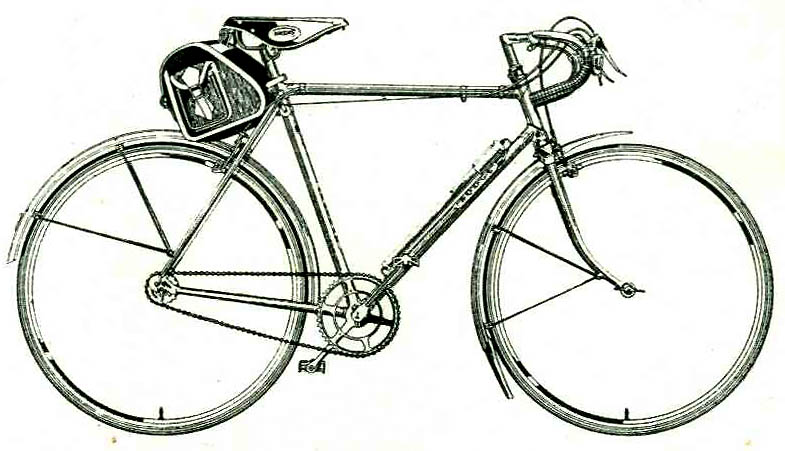
This is just about always the case on bikes with upright handlebars, and often (or usually) the case on bikes with drop bars.
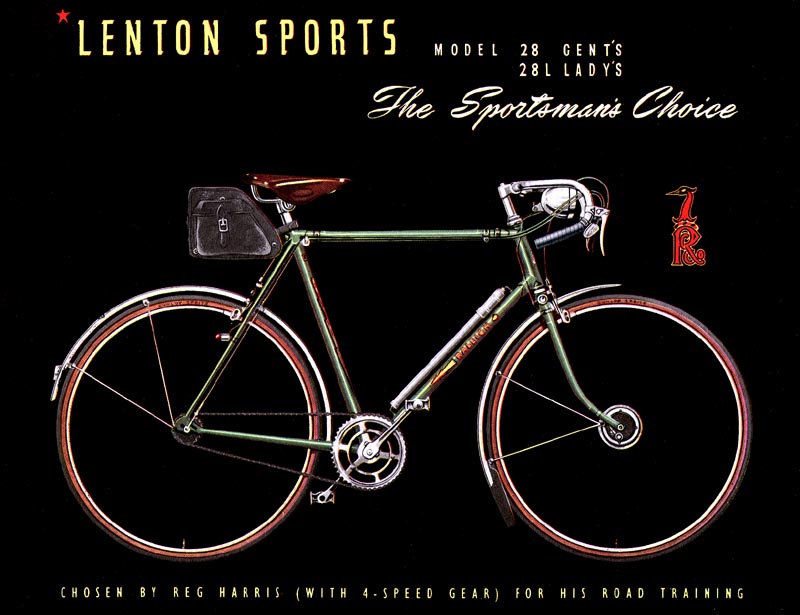
Today, of course, we always put the seat clamp on the back of the post, or use a seat post with an integrated clamp that always goes to the back. Actually, I'm not even sure it would be possible to use a typical "modern" post this way ("backwards") (has anyone tried?).
And it would appear that il campionissimo had his 1952 Bianchi set up like a modern one (though of course it may have been changed later):

So I'm wondering, were the older bikes designed for a different weight distribution than today's? Does anyone ride this way today? I'm especially curious about those of you who ride bikes from the 50's and earlier.
This is just about always the case on bikes with upright handlebars, and often (or usually) the case on bikes with drop bars.
Today, of course, we always put the seat clamp on the back of the post, or use a seat post with an integrated clamp that always goes to the back. Actually, I'm not even sure it would be possible to use a typical "modern" post this way ("backwards") (has anyone tried?).
And it would appear that il campionissimo had his 1952 Bianchi set up like a modern one (though of course it may have been changed later):
So I'm wondering, were the older bikes designed for a different weight distribution than today's? Does anyone ride this way today? I'm especially curious about those of you who ride bikes from the 50's and earlier.
Last edited by rhm; 07-17-09 at 12:45 PM.
 07-17-09 | 12:50 PM
#2

You gonna eat that?
Joined: Sep 2008
Posts: 14,917
Likes: 543
From: Fort Worth, Texas Church of Hopeful Uncertainty
Bikes: 1966 Raleigh DL-1 Tourist, 1973 Schwinn Varsity, 1983 Raleigh Marathon, 1994 Nishiki Sport XRS
Actually, it makes more sense from a structural standpoint. Most of your weight goes through your "sit bones" which (for me at least) settle in at about the widest part of the seat. Putting the clamp that way positions the sit bone contact point directly over the seatpost. Doing it the "modern" way is more aesthetically pleasing to our eyes, but it ends up meaning the load is further aft of the seatpost and the seat has to carry higher bending load along with the vertical load. The old pictures are correct from a structural efficiency standpoint, but it looks dorky to us today.
__________________
I stop for people / whose right of way I honor / but not for no one.
 Originally Posted by bragi
  "However, it's never a good idea to overgeneralize."
I stop for people / whose right of way I honor / but not for no one.
Originally Posted by bragi "However, it's never a good idea to overgeneralize."
07-17-09 | 12:55 PM
#3

Bicycle Repair Man !!!
Joined: Sep 2007
Posts: 27,266
Likes: 152
From: YEG
Bikes: See my sig...

I think it has always been about fit... my Reg Harris model has a long top tube and those bars have some pretty good extension (I have some decent reach).
In a time when frame sizes were more limited to 1 inch increments reversing the seatpost just allowed the rider a greater range of adjustment... I never see this as being backwards on older bikes.
07-17-09 | 12:58 PM
#4
Bicycle Repair Man !!!
Joined: Sep 2007
Posts: 27,266
Likes: 152
From: YEG
Bikes: See my sig...
We should also know that Reg did a great deal of his road training on a fixed gear... 
I have thought of reversing my clamp but that would be to meet an aesthetic as the bike is perfectly dialled in... I would do it for science.
I have thought of reversing my clamp but that would be to meet an aesthetic as the bike is perfectly dialled in... I would do it for science.
07-17-09 | 01:00 PM
#5
Senior Member
Joined: Oct 2004
Posts: 1,744
Likes: 3
From: Toronto, Ontario
Bikes: Miele Azsora, Kuwahara Cascade
Actually, it makes more sense from a structural standpoint. Most of your weight goes through your "sit bones" which (for me at least) settle in at about the widest part of the seat. Putting the clamp that way positions the sit bone contact point directly over the seatpost. Doing it the "modern" way is more aesthetically pleasing to our eyes, but it ends up meaning the load is further aft of the seatpost and the seat has to carry higher bending load along with the vertical load. The old pictures are correct from a structural efficiency standpoint, but it looks dorky to us today.
Maybe I'm just confused about what is being talked about.
07-17-09 | 01:00 PM
#6
Thread Starter
multimodal commuter
Joined: Nov 2006
Posts: 19,810
Likes: 597
From: NJ, NYC, LI
Bikes: 1940s Fothergill, 1959 Allegro Special, 1963? Claud Butler Olympic Sprint, Lambert 'Clubman', 1974 Fuji "the Ace", 1976 Holdsworth 650b conversion rando bike, 1983 Trek 720 tourer, 1984 Counterpoint Opus II, 1993 Basso Gap, 2010 Downtube 8h, and...
Another thing that I forgot to mention: the old seat post bags fit much better if the seat is farther forward.
Sixty Fiver, I can't tell from the photo; but you have your clamp in front of the post? Beautiful bike, anyway.
Sixty Fiver, I can't tell from the photo; but you have your clamp in front of the post? Beautiful bike, anyway.
07-17-09 | 01:03 PM
#7
Thread Starter
multimodal commuter
Joined: Nov 2006
Posts: 19,810
Likes: 597
From: NJ, NYC, LI
Bikes: 1940s Fothergill, 1959 Allegro Special, 1963? Claud Butler Olympic Sprint, Lambert 'Clubman', 1974 Fuji "the Ace", 1976 Holdsworth 650b conversion rando bike, 1983 Trek 720 tourer, 1984 Counterpoint Opus II, 1993 Basso Gap, 2010 Downtube 8h, and...
No. Assuming the clamp attaches to the rails at the same spot, then having the clamp in in front of the post puts it about 2" forward of where it would be if the clamp is behind the post. The length of the rails on your typical saddle allow for about 1 1/2" of adjustment.
07-17-09 | 01:07 PM
#8
Bicycle Repair Man !!!
Joined: Sep 2007
Posts: 27,266
Likes: 152
From: YEG
Bikes: See my sig...

1955 Raleigh Lenton Sports Reg Harris Road Model
This what a Lenton looks like it after it has been ridden continuously for nearly 60 years...
I had things set up for more upright touring when I took this shot but have lowered and levelled my bars a little since... I have a new Brooks clamp for the bike and I will install it reversed.
07-17-09 | 01:08 PM
#9

Senior Member


Joined: Dec 2008
Posts: 1,629
Likes: 32
From: Spring, TX
I've got some modern bikes and some vintage bikes, and the only one with the seatpost clamp facing forward it my Airborne Manhattan Project, which you can see below. Everything else has the bolt at the back.

07-17-09 | 01:13 PM
#10
Senior Member
Joined: Oct 2004
Posts: 1,744
Likes: 3
From: Toronto, Ontario
Bikes: Miele Azsora, Kuwahara Cascade
Was about to write a big ol' paragraph about not understanding the structural argument still, but then it all clicked. I wasthinking it'd put you further behind the clamp than the modern way, then realized that would probably put you right over the seat tube, which is exactly what doohickie was talking about (i think).
07-17-09 | 01:26 PM
#12
Thread Starter
multimodal commuter
Joined: Nov 2006
Posts: 19,810
Likes: 597
From: NJ, NYC, LI
Bikes: 1940s Fothergill, 1959 Allegro Special, 1963? Claud Butler Olympic Sprint, Lambert 'Clubman', 1974 Fuji "the Ace", 1976 Holdsworth 650b conversion rando bike, 1983 Trek 720 tourer, 1984 Counterpoint Opus II, 1993 Basso Gap, 2010 Downtube 8h, and...
No, you misunderstand me. I'm talking about the seat clamp, which holds the seat to the post, not the seat post clamp that holds the seat post in the bike frame. Thanks for your photo; it shows a typical modern post with integral clamp on the back of the post.
07-17-09 | 01:34 PM
#13

Señor Member


Joined: Oct 2004
Posts: 18,487
Likes: 1,568
From: Hardy, VA
Bikes: Mostly English - predominantly Raleighs
We have a winner!
__________________
In search of what to search for.
In search of what to search for.
07-17-09 | 01:36 PM
#14
Senior Member
Joined: Dec 2008
Posts: 1,629
Likes: 32
From: Spring, TX
I follow you now...I was thinking of the wrong clamp.
07-17-09 | 01:51 PM
#15
Thread Starter
multimodal commuter
Joined: Nov 2006
Posts: 19,810
Likes: 597
From: NJ, NYC, LI
Bikes: 1940s Fothergill, 1959 Allegro Special, 1963? Claud Butler Olympic Sprint, Lambert 'Clubman', 1974 Fuji "the Ace", 1976 Holdsworth 650b conversion rando bike, 1983 Trek 720 tourer, 1984 Counterpoint Opus II, 1993 Basso Gap, 2010 Downtube 8h, and...

