


Taking Great Photos
 08-27-09 | 09:33 AM
#26

If I own it, I ride it


Joined: Nov 2005
Posts: 5,685
Likes: 820
From: Cardinal Country
Bikes: Lejeune(14), Raleigh, Raysport, Jan De Reus, Gazelle, Masi, B. Carré(4), Springfield, Greg Lemond, Andre Bertin, Schwinn Paramount


Learn to use macro for closeups.
 08-27-09 | 09:35 AM
#27

Thread Starter
PanGalacticGargleBlaster
Joined: Apr 2009
Posts: 7,531
Likes: 9
From: Smugglers Notch, Vermont
Bikes: Upright and Recumbent....too many to list, mostly Vintage.
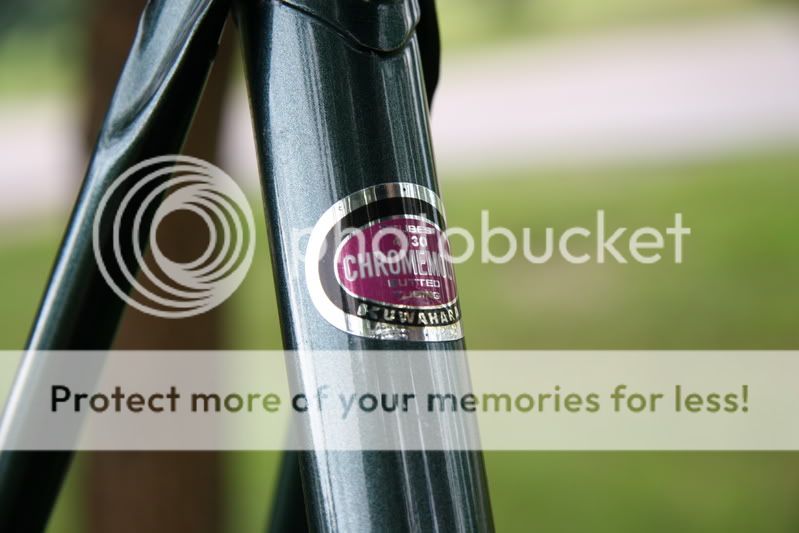
1. Is that the actual frame that you shot or did you crop it afterwards? Do you frequently crop photos?
2. Whats 1/60th translate to in ISO? how do you do that conversion?
08-27-09 | 09:52 AM
#28

Senior Member

Joined: May 2008
Posts: 10,106
Likes: 2,757
From: Fredericksburg, Va
Bikes: ? Proteous, '65 Frejus TDF, '73 Bottecchia Giro d'Italia, '83 Colnago Superissimo, '84 Trek 610, '84 Trek 760, '88 Pinarello Veneto, '88 De Rosa Pro, '89 Pinarello Montello, 'Litespeed Catalyst'94 Burley Duet, 97 Specialized RockHopper, 2010 Langster
I crop all the time! Rarely do I find a picture that does not improve with a crop. Often, I do several different ones. It really helps to have a high resolution picture for this operation.
A lot of my bike pics are cropped for my 24" wide screen on my computer. Because of this, I end up taking a picture further back due to the typical bicycle height to length ratio.
Like many said, play. With the advent of digital photography, you can do a lot a playing in very short time. My suggestion, if you are a novice, is to use the point and shoot on auto exposure and play with lighting and composition first. Once you feel comfortable, learn about depth of field and play with it.
Zoom or lens focal length variations are worth playing with too. It takes awhile to see the subtleties of the difference between a 85-100mm lens vs. a good 50mm Macro at 1:1 ratio. The perspective changes dramatically. Many good portrait pictures are taken with 85mm lens vs. the 50mm due to the change in the perspective of a person’s face. A fish eye lens, like an 18mm, will really distort the image by spreading it out like a circus mirror.
There are a lot of good basic photography books/articles out there. Read, learn and play.
A lot of my bike pics are cropped for my 24" wide screen on my computer. Because of this, I end up taking a picture further back due to the typical bicycle height to length ratio.
Like many said, play. With the advent of digital photography, you can do a lot a playing in very short time. My suggestion, if you are a novice, is to use the point and shoot on auto exposure and play with lighting and composition first. Once you feel comfortable, learn about depth of field and play with it.
Zoom or lens focal length variations are worth playing with too. It takes awhile to see the subtleties of the difference between a 85-100mm lens vs. a good 50mm Macro at 1:1 ratio. The perspective changes dramatically. Many good portrait pictures are taken with 85mm lens vs. the 50mm due to the change in the perspective of a person’s face. A fish eye lens, like an 18mm, will really distort the image by spreading it out like a circus mirror.
There are a lot of good basic photography books/articles out there. Read, learn and play.
08-27-09 | 10:30 AM
#29
Thread Starter
PanGalacticGargleBlaster
Joined: Apr 2009
Posts: 7,531
Likes: 9
From: Smugglers Notch, Vermont
Bikes: Upright and Recumbent....too many to list, mostly Vintage.
Since I've just got a little Canon Elph I can't make use of interchangeable lenses. I'm stuck with what I've got in that respect.
I read up on Depth of Field and F-Stop, makes much more sense now how to use that to my advantage when trying to photograph specific parts of the bike.
I saw the term "Aperture Priority" come up. I assume that means that the camera will adjust the Shutter Speed accordingly so that the Aperture setting takes priority is that correct? Whats the other settings aside from "Aperture Priority"
I'm in the habit of shooting lots and discarding most...I've got an 8 gig card in there so I can shoot like 1500 something pictures at full resolution. I haven't tried shooting RAW with this camera yet but I'm pretty sure the camera is capable of it so I'll play with that too. I've worked with RAW before but it was being shot with a Canon D-30...which was pretty f'in sweet as far as i was concerned. Even I could take pro lookin photos with that thing.
That Ray Dobbins guy has a pretty serious studio. Looks like he has a cyc wall to shoot those bikes on...a little out of reach for most of us...and his bikes are too nice
I read up on Depth of Field and F-Stop, makes much more sense now how to use that to my advantage when trying to photograph specific parts of the bike.
I saw the term "Aperture Priority" come up. I assume that means that the camera will adjust the Shutter Speed accordingly so that the Aperture setting takes priority is that correct? Whats the other settings aside from "Aperture Priority"
I'm in the habit of shooting lots and discarding most...I've got an 8 gig card in there so I can shoot like 1500 something pictures at full resolution. I haven't tried shooting RAW with this camera yet but I'm pretty sure the camera is capable of it so I'll play with that too. I've worked with RAW before but it was being shot with a Canon D-30...which was pretty f'in sweet as far as i was concerned. Even I could take pro lookin photos with that thing.
That Ray Dobbins guy has a pretty serious studio. Looks like he has a cyc wall to shoot those bikes on...a little out of reach for most of us...and his bikes are too nice
Last edited by Zaphod Beeblebrox; 08-27-09 at 10:40 AM.
08-27-09 | 10:57 AM
#30

Senior Member
Joined: Mar 2007
Posts: 2,465
Likes: 10
From: Saskatchewan
As a semi-pro I enjoy getting my pictures correct the first time. Adjustments after the fact if I screw it up. But I usually leave that to our photo-tech.
1/60th is the shutter speed. I probably shot that pic of the tubing label at 400ISO as it was an overcast day. Your lens will determine how open you can have the aperture. If its very overcast bump the ISO to 800 or higher. This way you can use a higher shutter speed. The new cameras have very little noise and I frequently use 800 or higher for extended shooting at night.
But you can also compensate for exposure. Lets say you have your bike parked up against the white garage door. The camera is going to underexpose (dark). Bump the exposure up 1/3 or 1/2 a stop.
Experiment above all and have fun.
08-27-09 | 11:02 AM
#31

Veni, Vidi, Bici
Joined: Jan 2008
Posts: 1,116
Likes: 10
Bikes: Colnagos (2005 Brera Art, 2007 President LdV, 2007 CF6)
It only looks that way. The white background paper is, as he told me, something one can get (or order if it's not in stock) at your local camera shop. I think I paid about $50 for a 9' wide roll. They come in various colors. Then mount it on a rod like Ray did and attach it to something like a shelving unit so you can roll it up when you're not using it. You'll also need lighting. Ray told me he used a couple of 500 watt work lamps (the kind on the tripod), which you can find at Home Depot for maybe $40 apiece. He also made a simple strut to keep the bike upright when taking pictures. That's basically it.
08-27-09 | 11:10 AM
#32
Senior Member
Joined: Mar 2007
Posts: 2,465
Likes: 10
From: Saskatchewan
Here is an example of extreme depth of field or lack thereof.
These are pics of a stylus (record needle for you youngsters), which is about 2mm long.
The depth of field with this particular Canon macro lens (on copy stand) is less than the stylus is long. At this magnification.
All I could focus was the very tip of the needle.

These are pics of a stylus (record needle for you youngsters), which is about 2mm long.
The depth of field with this particular Canon macro lens (on copy stand) is less than the stylus is long. At this magnification.
All I could focus was the very tip of the needle.
08-27-09 | 11:25 AM
#33

Senior Member
Joined: Aug 2009
Posts: 169
Likes: 0
From: Austin
Bikes: Trek ST-120; Jamis Satellite; Miyata Seven Ten
and when you are really good....you can do things like this... (and yes, this is an ACTUAL PHOTO, not a painting)

This is taken from the website, https://www.americanprideandpassion.com/
If you take the time to read, you will see how he does it...it's all with lights and timed exposure. Some refer to this technique as "painting with light"...pretty cool stuff.
This is taken from the website, https://www.americanprideandpassion.com/
If you take the time to read, you will see how he does it...it's all with lights and timed exposure. Some refer to this technique as "painting with light"...pretty cool stuff.
08-27-09 | 11:43 AM
#34
Senior Member
Joined: Mar 2007
Posts: 2,465
Likes: 10
From: Saskatchewan
and when you are really good....you can do things like this... (and yes, this is an ACTUAL PHOTO, not a painting)
This is taken from the website, https://www.americanprideandpassion.com/
If you take the time to read, you will see how he does it...it's all with lights and timed exposure. Some refer to this technique as "painting with light"...pretty cool stuff.
This is taken from the website, https://www.americanprideandpassion.com/
If you take the time to read, you will see how he does it...it's all with lights and timed exposure. Some refer to this technique as "painting with light"...pretty cool stuff.
 08-27-09 | 01:24 PM
#35

Senior Member
Joined: Mar 2008
Posts: 5,630
Likes: 18
From: Rhode Island (an obscure suburb of Connecticut)
Bikes: one of each
As I recall, back in the old days, ISO refered to the sensitivity of the film to light. You adjust your aperture/exposure combination to suite the film. Does anyone have the lowdown on how a digital camera does this?
Aperture priority is where you choose the aperture and the camera choses the exposure that works best. An old camera I have has Exposure Priority where you set the exposure and the camera choses the aperture. I haven't seen that in a while but I haven't looked very hard.
Depth of field is how much of the picture is in focus. A small depth of field will have the subject in focus and the forground and background fuzzy. A large depth of field will have the subject, the foreground and the background in focus.
The depth of field is determined by your aperture (f-stop). A large aperture lets lots of light in but narrows the depth of field. A small aperture needs a longer exposure but gets more things in focus. If you can still afford film, go play with a pinhole camera sometime (they have a very small aperture, long, long exposure but EVERYTHING will be in focus).
With new cameras you can choose the ISO to suite the aperture/exposure/depth of field you want. Back in the day, we had to change the film to change the ISO.
Aperture priority is where you choose the aperture and the camera choses the exposure that works best. An old camera I have has Exposure Priority where you set the exposure and the camera choses the aperture. I haven't seen that in a while but I haven't looked very hard.
Depth of field is how much of the picture is in focus. A small depth of field will have the subject in focus and the forground and background fuzzy. A large depth of field will have the subject, the foreground and the background in focus.
The depth of field is determined by your aperture (f-stop). A large aperture lets lots of light in but narrows the depth of field. A small aperture needs a longer exposure but gets more things in focus. If you can still afford film, go play with a pinhole camera sometime (they have a very small aperture, long, long exposure but EVERYTHING will be in focus).
With new cameras you can choose the ISO to suite the aperture/exposure/depth of field you want. Back in the day, we had to change the film to change the ISO.
08-27-09 | 01:24 PM
#36
Thread Starter
PanGalacticGargleBlaster
Joined: Apr 2009
Posts: 7,531
Likes: 9
From: Smugglers Notch, Vermont
Bikes: Upright and Recumbent....too many to list, mostly Vintage.
Can you clear up my misconceptions please?
The way I understand it, Shutter speed is simply how long the shutter stays open when you hit the button.
ISO I thought, was Film Speed, and I assume that in the Digital world, the setting causes the camera to mimic the properties of the film ISO you set it to.
I think I'm starting to understand it. Basically you want a low ISO to produce the finest quality images. A higher ISO will result in a grainier image, but it will work better in low light applications where lengthening the shutter speed would produce a not-so-sharp image.
F-stop controls the aperture and by extension the Depth of Field. a Higher F-stop will produce a larger depth of field meaning more things will appear in focus in the image.
am I at least close with these statements so far?
this article illuminated much for me https://www.slrphotographyguide.com/c...ings/iso.shtml as did the wikipedia articles on F-stop, Depth of Field and ISO
08-27-09 | 01:36 PM
#38
Member
Joined: Jun 2009
Posts: 34
Likes: 0
From: That London, that England
It only looks that way. The white background paper is, as he told me, something one can get (or order if it's not in stock) at your local camera shop. I think I paid about $50 for a 9' wide roll. They come in various colors. Then mount it on a rod like Ray did and attach it to something like a shelving unit so you can roll it up when you're not using it. You'll also need lighting. Ray told me he used a couple of 500 watt work lamps (the kind on the tripod), which you can find at Home Depot for maybe $40 apiece. He also made a simple strut to keep the bike upright when taking pictures. That's basically it.
https://www.raydobbins.com/photosetup.htm
He uses a $300, 4.0 megapixel Kodak compact camera.
Just goes to show what you can do with relatively modest resources and careful lighting
 08-27-09 | 03:12 PM
#39
Senior Member
Joined: Mar 2007
Posts: 2,465
Likes: 10
From: Saskatchewan
CravenMoarhead;9567783]Can you clear up my misconceptions please?
The way I understand it, Shutter speed is simply how long the shutter stays open when you hit the button.
Correct
ISO I thought, was Film Speed, and I assume that in the Digital world, the setting causes the camera to mimic the properties of the film ISO you set it to.
Correct but...
I think I'm starting to understand it. Basically you want a low ISO to produce the finest quality images. A higher ISO will result in a grainier image, but it will work better in low light applications where lengthening the shutter speed would produce a not-so-sharp image.
In the digital age the higher the ISO the more "noise" in the picture. That said I have shot at 3000 and higher with a Canon 50D and there was no noise worth commenting on. Of course this depends on the situation. If your shooting at night and using ambient light available and you need to raise your shutter speed (because its gusting 40) these options are available. Couldn't even think about this 1 decade ago.
However, I will use 100-200 in normal conditions.
F-stop controls the aperture and by extension the Depth of Field. a Higher F-stop will produce a larger depth of field meaning more things will appear in focus in the image.
Yes. But you need to increase your exposure as you tighten up the aperture. Without a flash of course. On the Canons I use I usually let the camera decide on the shutter speed while I decide what I want for depth of field.
am I at least close with these statements so far?
Yup
The way I understand it, Shutter speed is simply how long the shutter stays open when you hit the button.
Correct
ISO I thought, was Film Speed, and I assume that in the Digital world, the setting causes the camera to mimic the properties of the film ISO you set it to.
Correct but...
I think I'm starting to understand it. Basically you want a low ISO to produce the finest quality images. A higher ISO will result in a grainier image, but it will work better in low light applications where lengthening the shutter speed would produce a not-so-sharp image.
In the digital age the higher the ISO the more "noise" in the picture. That said I have shot at 3000 and higher with a Canon 50D and there was no noise worth commenting on. Of course this depends on the situation. If your shooting at night and using ambient light available and you need to raise your shutter speed (because its gusting 40) these options are available. Couldn't even think about this 1 decade ago.
However, I will use 100-200 in normal conditions.
F-stop controls the aperture and by extension the Depth of Field. a Higher F-stop will produce a larger depth of field meaning more things will appear in focus in the image.
Yes. But you need to increase your exposure as you tighten up the aperture. Without a flash of course. On the Canons I use I usually let the camera decide on the shutter speed while I decide what I want for depth of field.
am I at least close with these statements so far?
Yup
08-27-09 | 03:18 PM
#40
Thread Starter
PanGalacticGargleBlaster
Joined: Apr 2009
Posts: 7,531
Likes: 9
From: Smugglers Notch, Vermont
Bikes: Upright and Recumbent....too many to list, mostly Vintage.
F-stop controls the aperture and by extension the Depth of Field. a Higher F-stop will produce a larger depth of field meaning more things will appear in focus in the image.
Yes. But you need to increase your exposure as you tighten up the aperture. Without a flash of course. On the Canons I use I usually let the camera decide on the shutter speed while I decide what I want for depth of field.
Thanks for your expertise Ricohman, its really been a huge help to me....at least conceptually...lets see how I do this evening when the "Magic Hour" rolls around.

Thanks to everyone for all the help and links thus far. Call me Encyclopedia Brown...I'm reading it all!
08-27-09 | 03:29 PM
#41
Senior Member
Joined: Mar 2007
Posts: 2,465
Likes: 10
From: Saskatchewan
OK that makes perfect sense then. Is that what they refer to as "Aperture Priority"?
Thanks for your expertise Ricohman, its really been a huge help to me....at least conceptually...lets see how I do this evening when the "Magic Hour" rolls around.
Thanks to everyone for all the help and links thus far. Call me Encyclopedia Brown...I'm reading it all!
Thanks for your expertise Ricohman, its really been a huge help to me....at least conceptually...lets see how I do this evening when the "Magic Hour" rolls around.
Thanks to everyone for all the help and links thus far. Call me Encyclopedia Brown...I'm reading it all!
Yup, that last 30 minutes before the sun sets makes for some great lighting.
08-27-09 | 08:04 PM
#42

missing in action
Joined: Nov 2007
Posts: 4,483
Likes: 53
Experienced photogs might consider this a "shotgun" approach, but cameras with an auto bracketing function are great for experimenting with alternative exposures. I generally find that my camera takes the best pics with a 1/3 stop underexposed setting.
08-27-09 | 08:28 PM
#43
Thread Starter
PanGalacticGargleBlaster
Joined: Apr 2009
Posts: 7,531
Likes: 9
From: Smugglers Notch, Vermont
Bikes: Upright and Recumbent....too many to list, mostly Vintage.
My camera doesn't have the kinds of settings I had hoped it did. When I put it in Manual mode There's no F-stop setting, no RAW mode, and something called "Exposure Compensation" (which seems to work something like shutter speed) its measured in increments of + or - 1/3. It does have an option to manually set the white balance, which worked well.
Here's how I did
the rest are in this album and all in hi-res https://picasaweb.google.com/alario/S...eat=directlink
They're an improvement over what I usually produce, I'll say that much. Some of these seem a little underexposed, but the versions I took with the "Exposure Compensation" set to 0 were definitely overexposed.
What I really like is that its the first time I've been able to accurately capture the color of this bike.
I'm gonna see if I can improve it with GIMP any.
Thanks again for all the help, I can see improvement already
08-27-09 | 09:52 PM
#45
Senior Member
Joined: Mar 2007
Posts: 2,465
Likes: 10
From: Saskatchewan
Good job.
Exposure comp is just bumping the F stop up or down. Same thing as I described above with the white garage door.
You do not need to shoot in RAW. I shoot RAW images only when photographing latent fingerprints under a light source. Lots of agencies (police) used to shoot in RAW + reg format for all pictures but they are slowly moving away from this.
A digital SLR will have more functions than the basic point and shoot. Some are very reasonably priced.
Exposure comp is just bumping the F stop up or down. Same thing as I described above with the white garage door.
You do not need to shoot in RAW. I shoot RAW images only when photographing latent fingerprints under a light source. Lots of agencies (police) used to shoot in RAW + reg format for all pictures but they are slowly moving away from this.
A digital SLR will have more functions than the basic point and shoot. Some are very reasonably priced.
08-27-09 | 09:59 PM
#46
Thread Starter
PanGalacticGargleBlaster
Joined: Apr 2009
Posts: 7,531
Likes: 9
From: Smugglers Notch, Vermont
Bikes: Upright and Recumbent....too many to list, mostly Vintage.
Thank You
It's a repaint, I asked the local autobody shop to paint it "That color that you paint a Cream color Mini or BMW" They did a decent job. Its not clearcoated, I I just prefer the way it looks without it.
It was originally Copper Bronze, but there was barely any left of it when i got it.
Her's my attempt at touching it up in GIMP. I'm not sure whether or not its an improvement.

It's a repaint, I asked the local autobody shop to paint it "That color that you paint a Cream color Mini or BMW" They did a decent job. Its not clearcoated, I I just prefer the way it looks without it.
It was originally Copper Bronze, but there was barely any left of it when i got it.
Her's my attempt at touching it up in GIMP. I'm not sure whether or not its an improvement.
08-27-09 | 10:03 PM
#47

Senior Member
Joined: Sep 2007
Posts: 4,466
Likes: 24
From: Scottsdale, AZ
Bikes: many
Since I've just got a little Canon Elph I can't make use of interchangeable lenses. I'm stuck with what I've got in that respect.
I read up on Depth of Field and F-Stop, makes much more sense now how to use that to my advantage when trying to photograph specific parts of the bike.
I saw the term "Aperture Priority" come up. I assume that means that the camera will adjust the Shutter Speed accordingly so that the Aperture setting takes priority is that correct? Whats the other settings aside from "Aperture Priority"
I'm in the habit of shooting lots and discarding most...I've got an 8 gig card in there so I can shoot like 1500 something pictures at full resolution. I haven't tried shooting RAW with this camera yet but I'm pretty sure the camera is capable of it so I'll play with that too. I've worked with RAW before but it was being shot with a Canon D-30...which was pretty f'in sweet as far as i was concerned. Even I could take pro lookin photos with that thing.
That Ray Dobbins guy has a pretty serious studio. Looks like he has a cyc wall to shoot those bikes on...a little out of reach for most of us...and his bikes are too nice
I read up on Depth of Field and F-Stop, makes much more sense now how to use that to my advantage when trying to photograph specific parts of the bike.
I saw the term "Aperture Priority" come up. I assume that means that the camera will adjust the Shutter Speed accordingly so that the Aperture setting takes priority is that correct? Whats the other settings aside from "Aperture Priority"
I'm in the habit of shooting lots and discarding most...I've got an 8 gig card in there so I can shoot like 1500 something pictures at full resolution. I haven't tried shooting RAW with this camera yet but I'm pretty sure the camera is capable of it so I'll play with that too. I've worked with RAW before but it was being shot with a Canon D-30...which was pretty f'in sweet as far as i was concerned. Even I could take pro lookin photos with that thing.
That Ray Dobbins guy has a pretty serious studio. Looks like he has a cyc wall to shoot those bikes on...a little out of reach for most of us...and his bikes are too nice


 08-30-09 | 07:01 PM
#49

Senior Member
Joined: Jan 2008
Posts: 1,882
Likes: 187
From: SF Bay Area
Bikes: Peugeot, Motobecane, Joannou, Kona, Specialized, Ironhorse, Royal Scot, Dahon
