


1937 Miyata
 09-30-09 | 04:45 AM
#26


The fender emblem on the front is awesome, as are a couple of other small details!
From Wiki for what it's worth: "In the years since its inception, Miyata played an innovative role in the Japanese bicycle industry, and claims to have been the first Japanese producer of flash-butt welded frame tubes (1946) and the first to use electrostatic painting (1950). "
https://en.wikipedia.org/wiki/Miyata
I tend to think pacificaslim is onto the right idea, or at least closer to the year:
From Wiki for what it's worth: "In the years since its inception, Miyata played an innovative role in the Japanese bicycle industry, and claims to have been the first Japanese producer of flash-butt welded frame tubes (1946) and the first to use electrostatic painting (1950). "
https://en.wikipedia.org/wiki/Miyata
I tend to think pacificaslim is onto the right idea, or at least closer to the year:
This is the Japanese company Miyata, right? Were they selling a lot internationally in those days? If they were mainly domestic, I doubt they would use serial numbers using the western calendar years, especially in the 1930s when sentiment in Japan was very anti-west.
So.."937": 9 could be September and the 37 could be the year. In the Japanese calendar, the only 37 that could make sense would be Showa era year 37 and that is 1962.
Just a guess.
So.."937": 9 could be September and the 37 could be the year. In the Japanese calendar, the only 37 that could make sense would be Showa era year 37 and that is 1962.
Just a guess.
Last edited by YoKev; 09-30-09 at 04:51 AM.
 09-30-09 | 05:24 AM
#27
.


Joined: Aug 2005
Posts: 12,769
Likes: 38
From: Rocket City, No'ala
Bikes: 2014 Trek Domane 5.2, 1985 Pinarello Treviso, 1990 Gardin Shred, 2006 Bianchi San Jose
 09-30-09 | 05:49 AM
#28
Anything stamped on the underside of the bottom bracket?
__________________
1989 Schwinn Paramount OS
1980 Mclean/Silk Hope Sport Touring
1983 Bianchi pista
1976 Fuji Feather track
1979 raleigh track
"I've consulted my sources and I'm pretty sure your derailleur does not exist"
1989 Schwinn Paramount OS
1980 Mclean/Silk Hope Sport Touring
1983 Bianchi pista
1976 Fuji Feather track
1979 raleigh track
"I've consulted my sources and I'm pretty sure your derailleur does not exist"
09-30-09 | 07:21 AM
#30

Senior Member
Joined: Sep 2008
Posts: 790
Likes: 0
From: Plano, TX
Bikes: 1968 Falcon San Remo 1973 Raleigh International, 1974 Schwinn Suburban, 1987 Schwinn High Sierra, 1992 Univega Ultraleggera, 2007 Dahon Vitesse DH7G
I had a Myata very much like this one, but in Yellow, when I lived in Japan in the 90's. I bought it used at a flea market, and the guy who sold it to me couldn't tell me how old it was, mostly becasue we couldn't communicate. It was heavy on those hills.
09-30-09 | 08:01 AM
#31

PanGalacticGargleBlaster
Joined: Apr 2009
Posts: 7,531
Likes: 9
From: Smugglers Notch, Vermont
Bikes: Upright and Recumbent....too many to list, mostly Vintage.
09-30-09 | 09:16 AM
#33
Thread Starter
Member
Joined: Sep 2009
Posts: 37
Likes: 0
I sent an email to Herman Burgos who has the web site on Miyata catalogs, the following is what he wrote back, I've sence sent him pictures. If he is correct, maybe the serial number will tell the story.
Dear Dave:
I do not have records for your 1937 Miyata Bicycle , but it will be a good idea to have the picture to see it. At this time Miyata used to have the date on the serial number R 937(year), now the first letter is the year.
Regards,
Hernan P.Burgos
Kevinsubaru, I think the fender ornament is cool too, the entire bike has a very 'antique' flavor. I'm not saying that the ones who think it is newer are wrong, it certainly could be and all the comments about it being a 60's or 70's bike certainly have merrit. I do believe that if it is a 60's or 70's bike, it was one of those bikes that was in production for a long time and carried a lot of the pre-war style with it. I'm just hoping to find out what it really is. Thanks, Dave
Dear Dave:
I do not have records for your 1937 Miyata Bicycle , but it will be a good idea to have the picture to see it. At this time Miyata used to have the date on the serial number R 937(year), now the first letter is the year.
Regards,
Hernan P.Burgos
Kevinsubaru, I think the fender ornament is cool too, the entire bike has a very 'antique' flavor. I'm not saying that the ones who think it is newer are wrong, it certainly could be and all the comments about it being a 60's or 70's bike certainly have merrit. I do believe that if it is a 60's or 70's bike, it was one of those bikes that was in production for a long time and carried a lot of the pre-war style with it. I'm just hoping to find out what it really is. Thanks, Dave
09-30-09 | 09:17 AM
#34

Senior Member
Joined: Mar 2008
Posts: 5,630
Likes: 18
From: Rhode Island (an obscure suburb of Connecticut)
Bikes: one of each
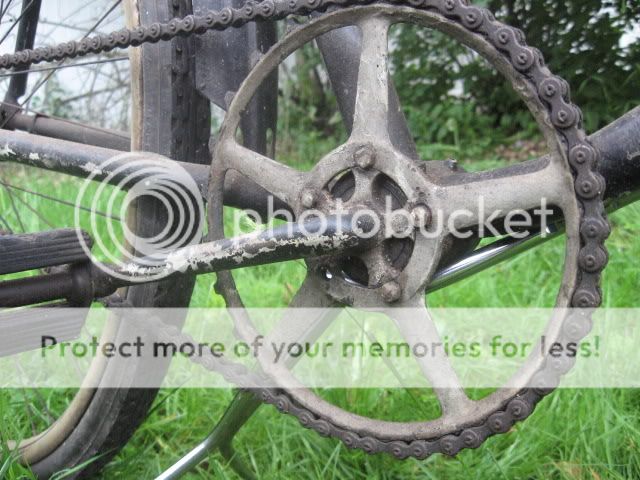
"Skip tooth" chains use a "1" pitch" instead of the "1/2" pitch" that we're usd to seeing. It has one long link and one short link in the chain and the chainrings look like they're missing every other tooth.
It was common on prewar american bikes but it's use faded out a lot earlier in europe, at least partially because it doesn't work with derraillers.
It was common on prewar american bikes but it's use faded out a lot earlier in europe, at least partially because it doesn't work with derraillers.
 09-30-09 | 10:38 AM
#39
Thread Starter
Member
Joined: Sep 2009
Posts: 37
Likes: 0
dityres wrote: I don't care how old it is...
I think I'm in love
I think I'm in love
T-Mar, I appreciate you looking it up for me, I understand you are very knowledgeable on vintage bikes and that puts you lightyears ahead of me.
09-30-09 | 11:12 AM
#40

You gonna eat that?
Joined: Sep 2008
Posts: 14,917
Likes: 543
From: Fort Worth, Texas Church of Hopeful Uncertainty
Bikes: 1966 Raleigh DL-1 Tourist, 1973 Schwinn Varsity, 1983 Raleigh Marathon, 1994 Nishiki Sport XRS
My Raleigh with a 12/65 rear hub date and ambiguous serial number came with reflectors. They may not have been original, but they are clearly old. They show up in the 1970 Raleigh catalog, but they may have been routinely installed prior to that.
__________________
I stop for people / whose right of way I honor / but not for no one.
 Originally Posted by bragi
  "However, it's never a good idea to overgeneralize."
I stop for people / whose right of way I honor / but not for no one.
Originally Posted by bragi "However, it's never a good idea to overgeneralize."
09-30-09 | 11:23 AM
#41

multimodal commuter
Joined: Nov 2006
Posts: 19,810
Likes: 597
From: NJ, NYC, LI
Bikes: 1940s Fothergill, 1959 Allegro Special, 1963? Claud Butler Olympic Sprint, Lambert 'Clubman', 1974 Fuji "the Ace", 1976 Holdsworth 650b conversion rando bike, 1983 Trek 720 tourer, 1984 Counterpoint Opus II, 1993 Basso Gap, 2010 Downtube 8h, and...
Nice photo. Cool crank.
Certainly a skip-tooth crank etc would be consistent with a 1937 date on an American bike; but a normal 1/2" chain is also common on American bikes of that period. More to the point: what were Japanese chains like at that period? I don't know, but I'd guess they were the same as English ones, typically 1/2".
I agree with those who say the bike just doesn't look that old. It's too clean, the paint is too even; the paint on such an old bike will have faded in some places, remaining dark in others; dirt will have accumulated in the nooks and crannies; and so on. Of course it's possible for a bike to have been in storage the whole time and not got that kind of aging; but the odds are against it. And the plastic thingie on the right crank arm is definitely not that old.
Certainly a skip-tooth crank etc would be consistent with a 1937 date on an American bike; but a normal 1/2" chain is also common on American bikes of that period. More to the point: what were Japanese chains like at that period? I don't know, but I'd guess they were the same as English ones, typically 1/2".
I agree with those who say the bike just doesn't look that old. It's too clean, the paint is too even; the paint on such an old bike will have faded in some places, remaining dark in others; dirt will have accumulated in the nooks and crannies; and so on. Of course it's possible for a bike to have been in storage the whole time and not got that kind of aging; but the odds are against it. And the plastic thingie on the right crank arm is definitely not that old.
09-30-09 | 11:29 AM
#42
Thread Starter
Member
Joined: Sep 2009
Posts: 37
Likes: 0
On the googled picture, I just posted what came up and looked like my model, I was more curious as to the type of seat it had since I know that my seat is wrong. If these are mid-60 models, then I suppose the reflectors could be correct, mine didn't have them and I guess they could have been added too.
I have no idea, but I would guess that Miyata probably had a 'if it's not broke, don't fix it' attitude in their bicycle manufacturing, especially after the war. If it is a 60's model, I'm thinking it's a model that Miyata produced for many years and just didn't change all the tooling. That would account for some obviously old patterns and styles combined with some newer materials. But I'm guessing.
Dave
I have no idea, but I would guess that Miyata probably had a 'if it's not broke, don't fix it' attitude in their bicycle manufacturing, especially after the war. If it is a 60's model, I'm thinking it's a model that Miyata produced for many years and just didn't change all the tooling. That would account for some obviously old patterns and styles combined with some newer materials. But I'm guessing.
Dave
 09-30-09 | 11:50 AM
#44
Thread Starter
Member
Joined: Sep 2009
Posts: 37
Likes: 0
rhm wrote: I agree with those who say the bike just doesn't look that old. It's too clean, the paint is too even; the paint on such an old bike will have faded in some places, remaining dark in others; dirt will have accumulated in the nooks and crannies; and so on. Of course it's possible for a bike to have been in storage the whole time and not got that kind of aging; but the odds are against it. And the plastic thingie on the right crank arm is definitely not that old.
09-30-09 | 11:50 AM
#45

GO BIG RED
Joined: Nov 2008
Posts: 678
Likes: 3
From: Hastings,NE
Bikes: 1996 Bianchi Veloce 1993 Bridgestone MB-3 1992 Trek 700 1992 Trek 820
On the googled picture, I just posted what came up and looked like my model, I was more curious as to the type of seat it had since I know that my seat is wrong. If these are mid-60 models, then I suppose the reflectors could be correct, mine didn't have them and I guess they could have been added too.
I have no idea, but I would guess that Miyata probably had a 'if it's not broke, don't fix it' attitude in their bicycle manufacturing, especially after the war. If it is a 60's model, I'm thinking it's a model that Miyata produced for many years and just didn't change all the tooling. That would account for some obviously old patterns and styles combined with some newer materials. But I'm guessing.
Dave
I have no idea, but I would guess that Miyata probably had a 'if it's not broke, don't fix it' attitude in their bicycle manufacturing, especially after the war. If it is a 60's model, I'm thinking it's a model that Miyata produced for many years and just didn't change all the tooling. That would account for some obviously old patterns and styles combined with some newer materials. But I'm guessing.
Dave
'60's or '70's vintage seems about right for your bike.
09-30-09 | 12:02 PM
#46
Thread Starter
Member
Joined: Sep 2009
Posts: 37
Likes: 0
XR2 wrote: Regardless of vintage it's a very cool bike.I likey.
09-30-09 | 12:07 PM
#47
Thread Starter
Member
Joined: Sep 2009
Posts: 37
Likes: 0
Norwood wrote: You should remember this is a bike made for the domestic Asian market. It's transportation, a means of getting around, likely the only means in most cases. Bicycles were necessities not recreational "toys" as we Americans now tend to think of them. As such the bike may very well be a pre-war design. Truely a "if it ain't broke don't fix it" attitude on Miyata's part.
'60's or '70's vintage seems about right for your bike.
'60's or '70's vintage seems about right for your bike.
I'm still hopeful that someone can brake down the serial number.
Dave
09-30-09 | 02:03 PM
#48
Surf Bum
Joined: Aug 2008
Posts: 2,184
Likes: 5
From: Pacifica, CA
Bikes: Lapierre Pulsium 500 FdJ, Ritchey breakaway cyclocross, vintage trek mtb.
Well, Hernan P.Burgos above said, "At this time Miyata used to have the date on the serial number R 937(year), now the first letter is the year."
"93" can't be a year so it'd be a strong guess that "9" is the month. Then we have "37" for the year: You just have to find out if Miyata was using the evil western calendar in 1937, an era of very strong Japanese nationalism and imperialism, or if they were using the Japanese calendar (in which case "37" means Showa 37 which was 1962).
"93" can't be a year so it'd be a strong guess that "9" is the month. Then we have "37" for the year: You just have to find out if Miyata was using the evil western calendar in 1937, an era of very strong Japanese nationalism and imperialism, or if they were using the Japanese calendar (in which case "37" means Showa 37 which was 1962).
09-30-09 | 02:25 PM
#49
PanGalacticGargleBlaster
Joined: Apr 2009
Posts: 7,531
Likes: 9
From: Smugglers Notch, Vermont
Bikes: Upright and Recumbent....too many to list, mostly Vintage.
yes but if they were using the showa year "37" that means it was actually 1962....not 1937 when the Japanese nationalism was so strong. Was Japanese nationalism still as strong (strong enough to use Showa years on their Ser. Numbers) in 1962 as it was in 1937?
09-30-09 | 03:10 PM
#50
Thread Starter
Member
Joined: Sep 2009
Posts: 37
Likes: 0
Bbattle wrote: The bike is a Miyata Mister Cycle.
CravenMoarhead wrote: yes but if they were using the showa year "37" that means it was actually 1962....not 1937 when the Japanese nationalism was so strong. Was Japanese nationalism still as strong (strong enough to use Showa years on their Ser. Numbers) in 1962 as it was in 1937?