


Mavic Module 4...
 03-20-10 | 09:30 AM
#1

Thread Starter
Senior Member


Joined: Apr 2007
Posts: 12,565
Likes: 2,739
From: Thunder Bay, Ontario, Canada - burrrrr!
Bikes: 1958 Rabeneick 120D, 1968 Legnano Gran Premio, 196? Torpado Professional, 2000 Marinoni Piuma
Mavic Module 4...
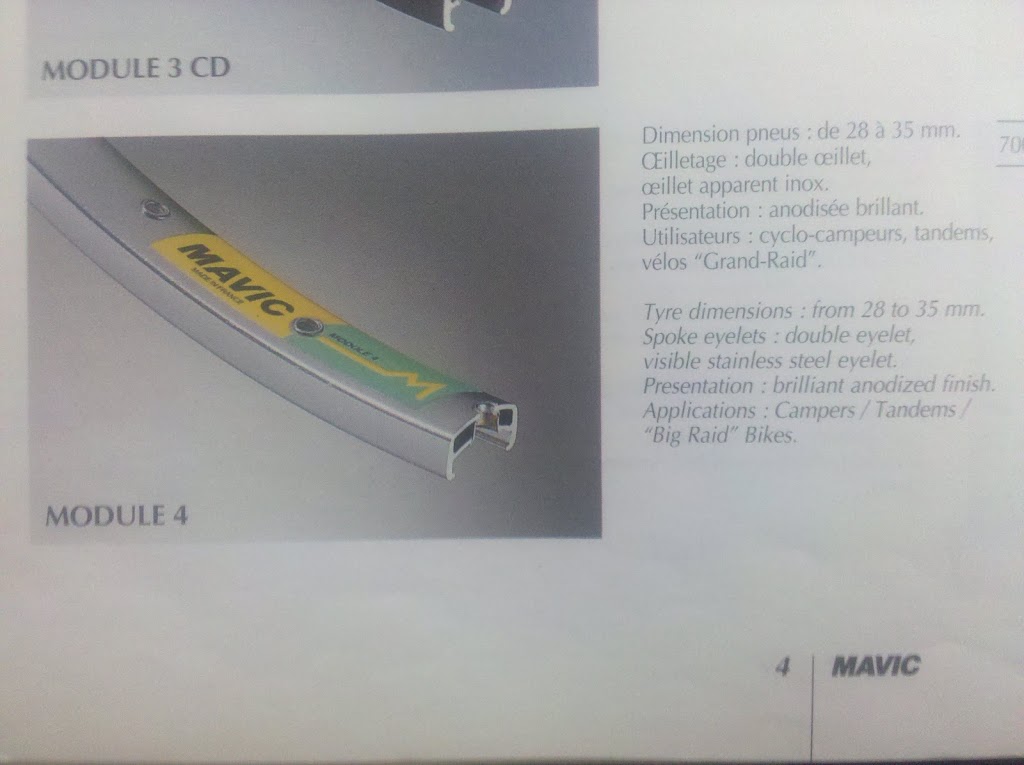
I picked up a pair of NOS Mavic Module 4 clincher rims today. They sport minor shelf wear and 36 holes with eyelets. Does anyone know what these rims are best suited or targeted for?
Also, if anyone knows, what width tires are best for these rims?
Also, if anyone knows, what width tires are best for these rims?



 03-20-10 | 02:22 PM
#4
Thread Starter
Senior Member
Joined: Apr 2007
Posts: 12,565
Likes: 2,739
From: Thunder Bay, Ontario, Canada - burrrrr!
Bikes: 1958 Rabeneick 120D, 1968 Legnano Gran Premio, 196? Torpado Professional, 2000 Marinoni Piuma
Thanks for the information. The ones I managed to find have the older Mavic label. I thought they they might be for the more demanding tasks presented to the road bicycle.


 12-10-23 | 07:32 PM
#9

spondylitis.org

Joined: Mar 2013
Posts: 1,053
Likes: 128
From: Fleetwood, PA, USA
Bikes: '84 Colnago Super; '90 Bridgestone MB-1; '81 Trek 930; '01 Cinelli Supercorsa; '62 Ideor Asso; '87 Tommasini Super Prestige; '13 Lynskey R2300; '84 Serotta Nova Special; '94 Litespeed Catalyst; etc.
Mavic rims can be converted to tubeless operation with very few issues. And because these rims are for 36 spokes, the wheels they build into will true easily and go out of true reluctantly.
Note to Randy - you should be able to run a lot of different clincher setups on these if they're 700C. And if you want to jump into tubeless, a Stan's conversion kit should get you in business pretty quickly. Just make sure the tires are TLR-rated and have the special Aramid beads.
12-10-23 | 11:25 PM
#10

Ride, Wrench, Swap, Race
Joined: Jan 2010
Posts: 9,813
Likes: 1,790
From: Northern California
Bikes: Cheltenham-Pedersen racer, Boulder F/S Paris-Roubaix, Varsity racer, '52 Christophe, '62 Continental, '92 Merckx, '75 Limongi, '76 Presto, '72 Gitane SC, '71 Schwinn SS, etc.
While there are a lot of wide clincher rims available today, these stand out together with current Pacenti Brevit rims as having a shiny finish and shape profile that mimics traditional tubular rims. The Mod4 rim's 25mm external width was among the widest touring rims, perhaps wider than any other brand's double-walled touring rims (before Sun Rhynolite rims were later released).
The Mod4 rims are crazy strong, but with their staggered spoke eyelets they do not get as much in the way of spoke bracing support, compared to rims having their spoke holes all in a straight line.
One result of this is that there may be brake pad rub, which is made worse by the rim's extreme rigidity (which mirrors any lateral displacements about the loaded contact patch 180-degrees up to the brake pads).
I replaced similarly-wide aluminum single-walled rims with these Mod4 rims, and was quite surprised by the above tendencies.
A solution for the above lies in the use of wider axle widths and flange spacing, and the use of narrower freewheels to limit wheel dish. So on wide-spaced tandem rear hubs (having a "traditional" numbers of cogs concurrent with these rim's 1970's introduction), the mirrored flex up to the brake pads would not be noticeable.
The Mod4 shape profile was also used in a 26" (M261) rim variant that was seemingly the preferred choice for the nacent sport of downhill MTB racing.
Mavic over some short period of years went on to produce even wider versions as well, the M5, M6, and M7 Rondo rims were based on the same profile shape but their external widths ran from 27mm to 32mm. Some of these may have been only available in 26" however.
I believe these were by far the widest double-walled rims made as of around the late 1980's or so, presenting a stunning appearance.
Mod4 rims can be 36, 40 or 48-hole, and were replaced by the taller-profiled A719 rims which had similar inside width but a slightly narrower machined outside width. The A719 kept the spoke holes in a straight line for better spoke bracing on modern, more heavily-dished wheel builds having wider stacks of cogs.
Prior to wide rims having been considered desirable for road bikes, I would inquire with all of the rim vendors at Interbike year after year, and the vendor's response to my inquiry about wider "road" rims was often met with a look of "are you crazy" (wider rims being seen as heavier and less-aero, and of little benefit to a 23mm tire).
I recall REAL as one maker who around 2003 touted their newly-widened rims (of at most 15mm internal width) and who seemed to take me seriously (I have their shiny rims on my Litespeed Siena).
I kept an eye out for many years looking for more Mod4 rims to build with, my current inventory including four built sets, one set being 27" and two being 700c on cassette hubsets. A final set is built onto a flashy pair of solid-hi-flange Specialized tandem freewheel-style hubs to which I retrofitted hollow axles, 126mm in the rear (lives on my Trek 720 limo).
The Mod4 rims are crazy strong, but with their staggered spoke eyelets they do not get as much in the way of spoke bracing support, compared to rims having their spoke holes all in a straight line.
One result of this is that there may be brake pad rub, which is made worse by the rim's extreme rigidity (which mirrors any lateral displacements about the loaded contact patch 180-degrees up to the brake pads).
I replaced similarly-wide aluminum single-walled rims with these Mod4 rims, and was quite surprised by the above tendencies.
A solution for the above lies in the use of wider axle widths and flange spacing, and the use of narrower freewheels to limit wheel dish. So on wide-spaced tandem rear hubs (having a "traditional" numbers of cogs concurrent with these rim's 1970's introduction), the mirrored flex up to the brake pads would not be noticeable.
The Mod4 shape profile was also used in a 26" (M261) rim variant that was seemingly the preferred choice for the nacent sport of downhill MTB racing.
Mavic over some short period of years went on to produce even wider versions as well, the M5, M6, and M7 Rondo rims were based on the same profile shape but their external widths ran from 27mm to 32mm. Some of these may have been only available in 26" however.
I believe these were by far the widest double-walled rims made as of around the late 1980's or so, presenting a stunning appearance.
Mod4 rims can be 36, 40 or 48-hole, and were replaced by the taller-profiled A719 rims which had similar inside width but a slightly narrower machined outside width. The A719 kept the spoke holes in a straight line for better spoke bracing on modern, more heavily-dished wheel builds having wider stacks of cogs.
Prior to wide rims having been considered desirable for road bikes, I would inquire with all of the rim vendors at Interbike year after year, and the vendor's response to my inquiry about wider "road" rims was often met with a look of "are you crazy" (wider rims being seen as heavier and less-aero, and of little benefit to a 23mm tire).
I recall REAL as one maker who around 2003 touted their newly-widened rims (of at most 15mm internal width) and who seemed to take me seriously (I have their shiny rims on my Litespeed Siena).
I kept an eye out for many years looking for more Mod4 rims to build with, my current inventory including four built sets, one set being 27" and two being 700c on cassette hubsets. A final set is built onto a flashy pair of solid-hi-flange Specialized tandem freewheel-style hubs to which I retrofitted hollow axles, 126mm in the rear (lives on my Trek 720 limo).
Last edited by dddd; 12-11-23 at 07:27 PM. Reason: 32mm not 132mm!
12-11-23 | 07:24 PM
#13
Ride, Wrench, Swap, Race
Joined: Jan 2010
Posts: 9,813
Likes: 1,790
From: Northern California
Bikes: Cheltenham-Pedersen racer, Boulder F/S Paris-Roubaix, Varsity racer, '52 Christophe, '62 Continental, '92 Merckx, '75 Limongi, '76 Presto, '72 Gitane SC, '71 Schwinn SS, etc.
Same Maxtal alloy, welded joint, eyelets, taller modern shape and machined sidewalls, and at about the same 440g or so weight.
I raced Cyclocross on the above two rims for 20 years, running 28h in front and 32h in back. I had to somewhat regularly straighten or replace the rear rim, but the front wheel went the distance until the spokes suddenly started breaking from fatigue (roughly one broken spoke per outing).
I moved on to stronger Cane-Creek wheels and from then to this day, to wide, tubeless Ksyrium-based Mavic Allroad Elite wheels
Mavic's early Helium wheels used the same Reflex-style rim shape at lower spoke counts in their first effort at marketing pre-built wheels.
The Ksyrium wheels that followed went into very different territory, though the budget Ksyrium Equippe used the same rim style as the Reflex and Open Pro.
It's hard to believe that Mavic let their market slip away, allowing newcomers to out-innovate them with bold offerings, especially carbon rims.

