


Optimal tire size
 05-23-10 | 06:15 PM
#1

Thread Starter
What??? Only 2 wheels?


Joined: Apr 2010
Posts: 13,501
Likes: 995
From: Boston-ish, MA
Bikes: 72 Peugeot UO-8, 82 Peugeot TH8, 87 Bianchi Brava, 76? Masi Grand Criterium, 74 Motobecane Champion Team, 86 & 77 Gazelle champion mondial, 81? Grandis, 82? Tommasini, 83 Peugeot PF10
Optimal tire size
I posted a query to Framebuilders about the effect of small changes in wheel diameter on handling. The starting point was that fork rake doesn't scale with wheel size, so going to a smaller wheel (27" to 700c) produces a relatively larger reduction in trail. This was all prompted by an observation that on my '73 Gran Sport a switch from Pasela TG 28mm to Pasela TG 25mm tires seems to have made the bike more sensitive and less stable. But am digressing.
The reason for this thread is that someone posted a reply saying:
He also said that bike of this vintage would have been optimized for 1-1/4" or 1-1/8". I can believe that. I can believe the comfortable, longer-lasting part. I'm not sure about cornering. But the faster part is surely not the common opinion. An ex-racer, ex-bike mechanic friend has told me firmly that narrower, higher-pressure is the lower-effort way to go. And I've been told here in FG that 25mm was the sweet spot for these roads. I just finished a 9 mile run around town on 25mm tires pumped to 115lbs. I do believe they roll easier, but then I never had the 28s pumped up like that.
I'm curious about opinions here in C&V.
The reason for this thread is that someone posted a reply saying:
Going to a narrower, higher-pressure tire isn't necessary (or always desirable) for better performance. Given two tires OF EQUAL QUALITY AND SIMILAR DESIGN, the wider, lower-pressure tire will actually be faster in most real-world situations (chipseal, rough roads, etc), as well as being more comfortable, longer-lasting and better-cornering.
I'm curious about opinions here in C&V.
__________________
Real cyclists use toe clips.
With great bikes comes great responsibility.
jimmuller
Real cyclists use toe clips.
With great bikes comes great responsibility.
jimmuller
 05-23-10 | 07:36 PM
#2

Señor Member


Joined: Oct 2004
Posts: 18,481
Likes: 1,565
From: Hardy, VA
Bikes: Mostly English - predominantly Raleighs
You've opened quite the can of worms here. Some people swear by skinnier tires with high pressure because they show lower rolling resistance on the rollers that have traditionally been used to measure it. The catch is, unless you're riding on a perfectly smooth surface, those tires aren't optimal. Handling is another matter altogether, but larger tires tend to make steering more stable.
I can offer anecdotal evidence that moderately, or slightly wider tires (25 - 32mm) roll marvelously when optimally inflated. I've run regular Pasela's in 32 (85 and 90 psi), and grand Bois in 26's (95 and 100 psi), and they give away nothing in terms of rolling resistance to skinnier tires I've run that are run at higher pressure. Given what you're saying, I suggest finding a size that gives you handling you like, and then finding a good tire with supple casings and a fast compound on the contact surface in that size.
I can offer anecdotal evidence that moderately, or slightly wider tires (25 - 32mm) roll marvelously when optimally inflated. I've run regular Pasela's in 32 (85 and 90 psi), and grand Bois in 26's (95 and 100 psi), and they give away nothing in terms of rolling resistance to skinnier tires I've run that are run at higher pressure. Given what you're saying, I suggest finding a size that gives you handling you like, and then finding a good tire with supple casings and a fast compound on the contact surface in that size.
__________________
In search of what to search for.
In search of what to search for.
05-23-10 | 07:39 PM
#3

Senior Member
Joined: Sep 2009
Posts: 2,067
Likes: 73
From: USA
Bikes: 84 Pinarello Trevisio, 86 Guerciotti SLX, 96 Specialized Stumpjumper, 2010 Surly Cross Check, 88 Centurion Prestige, 73 Raleigh Sports, GT Force, Bridgestone MB4
Have you ever done a coasting test. I have. Same day, same bike, averaged over and over, the narrow 23mm high pressure tires roll further than the same tire in a 25 and any tire I had in a 28. Reducing pressure on a given tire also reduced coasting distance.
05-23-10 | 07:42 PM
#4
Senior Member
Joined: Mar 2008
Posts: 1,683
Likes: 13
From: Kansai
I ride several miles of unpaved, gravel bike path on almost a daily basis. Some of this, I definitely ride faster on the wider, softer tires for two reasons. First, the high pressure tires start shaking the bejeezus out of me and the bike which is both uncomfortable and also makes me feel like I'm beating up the equipment for no good purpose. The second is that on this type of surface, I feel that I'm possibly losing control of the situation at a lower speed on HP tires than I do with LP tires.
However, on smooth pavement, skinny high pressure tires win hands down with me.
However, on smooth pavement, skinny high pressure tires win hands down with me.
05-23-10 | 07:45 PM
#5
Señor Member
Joined: Oct 2004
Posts: 18,481
Likes: 1,565
From: Hardy, VA
Bikes: Mostly English - predominantly Raleighs
My bike with the Grand Bois 26's absolutely kills anything I've been on club rides with when it comes to a coasting contest. Granted, it's partly the hubs, and partly the weight, but I outcoast big boys on Dura Ace hubs with skinny tires - what would you conclude?
__________________
In search of what to search for.
In search of what to search for.
05-23-10 | 08:31 PM
#6
Senior Member

Joined: Dec 2005
Posts: 18,822
Likes: 11,673
You can read Bicycle Quarterly's take on the subject here:
https://www.vintagebicyclepress.com/i...64TireTest.pdf
Fwiw, the key is good tires, whether skinny or wide. As USAZ points out, the Grand Bois tires are like riding on fast clouds, and I push the 30mm version around. But my favorite ride currently is on my 584mm x 41mm Hetre tires on my Ebisu, pumped to 50 psi.
Neal
https://www.vintagebicyclepress.com/i...64TireTest.pdf
Fwiw, the key is good tires, whether skinny or wide. As USAZ points out, the Grand Bois tires are like riding on fast clouds, and I push the 30mm version around. But my favorite ride currently is on my 584mm x 41mm Hetre tires on my Ebisu, pumped to 50 psi.
Neal
 05-23-10 | 08:40 PM
#7


This is a subject that's been done to death in many contexts, and the problem is that people providing the “evidence” or doing the testing all seem to have a preconceived notion of what the answer should be, based on their “gut.” In my humble opinion, of course. I've read a lot of this stuff, and that's how it looks to me -- a question of religious belief. I believe in religious tolerance, so I'm happy to let people believe whatever is going to get them through the day. And I won't even trouble you with my own beliefs on this matter.
What I believe is not a matter of religious belief is: that skinny tires at high pressure obviously make a lot of people feel like they're going faster; and that wider tires smooth out what the road surface dishes out -- I don't think that anyone will disagree about those statements. So everyone chooses their tires based on marketing hype, where their head is at regarding self-image and the necessity of comfort; and the rest is rationalization, unfortunately.
What I believe is not a matter of religious belief is: that skinny tires at high pressure obviously make a lot of people feel like they're going faster; and that wider tires smooth out what the road surface dishes out -- I don't think that anyone will disagree about those statements. So everyone chooses their tires based on marketing hype, where their head is at regarding self-image and the necessity of comfort; and the rest is rationalization, unfortunately.
Last edited by Charles Wahl; 05-24-10 at 05:55 AM.
05-23-10 | 08:41 PM
#8

Bicycle Repair Man !!!
Joined: Sep 2007
Posts: 27,266
Likes: 152
From: YEG
Bikes: See my sig...
On my road bike I roll around on 630:32 tyres that roll out just about as nicely as my 630:20 racing tyres and make better time because the stuff I have to dodge when I am running the skinnies is stuff I can blow through at speed on the 32's and descending and handling at speed is great.
Have some 630:25 Panaracers coming to me that I expect to be just a little faster and still won't sacrifice much ride quality... I also roll on custom cartridge bearing hubs so figure I will win just about any coasting contest and a lot of this is also reliant on personal aerodynamics.
When it comes to commuting and utilitarian riding I like a wider higher volume tyre with a good roll out as again... being able to blow through perils at speed without worrying about pinch flats and rim damage will help you make better time.
Have some 630:25 Panaracers coming to me that I expect to be just a little faster and still won't sacrifice much ride quality... I also roll on custom cartridge bearing hubs so figure I will win just about any coasting contest and a lot of this is also reliant on personal aerodynamics.
When it comes to commuting and utilitarian riding I like a wider higher volume tyre with a good roll out as again... being able to blow through perils at speed without worrying about pinch flats and rim damage will help you make better time.
05-23-10 | 08:51 PM
#10
Banned.
Joined: Dec 2007
Posts: 27,199
Likes: 1,463
I've experimented, as I'm way too ADD to read up on it. Just my opinion, but:
700x18's and 700x20's tend to ride hard, and let's say my criterium attempt with them was not a fun thing.
27 to 700c conversions may change the handling, but you're dealing with the sum of three changes (size, tires, wheels). All are appreciably better quality than the average 27. For example, going from Rigida 27 steel on Maillard hubs/old Conti tires to 700c alloys on Shimano hubs and Michelin Citi tires was a nice change, but changing back to new Alex 27's with Gatorskins was a big step up from that.
I've learned from mrmw and miamijim how wheelsets make a big difference, and it's the combination of size, wheelset, tires that seems to be the improvement. I doubt I could make a less general statement than that.
700x18's and 700x20's tend to ride hard, and let's say my criterium attempt with them was not a fun thing.
27 to 700c conversions may change the handling, but you're dealing with the sum of three changes (size, tires, wheels). All are appreciably better quality than the average 27. For example, going from Rigida 27 steel on Maillard hubs/old Conti tires to 700c alloys on Shimano hubs and Michelin Citi tires was a nice change, but changing back to new Alex 27's with Gatorskins was a big step up from that.
I've learned from mrmw and miamijim how wheelsets make a big difference, and it's the combination of size, wheelset, tires that seems to be the improvement. I doubt I could make a less general statement than that.
05-23-10 | 08:59 PM
#11
Senior Member
Joined: Sep 2009
Posts: 2,067
Likes: 73
From: USA
Bikes: 84 Pinarello Trevisio, 86 Guerciotti SLX, 96 Specialized Stumpjumper, 2010 Surly Cross Check, 88 Centurion Prestige, 73 Raleigh Sports, GT Force, Bridgestone MB4
You did not read what I said, I performed the test on the same bike and wheels as much as possible, the only difference was the tires/tubes/pressure. Read before you jump----.
05-24-10 | 05:58 AM
#13
Thread Starter
What??? Only 2 wheels?
Joined: Apr 2010
Posts: 13,501
Likes: 995
From: Boston-ish, MA
Bikes: 72 Peugeot UO-8, 82 Peugeot TH8, 87 Bianchi Brava, 76? Masi Grand Criterium, 74 Motobecane Champion Team, 86 & 77 Gazelle champion mondial, 81? Grandis, 82? Tommasini, 83 Peugeot PF10
Now boys, play nice.
Interesting discussion. Of course I figured it would be a can of worms. Though it may have been discussed many times before, I wasn't here to read it then.
I did take a few ideas from all this. Some things would seem to be obvious or at least not surprising. Pure rolling resistance may indeed be lower with skinny, high-pressure tires. Tire design matters. Width and pressure affect what the rider feels.
What isn't so obvious is how that feel translates into real-world speed. A rider who constantly slows over rougher pavement or who tires (no pun intended ) from lifting off the saddle or whose hands go numb may be slower at the end of the ride. So the pure physics of lower rolling resistance may be trumped by the aggregate effect of road quality, bike stiffness, ride length, the rider's resilience, etc. I have read various reports of rolling resistance. I've read about the softer or harder feel of tires. Few discussions connect the feel of the tire to end-of-day speed.
I will continue to evaluate the new 25mm's in those terms.
Interesting discussion. Of course I figured it would be a can of worms. Though it may have been discussed many times before, I wasn't here to read it then.
I did take a few ideas from all this. Some things would seem to be obvious or at least not surprising. Pure rolling resistance may indeed be lower with skinny, high-pressure tires. Tire design matters. Width and pressure affect what the rider feels.
What isn't so obvious is how that feel translates into real-world speed. A rider who constantly slows over rougher pavement or who tires (no pun intended
) from lifting off the saddle or whose hands go numb may be slower at the end of the ride. So the pure physics of lower rolling resistance may be trumped by the aggregate effect of road quality, bike stiffness, ride length, the rider's resilience, etc. I have read various reports of rolling resistance. I've read about the softer or harder feel of tires. Few discussions connect the feel of the tire to end-of-day speed.I will continue to evaluate the new 25mm's in those terms.
__________________
Real cyclists use toe clips.
With great bikes comes great responsibility.
jimmuller
Real cyclists use toe clips.
With great bikes comes great responsibility.
jimmuller
05-24-10 | 06:39 AM
#14
Banned.
Joined: Dec 2007
Posts: 27,199
Likes: 1,463
Exactly. Other than trial and error, some lucky successes and some not so successful, I wouldn't have a clue what I really need in a tire or wheel. Over time, I've narrowed down more of what I don't like than what I do, both in wheels and tires, but I can't say I'm much more savvy than I was when I started.
05-24-10 | 07:13 AM
#15
Señor Member
Joined: Oct 2004
Posts: 18,481
Likes: 1,565
From: Hardy, VA
Bikes: Mostly English - predominantly Raleighs
A couple years ago, when I was running the same bicycle, with the same hubs and 21mm tubulars, I did not have the experience of having to brake multiple time coasting down hill to keep from overtaking other coasting riders.
__________________
In search of what to search for.
In search of what to search for.
05-24-10 | 07:40 AM
#16
Senior Member
Joined: Sep 2009
Posts: 2,067
Likes: 73
From: USA
Bikes: 84 Pinarello Trevisio, 86 Guerciotti SLX, 96 Specialized Stumpjumper, 2010 Surly Cross Check, 88 Centurion Prestige, 73 Raleigh Sports, GT Force, Bridgestone MB4
You just want to argue. FYI, yes, I did and I did a lot more. The year was 1988, I was part of a tri clinic that I was to give a show and tell at. At the time there was a big deal going on over sew ups vs the new high pressure clinchers and which was the better choice for the triathlete. I owned at the time four sets of MA40 on Mavic (501?) hubs and yes, I ran numerous tests over several days on the Rice University parking lot and two things became quickly apparent:
1. The biggest difference was tire pressure. I ran tests starting 20psi over max rated all the way down to nearly flat. The higher the pressure, the further I rolled. The biggest declines occurred after about 20% pressure reduction and downward. Wow, you mean properly inflated tires matter--yes, they do.
2. The smaller cross section tires did roll further. Wow, you mean a minimal contact patch equals lower rolling resistance, yes, duh.
Yes, I corrected each tire/wheel for diameter into the old Solar Cateye which allowed you to input the exact rolling distance allowing me to keep my speed, 10MPH, over the start line consistent.
I tested Specialized Turbo R in three sizes, Michelin Pro in three sizes, also ran some sew ups for the fun of it and no, the 28mm tires was a different brand because nobody make at the time a racing tire in that size. The two in that size I used were the smoothest, lightest, I could find.
I crossed the start line 10X with each set at exactly 10MPH stable for 25 yards before the start line on smooth, fresh asphalt and rolled until my the bike fell over and where my foot touched is where we called the end mark. The ten runs were measured and repeated in the other direction and then averaged. Temp was about 94 degrees and zero wind and yes I had a hang glider hand held wind meter.
Go ahead, argue some more. Tire pressure was the biggest factor followed by the tire cross section.
I was concerned that the 19mm tire would sink into the asphalt, and roll less distance, this proved not to be an issue. Also, the Vittoria 180 psi sew up rolled slightly further than the Turbo 23mm but not as far as the 19mm high pressure clincher. I attribute this to the sew up not being as smooth and true as the clinchers.
1. The biggest difference was tire pressure. I ran tests starting 20psi over max rated all the way down to nearly flat. The higher the pressure, the further I rolled. The biggest declines occurred after about 20% pressure reduction and downward. Wow, you mean properly inflated tires matter--yes, they do.
2. The smaller cross section tires did roll further. Wow, you mean a minimal contact patch equals lower rolling resistance, yes, duh.
Yes, I corrected each tire/wheel for diameter into the old Solar Cateye which allowed you to input the exact rolling distance allowing me to keep my speed, 10MPH, over the start line consistent.
I tested Specialized Turbo R in three sizes, Michelin Pro in three sizes, also ran some sew ups for the fun of it and no, the 28mm tires was a different brand because nobody make at the time a racing tire in that size. The two in that size I used were the smoothest, lightest, I could find.
I crossed the start line 10X with each set at exactly 10MPH stable for 25 yards before the start line on smooth, fresh asphalt and rolled until my the bike fell over and where my foot touched is where we called the end mark. The ten runs were measured and repeated in the other direction and then averaged. Temp was about 94 degrees and zero wind and yes I had a hang glider hand held wind meter.
Go ahead, argue some more. Tire pressure was the biggest factor followed by the tire cross section.
I was concerned that the 19mm tire would sink into the asphalt, and roll less distance, this proved not to be an issue. Also, the Vittoria 180 psi sew up rolled slightly further than the Turbo 23mm but not as far as the 19mm high pressure clincher. I attribute this to the sew up not being as smooth and true as the clinchers.
05-24-10 | 09:41 AM
#17
 05-24-10 | 10:08 AM
#18
Señor Member
Joined: Oct 2004
Posts: 18,481
Likes: 1,565
From: Hardy, VA
Bikes: Mostly English - predominantly Raleighs
You just want to argue. FYI, yes, I did and I did a lot more. The year was 1988, I was part of a tri clinic that I was to give a show and tell at. At the time there was a big deal going on over sew ups vs the new high pressure clinchers and which was the better choice for the triathlete. I owned at the time four sets of MA40 on Mavic (501?) hubs and yes, I ran numerous tests over several days on the Rice University parking lot and two things became quickly apparent:
1. The biggest difference was tire pressure. I ran tests starting 20psi over max rated all the way down to nearly flat. The higher the pressure, the further I rolled. The biggest declines occurred after about 20% pressure reduction and downward. Wow, you mean properly inflated tires matter--yes, they do.
2. The smaller cross section tires did roll further. Wow, you mean a minimal contact patch equals lower rolling resistance, yes, duh.
Yes, I corrected each tire/wheel for diameter into the old Solar Cateye which allowed you to input the exact rolling distance allowing me to keep my speed, 10MPH, over the start line consistent.
I tested Specialized Turbo R in three sizes, Michelin Pro in three sizes, also ran some sew ups for the fun of it and no, the 28mm tires was a different brand because nobody make at the time a racing tire in that size. The two in that size I used were the smoothest, lightest, I could find.
I crossed the start line 10X with each set at exactly 10MPH stable for 25 yards before the start line on smooth, fresh asphalt and rolled until my the bike fell over and where my foot touched is where we called the end mark. The ten runs were measured and repeated in the other direction and then averaged. Temp was about 94 degrees and zero wind and yes I had a hang glider hand held wind meter.
Go ahead, argue some more. Tire pressure was the biggest factor followed by the tire cross section.
I was concerned that the 19mm tire would sink into the asphalt, and roll less distance, this proved not to be an issue. Also, the Vittoria 180 psi sew up rolled slightly further than the Turbo 23mm but not as far as the 19mm high pressure clincher. I attribute this to the sew up not being as smooth and true as the clinchers.
1. The biggest difference was tire pressure. I ran tests starting 20psi over max rated all the way down to nearly flat. The higher the pressure, the further I rolled. The biggest declines occurred after about 20% pressure reduction and downward. Wow, you mean properly inflated tires matter--yes, they do.
2. The smaller cross section tires did roll further. Wow, you mean a minimal contact patch equals lower rolling resistance, yes, duh.
Yes, I corrected each tire/wheel for diameter into the old Solar Cateye which allowed you to input the exact rolling distance allowing me to keep my speed, 10MPH, over the start line consistent.
I tested Specialized Turbo R in three sizes, Michelin Pro in three sizes, also ran some sew ups for the fun of it and no, the 28mm tires was a different brand because nobody make at the time a racing tire in that size. The two in that size I used were the smoothest, lightest, I could find.
I crossed the start line 10X with each set at exactly 10MPH stable for 25 yards before the start line on smooth, fresh asphalt and rolled until my the bike fell over and where my foot touched is where we called the end mark. The ten runs were measured and repeated in the other direction and then averaged. Temp was about 94 degrees and zero wind and yes I had a hang glider hand held wind meter.
Go ahead, argue some more. Tire pressure was the biggest factor followed by the tire cross section.
I was concerned that the 19mm tire would sink into the asphalt, and roll less distance, this proved not to be an issue. Also, the Vittoria 180 psi sew up rolled slightly further than the Turbo 23mm but not as far as the 19mm high pressure clincher. I attribute this to the sew up not being as smooth and true as the clinchers.
The old Cateye is accurate to +/- .5 mph. That's an appreciable difference in a test like this. You did run it 10 times, but a test today could be a lot much more tightly controlled here. Starting at the same point on an incline from zero mph would have eliminated this variable.
Smooth, fresh asphalt is a variable, in the sense that not all riding is done on ideal surfaces. It takes away the very condition that causes skinny, high pressure tires to suffer performance losses, and which also brings out the advantages which higher volume tires can confer.
It seems to have been out of your control, but using entirely different 28 mm tires moved your test into the category of comparing "apples to oranges". More recent experiments point to tire construction as the greater variable.
You may have been correct in your assessment about the tubulars, but it sounds like you leapt to a conclusion. Did you measure the roundness? Did you consider the composition of the tread compound? Did you consider the flexibility of the sidewalls of the casing?
I'm not looking to pick a fight, but there is evidence - both scientific and anecdotal, that there's a lot more to rolling resistance than size and pressure.
__________________
In search of what to search for.
In search of what to search for.
05-24-10 | 10:47 AM
#19

www.theheadbadge.com
Joined: Sep 2005
Posts: 29,025
Likes: 5,537
From: Southern Florida
Bikes: https://www.theheadbadge.com

 05-24-10 | 10:58 AM
#20
Senior Member
Joined: Feb 2007
Posts: 131
Likes: 2
From: Bristol, British Isles
When I was Technical Editor of Cycling Plus magazine in the mid 90s I conducted two lots of roll down tyre tests - one for 700C and tubulars and another for road 26in 559 tyres. In the 700C/tubular test the fastest tyre were Clement Criterium tubulars which significantly outrolled all the others except for the Veloflex tubulars and wired-ons. But we did test three sizes of a Michelin tyre and I remember clearly that the 18mm was significntly slower than the 20 and 23mm tyres of the same model with the 23mm tyre just edging out the 20mm. We did include in the test some Vittoria TT tubulars - 19mm and these did prove to be pretty fast but not as fast as the Clement Crits (22mm) or the Veloflexs. One fundamental of any testing is that the results should be repeatable - and this we showed - we were very disappointed with the Continental Grand Prixs we had on test so a couple of days after the initial testing we went back and retested the Contis against the Veloflexs. We got the same results. Our test method was:
We had two bikes, two riders. One bike and rider was the control. Neither bike had a chain. We started simultaneously from 0mph, there was enough of a slope to get started and coasted approx 300-400 metres - at no point did our speed go over 12 mph. And we measured the difference between the two roll-out spots. In the test we repeated the coast-down three times and averaged the results. The road surface was fine granite chips rolled in tarmac so not especially smooth and very typical of the road surfaces found in the UK.
Tyre presssures did certainly affect the results and generally higher tyre pressures were faster but this was not the case with all the 18 and 20mm tyres... A bigger difference was the tyre construction - high TPI certainly helped but we also discovered that Nokia tyres (in both the 559mm road tyre test and the 700C/tubular test) rolled significantly better than others of equally low tpi - we thought that this possibly due to other actors in the tyre construction which we could not point our fingers too with any certainty.
We had two bikes, two riders. One bike and rider was the control. Neither bike had a chain. We started simultaneously from 0mph, there was enough of a slope to get started and coasted approx 300-400 metres - at no point did our speed go over 12 mph. And we measured the difference between the two roll-out spots. In the test we repeated the coast-down three times and averaged the results. The road surface was fine granite chips rolled in tarmac so not especially smooth and very typical of the road surfaces found in the UK.
Tyre presssures did certainly affect the results and generally higher tyre pressures were faster but this was not the case with all the 18 and 20mm tyres... A bigger difference was the tyre construction - high TPI certainly helped but we also discovered that Nokia tyres (in both the 559mm road tyre test and the 700C/tubular test) rolled significantly better than others of equally low tpi - we thought that this possibly due to other actors in the tyre construction which we could not point our fingers too with any certainty.
05-24-10 | 11:09 AM
#21

multimodal commuter
Joined: Nov 2006
Posts: 19,810
Likes: 597
From: NJ, NYC, LI
Bikes: 1940s Fothergill, 1959 Allegro Special, 1963? Claud Butler Olympic Sprint, Lambert 'Clubman', 1974 Fuji "the Ace", 1976 Holdsworth 650b conversion rando bike, 1983 Trek 720 tourer, 1984 Counterpoint Opus II, 1993 Basso Gap, 2010 Downtube 8h, and...
Were your test results published?
Can you point us to other (published) tests of this type?
05-24-10 | 11:25 AM
#22
Senior Member
Joined: Nov 2009
Posts: 2,025
Likes: 154
From: Boston area
Bikes: 1984 Bridgestone 400 1985Univega nouevo sport 650b conversion 1993b'stone RBT 1985 Schwinn Tempo
I've read the results of the roll down tests done by Bicycle Quarterly a few years ago, and the comments posted here, and I still wonder about them. Although the tests might be accurate for determining the fastest front tire and the fastest rear tire when coasting, are these tests accurate for a rear tire when the rider is peddling? I am not an engineer, nor do I play one on television, but it seems to me that the forces on a rear tire are different when it is actually driving the bike, than when it is passively rolling. I've often wondered whether rear tires should be built differently than front tires. Has anyone else any thoughts about this?
05-24-10 | 11:29 AM
#23

sultan of schwinn
Joined: Sep 2009
Posts: 3,536
Likes: 17
From: Lehigh Valley, PA

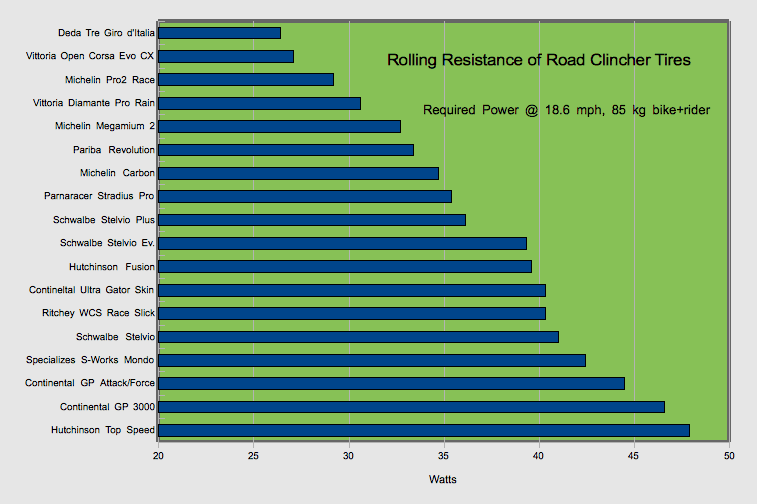
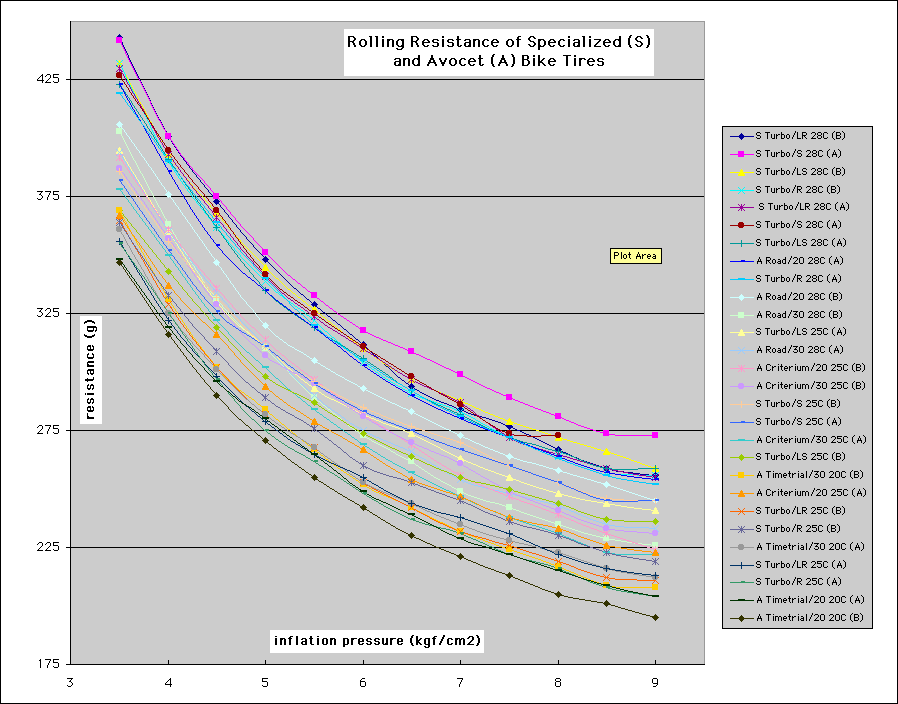
and another one: (same study different write up)
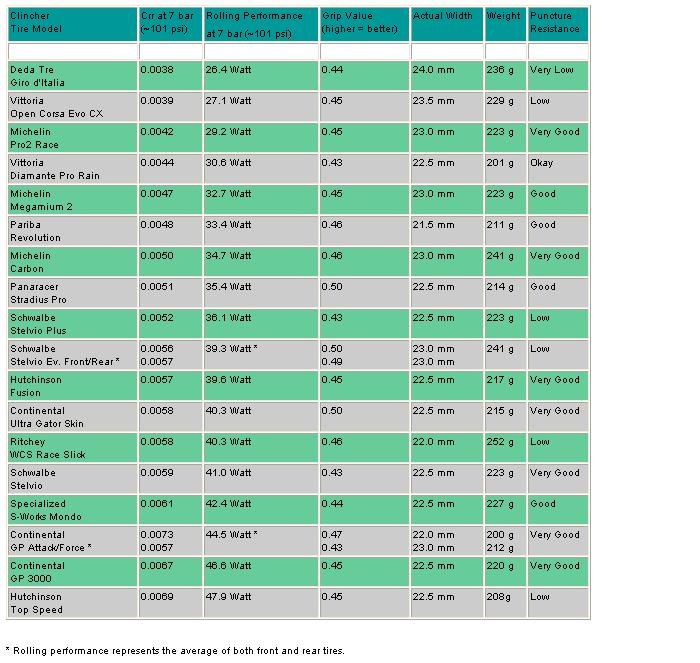
Both of these (and a whole bunch of others) are done in a 'controlled environment' and such a thing does not really exist on the road. The one thing that one needs to conclude (based on the data) is that there are clearly some trends that show, but the sample size is a bit too small (you got to test about 500ish tires to be confident that the deviations you do are true - plus you got to test like 5-10 different batches of tires so you do not have one bad sample-type results) to make statistically significant conclusions... Both those studies (and pretty much everything else I have seen) will not fly in a peer-reviewed publication.
05-24-10 | 04:45 PM
#24
Señor Member
Joined: Oct 2004
Posts: 18,481
Likes: 1,565
From: Hardy, VA
Bikes: Mostly English - predominantly Raleighs
Thanks Hilary. Sounds like a practical, well constructed test.
__________________
In search of what to search for.
In search of what to search for.
05-24-10 | 07:27 PM
#25
sultan of schwinn
Joined: Sep 2009
Posts: 3,536
Likes: 17
From: Lehigh Valley, PA
Absolutely zero scientific conclusions could be drawn from that.
However, you could (if possible) do a test that would... You'd need at least three different size tires mounted on the same kind of wheels and hubs, and in a similiar state of lube/cleanliness, then pick a stretch of road, or even better, a track, and have somebody with a stopwatch click off when you go by a marker at a certain speed at which point you stop pedaling and coast... then have them time you to the next marker. Do this with each set of tires and you'll have at least a small basis for your beliefs.
Personally, I think you're right - but it'd be interesting to find out the truth scientifically.
However, you could (if possible) do a test that would... You'd need at least three different size tires mounted on the same kind of wheels and hubs, and in a similiar state of lube/cleanliness, then pick a stretch of road, or even better, a track, and have somebody with a stopwatch click off when you go by a marker at a certain speed at which point you stop pedaling and coast... then have them time you to the next marker. Do this with each set of tires and you'll have at least a small basis for your beliefs.
Personally, I think you're right - but it'd be interesting to find out the truth scientifically.
Absolutely no scientist will accept data from such a test in a peer reviewed scientific publication. Small sample size and potential variables with individual tires (not to talk about the other variables).
To create a scientific test that would give you results with some statistic confidence and would be acceptable in the academic community, you would need to try at least 5-10 different copies of the same tire (hopefully of different batches and bought from different locations) in 2-3 sizes, and at least 50 different tires. That's 500-1000 tires x $35 = $17.5-30K + time and material and instruments and salaries. Let's round it up to an even $50K, maybe $100K depending on the instrumentation you need. That's why scientists need grands to do their experiments...