


path racer availability
 07-06-10 | 06:02 PM
#26
Senior Member
Joined: Jul 2007
Posts: 5,045
Likes: 15
From: Lancaster County, PA
Bikes: '39 Hobbs, '58 Marastoni, '73 Italian custom, '75 Wizard, '76 Wilier, '78 Tom Kellogg, '79 Colnago Super, '79 Sachs, '81 Masi Prestige, '82 Cuevas, '83 Picchio Special, '84 Murray-Serotta, '85 Trek 170, '89 Bianchi, '90 Bill Holland, '94 Grandis
What were path racers used for originally? Were they the original road bike before deraillers came along? Or was there some other purpose?
Obviously us C&V folk don't always do things because they are practical, so I was just curious if there was another reason for a path racer.
Obviously us C&V folk don't always do things because they are practical, so I was just curious if there was another reason for a path racer.
 07-06-10 | 06:06 PM
#27
Senior Member
Joined: Jul 2007
Posts: 5,045
Likes: 15
From: Lancaster County, PA
Bikes: '39 Hobbs, '58 Marastoni, '73 Italian custom, '75 Wizard, '76 Wilier, '78 Tom Kellogg, '79 Colnago Super, '79 Sachs, '81 Masi Prestige, '82 Cuevas, '83 Picchio Special, '84 Murray-Serotta, '85 Trek 170, '89 Bianchi, '90 Bill Holland, '94 Grandis
What were path racers used for originally? Were they the original road bike before deraillers came along? Or was there some other purpose?
Obviously us C&V folk don't always do things because they are practical, so I was just curious if there was another reason for a path racer.
Obviously us C&V folk don't always do things because they are practical, so I was just curious if there was another reason for a path racer.
Last edited by Picchio Special; 07-07-10 at 04:20 AM.


 07-06-10 | 09:39 PM
#30

Phyllo-buster


Joined: Jan 2010
Posts: 9,264
Likes: 2,690
From: Nova Scotia
Bikes: roadsters, club bikes, fixed and classic
A "road/path," on the other hand, could be raced on a track on weekends and used for training, with fenders, during the week, or used for "club runs." They would pass muster to be allowed on a track, but had a higher bottom bracket, more relaxed angles, and some braze-ons to give them a fair degree of versatility.
07-06-10 | 09:50 PM
#31

Senior Member
Joined: Feb 2010
Posts: 904
Likes: 1
From: New Jersey
Here's my old Hercules Renoun, sporting some relaxed geometry
Me thinks it wiser to find a nice frame and components, build something up that you can actually ride unless your interested in a museum piece. IMHO
Last edited by Andrew F; 07-06-10 at 09:59 PM.
07-06-10 | 09:57 PM
#32

French threaded
Joined: Aug 2008
Posts: 1,199
Likes: 4
From: Portland, OR.
Bikes: many
Path is what they used to call track, but back then a track could be dirt or grass.
The other venerability of path bikes is they were frequently your only bike so for riding to a race you would have a brake attached and sometimes carry a second set of wheels.
It also became your time trial bike for 25 mile rides and may be fitted with fenders for those nasty roads.
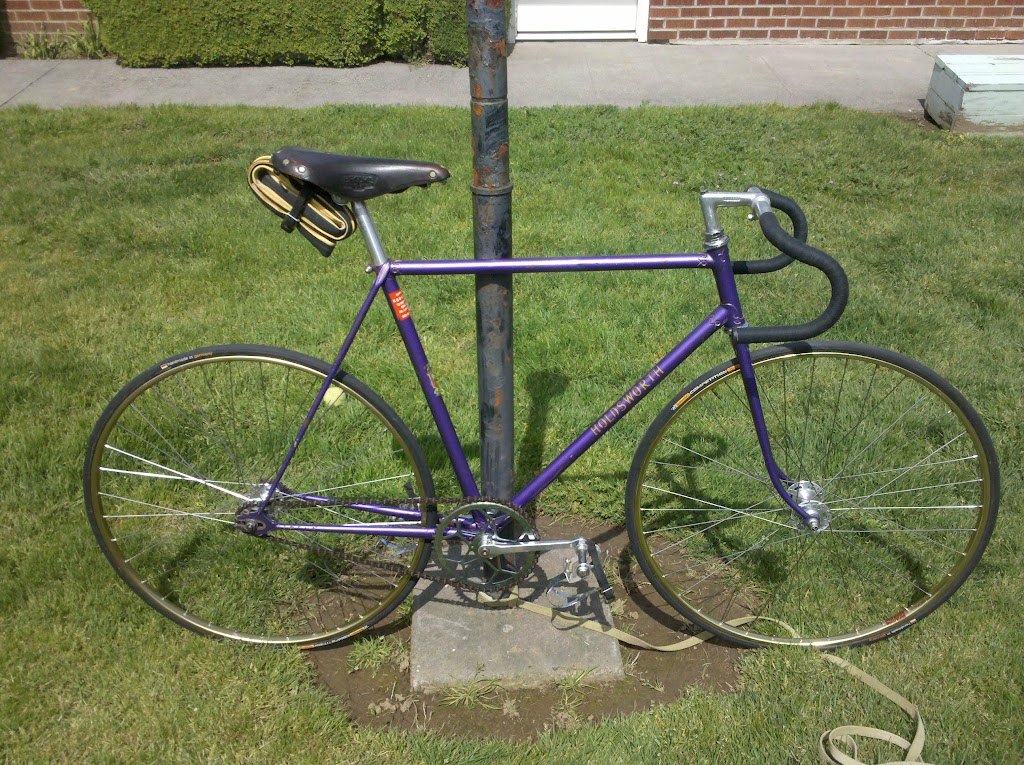
Here is my 1956 contribution from england (minus the french wheels)
 p
p
The other venerability of path bikes is they were frequently your only bike so for riding to a race you would have a brake attached and sometimes carry a second set of wheels.
It also became your time trial bike for 25 mile rides and may be fitted with fenders for those nasty roads.
Here is my 1956 contribution from england (minus the french wheels)
p
 07-07-10 | 04:21 AM
#34
Senior Member
Joined: Jul 2007
Posts: 5,045
Likes: 15
From: Lancaster County, PA
Bikes: '39 Hobbs, '58 Marastoni, '73 Italian custom, '75 Wizard, '76 Wilier, '78 Tom Kellogg, '79 Colnago Super, '79 Sachs, '81 Masi Prestige, '82 Cuevas, '83 Picchio Special, '84 Murray-Serotta, '85 Trek 170, '89 Bianchi, '90 Bill Holland, '94 Grandis
True, though "path" refers to any type of track surface. More importantly, tracks tended to be less steeply banked than is often the case now, making the lower BB feasible and the greater utility of the road/path possible.
 07-07-10 | 09:13 AM
#36

Full Member
Joined: Sep 2009
Posts: 354
Likes: 0
Bikes: team miyata, '73 p-14, MB-3, centurion lemans, Mystery TT, mongoose atb '85
so nice...
Path is what they used to call track, but back then a track could be dirt or grass.
The other venerability of path bikes is they were frequently your only bike so for riding to a race you would have a brake attached and sometimes carry a second set of wheels.
It also became your time trial bike for 25 mile rides and may be fitted with fenders for those nasty roads.
Here is my 1956 contribution from england (minus the french wheels)
p
The other venerability of path bikes is they were frequently your only bike so for riding to a race you would have a brake attached and sometimes carry a second set of wheels.
It also became your time trial bike for 25 mile rides and may be fitted with fenders for those nasty roads.
Here is my 1956 contribution from england (minus the french wheels)
p
07-07-10 | 12:46 PM
#37
French threaded
Joined: Aug 2008
Posts: 1,199
Likes: 4
From: Portland, OR.
Bikes: many
07-07-10 | 04:56 PM
#38
Senior Member
Joined: Feb 2010
Posts: 904
Likes: 1
From: New Jersey
Am I wrong?....I thought Path Racers had headtubes set at about 68 degrees to deal with the grass or dirt surfaces while Track bikes were set up much tighter, say 71or 72, since they were on a hard surface?
07-07-10 | 05:16 PM
#39
Senior Member
Joined: Jul 2007
Posts: 5,045
Likes: 15
From: Lancaster County, PA
Bikes: '39 Hobbs, '58 Marastoni, '73 Italian custom, '75 Wizard, '76 Wilier, '78 Tom Kellogg, '79 Colnago Super, '79 Sachs, '81 Masi Prestige, '82 Cuevas, '83 Picchio Special, '84 Murray-Serotta, '85 Trek 170, '89 Bianchi, '90 Bill Holland, '94 Grandis
Yes, you're wrong. A "path racer" is a track bike - they're one and the same thing. A "path" and a "track" are two names for the same thing - regardless of surface material (tarmac, wood, grass). A "road/path" (i.e. dual purpose) bike may indeed have been more relaxed, but for reasons of utility, not road surface.
07-07-10 | 08:40 PM
#40
Senior Member
Joined: Feb 2010
Posts: 904
Likes: 1
From: New Jersey
Picchio, are you 100% on that? I am developing a bit of interest in early frame geometry and have noticed a rather slack geometry that gets tighter as the years progress. Here is a cut from the 1896 Star cataloge and shows both the Path and the Path/Road with the same relaxed frame, looks (less then 68 degree) . The difference is noted that the Path/Road is studier and heavier. Also, wouldn't slack frame have an advantage over tight geometry on an unstable surface such as truff or dirt? Just askin'?

07-08-10 | 04:49 AM
#41
Senior Member
Joined: Jul 2007
Posts: 5,045
Likes: 15
From: Lancaster County, PA
Bikes: '39 Hobbs, '58 Marastoni, '73 Italian custom, '75 Wizard, '76 Wilier, '78 Tom Kellogg, '79 Colnago Super, '79 Sachs, '81 Masi Prestige, '82 Cuevas, '83 Picchio Special, '84 Murray-Serotta, '85 Trek 170, '89 Bianchi, '90 Bill Holland, '94 Grandis
Picchio, are you 100% on that? I am developing a bit of interest in early frame geometry and have noticed a rather slack geometry that gets tighter as the years progress. Here is a cut from the 1896 Star cataloge and shows both the Path and the Path/Road with the same relaxed frame, looks (less then 68 degree) . The difference is noted that the Path/Road is studier and heavier. Also, wouldn't slack frame have an advantage over tight geometry on an unstable surface such as truff or dirt? Just askin'?
https://www.juniorvelo.com/wp-content...e_filtered.jpg
As track bikes became more "upright," road bikes (eventually) did, too - but not to the same extent obviously, leaving models intended for dual use with more relaxed geometry and lower bottom brackets. Yes, the early road bikes benefited from geometry that made them more suited for bad road surfaces, but track bikes shared that geometry, as your example suggests. As noted by The Racing Bicycle:
"Board track and road racing bicycles of the
prewar era have a more relaxed frame geometry as compared to modern race bikes. This made these bikes
less responsive, therefore more challenging to handle in tight quarters, however the long wheelbase
made the road racing bicycles more stable on the mostly unpaved roads they raced on."
Keep in mind that in some forms of track racing (the brutal 6-Day races for example), endurance was as important as sheer speed and agility, and perhaps more so.
I suspect that track bikes evolved more toward upright geometry more for reasons of handling than improved racing surfaces. As to road bikes, Dave Moulton offers as alternative theory to the commonly held "road surface" one here:
https://tinyurl.com/y95tntg
And again, the persistence of slack angles may have had much to do with old design habits:
https://davesbikeblog.squarespace.com...-die-hard.html
Whether or not a slack frame has a real advantage on unstable road surfaces is an interesting question - a shorter wheelbase + lower trail geometry is actually more maneuverable when it comes to dodging potholes and other obstacles (which we have plenty of around here), though a longer wheelbase is more stable.
In any case, my earlier post mainly concerned the more familiar post-war period. But again, the distinction between a "path racer" and a "road/path" is that one is designed for track racing and the other is designed for some versatility while still being eligible for use on a dedicated track (track ends).
Last edited by Picchio Special; 07-08-10 at 04:56 AM.
07-09-10 | 11:59 AM
#44
Senior Member
Joined: Feb 2007
Posts: 131
Likes: 2
From: Bristol, British Isles
Path racers are track bikes, nothing else... Road/path bikes or road/track or Path/road bikes were used in the UK by many clubman for general riding combined with time trialling or racing on the local track. The height of their popularity was in the 1930s, 40 and 50s when virtually every short distance (25 and 50 miles - 10 miles was not generally considered a serious distance back then) time triallist used a fixed gear. Of course as now rear facing dropouts were not essential and many used standard clubman's style frames - which were more practical when fitted with mudguards (fenders) - try removing a rear wheel with mudguard and rear facing dropouts... The more stylish riders and those able to afford more than one machine may well have bought a road/path frame specifically for time trialling.The use of gears for longer distance events (100 miles, 12 and 24 hours) increased during the 30s - Sturmey Archer developed closer ratio hub gears specifically for the time triallist and this continued in the 50s. As late as the 60s a few old die-hard long distance TTers continued to use hub gears often combined with a road/path frame...
07-09-10 | 12:46 PM
#45
Senior Member
Joined: Oct 2004
Posts: 1,744
Likes: 2
From: Toronto, Ontario
Bikes: Miele Azsora, Kuwahara Cascade
Picchio, are you 100% on that? I am developing a bit of interest in early frame geometry and have noticed a rather slack geometry that gets tighter as the years progress. Here is a cut from the 1896 Star cataloge and shows both the Path and the Path/Road with the same relaxed frame, looks (less then 68 degree) . The difference is noted that the Path/Road is studier and heavier. Also, wouldn't slack frame have an advantage over tight geometry on an unstable surface such as truff or dirt? Just askin'?
07-09-10 | 12:51 PM
#46
Senior Member
Joined: Jul 2007
Posts: 5,045
Likes: 15
From: Lancaster County, PA
Bikes: '39 Hobbs, '58 Marastoni, '73 Italian custom, '75 Wizard, '76 Wilier, '78 Tom Kellogg, '79 Colnago Super, '79 Sachs, '81 Masi Prestige, '82 Cuevas, '83 Picchio Special, '84 Murray-Serotta, '85 Trek 170, '89 Bianchi, '90 Bill Holland, '94 Grandis
You are correct in that, back when they were called "path racers" the geometry was slacker than now, when we call them track bikes. However, that's not a design feature inherent to path racers or track bikes, just a difference between how bikes are make now versus then.
07-09-10 | 12:58 PM
#47

Bicycle Repair Man !!!
Joined: Sep 2007
Posts: 27,266
Likes: 150
From: YEG
Bikes: See my sig...

1951 CCM - Path / Road concept.
Now that I have access to materials and a good instructor am considering building a replica of an early path racer and the fabrication should not be that difficult... even have the materials to make a Major Taylor stem for the bike.
07-09-10 | 01:24 PM
#48

Ride heavy metal.
Joined: Sep 2009
Posts: 1,538
Likes: 2
From: Teenage Wasteland, USA
Bikes: '74 Raleigh LTD-3, '76 Motobecane Grand Jubile, '83 Fuji TSIII (customized commuter), '10 Mercier Kilo WT (fixed obsession), '83 Bianchi Alloro, '92 Bridgestone MB-1 (project), '83 Specialized Expedition (project), '79 Peugeot UO-8 (sold)
Do it.
07-09-10 | 02:08 PM
#49

My bikes became Vintage
Joined: Aug 2005
Posts: 1,140
Likes: 13
From: Ontario, Canada
Yes, but why not use the correct term if you know what it is? Even the Wikipedia entry is not really correct because a path racer was what a track bike was called in the UK back in the 1930s or so. It's just a track bike from that era. It's just that back in those days cyclists there were working class people who could only afford one bike, so their racer had to allow the fitting of brakes, lights and fenders for daily use.
07-09-10 | 03:11 PM
#50
Senior Member
Joined: Feb 2010
Posts: 904
Likes: 1
From: New Jersey
Hmmmmmmm.....
[QUOTE]
Picchio Special
The 1896 Star cataloge lists a Path Racer as well as the 1906 Rudge and Raleigh advertisments. So I would assume the Mfg.'s were following existing terminolgy and not trying to coin a new term.
[QUOTE]
Picchio Special
I doubt that the term "Path Racer" was ever in wide usage.
The 1896 Star cataloge lists a Path Racer as well as the 1906 Rudge and Raleigh advertisments. So I would assume the Mfg.'s were following existing terminolgy and not trying to coin a new term.