


DIY Drillium?
 08-03-10 | 01:06 PM
#1

Thread Starter
Senior Member
Joined: Nov 2007
Posts: 634
Likes: 38
DIY Drillium?
I always liked the look of classic drillium brake levers, but having the brake cable exit the top of the lever is not a classic feature I miss. I really want some drillium levers with aero routing, but as far as I know, no one makes/made such a thing.
I was thinking of buying a set of new Tectro Campy knock-offs, and doing the ventilation job on them myself. I have access to a proper machine shop drill press and lathe. I'm actually considering riding these things. What do you all think? Suicidal? I'd especially like to hear from engineers.
I was thinking of buying a set of new Tectro Campy knock-offs, and doing the ventilation job on them myself. I have access to a proper machine shop drill press and lathe. I'm actually considering riding these things. What do you all think? Suicidal? I'd especially like to hear from engineers.
 08-03-10 | 01:20 PM
#2

FBoD Member at Large
Joined: Aug 2008
Posts: 6,094
Likes: 8
From: Woodbury, MN
I think it's suicidal only if you MEAN to hurt yourself 
That said, I would think that even and consistent spacing would be the hard part. There are some vented aero levers though, look for Dia-Compe Aero Grand Compe:

That said, I would think that even and consistent spacing would be the hard part. There are some vented aero levers though, look for Dia-Compe Aero Grand Compe:

 08-03-10 | 01:31 PM
#4
Thread Starter
Senior Member
Joined: Nov 2007
Posts: 634
Likes: 38
Nice! I'll bet those cost a fortune when/if they turn up on eBay.
08-03-10 | 01:32 PM
#5
FBoD Member at Large
Joined: Aug 2008
Posts: 6,094
Likes: 8
From: Woodbury, MN
08-03-10 | 02:29 PM
#6
Senior Member
Joined: Oct 2008
Posts: 2,929
Likes: 2
Drillium would require a drill press and a mill, not a lathe.
Tooling is the key to success. Designing and fabricating the tooling is MUCH harder than detailing the parts.
Be careful drilling brake levers and other safety-related items. You don't want a catastrophic lever failure right when you need the lever the most (a panic stop).
Tooling is the key to success. Designing and fabricating the tooling is MUCH harder than detailing the parts.
Be careful drilling brake levers and other safety-related items. You don't want a catastrophic lever failure right when you need the lever the most (a panic stop).
08-03-10 | 02:38 PM
#7
Thread Starter
Senior Member
Joined: Nov 2007
Posts: 634
Likes: 38
Drillium would require a drill press and a mill, not a lathe.
Tooling is the key to success. Designing and fabricating the tooling is MUCH harder than detailing the parts.
Be careful drilling brake levers and other safety-related items. You don't want a catastrophic lever failure right when you need the lever the most (a panic stop).
Tooling is the key to success. Designing and fabricating the tooling is MUCH harder than detailing the parts.
Be careful drilling brake levers and other safety-related items. You don't want a catastrophic lever failure right when you need the lever the most (a panic stop).
Last edited by Fissile; 08-03-10 at 02:41 PM.
 08-03-10 | 03:06 PM
#9
Senior Member
Joined: Dec 2009
Posts: 1,681
Likes: 1
From: St. Louis, MO
You need to make a set of jigs/fixtures to hold the complex shaped part without allowing it to move and thus marring it. The VMC could be programmed to do the job of course.
Alternatively you could use soft jaws and some kind of rag/leather/etc. and hand do it very carefully. Layout the pattern and center punch the holes then use a centering drill which will give you a nice hole plus an angled chamfer of larger size around it.
Probably easier to buy a set of levers unless you have the skills/tools/extra time or just like fabricating stuff (I do).
Alternatively you could use soft jaws and some kind of rag/leather/etc. and hand do it very carefully. Layout the pattern and center punch the holes then use a centering drill which will give you a nice hole plus an angled chamfer of larger size around it.
Probably easier to buy a set of levers unless you have the skills/tools/extra time or just like fabricating stuff (I do).
08-03-10 | 03:17 PM
#10
Thread Starter
Senior Member
Joined: Nov 2007
Posts: 634
Likes: 38
You need to make a set of jigs/fixtures to hold the complex shaped part without allowing it to move and thus marring it. The VMC could be programmed to do the job of course.
Alternatively you could use soft jaws and some kind of rag/leather/etc. and hand do it very carefully. Layout the pattern and center punch the holes then use a centering drill which will give you a nice hole plus an angled chamfer of larger size around it.
Probably easier to buy a set of levers unless you have the skills/tools/extra time or just like fabricating stuff (I do).
Alternatively you could use soft jaws and some kind of rag/leather/etc. and hand do it very carefully. Layout the pattern and center punch the holes then use a centering drill which will give you a nice hole plus an angled chamfer of larger size around it.
Probably easier to buy a set of levers unless you have the skills/tools/extra time or just like fabricating stuff (I do).
08-03-10 | 03:29 PM
#11

Senior Member


Joined: Mar 2009
Posts: 1,574
Likes: 174
From: Kingwood, TX
Bikes: Road, Touring, BMX, Cruisers...
I didn't even know it till I bought an old pair but most late 80s Modolo levers have routing for the top of the hood and for internal aero routing.
Cheaper than tooling unless you have the time and material. Just skip ove the "rare" wording.
https://cgi.ebay.com/Mavic-410-Brake-...item41515f48a5
Cheaper than tooling unless you have the time and material. Just skip ove the "rare" wording.
https://cgi.ebay.com/Mavic-410-Brake-...item41515f48a5
__________________
1984 Cannondale ST
1985 Cannondale SR300
1980 Gary Littlejohn Cruiser
1984 Trek 760
1981 Trek 710
Pics
1984 Cannondale ST
1985 Cannondale SR300
1980 Gary Littlejohn Cruiser
1984 Trek 760
1981 Trek 710
Pics
08-03-10 | 03:39 PM
#12
Senior Member
Joined: May 2006
Posts: 2,180
Likes: 16
I didn't even know it till I bought an old pair but most late 80s Modolo levers have routing for the top of the hood and for internal aero routing.
Cheaper than tooling unless you have the time and material. Just skip ove the "rare" wording.
https://cgi.ebay.com/Mavic-410-Brake-...item41515f48a5
Cheaper than tooling unless you have the time and material. Just skip ove the "rare" wording.
https://cgi.ebay.com/Mavic-410-Brake-...item41515f48a5
vjp
08-03-10 | 03:55 PM
#13
Senior Member
Joined: Oct 2008
Posts: 2,929
Likes: 2
A drill press can be used like a mill if it's fitted with an end mill (the cutting bit) and equipped with a sliding machinist's vice (typically hand cranked). These vices are relatively inexpensive (under $100), as are the carbide bits (under $50). Just go slowly (low feed rate and shallow depth of cut). Don't forget to use liberal amounts of cutting oil.
08-03-10 | 04:22 PM
#15

Senior Member
Joined: Jul 2009
Posts: 11,128
Likes: 39
Bikes: 1986 Alan Record Carbonio, 1985 Vitus Plus Carbone 7, 1984 Peugeot PSV, 1972 Line Seeker, 1986(est.) Medici Aerodynamic (Project), 1985(est.) Peugeot PY10FC
Here's my own set of Diacompe AGCs presently on my 84 Peugeot PSV:

They're stamped with the perforations and not really "drillium" but they are very light. The original silicone (instead of latex) hoods also have lasted all these years with no signs of aging and rotting. Highly recommend these for classic buildups if you want light weight, lasting quality and looks.
If you want real light wieght but not fussy on quality, these CLB aero levers could work for you:
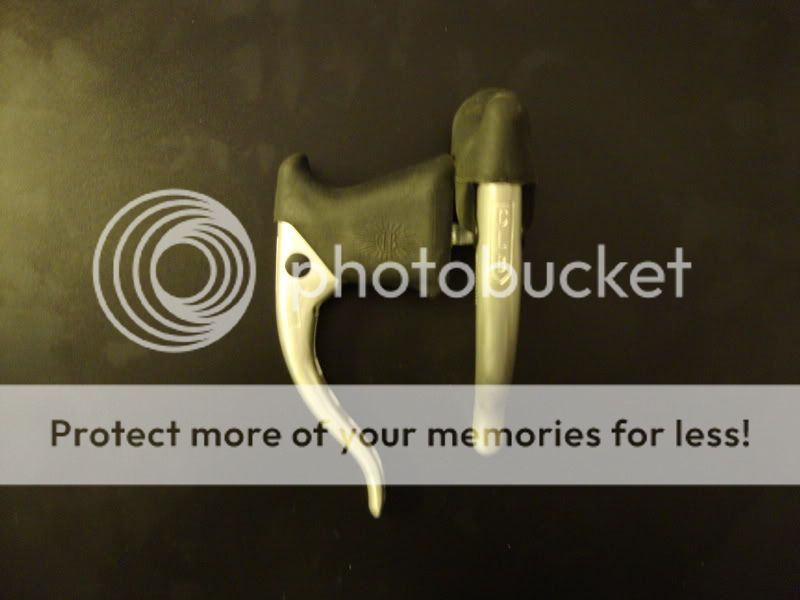
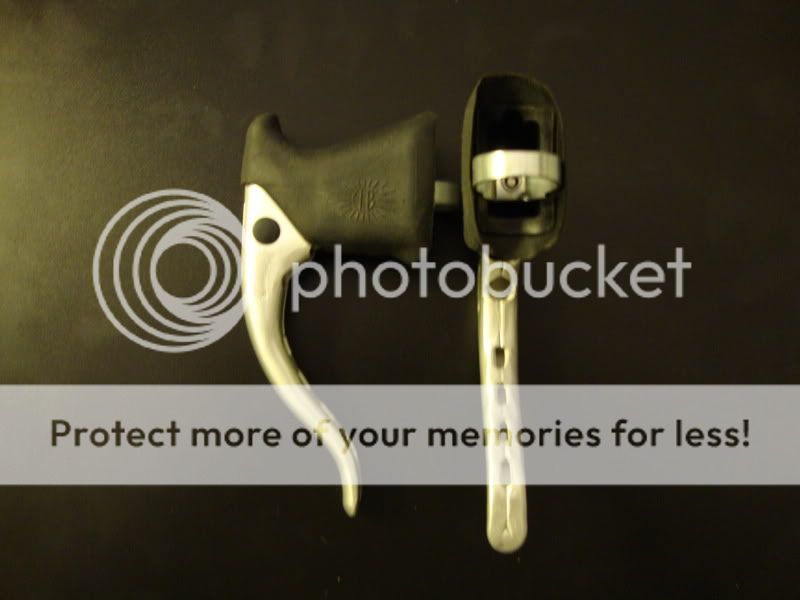
Again, not really "drillium" but stamped with perforations, this time at the back of the lever arms.
Not the cleanest finished levers, but passable.
They're stamped with the perforations and not really "drillium" but they are very light. The original silicone (instead of latex) hoods also have lasted all these years with no signs of aging and rotting. Highly recommend these for classic buildups if you want light weight, lasting quality and looks.
If you want real light wieght but not fussy on quality, these CLB aero levers could work for you:
Again, not really "drillium" but stamped with perforations, this time at the back of the lever arms.
Not the cleanest finished levers, but passable.
Last edited by Chombi; 08-03-10 at 04:27 PM.
08-03-10 | 04:28 PM
#16
Senior Member

Joined: Jul 2005
Posts: 2,308
Likes: 16
Hmm. That's interesting. What are the relative advantages of silicone and latex (and gum rubber???) for this application? I had never thought of their being made of different materials.
08-03-10 | 04:33 PM
#17
Senior Member
Joined: Apr 2007
Posts: 962
Likes: 30
We used a cnc mill way back in the day to do chain rings. You could program it and it would come out perfect every time. I don't like to do drillium on derailleurs or brake calipers or hubs because they are engineered to their limits already. For a one time use like a world championship or something, I'd give it a shot. I think brake lever s can be successfully drilled, but the weight saved is really insignificant.
I got a funny story about this nonsence: a guy in work saw us drilling chainrings and asked us why we were doing it. After we explained the cosmetic, and weight reduction reasons he seemed to have a glimmer of understanding. Weeks later, I run into him, and he has black tape all over his (really cheap) bike. He had drilled 7/8 th inch holes through the frame, down tube, seat tube, and top tube. He drilled the ashtabula crankset up through the end of the arms, right through the pedal threaded ends! He drilled the brakes, the seat post, everything. He thought we would make fun of him so he covered all the holes with black vinyl tape!
The tape probably weighed more than the metal re removed.
I got a funny story about this nonsence: a guy in work saw us drilling chainrings and asked us why we were doing it. After we explained the cosmetic, and weight reduction reasons he seemed to have a glimmer of understanding. Weeks later, I run into him, and he has black tape all over his (really cheap) bike. He had drilled 7/8 th inch holes through the frame, down tube, seat tube, and top tube. He drilled the ashtabula crankset up through the end of the arms, right through the pedal threaded ends! He drilled the brakes, the seat post, everything. He thought we would make fun of him so he covered all the holes with black vinyl tape!
The tape probably weighed more than the metal re removed.
08-03-10 | 04:36 PM
#18
Senior Member
Joined: Jul 2009
Posts: 11,128
Likes: 39
Bikes: 1986 Alan Record Carbonio, 1985 Vitus Plus Carbone 7, 1984 Peugeot PSV, 1972 Line Seeker, 1986(est.) Medici Aerodynamic (Project), 1985(est.) Peugeot PY10FC
Not 100% sure the AGC hoods are silicone, but that's the only explanation I can think of why the original white hoods on mine had not dried up and cracked after over 20 years on the bike in all kinds of environement.
Chombi
Last edited by Chombi; 08-03-10 at 04:40 PM.
08-03-10 | 08:33 PM
#19

Old fart

Joined: Nov 2004
Posts: 26,324
Likes: 5,233
From: Appleton WI
Bikes: Several, mostly not name brands.
This is the fixture (with a lever installed and ready to drill) that Frank Spivey used to make drillium brake levers back before you could get them drilled from the factory:

More info of Spivey and drillium here: https://www.velo-retro.com/peterjohnson.html
More info of Spivey and drillium here: https://www.velo-retro.com/peterjohnson.html
08-03-10 | 08:40 PM
#20

^^^That is unbelievably cool.
08-03-10 | 08:56 PM
#21
Senior Member
Joined: Oct 2008
Posts: 2,929
Likes: 2
Silicone can stretch at least 100% before breaking (actually, elongation is up in the 200 to 400% range). However, silicone is notch sensitive, so if it is nicked, it will break long before it gets to the 100% elongation. If you use the silicone in compression, notch sensitivty is less of a concern.
You can add fillers, such as fibers, to improve the properties.
08-03-10 | 08:57 PM
#22

Passista
Joined: Jul 2005
Posts: 8,244
Likes: 1,209
Bikes: 1998 Pinarello Asolo, 1992 KHS Montaña pro, 1980 Raleigh DL-1, IGH Hybrid, IGH Utility
08-03-10 | 09:10 PM
#23
Thread Starter
Senior Member
Joined: Nov 2007
Posts: 634
Likes: 38
Thanks for the link!
This is the fixture (with a lever installed and ready to drill) that Frank Spivey used to make drillium brake levers back before you could get them drilled from the factory:
More info of Spivey and drillium here: https://www.velo-retro.com/peterjohnson.html
More info of Spivey and drillium here: https://www.velo-retro.com/peterjohnson.html
08-03-10 | 09:11 PM
#24
Thread Starter
Senior Member
Joined: Nov 2007
Posts: 634
Likes: 38
Thank you for the links!
08-03-10 | 09:22 PM
#25
Banned
Joined: Jun 2010
Posts: 43,586
Likes: 1,380
From: NW,Oregon Coast
Bikes: 8
Campag super record levers where drilled while the aluminum was a Flat sheet,
then it was put into the punch press, and shaped into the part.
The D-C AGC and the CLB appear to have done the same.

then it was put into the punch press, and shaped into the part.
The D-C AGC and the CLB appear to have done the same.
Last edited by fietsbob; 08-03-10 at 09:27 PM.


