


Problems with Steering and Shifting
 03-18-11 | 07:58 PM
#1
Thread Starter
Senior Member
Joined: Oct 2009
Posts: 1,001
Likes: 6
From: New England
Bikes: Trek 1.1
Problems with Steering and Shifting
Was feeling pretty good about the overhaul I had done on a $20 FS Sovereign roadbike until today when I took it out for a test ride.
Seems I have a problem shifting on to the large chainring which no amount of adjustment corrects. Also there is a tendency for the bike to steer to the right. Wonder if the two could be related? (photo is before cleanup was complete).

and after:

Seems I have a problem shifting on to the large chainring which no amount of adjustment corrects. Also there is a tendency for the bike to steer to the right. Wonder if the two could be related? (photo is before cleanup was complete).
and after:
 03-18-11 | 08:29 PM
#2
Banned.
Joined: Dec 2007
Posts: 27,199
Likes: 1,462
The front derailleur won't go out far enough?
1-pull the chain off.
2-undo the FD cable.
3-sight down through the FD cage at the crankset. It should be in all the way.
4-back off the limit screws quite a bit. You should be able to see if they're touching the cam inside them.
5-make sure it "rests" in far enough to guide the chain over the small front ring.
6-push it out with your hand to see if it moves out far enough to guide the chain over the largest front ring.
If it won't go out far enough with the setting screws backed out, next step is to check how it's mounted on the seat tube.
Make sure it's above the largest ring with clearance for the outside of the cage to clear it by 2-3mm.
Make sure the cage is aligned with the chain rings longitudinally. Make sure the FD is not bent.
If it's aligned and can clear the big ring, and the setting screws are backed out, check the crankset.
The crankset may not be on far enough.
The bottom bracket spindle may have been replaced.
The chain ring may have been replaced.
If it still won't clear the large chainring, you could have a bent frame, but that area is pretty darn strong.
To me, it may be more likely that the FD is the wrong model, or has some flaw that is limiting it's movement.
If it won't clear the rings by hand, with no chain, don't bother with the cable or chain.
You've likely got a bigger problem, most likely the FD, which is a $20 fix on that bike.
If it does clear the outer ring once you've checked everything, reattach the cable (without the chain).
Now do the shifting to see if it still works, and clears the chain rings.
If it does, install the chain, adjust the inner and outer set screws, and ride.
1-pull the chain off.
2-undo the FD cable.
3-sight down through the FD cage at the crankset. It should be in all the way.
4-back off the limit screws quite a bit. You should be able to see if they're touching the cam inside them.
5-make sure it "rests" in far enough to guide the chain over the small front ring.
6-push it out with your hand to see if it moves out far enough to guide the chain over the largest front ring.
If it won't go out far enough with the setting screws backed out, next step is to check how it's mounted on the seat tube.
Make sure it's above the largest ring with clearance for the outside of the cage to clear it by 2-3mm.
Make sure the cage is aligned with the chain rings longitudinally. Make sure the FD is not bent.
If it's aligned and can clear the big ring, and the setting screws are backed out, check the crankset.
The crankset may not be on far enough.
The bottom bracket spindle may have been replaced.
The chain ring may have been replaced.
If it still won't clear the large chainring, you could have a bent frame, but that area is pretty darn strong.
To me, it may be more likely that the FD is the wrong model, or has some flaw that is limiting it's movement.
If it won't clear the rings by hand, with no chain, don't bother with the cable or chain.
You've likely got a bigger problem, most likely the FD, which is a $20 fix on that bike.
If it does clear the outer ring once you've checked everything, reattach the cable (without the chain).
Now do the shifting to see if it still works, and clears the chain rings.
If it does, install the chain, adjust the inner and outer set screws, and ride.
03-18-11 | 08:45 PM
#3

Senior Member
Joined: Apr 2009
Posts: 10,303
Likes: 60
From: Detroit
+1 to what Robbie said about FD adjustment.
The shifter and pulling conditions are not related:
If the bike pulls to one side or the other the likely cause is fork or frame alignment.
The alignment of the rear wheel in the DOs (or extremely poor wheel dishing) can affect this but should be pretty obvious.
Less obvious is damage or bending of the fork or frame:
First, make SURE that the front axle is fully seated. Do the fork legs align with the fork crown? With a long threaded rod, see if the axis of the axle is perpendicular to the steerer tube.
Check frame alignment with the string test - a string looping around the lower headset cup and tied to each of the rear drop-outs should be equidistant to the seat tube on the right and the left.
Beyond these very basic measures, you would likely need some more sophisticated tools to determine if there is twist in the frame at the head tube, or at the bb. There are also specialized tools that can also more accurately check and reset the alignment of the dropouts themselves.
The shifter and pulling conditions are not related:
If the bike pulls to one side or the other the likely cause is fork or frame alignment.
The alignment of the rear wheel in the DOs (or extremely poor wheel dishing) can affect this but should be pretty obvious.
Less obvious is damage or bending of the fork or frame:
First, make SURE that the front axle is fully seated. Do the fork legs align with the fork crown? With a long threaded rod, see if the axis of the axle is perpendicular to the steerer tube.
Check frame alignment with the string test - a string looping around the lower headset cup and tied to each of the rear drop-outs should be equidistant to the seat tube on the right and the left.
Beyond these very basic measures, you would likely need some more sophisticated tools to determine if there is twist in the frame at the head tube, or at the bb. There are also specialized tools that can also more accurately check and reset the alignment of the dropouts themselves.
__________________
- Auchen
- Auchen
03-19-11 | 07:34 AM
#4
Thread Starter
Senior Member
Joined: Oct 2009
Posts: 1,001
Likes: 6
From: New England
Bikes: Trek 1.1
Thanks for the response. In re-reading my post I see that I did not properly indicate the chain/derailleur problem. First, on this low-entry bike the crank and chain shield are an integral part riveted together. Also this is a cottered crank. In sighting from above it would appear that the chain is going far enough to the outside, in fact it is coming off the large chain ring and gives the appearance of angling out from the chain ring and then it gets caught in the shield (which by the way is bent in various places and which I could not properly straighten since it can't be separated from the chain rings. The result is the chain over-running the large chain ring and getting caught between it and the shield. By careful tweaking of the limit screws I am able to get it to function correctly some of the time but not all. Sighting from above I can't detect the chainrings and crank arms as being not perpendicular to the bb. I did remove the bb and replaced the bearings, cleaned and greased it etc.
In regard to the steering I will conduct those tests suggested and see if there is any discernible mis alignment. The headset and bearings were also overhualed and bearings replaced. Seems to move smoothly with no indication of play, or roughness.
In regard to the steering I will conduct those tests suggested and see if there is any discernible mis alignment. The headset and bearings were also overhualed and bearings replaced. Seems to move smoothly with no indication of play, or roughness.
03-19-11 | 08:11 AM
#5

Senior Member


Joined: Apr 2007
Posts: 12,565
Likes: 2,739
From: Thunder Bay, Ontario, Canada - burrrrr!
Bikes: 1958 Rabeneick 120D, 1968 Legnano Gran Premio, 196? Torpado Professional, 2000 Marinoni Piuma
To address your pulling one way or the other issue, you might find some enlightenment here.
Hope it is a help.
Hope it is a help.
__________________
"98% of the bikes I buy are projects".
"98% of the bikes I buy are projects".
03-19-11 | 08:46 AM
#6
Senior Member
Joined: Apr 2009
Posts: 10,303
Likes: 60
From: Detroit
Sculptor 7 -
If your chain guard ("shield") is so buggered up as it cannot be straightened, it's time for a new crank. There is the added possibility that the rings themselves are not true either, based on your description.
You can get a truly fine cottered crank set from eBay for about $30 (one and one-half times the price of your bike! )
)
Just make sure you have the right size new cotters on hand because there are British, French and Italian sizes.
(I assume you already have some experience and tools for removing and refitting these, if you have already overhauled the bike.)
If your chain guard ("shield") is so buggered up as it cannot be straightened, it's time for a new crank. There is the added possibility that the rings themselves are not true either, based on your description.
You can get a truly fine cottered crank set from eBay for about $30 (one and one-half times the price of your bike!
) Just make sure you have the right size new cotters on hand because there are British, French and Italian sizes.
(I assume you already have some experience and tools for removing and refitting these, if you have already overhauled the bike.)
__________________
- Auchen
- Auchen
03-19-11 | 11:43 AM
#7


feros ferio

Joined: Jul 2000
Posts: 22,398
Likes: 1,865
From: www.ci.encinitas.ca.us
Bikes: 1959 Capo Modell Campagnolo; 1960 Capo Sieger (2); 1962 Carlton Franco Suisse; 1970 Peugeot UO-8; 1982 Bianchi Campione d'Italia; 1988 Schwinn Project KOM-10;
You may be able to excise the chainguard with a cutting wheel on a Dremel motor.
__________________
"Far and away the best prize that life offers is the chance to work hard at work worth doing." --Theodore Roosevelt
Capo: 1959 Modell Campagnolo, S/N 40324; 1960 Sieger (2), S/N 42624, 42597
Carlton: 1962 Franco Suisse, S/N K7911
Peugeot: 1970 UO-8, S/N 0010468
Bianchi: 1982 Campione d'Italia, S/N 1.M9914
Schwinn: 1988 Project KOM-10, S/N F804069
"Far and away the best prize that life offers is the chance to work hard at work worth doing." --Theodore Roosevelt
Capo: 1959 Modell Campagnolo, S/N 40324; 1960 Sieger (2), S/N 42624, 42597
Carlton: 1962 Franco Suisse, S/N K7911
Peugeot: 1970 UO-8, S/N 0010468
Bianchi: 1982 Campione d'Italia, S/N 1.M9914
Schwinn: 1988 Project KOM-10, S/N F804069
03-19-11 | 03:41 PM
#8
Thread Starter
Senior Member
Joined: Oct 2009
Posts: 1,001
Likes: 6
From: New England
Bikes: Trek 1.1
Checked again to see if wheels where properly in the forks and I believe the front wheel may not have been fully in. Read somewhere that it is a good idea to install wheels with bike on ground to avoid that happening and I had done it while the bike was in the rackstand. Not sure if that has solved the problem as I work in the basement and did not have time to lug the bike outside yet.
In regard to the shifting problem I notice that the chain does have a degree of wear but it is slight. I bent the guard away from the chainring a bit and I also re-seated the rear axle in the dropouts. With the chain on the middle cog I was able to consistently shift back and forth between the large and small chainrings without any derail to the outside or inside. However, when I put the chain on the smallest cog and tried shifting the front derailleur it ran off the large ring again to the outside after a few tries. I am wondering about the seating of the rear axle in the dropouts. Because of the way the derailleur butts up against the hanger bolt in order to have the wheel centered between the chainstays the left side of the axle is very near the limit of the drop out slot instead of seated back to the rear.
In regard to the checks for straightness I am sorry now that I did not perform them more thoroughly when I had everything stripped down to the frame. All I can say is that things looked straight visually. As an artist I have a pretty good eye for such things but perhaps that is not enough.
In regard to the shifting problem I notice that the chain does have a degree of wear but it is slight. I bent the guard away from the chainring a bit and I also re-seated the rear axle in the dropouts. With the chain on the middle cog I was able to consistently shift back and forth between the large and small chainrings without any derail to the outside or inside. However, when I put the chain on the smallest cog and tried shifting the front derailleur it ran off the large ring again to the outside after a few tries. I am wondering about the seating of the rear axle in the dropouts. Because of the way the derailleur butts up against the hanger bolt in order to have the wheel centered between the chainstays the left side of the axle is very near the limit of the drop out slot instead of seated back to the rear.
In regard to the checks for straightness I am sorry now that I did not perform them more thoroughly when I had everything stripped down to the frame. All I can say is that things looked straight visually. As an artist I have a pretty good eye for such things but perhaps that is not enough.
03-19-11 | 04:35 PM
#9
Senior Member
Joined: Apr 2009
Posts: 10,303
Likes: 60
From: Detroit
...... I am wondering about the seating of the rear axle in the dropouts. Because of the way the derailleur butts up against the hanger bolt in order to have the wheel centered between the chainstays the left side of the axle is very near the limit of the drop out slot instead of seated back to the rear......
__________________
- Auchen
- Auchen
03-19-11 | 09:20 PM
#10
Thread Starter
Senior Member
Joined: Oct 2009
Posts: 1,001
Likes: 6
From: New England
Bikes: Trek 1.1
Took the bike out again for a road test after reseating the front wheel and it was just as bad as ever. Also the shifting just does not seem to be consistent no matter how much I adjust the limit screws. With the bike all assembled it is difficult to perform the tests indicated on "My Ten Speeds" site.
This has been a lesson for me about working on old bikes. Next time I will make it a point to test ride before investing a lot of time on rust removal, new tires, cables, bearings, etc. Also don't think I will undertake any more low end entry level bikes although the lugged frame on this one is still in pretty nice condition.
The space between dropouts on the rear is around 131 mm and it just accommodates the rear axle in fact is a little tight. Certainly not 120 or 125 mm as indicated in "My Ten Speeds" info.
As well as possible I tried to measure distances and look for deformities but without success. The headtube looks to be perfectly aligned with the fork from side view. The fork does not appear to be out of line, either with the head tube or with itself.
This has been a lesson for me about working on old bikes. Next time I will make it a point to test ride before investing a lot of time on rust removal, new tires, cables, bearings, etc. Also don't think I will undertake any more low end entry level bikes although the lugged frame on this one is still in pretty nice condition.
The space between dropouts on the rear is around 131 mm and it just accommodates the rear axle in fact is a little tight. Certainly not 120 or 125 mm as indicated in "My Ten Speeds" info.
As well as possible I tried to measure distances and look for deformities but without success. The headtube looks to be perfectly aligned with the fork from side view. The fork does not appear to be out of line, either with the head tube or with itself.
03-20-11 | 06:35 AM
#11

Senior Member
Joined: Jul 2006
Posts: 6,930
Likes: 5
From: Toronto (again) Ontario, Canada
Bikes: Old Bike: 1975 Raleigh Delta, New Bike: 2004 Norco Bushpilot
Checked again to see if wheels where properly in the forks and I believe the front wheel may not have been fully in. Read somewhere that it is a good idea to install wheels with bike on ground to avoid that happening and I had done it while the bike was in the rackstand. Not sure if that has solved the problem as I work in the basement and did not have time to lug the bike outside yet.
In regard to the shifting problem I notice that the chain does have a degree of wear but it is slight. I bent the guard away from the chainring a bit and I also re-seated the rear axle in the dropouts. With the chain on the middle cog I was able to consistently shift back and forth between the large and small chainrings without any derail to the outside or inside. However, when I put the chain on the smallest cog and tried shifting the front derailleur it ran off the large ring again to the outside after a few tries. I am wondering about the seating of the rear axle in the dropouts. Because of the way the derailleur butts up against the hanger bolt in order to have the wheel centered between the chainstays the left side of the axle is very near the limit of the drop out slot instead of seated back to the rear.
In regard to the checks for straightness I am sorry now that I did not perform them more thoroughly when I had everything stripped down to the frame. All I can say is that things looked straight visually. As an artist I have a pretty good eye for such things but perhaps that is not enough.
In regard to the shifting problem I notice that the chain does have a degree of wear but it is slight. I bent the guard away from the chainring a bit and I also re-seated the rear axle in the dropouts. With the chain on the middle cog I was able to consistently shift back and forth between the large and small chainrings without any derail to the outside or inside. However, when I put the chain on the smallest cog and tried shifting the front derailleur it ran off the large ring again to the outside after a few tries. I am wondering about the seating of the rear axle in the dropouts. Because of the way the derailleur butts up against the hanger bolt in order to have the wheel centered between the chainstays the left side of the axle is very near the limit of the drop out slot instead of seated back to the rear.
In regard to the checks for straightness I am sorry now that I did not perform them more thoroughly when I had everything stripped down to the frame. All I can say is that things looked straight visually. As an artist I have a pretty good eye for such things but perhaps that is not enough.
String test the frame, a bent frame doesn't mean that the bike is toast, it means it needs a frame shop with an alignment table to align it, probably no more then about $50 or so. If the frame is straight, then take a drywall square put it so that the one side is at the stem and the other end at the bars, and see if the bars are the same on both sides, it's possible that someone crashed into something and bent the bar, rather then the frame. With the same square, run it along from the wheel to the bars, to make sure the bars are square to the wheel.
If the bars are okay and aligned, get a shop to replace the headset, because someone probably did a home headset repair and goofed it up....
As for the chain issue, a frame out of alignment could do that, so could a bent ring, and improperly installed BB, the wrong BB spindle, the wrong cotters, improperly installed cotters, improperly installed rings.
03-20-11 | 09:52 AM
#12
Banned.
Joined: Dec 2007
Posts: 27,199
Likes: 1,462
I"m pretty much at a loss on the front chainring issue unless I can see it in action.
If it's able to overshoot the big ring at all, the parameter is set too wide.
A wildy out of parameter rear could do what you say: chain toss when you're on both outer cog and outer chain ring.
In my opinion, That's possibly indicative of both chain stays bent to the R. They may be parallell, but over to the R.
That could produce both the steering and the shifting problem. Just a guess without seeing it. clues would be at seat lug area, where the seat stays meet the seat tube, and at the rear of the bottom bracket shell, where the chain stays meet the shell.
Good mental work, but I've already exhausted my supply of mental.
If it's able to overshoot the big ring at all, the parameter is set too wide.
A wildy out of parameter rear could do what you say: chain toss when you're on both outer cog and outer chain ring.
In my opinion, That's possibly indicative of both chain stays bent to the R. They may be parallell, but over to the R.
That could produce both the steering and the shifting problem. Just a guess without seeing it. clues would be at seat lug area, where the seat stays meet the seat tube, and at the rear of the bottom bracket shell, where the chain stays meet the shell.
Good mental work, but I've already exhausted my supply of mental.
03-20-11 | 03:46 PM
#13
Thread Starter
Senior Member
Joined: Oct 2009
Posts: 1,001
Likes: 6
From: New England
Bikes: Trek 1.1
"A wildy out of parameter rear could do what you say: chain toss when you're on both outer cog and outer chain ring.
In my opinion, That's possibly indicative of both chain stays bent to the R. They may be parallell, but over to the R."
Actually, if anything, they seem possibly bent to the left. Don't believe the problem is with the fork or the head tube. The string test indicates no error for the head tube/seat tube relationship and a lateral view of the forks and their relationship to the head tube seems okay.
Will have to photograph it.
In my opinion, That's possibly indicative of both chain stays bent to the R. They may be parallell, but over to the R."
Actually, if anything, they seem possibly bent to the left. Don't believe the problem is with the fork or the head tube. The string test indicates no error for the head tube/seat tube relationship and a lateral view of the forks and their relationship to the head tube seems okay.
Will have to photograph it.


 03-21-11 | 07:36 AM
#15
Thread Starter
Senior Member
Joined: Oct 2009
Posts: 1,001
Likes: 6
From: New England
Bikes: Trek 1.1
Thought it would be more helpful to show views from above but here is a side view:

The left side dropout has the axle placed right at the forward opening. More so than any of my other bikes (In order to have the wheel centered).
The left side dropout has the axle placed right at the forward opening. More so than any of my other bikes (In order to have the wheel centered).
Last edited by Sculptor7; 03-21-11 at 07:40 AM.
03-21-11 | 09:23 AM
#16
Thread Starter
Senior Member
Joined: Oct 2009
Posts: 1,001
Likes: 6
From: New England
Bikes: Trek 1.1
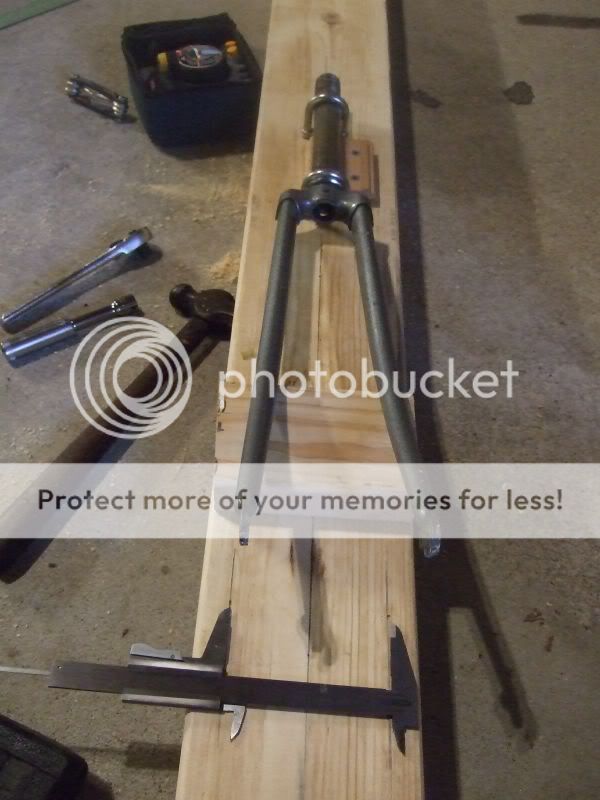
Steering still has me puzzled. The headset lines up with the seat post but there is the appearance of problems with the fork(s). The front left side dropout seems a tad higher than the right (although there is no indication of misalignment of the forks themselves). Would not that create a castoring to the left instead of to the right as is the case?
The rear dropouts may not be perfectly parallel and the axle nut on the left side has to be right at the forward limit of the dropout to have the wheel aligned between the chainstays.
Last edited by Sculptor7; 03-21-11 at 09:29 AM.
03-21-11 | 10:54 AM
#17
Senior Member
Joined: Apr 2009
Posts: 10,303
Likes: 60
From: Detroit
...
Steering still has me puzzled. The headset lines up with the seat post but there is the appearance of problems with the fork(s). The front left side dropout seems a tad higher than the right (although there is no indication of misalignment of the forks themselves). Would not that create a castoring to the left instead of to the right as is the case?.....
Steering still has me puzzled. The headset lines up with the seat post but there is the appearance of problems with the fork(s). The front left side dropout seems a tad higher than the right (although there is no indication of misalignment of the forks themselves). Would not that create a castoring to the left instead of to the right as is the case?.....
__________________
- Auchen
- Auchen
03-21-11 | 01:02 PM
#18
Thread Starter
Senior Member
Joined: Oct 2009
Posts: 1,001
Likes: 6
From: New England
Bikes: Trek 1.1
Think I was just reading about those the other night. If I am correct they screw into the dropouts from each side and can show the degree of misalignment.
Further on the crank problem I have started dismantling that area and with the chain off the chainrings I can see that there is a wobble of about 1 or 2 mm in the chain ring relative to the bb. This bike does not warrant all this work but I am curious to see if I can correct the problems particularly having spent some time prettying it up with new tires, bearings, bar tape, cables, etc.
Further on the crank problem I have started dismantling that area and with the chain off the chainrings I can see that there is a wobble of about 1 or 2 mm in the chain ring relative to the bb. This bike does not warrant all this work but I am curious to see if I can correct the problems particularly having spent some time prettying it up with new tires, bearings, bar tape, cables, etc.
03-21-11 | 01:16 PM
#19
Senior Member
Joined: Apr 2009
Posts: 10,303
Likes: 60
From: Detroit
Think I was just reading about those the other night. If I am correct they screw into the dropouts from each side and can show the degree of misalignment.
Further on the crank problem I have started dismantling that area and with the chain off the chainrings I can see that there is a wobble of about 1 or 2 mm in the chain ring relative to the bb. This bike does not warrant all this work but I am curious to see if I can correct the problems particularly having spent some time prettying it up with new tires, bearings, bar tape, cables, etc.
Further on the crank problem I have started dismantling that area and with the chain off the chainrings I can see that there is a wobble of about 1 or 2 mm in the chain ring relative to the bb. This bike does not warrant all this work but I am curious to see if I can correct the problems particularly having spent some time prettying it up with new tires, bearings, bar tape, cables, etc.
Just bear in mind those Park tools will square the DO's to each other, but won't correct the fork is it is parallelogramed.
If there is a noticeable wobble in the chain ring, then it's more than likely the chainring itself is bent (along with the aforementioned guard). If you can't straighten it, it may be time for a new crankset.
__________________
- Auchen
- Auchen

Thread
Thread Starter
Forum
Replies
Last Post
bikecommuter13
Bicycle Mechanics
6
07-24-15 03:35 AM
Chi_Z
Bicycle Mechanics
7
10-26-14 03:57 AM
