


Good tools for measuring frame geometry
 11-19-11 | 12:22 AM
#1

Thread Starter
Senior Member
Joined: Mar 2008
Posts: 5,630
Likes: 18
From: Rhode Island (an obscure suburb of Connecticut)
Bikes: one of each
Good tools for measuring frame geometry
I'm gonna measure my favorite bikes to try to unravel this frame geometry thing. I was holding my dime store protractor up to them tonight and I see that it;
A;is too small for an accurate reading,
B;has trouble reading around the lugs.
I've got a big shipwright's bevel guage that is pretty darn accurate but you need a bevel board to go with it. Maybe I'll cut some triangles out of thin plywood with a range of angles that I can hold up to the bike. Cut them to 71, 72, 73 degree angles and cut the corners off so the lugs don't get in the way.
Any of you ever monkey with this kind of stuff?
A;is too small for an accurate reading,
B;has trouble reading around the lugs.
I've got a big shipwright's bevel guage that is pretty darn accurate but you need a bevel board to go with it. Maybe I'll cut some triangles out of thin plywood with a range of angles that I can hold up to the bike. Cut them to 71, 72, 73 degree angles and cut the corners off so the lugs don't get in the way.
Any of you ever monkey with this kind of stuff?
 11-19-11 | 12:33 AM
#2
Senior Member
Joined: Apr 2009
Posts: 1,511
Likes: 7
From: Boulder County, CO
Bikes: '92 22" Cannondale M2000, '92 Cannondale R1000 Tandem, another modern Canndondale tandem, Two Holy Grail '86 Cannondale ST800s 27" (68.5cm) Touring bike w/Superbe Pro components and Phil Wood hubs. A bunch of other 27" ST frames & bikes.
I picked up a set of digital vernier calipers at Harbor freight on sale for $14 a couple of years ago. Like anything truly decent they can recalibrate to zero. Checked against a reference they are very very accurate (to within .01 mm). I take 'em with me to bike swaps and Veloswap to instantly identify what size a stem/seatpost are (so I don't end up with anything weird and French). In context when I'm looking for a 27.2 seatpost they return readings of say 27.21 or 27.19. So I still now exactly what I'm looking at. I wouldn't machine with 'em but for bicycles I certainly didn't need more precision. The plastic $3 vernier calipers I bought at HF that were slide read worked fine, but I wanted digital. Only issue is to remove battery after every use or it will drain. No issue as the hard case includes a space to store the button cell.
Another thing that Harbor Freight has is a very accurate digital scale. I picked one up for $12, but they typically sell for $14.99 and I've seen 'em on sale for as low as $9-10. Not the Cen-tech, but a decent brand. 1000g capacity. Dead on accurate. Great for counting out spoke nipples (just tare and drop in nipples until you reach 32 x average weight). I like to geek out when I buy old bits to know their weight.
However, what you're looking for here is also available at HF for cheap:
https://www.harborfreight.com/dial-ga...der-34214.html
Accurate enough angle finder for measuring bicycles. They have a $23 digital one, but that might be overkill unless you wanted it for fun.
Another thing that Harbor Freight has is a very accurate digital scale. I picked one up for $12, but they typically sell for $14.99 and I've seen 'em on sale for as low as $9-10. Not the Cen-tech, but a decent brand. 1000g capacity. Dead on accurate. Great for counting out spoke nipples (just tare and drop in nipples until you reach 32 x average weight). I like to geek out when I buy old bits to know their weight.
However, what you're looking for here is also available at HF for cheap:
https://www.harborfreight.com/dial-ga...der-34214.html
Accurate enough angle finder for measuring bicycles. They have a $23 digital one, but that might be overkill unless you wanted it for fun.
11-19-11 | 01:10 AM
#3

Dolce far niente


Joined: Dec 2004
Posts: 10,710
Likes: 33
From: Southwest Idaho
This is pretty handy:
https://www.amazon.com/Wixey-WR300-Di...1686591&sr=8-4
This might work pretty well, too:
https://www.harborfreight.com/multipu...nder-1028.html
https://www.amazon.com/Wixey-WR300-Di...1686591&sr=8-4
This might work pretty well, too:
https://www.harborfreight.com/multipu...nder-1028.html
__________________
"Love is not the dying moan of a distant violin, it’s the triumphant twang of a bedspring."
S. J. Perelman
"Love is not the dying moan of a distant violin, it’s the triumphant twang of a bedspring."
S. J. Perelman
11-19-11 | 01:14 AM
#4


Decrepit Member
Joined: Aug 2005
Posts: 10,488
Likes: 94
From: Santa Rosa, California
Bikes: Waterford 953 RS-22, several Paramounts
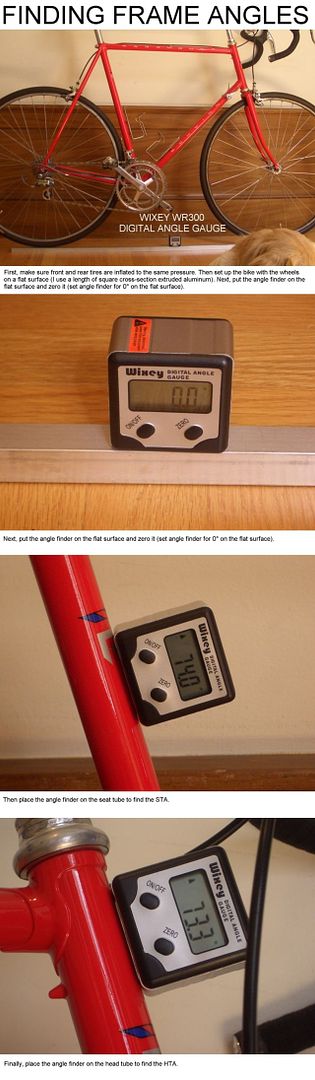
Here's how I measure frame angles using a Wixey digital angle gauge.
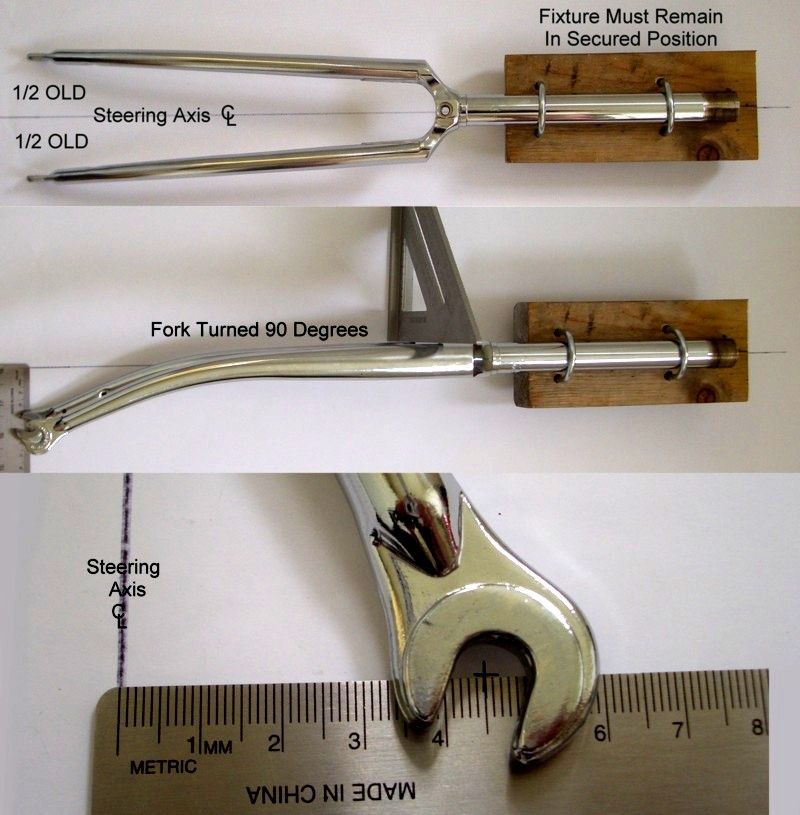
Finding fork offset (rake)
BB drop and wheelbase.

Here's the 1940 Paramount geometry after carefully measuring frame angles with the Wixey, BB drop, fork rake, wheelbase, and tubing lengths.

Finding fork offset (rake)
BB drop and wheelbase.
Here's the 1940 Paramount geometry after carefully measuring frame angles with the Wixey, BB drop, fork rake, wheelbase, and tubing lengths.
 11-19-11 | 01:49 AM
#5

Full Member
Joined: Sep 2009
Posts: 354
Likes: 0
Bikes: team miyata, '73 p-14, MB-3, centurion lemans, Mystery TT, mongoose atb '85
... *crickets* ...


 11-19-11 | 06:51 AM
#9

Senior Member

Joined: Aug 2010
Posts: 3,123
Likes: 98
From: Liberty, Missouri
Bikes: 1966 Paramount | 1971 Raleigh International | ca. 1970 Bernard Carre | 1989 Waterford Paramount | 2012 Boulder Brevet | 2019 Specialized Diverge
11-19-11 | 09:10 AM
#11
Thread Starter
Senior Member
Joined: Mar 2008
Posts: 5,630
Likes: 18
From: Rhode Island (an obscure suburb of Connecticut)
Bikes: one of each
This might work pretty well, too:
https://www.harborfreight.com/multipu...nder-1028.html
https://www.harborfreight.com/multipu...nder-1028.html
11-19-11 | 09:30 AM
#12
Decrepit Member
Joined: Aug 2005
Posts: 10,488
Likes: 94
From: Santa Rosa, California
Bikes: Waterford 953 RS-22, several Paramounts
As bigbossman pointed out in his post, the WR300 is $29.95 through amazon.com (and it has 0.1° resolution, accuracy, and repeatability).
Last edited by Scooper; 11-19-11 at 09:48 AM.
11-19-11 | 09:38 AM
#13

Measuring frame angles isn't where my ambition to measure frames hits the wall -- it's the BB drop and fork geometry that's complicated enough to get my attention distracted by other things. You have to be dedicated to this to do what Scooper's illustrated. Maybe if I had some purpose-built wooden stick tools that allowed me to measure these without disassembling a complete bike, or fitting fork to frame for those already torn down. Having a CAD template to draw the relevant "critical nodes" for a frame's geometry using input from measurements is also something that would help to visualize (and overlay multiple bikes) would be great too.
11-19-11 | 10:23 AM
#14

aka Tom Reingold


Joined: Jan 2009
Posts: 44,320
Likes: 6,606
From: New York, NY, and High Falls, NY, USA
Bikes: 1962 Rudge Sports, 1971 Raleigh Super Course, 1971 Raleigh Pro Track, 1974 Raleigh International, 1975 Viscount Fixie, 1982 McLean, 1996 Lemond (Ti), 2002 Burley Zydeco tandem
Stan! You the man!
__________________
Tom Reingold, tom@noglider.com
New York City and High Falls, NY
Blogs: The Experienced Cyclist; noglider's ride blog
“When man invented the bicycle he reached the peak of his attainments.” — Elizabeth West, US author
Please email me rather than PM'ing me. Thanks.
Tom Reingold, tom@noglider.com
New York City and High Falls, NY
Blogs: The Experienced Cyclist; noglider's ride blog
“When man invented the bicycle he reached the peak of his attainments.” — Elizabeth West, US author
Please email me rather than PM'ing me. Thanks.
11-19-11 | 12:32 PM
#15
Dolce far niente
Joined: Dec 2004
Posts: 10,710
Likes: 33
From: Southwest Idaho
That's the beauty of the Wixey WR300; you don't need a level surface, you just need a straight one. After you "zero" the WR300 on the straight surface, the measured tubing angles are relative to the straight surface the wheels are on.
As bigbossman pointed out in his post, the WR300 is $29.95 through amazon.com (and it has 0.1° resolution, accuracy, and repeatability).
As bigbossman pointed out in his post, the WR300 is $29.95 through amazon.com (and it has 0.1° resolution, accuracy, and repeatability).
__________________
"Love is not the dying moan of a distant violin, it’s the triumphant twang of a bedspring."
S. J. Perelman
"Love is not the dying moan of a distant violin, it’s the triumphant twang of a bedspring."
S. J. Perelman
 11-19-11 | 09:38 PM
#17

Senior Member
Joined: Apr 2005
Posts: 17,196
Likes: 761
From: Ann Arbor, MI
Bikes: 1980 Masi, 1984 Mondonico, 1984 Trek 610, 1980 Woodrup Giro, 2005 Mondonico Futura Leggera ELOS, 1967 PX10E, 1971 Peugeot UO-8
Yes the iPhone has angle/carpenter apps available, but both it and the Wixey share the issue that you have to lay the phone or the Wixey square against the surface to be measured. I know it's difficult on the phone, I'd expect it's easier on a Wixey. I use an 8 inch Craftsman digital level for the long tubes. If I lay it against the headset bearings I can get the angle across them. By measuring the ODs of those bearings, I can compute the deviation angle and get the head angle. I get the fork offset by fixturing it. I use a different technique than Scooper that is, I think, a little more consistent since it does not require aligning the fork tube with a specific pencil line. It only depends on getting the steer tube parallel to a flat table surface, then to measure the altitude of the axle center and the altitude of the steer tube axis. The difference between them is the fork offset.
Last edited by Road Fan; 11-19-11 at 09:46 PM.
11-19-11 | 09:49 PM
#18
Senior Member
Joined: Apr 2005
Posts: 17,196
Likes: 761
From: Ann Arbor, MI
Bikes: 1980 Masi, 1984 Mondonico, 1984 Trek 610, 1980 Woodrup Giro, 2005 Mondonico Futura Leggera ELOS, 1967 PX10E, 1971 Peugeot UO-8
With a good protractor, or a CAD program, you could make them out of cardboard and save the plywood. Or take a protractor and trim the ends that overhang the pivot off, to clear lugs. But the protractors I have would be no good for measuring obtuse angles (head tubes), so I think that cardboard templates are the best approach.
Measuring frame angles isn't where my ambition to measure frames hits the wall -- it's the BB drop and fork geometry that's complicated enough to get my attention distracted by other things. You have to be dedicated to this to do what Scooper's illustrated. Maybe if I had some purpose-built wooden stick tools that allowed me to measure these without disassembling a complete bike, or fitting fork to frame for those already torn down. Having a CAD template to draw the relevant "critical nodes" for a frame's geometry using input from measurements is also something that would help to visualize (and overlay multiple bikes) would be great too.
Measuring frame angles isn't where my ambition to measure frames hits the wall -- it's the BB drop and fork geometry that's complicated enough to get my attention distracted by other things. You have to be dedicated to this to do what Scooper's illustrated. Maybe if I had some purpose-built wooden stick tools that allowed me to measure these without disassembling a complete bike, or fitting fork to frame for those already torn down. Having a CAD template to draw the relevant "critical nodes" for a frame's geometry using input from measurements is also something that would help to visualize (and overlay multiple bikes) would be great too.
11-19-11 | 10:00 PM
#19
12-01-11 | 08:07 AM
#20
Full Member
Joined: Sep 2009
Posts: 354
Likes: 0
Bikes: team miyata, '73 p-14, MB-3, centurion lemans, Mystery TT, mongoose atb '85
sorry to awaken a sleeping thread, but the latest issue of Bicycle Quarterly has some interesting information about measuring frame angles from a photograph.
12-01-11 | 08:35 AM
#21

Curmudgeon in Training
Joined: May 2009
Posts: 1,956
Likes: 11
From: Rural Retreat, VA
Bikes: 1974 Gazelle Champion Mondial, 2010 Cannondale Trail SL, 1988 Peugeot Nice, 1992ish Stumpjumper Comp,1990's Schwinn Moab
Or.... you could just modify an adjustable triangle to fit over lugs and more easily measure the angles. They make them in various sizes which would work on everything but small frames.

They'll work on anything up to 90 degrees and can work on others if you're feeling creative. For bike purposes, nothing is going to be over 90 degrees. Just put it up against the tubes and measure away.
They'll work on anything up to 90 degrees and can work on others if you're feeling creative. For bike purposes, nothing is going to be over 90 degrees. Just put it up against the tubes and measure away.
12-01-11 | 10:37 PM
#22
Thread Starter
Senior Member
Joined: Mar 2008
Posts: 5,630
Likes: 18
From: Rhode Island (an obscure suburb of Connecticut)
Bikes: one of each
I'm gonna wake this thread up in a couple of weeks when I've had the time to do some work.
12-02-11 | 07:47 AM
#23
Senior Member
Joined: Apr 2005
Posts: 17,196
Likes: 761
From: Ann Arbor, MI
Bikes: 1980 Masi, 1984 Mondonico, 1984 Trek 610, 1980 Woodrup Giro, 2005 Mondonico Futura Leggera ELOS, 1967 PX10E, 1971 Peugeot UO-8
Or.... you could just modify an adjustable triangle to fit over lugs and more easily measure the angles. They make them in various sizes which would work on everything but small frames.
They'll work on anything up to 90 degrees and can work on others if you're feeling creative. For bike purposes, nothing is going to be over 90 degrees. Just put it up against the tubes and measure away.
They'll work on anything up to 90 degrees and can work on others if you're feeling creative. For bike purposes, nothing is going to be over 90 degrees. Just put it up against the tubes and measure away.
12-02-11 | 08:42 AM
#24
Curmudgeon in Training
Joined: May 2009
Posts: 1,956
Likes: 11
From: Rural Retreat, VA
Bikes: 1974 Gazelle Champion Mondial, 2010 Cannondale Trail SL, 1988 Peugeot Nice, 1992ish Stumpjumper Comp,1990's Schwinn Moab
Great for seat/top angles, not so good for top/head, down/head, or seat/down if you have a clamp derailleur, any computer wires, a water cage, or other stuff attached to the frame. I prefer the digital levels. You just have to work out a protocol for head tubes on smaller frames.
12-02-11 | 09:02 AM
#25
I made up some hardwood slides that fit over an 80x20 alloy extrusion with axles. I am not crazy with the tires on the ground, I would go bare rims if the bike was together.
Referencing off the axle centers will give the best info though in my mind and is how a framebuilder would replicate a bike.
The little digital angle finder is a nice one it appears, small enough, most are not, I had to use a 1/2/3 block to offset mine for the head tube.
IF the axle plane or base plane is level then the angle measures will be good. the fork can be arrived at without taking it apart, but I appreciate the element accuracy.
I think noting bottom bracket drop is important.
One thing not to do is assume that the top tube is level, it more than not isn't.
For measuring top tube ctc length I place some masking tape on the joints and draw the intersections out.
Referencing off the axle centers will give the best info though in my mind and is how a framebuilder would replicate a bike.
The little digital angle finder is a nice one it appears, small enough, most are not, I had to use a 1/2/3 block to offset mine for the head tube.
IF the axle plane or base plane is level then the angle measures will be good. the fork can be arrived at without taking it apart, but I appreciate the element accuracy.
I think noting bottom bracket drop is important.
One thing not to do is assume that the top tube is level, it more than not isn't.
For measuring top tube ctc length I place some masking tape on the joints and draw the intersections out.