


suggestions on aligning a fork?
 03-11-12 | 04:48 PM
#1

Thread Starter
Senior Member
Joined: Jun 2007
Posts: 4,809
Likes: 7
From: WA state
suggestions on aligning a fork?
Just picked up a bike and the wheel is slightly cocked to one side when sitting in the front drops (about 5mm off at the top of the tire). The fork isn't visibly bent, but the dropouts don't look quite paralell. I really want to save this fork, is there any way I can pull it off?
 03-11-12 | 06:03 PM
#2

Senior Member


Joined: Aug 2003
Posts: 13,973
Likes: 145
From: Tampa, Florida
The obvious answer is to buy the forke end/drop out alignment tools.....
But, if you dont have them a cheap work around would be to rig up something using threaded rod and nuts and washers. This seatup isnt strong/sturdy enough to allow alignment but you could gt an idea of how far its off.
Assuming you flipped the to verify its dish (it should sit in the fork the same when flipped) and off center measurement of 5mm could be 1 leg bent forward or back or both legs bent to side.
Good luck....
If my vice was set-up I'd offer to throw it in my jig.
But, if you dont have them a cheap work around would be to rig up something using threaded rod and nuts and washers. This seatup isnt strong/sturdy enough to allow alignment but you could gt an idea of how far its off.
Assuming you flipped the to verify its dish (it should sit in the fork the same when flipped) and off center measurement of 5mm could be 1 leg bent forward or back or both legs bent to side.
Good luck....
If my vice was set-up I'd offer to throw it in my jig.
03-11-12 | 06:08 PM
#3
Thread Starter
Senior Member
Joined: Jun 2007
Posts: 4,809
Likes: 7
From: WA state
Yeah I flipped the wheel and it's the same either way. So the park dropout alignment tool can also align the fork? If so I might have to just buy it. Sheldon's website says to bend it with your foot then ride it to check if it worked (lol), but I would rather do something more precise. I might call a shop and see of anyone around here can do it for a reasonable price... It's a chrome super vitus 980 fork, very nice, very light
 03-11-12 | 06:55 PM
#5

Senior Member


Joined: Dec 2008
Posts: 1,794
Likes: 83
From: Sendai, Japan: Tohoku region (Northern Honshu))
Bikes: Vitus 979, Simplon 4-Star, Woodrup, Gazelle AB, Dawes Atlantis
Interesting question. I did not think about this very much until the last time I saw the local frame-maker. I had three frames for him to check out. I told him that I wanted all three fork drop-outs aligned in addition to the rears, which formerly I had considered to the exclusion of the fronts. In addition to knowing that the wheel gets mounted true, the ease of slickly popping the front wheel in and out really makes a nice experience.
Mazda: I'll be following to see what you finally do.
Mazda: I'll be following to see what you finally do.
__________________
Vitus 979, Simplon 4 Star, Gazelle Champion Mondial, Woodrup Giro, Dawes Atlantis
Vitus 979, Simplon 4 Star, Gazelle Champion Mondial, Woodrup Giro, Dawes Atlantis
03-13-12 | 04:58 AM
#6

Ride, Wrench, Swap, Race
Joined: Jan 2010
Posts: 9,814
Likes: 1,790
From: Northern California
Bikes: Cheltenham-Pedersen racer, Boulder F/S Paris-Roubaix, Varsity racer, '52 Christophe, '62 Continental, '92 Merckx, '75 Limongi, '76 Presto, '72 Gitane SC, '71 Schwinn SS, etc.
Sheldon Brown was quite right imo.
Aligning the dropouts really isn't going to correct the tire not being centered within the crown.
Firstly, there are two ways to re-center the tire within the crown:
1) The fork blades are both bent to the right or left, moving the wheel in the same direction.
2) The dropout slot is filed deeper to tilt the wheel inone direction or the other.
The first thing to do is determine which approach is appropriate:
Riding the bike (with a smooth headset), does the wheel turn itself to the left or right?
Use one hand, then the other. Can you ride straight by only pushing foreward on one side of the bar or the other? Which side?
If you're pushing foreward with your right hand, the wheel and bike is pulling to the right.
To correct for a rightward pull, the tire contact patch needs to be moved to the right, either by bending both legs to the right, or by filing the right dropout deeper.
Note that tilting the wheel by filing will also move the tire in the opposite direction within the fork crown!
Whichever of those two methods corrects the steering and ALSO centers the tire within the crown, that's the method to use. It's not a matter of being able to simply use the easier (filing) method unless that corrects both issues, and a wrong choice may ruin the fork.
For filing the dropout deeper, you'll need a sharp round file.
For bending the legs, follow these steps:
First measure the space between the fork tips. It should match your hub and is usually 100mm.
Lay the bike on the side you want to move the rim toward. Weight should be borne by pedal, handlebar and saddle, with pads under each point. Rotating the crank to a best position by trial and error will help balance everything when thebending starts.
With hands on the bars and seat post, use one foot to push one dropout toward the floor. It will spring back until you've increased the force beyond a certain level. You will measure the distance between fork tips several times while repeating this, until you achieve 1-3mm of bend movement that holds.
Note that you can recover about 1mm of that bending with a much smaller force in the opposite direction. That's metal stress memory.
You will then do the same to the other leg, until the distance between fork tips again matches the hub's width.
Never try to over-correct, except as a final stress-relieving where you'll bend the leg "back" that 1mm of memory. It's better to ride the bike and test it between efforts, with a periodic re-evaluation of whether it is still better to bend or file your way to a perfect alignment.
Note that this is physical, hard work. Hard on the back when the wheel may have to be re-fitted many times and you'll have to squat down to measure the dropout spacing many, many times. The actual bending borders on gymnastic. You gotta be good, and patience is paramount.
Chainstays are done much the same way, during which the seat stays are nearly ignored. Rear dropouts sometimes need to get filed too. Filing front or rear dropouts is more about correcting a poorly-built frame than fixing a damaged one.
The rewards are that the job gets done, and that the task will get a little easier each time you do it, maybe.
I say maybe because there is a huge variability between frame tubings. Some almost melt, and some are like very stiff springs. I've more or less straightened them all, and at only 158 pounds, I've been challenged by some. Creating a sufficiently-impactful bending load with accuracy can definitely be challenging.
Lastly, you don't want to damage your fork by buckling it or bending it wildly. It takes a solid amount of confidence to do these repairs.
You can experiment on cheap frames, but remember they can be re-bent a whole lot easier than Columbus SL.
You really have to be a little cockey doing frame/fork repair this way, but you can actually do it roadside with no tools using only your wheel hub as a measuring guage. I've done that, not only in emergencies, but as part of getting a vintage bike finely sorted out while also trying to get in a longer ride. Practice makes almost perfect.
Always a bit of risk. I've done well over a hundred, and haven't wrecked one yet. But, I broke a fork tip off the other day by trying to twist out a frozen stem while holding the front wheel between my knees. Cheap Motobecane fork, but took hours to correct in the end, with a UO8 fork, stripped-to-chrome, rethreaded (BSA) and shortened steerer. That bike lives on!
BTW, about half of the used road bikes I buy have alignment issues. Usually it's cheaper ones, easier to bend and treated roughly by previous owners. And some (especially lower end frames)are no doubt made that way.
Aligning the dropouts really isn't going to correct the tire not being centered within the crown.
Firstly, there are two ways to re-center the tire within the crown:
1) The fork blades are both bent to the right or left, moving the wheel in the same direction.
2) The dropout slot is filed deeper to tilt the wheel inone direction or the other.
The first thing to do is determine which approach is appropriate:
Riding the bike (with a smooth headset), does the wheel turn itself to the left or right?
Use one hand, then the other. Can you ride straight by only pushing foreward on one side of the bar or the other? Which side?
If you're pushing foreward with your right hand, the wheel and bike is pulling to the right.
To correct for a rightward pull, the tire contact patch needs to be moved to the right, either by bending both legs to the right, or by filing the right dropout deeper.
Note that tilting the wheel by filing will also move the tire in the opposite direction within the fork crown!
Whichever of those two methods corrects the steering and ALSO centers the tire within the crown, that's the method to use. It's not a matter of being able to simply use the easier (filing) method unless that corrects both issues, and a wrong choice may ruin the fork.
For filing the dropout deeper, you'll need a sharp round file.
For bending the legs, follow these steps:
First measure the space between the fork tips. It should match your hub and is usually 100mm.
Lay the bike on the side you want to move the rim toward. Weight should be borne by pedal, handlebar and saddle, with pads under each point. Rotating the crank to a best position by trial and error will help balance everything when thebending starts.
With hands on the bars and seat post, use one foot to push one dropout toward the floor. It will spring back until you've increased the force beyond a certain level. You will measure the distance between fork tips several times while repeating this, until you achieve 1-3mm of bend movement that holds.
Note that you can recover about 1mm of that bending with a much smaller force in the opposite direction. That's metal stress memory.
You will then do the same to the other leg, until the distance between fork tips again matches the hub's width.
Never try to over-correct, except as a final stress-relieving where you'll bend the leg "back" that 1mm of memory. It's better to ride the bike and test it between efforts, with a periodic re-evaluation of whether it is still better to bend or file your way to a perfect alignment.
Note that this is physical, hard work. Hard on the back when the wheel may have to be re-fitted many times and you'll have to squat down to measure the dropout spacing many, many times. The actual bending borders on gymnastic. You gotta be good, and patience is paramount.
Chainstays are done much the same way, during which the seat stays are nearly ignored. Rear dropouts sometimes need to get filed too. Filing front or rear dropouts is more about correcting a poorly-built frame than fixing a damaged one.
The rewards are that the job gets done, and that the task will get a little easier each time you do it, maybe.
I say maybe because there is a huge variability between frame tubings. Some almost melt, and some are like very stiff springs. I've more or less straightened them all, and at only 158 pounds, I've been challenged by some. Creating a sufficiently-impactful bending load with accuracy can definitely be challenging.
Lastly, you don't want to damage your fork by buckling it or bending it wildly. It takes a solid amount of confidence to do these repairs.
You can experiment on cheap frames, but remember they can be re-bent a whole lot easier than Columbus SL.
You really have to be a little cockey doing frame/fork repair this way, but you can actually do it roadside with no tools using only your wheel hub as a measuring guage. I've done that, not only in emergencies, but as part of getting a vintage bike finely sorted out while also trying to get in a longer ride. Practice makes almost perfect.
Always a bit of risk. I've done well over a hundred, and haven't wrecked one yet. But, I broke a fork tip off the other day by trying to twist out a frozen stem while holding the front wheel between my knees. Cheap Motobecane fork, but took hours to correct in the end, with a UO8 fork, stripped-to-chrome, rethreaded (BSA) and shortened steerer. That bike lives on!
BTW, about half of the used road bikes I buy have alignment issues. Usually it's cheaper ones, easier to bend and treated roughly by previous owners. And some (especially lower end frames)are no doubt made that way.
Last edited by dddd; 03-13-12 at 05:16 AM.
03-13-12 | 05:38 AM
#7

Senior Member
Joined: May 2010
Posts: 3,904
Likes: 36
From: Hurricane Alley , Florida
Bikes: Treks (USA), Schwinn Paramount, Schwinn letour,Raleigh Team Professional, Gazelle GoldLine Racing, 2 Super Mondias, Carlton Professional.
Take a look at this. Good info on frame and fork alignment.
https://www.bcltechnologies.com/docum...les/sample.pdf
https://www.bcltechnologies.com/docum...les/sample.pdf
03-13-12 | 05:43 AM
#8
Senior Member
Joined: Aug 2003
Posts: 13,973
Likes: 145
From: Tampa, Florida
Sheldon Brown was quite right imo.
Aligning the dropouts really isn't going to correct the tire not being centered within the crown.
Firstly, there are two ways to re-center the tire within the crown:
1) The fork blades are both bent to the right or left, moving the wheel in the same direction.
2) The dropout slot is filed deeper to tilt the wheel inone direction or the other.
The first thing to do is determine which approach is appropriate:
Riding the bike (with a smooth headset), does the wheel turn itself to the left or right?
Use one hand, then the other. Can you ride straight by only pushing foreward on one side of the bar or the other? Which side?
If you're pushing foreward with your right hand, the wheel and bike is pulling to the right.
To correct for a rightward pull, the tire contact patch needs to be moved to the right, either by bending both legs to the right, or by filing the right dropout deeper.
Note that tilting the wheel by filing will also move the tire in the opposite direction within the fork crown!
Whichever of those two methods corrects the steering and ALSO centers the tire within the crown, that's the method to use. It's not a matter of being able to simply use the easier (filing) method unless that corrects both issues, and a wrong choice may ruin the fork.
For filing the dropout deeper, you'll need a sharp round file.
For bending the legs, follow these steps:
First measure the space between the fork tips. It should match your hub and is usually 100mm.
Lay the bike on the side you want to move the rim toward. Weight should be borne by pedal, handlebar and saddle, with pads under each point. Rotating the crank to a best position by trial and error will help balance everything when thebending starts.
With hands on the bars and seat post, use one foot to push one dropout toward the floor. It will spring back until you've increased the force beyond a certain level. You will measure the distance between fork tips several times while repeating this, until you achieve 1-3mm of bend movement that holds.
Note that you can recover about 1mm of that bending with a much smaller force in the opposite direction. That's metal stress memory.
You will then do the same to the other leg, until the distance between fork tips again matches the hub's width.
Never try to over-correct, except as a final stress-relieving where you'll bend the leg "back" that 1mm of memory. It's better to ride the bike and test it between efforts, with a periodic re-evaluation of whether it is still better to bend or file your way to a perfect alignment.
Note that this is physical, hard work. Hard on the back when the wheel may have to be re-fitted many times and you'll have to squat down to measure the dropout spacing many, many times. The actual bending borders on gymnastic. You gotta be good, and patience is paramount.
Chainstays are done much the same way, during which the seat stays are nearly ignored. Rear dropouts sometimes need to get filed too. Filing front or rear dropouts is more about correcting a poorly-built frame than fixing a damaged one.
The rewards are that the job gets done, and that the task will get a little easier each time you do it, maybe.
I say maybe because there is a huge variability between frame tubings. Some almost melt, and some are like very stiff springs. I've more or less straightened them all, and at only 158 pounds, I've been challenged by some. Creating a sufficiently-impactful bending load with accuracy can definitely be challenging.
Lastly, you don't want to damage your fork by buckling it or bending it wildly. It takes a solid amount of confidence to do these repairs.
You can experiment on cheap frames, but remember they can be re-bent a whole lot easier than Columbus SL.
You really have to be a little cockey doing frame/fork repair this way, but you can actually do it roadside with no tools using only your wheel hub as a measuring guage. I've done that, not only in emergencies, but as part of getting a vintage bike finely sorted out while also trying to get in a longer ride. Practice makes almost perfect.
Always a bit of risk. I've done well over a hundred, and haven't wrecked one yet. But, I broke a fork tip off the other day by trying to twist out a frozen stem while holding the front wheel between my knees. Cheap Motobecane fork, but took hours to correct in the end, with a UO8 fork, stripped-to-chrome, rethreaded (BSA) and shortened steerer. That bike lives on!
BTW, about half of the used road bikes I buy have alignment issues. Usually it's cheaper ones, easier to bend and treated roughly by previous owners. And some (especially lower end frames)are no doubt made that way.
Aligning the dropouts really isn't going to correct the tire not being centered within the crown.
Firstly, there are two ways to re-center the tire within the crown:
1) The fork blades are both bent to the right or left, moving the wheel in the same direction.
2) The dropout slot is filed deeper to tilt the wheel inone direction or the other.
The first thing to do is determine which approach is appropriate:
Riding the bike (with a smooth headset), does the wheel turn itself to the left or right?
Use one hand, then the other. Can you ride straight by only pushing foreward on one side of the bar or the other? Which side?
If you're pushing foreward with your right hand, the wheel and bike is pulling to the right.
To correct for a rightward pull, the tire contact patch needs to be moved to the right, either by bending both legs to the right, or by filing the right dropout deeper.
Note that tilting the wheel by filing will also move the tire in the opposite direction within the fork crown!
Whichever of those two methods corrects the steering and ALSO centers the tire within the crown, that's the method to use. It's not a matter of being able to simply use the easier (filing) method unless that corrects both issues, and a wrong choice may ruin the fork.
For filing the dropout deeper, you'll need a sharp round file.
For bending the legs, follow these steps:
First measure the space between the fork tips. It should match your hub and is usually 100mm.
Lay the bike on the side you want to move the rim toward. Weight should be borne by pedal, handlebar and saddle, with pads under each point. Rotating the crank to a best position by trial and error will help balance everything when thebending starts.
With hands on the bars and seat post, use one foot to push one dropout toward the floor. It will spring back until you've increased the force beyond a certain level. You will measure the distance between fork tips several times while repeating this, until you achieve 1-3mm of bend movement that holds.
Note that you can recover about 1mm of that bending with a much smaller force in the opposite direction. That's metal stress memory.
You will then do the same to the other leg, until the distance between fork tips again matches the hub's width.
Never try to over-correct, except as a final stress-relieving where you'll bend the leg "back" that 1mm of memory. It's better to ride the bike and test it between efforts, with a periodic re-evaluation of whether it is still better to bend or file your way to a perfect alignment.
Note that this is physical, hard work. Hard on the back when the wheel may have to be re-fitted many times and you'll have to squat down to measure the dropout spacing many, many times. The actual bending borders on gymnastic. You gotta be good, and patience is paramount.
Chainstays are done much the same way, during which the seat stays are nearly ignored. Rear dropouts sometimes need to get filed too. Filing front or rear dropouts is more about correcting a poorly-built frame than fixing a damaged one.
The rewards are that the job gets done, and that the task will get a little easier each time you do it, maybe.
I say maybe because there is a huge variability between frame tubings. Some almost melt, and some are like very stiff springs. I've more or less straightened them all, and at only 158 pounds, I've been challenged by some. Creating a sufficiently-impactful bending load with accuracy can definitely be challenging.
Lastly, you don't want to damage your fork by buckling it or bending it wildly. It takes a solid amount of confidence to do these repairs.
You can experiment on cheap frames, but remember they can be re-bent a whole lot easier than Columbus SL.
You really have to be a little cockey doing frame/fork repair this way, but you can actually do it roadside with no tools using only your wheel hub as a measuring guage. I've done that, not only in emergencies, but as part of getting a vintage bike finely sorted out while also trying to get in a longer ride. Practice makes almost perfect.
Always a bit of risk. I've done well over a hundred, and haven't wrecked one yet. But, I broke a fork tip off the other day by trying to twist out a frozen stem while holding the front wheel between my knees. Cheap Motobecane fork, but took hours to correct in the end, with a UO8 fork, stripped-to-chrome, rethreaded (BSA) and shortened steerer. That bike lives on!
BTW, about half of the used road bikes I buy have alignment issues. Usually it's cheaper ones, easier to bend and treated roughly by previous owners. And some (especially lower end frames)are no doubt made that way.
Mazdaspeed, if you want to screw-up your Super Vitus fork follow Sheldons advice.....go ahead, place that ultra-lightweight fork on the floor and step on it.
Fork end alignemnt tools, if you know how to use them, will align the legs and ends....if you know how to use them.
03-13-12 | 06:50 AM
#9

Bianchi Goddess
Joined: Apr 2009
Posts: 28,907
Likes: 4,149
From: Shady Pines Retirement Fort Wayne, In
Bikes: Too many to list here check my signature.
Jim I have to disagree with you and throw in with Oldroads lot. I think if the wheel looks off simply using dropout alignment tools on the forkends (do they even fit?) you need a fork guage to ensure the blades are straight and in alignment with the centerline of the steerer.
I can't find a pic of one to show unfortunately.
AH HA! here is the VAR version, it recently sold on ebay for $470. Park seems to have discontuned theirs.

I can't find a pic of one to show unfortunately.
AH HA! here is the VAR version, it recently sold on ebay for $470. Park seems to have discontuned theirs.
__________________
“One morning you wake up, the girl is gone, the bikes are gone, all that's left behind is a pair of old tires and a tube of tubular glue, all squeezed out"
Sugar "Kane" Kowalczyk
“One morning you wake up, the girl is gone, the bikes are gone, all that's left behind is a pair of old tires and a tube of tubular glue, all squeezed out"
Sugar "Kane" Kowalczyk
Last edited by Bianchigirll; 03-13-12 at 07:01 AM.
03-13-12 | 02:08 PM
#10
Ride, Wrench, Swap, Race
Joined: Jan 2010
Posts: 9,814
Likes: 1,790
From: Northern California
Bikes: Cheltenham-Pedersen racer, Boulder F/S Paris-Roubaix, Varsity racer, '52 Christophe, '62 Continental, '92 Merckx, '75 Limongi, '76 Presto, '72 Gitane SC, '71 Schwinn SS, etc.
Remember, Sheldon was old-school.
Like many of his generation, the do-it-yourself-with-what-you-have approach would have been well-honed, and that makes the difference.
I can find myself agreeing with MiamiJim that a first try at fork bending on an expensive frame really might not be a good idea, especially if the owner isn't experienced in the general art of metal-bending.
But for some of us, who may have had the privelege of having enough spare time and some good thrift or dumpster-sourced frames to work on, this fork-aligning business is relatively trivial, and I've not been embarrased to to perform the work in front of a bike's nervous owner.
Lastly, I would usually rather have someone work on my frame who had experience and a full understanding of the diagnostic procedure than have a less-experienced mechanic have a go even with the newest or best tools.
Usually the more-experienced mechanics have the good tools, but not always, and probably not every tool that they might ever need.
Case in point would be the Motobecane that I had to replace the fork on. I have only an English-threaded steerer die, but experience teaches me that it will cut nearly full-sized English threading on a smaller French steerer, which saved me from the delay and expense of searching out a chromed replacement fork with a long steerer. For a cheap bike like this one, experience was golden and the bike was literally saved from the dump. A good question then might be, how did I know this would work?
I've seen seasoned shop owners quickly do a very creditable job cutting down a 27.0 JIS fork steerer using a hand file.
Technique is everything, and the Campy tool won't slide over some of the bonded-in steerers from the early 1990's.
Sure, a lathe is better in this case, but only if the lathe operator knows how not to cut off center (the rotating fork is NOT balanced) and only if they get the right amount of press fit so as not to crack the headset race.
Like many of his generation, the do-it-yourself-with-what-you-have approach would have been well-honed, and that makes the difference.
I can find myself agreeing with MiamiJim that a first try at fork bending on an expensive frame really might not be a good idea, especially if the owner isn't experienced in the general art of metal-bending.
But for some of us, who may have had the privelege of having enough spare time and some good thrift or dumpster-sourced frames to work on, this fork-aligning business is relatively trivial, and I've not been embarrased to to perform the work in front of a bike's nervous owner.
Lastly, I would usually rather have someone work on my frame who had experience and a full understanding of the diagnostic procedure than have a less-experienced mechanic have a go even with the newest or best tools.
Usually the more-experienced mechanics have the good tools, but not always, and probably not every tool that they might ever need.
Case in point would be the Motobecane that I had to replace the fork on. I have only an English-threaded steerer die, but experience teaches me that it will cut nearly full-sized English threading on a smaller French steerer, which saved me from the delay and expense of searching out a chromed replacement fork with a long steerer. For a cheap bike like this one, experience was golden and the bike was literally saved from the dump. A good question then might be, how did I know this would work?
I've seen seasoned shop owners quickly do a very creditable job cutting down a 27.0 JIS fork steerer using a hand file.
Technique is everything, and the Campy tool won't slide over some of the bonded-in steerers from the early 1990's.
Sure, a lathe is better in this case, but only if the lathe operator knows how not to cut off center (the rotating fork is NOT balanced) and only if they get the right amount of press fit so as not to crack the headset race.
Last edited by dddd; 03-13-12 at 02:33 PM.
03-13-12 | 02:17 PM
#11


^ my LBS does that, eyeball alignment using "crude" methods at times. Usually not in front of customers though. Funny to see them put a foot to a frame or fork and call it a "precision alignment tool".
__________________
1989 Schwinn Paramount OS
1980 Mclean/Silk Hope Sport Touring
1983 Bianchi pista
1976 Fuji Feather track
1979 raleigh track
"I've consulted my sources and I'm pretty sure your derailleur does not exist"
1989 Schwinn Paramount OS
1980 Mclean/Silk Hope Sport Touring
1983 Bianchi pista
1976 Fuji Feather track
1979 raleigh track
"I've consulted my sources and I'm pretty sure your derailleur does not exist"
03-13-12 | 02:46 PM
#12
Banned
Joined: Jun 2010
Posts: 43,586
Likes: 1,380
From: NW,Oregon Coast
Bikes: 8
a V block holds round things, then you lay out a straight line on a base plate , then measure
the deviations off symmetry at the fork end,
you need the fork crown to be parallel to the base-plane so that needs to be blocked up level.
the strong arm to bend the blades is an extra item,
as is the way you hold the fork while the effort is applied.
the deviations off symmetry at the fork end,
you need the fork crown to be parallel to the base-plane so that needs to be blocked up level.
the strong arm to bend the blades is an extra item,
as is the way you hold the fork while the effort is applied.
03-13-12 | 03:36 PM
#13
Senior Member
Joined: Aug 2003
Posts: 13,973
Likes: 145
From: Tampa, Florida
Jim I have to disagree with you and throw in with Oldroads lot. I think if the wheel looks off simply using dropout alignment tools on the forkends (do they even fit?) you need a fork guage to ensure the blades are straight and in alignment with the centerline of the steerer.
I can't find a pic of one to show unfortunately.
AH HA! here is the VAR version, it recently sold on ebay for $470. Park seems to have discontuned theirs.
I can't find a pic of one to show unfortunately.
AH HA! here is the VAR version, it recently sold on ebay for $470. Park seems to have discontuned theirs.
If both dropout tool faces are 'faced' or 'parrallel' with one another yet one is higher than the other or one is more forward it means the fork legs are moved to the side or one is moved forward (or back)
If you'ved ever used the tools are were like, "wtf, why cant I get the ends aligned" its because one or both of the legs is off. I guess its something that's learned over time.
03-13-12 | 04:11 PM
#14

Senior Member
Joined: Apr 2007
Posts: 12,565
Likes: 2,740
From: Thunder Bay, Ontario, Canada - burrrrr!
Bikes: 1958 Rabeneick 120D, 1968 Legnano Gran Premio, 196? Torpado Professional, 2000 Marinoni Piuma
When I have to work on a fork, I use the fork alignment gauge. Basically, it is a tool that will tell you if the fork drops are centered in the same plane. Once this is achieve, a bit of time lining up the drops and you might be done. Then again, you might have to tweak this and that before they are on the money.
As far as I am concerned, it is more difficult to straighten out a fork set, than it is to straighten out a frame. But that is just me.


As far as I am concerned, it is more difficult to straighten out a fork set, than it is to straighten out a frame. But that is just me.
__________________
"98% of the bikes I buy are projects".
"98% of the bikes I buy are projects".
03-13-12 | 04:22 PM
#15

Senior Member
Joined: Apr 2009
Posts: 10,303
Likes: 60
From: Detroit
a V block holds round things, then you lay out a straight line on a base plate , then measure
the deviations off symmetry at the fork end,
you need the fork crown to be parallel to the base-plane so that needs to be blocked up level.
the strong arm to bend the blades is an extra item,
as is the way you hold the fork while the effort is applied.
the deviations off symmetry at the fork end,
you need the fork crown to be parallel to the base-plane so that needs to be blocked up level.
the strong arm to bend the blades is an extra item,
as is the way you hold the fork while the effort is applied.
+1
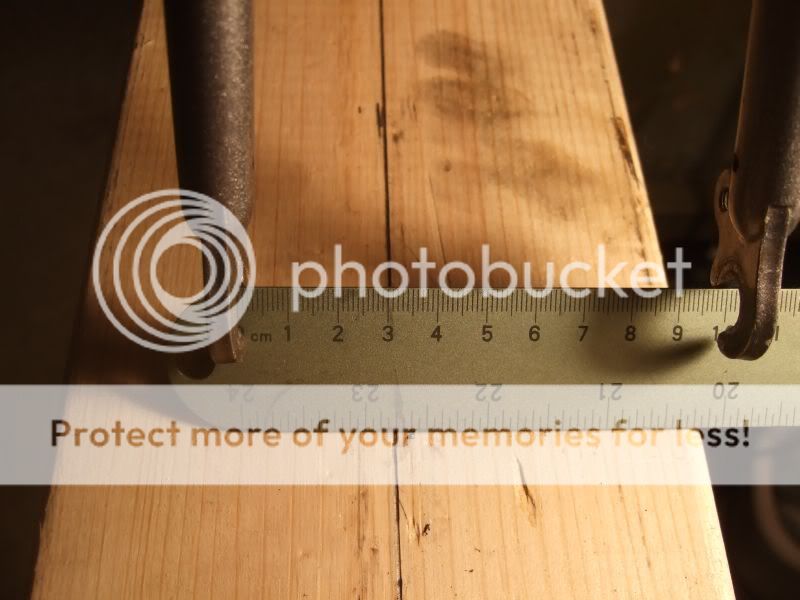
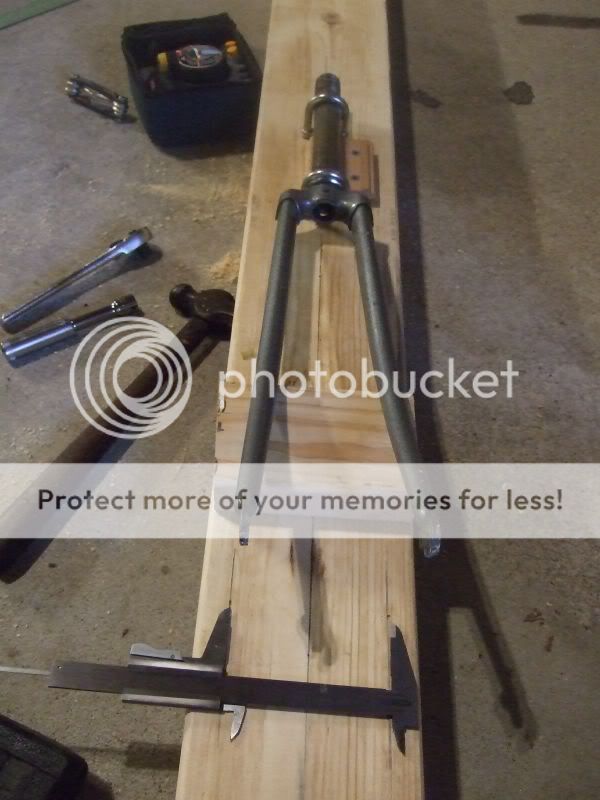
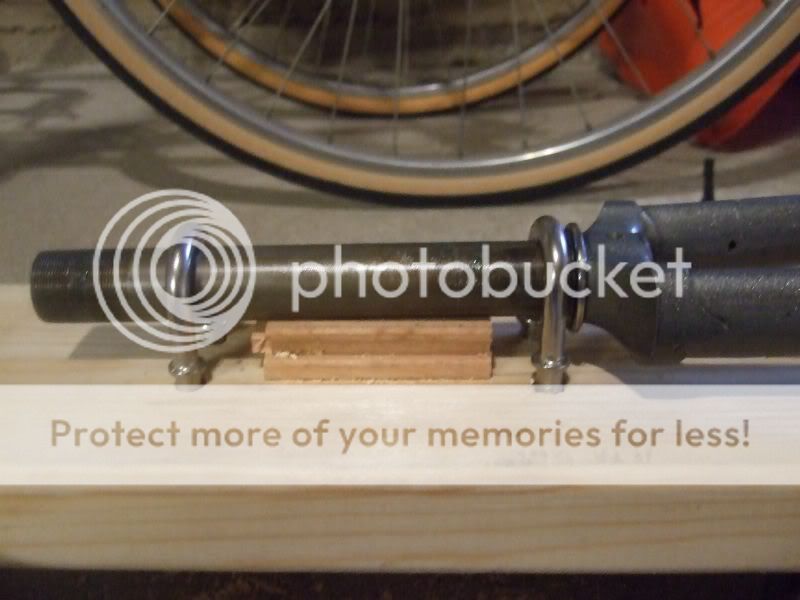
I certainly haven't done hundreds of them, but I've had pretty good luck with a v-block (u-bolt) arrangement to hold the steerer relative to a center-line.
The fork below was whacked over to the left and having even a such simple gage as this helped be get a handle on the direction and extent to whick the fork needed to be righted. Still, it's best to proceed slowly -patience is key, because it's not hard to over do things.
I just not feel confident/practiced enough to employ Sheldon's method.
__________________
- Auchen
- Auchen
03-13-12 | 04:25 PM
#16
Thread Starter
Senior Member
Joined: Jun 2007
Posts: 4,809
Likes: 7
From: WA state
Thanks for all of the opinions and ideas. I talked to a guy in town and he said to bring it by his shop, if it can be aligned (which I'm sure it can) he said it will cost $15-40 depending on how screwed up it is (not very). I might just go that route to make sure it's done right, I can always try to do it myself if it comes down to it.
03-13-12 | 11:30 PM
#17
Ride, Wrench, Swap, Race
Joined: Jan 2010
Posts: 9,814
Likes: 1,790
From: Northern California
Bikes: Cheltenham-Pedersen racer, Boulder F/S Paris-Roubaix, Varsity racer, '52 Christophe, '62 Continental, '92 Merckx, '75 Limongi, '76 Presto, '72 Gitane SC, '71 Schwinn SS, etc.
Sounds great, and is what I did after getting nailed by a hit/run car coming out of the Pizza&Brew at night, in the rain, back in 1993 in L.A.
The fork straightening on that Stumpjumper fork required mucho extra force anyway, and the LBS guy did the work while I waited after hours for a 6-pack.
One advantage of the foot method is not having to take the frame-fork apart.
I've even corrected a main frame triangle by leaving the front wheel in place and bouncing the whole thing back into plane, that after I bought a defective, new leftover 1984 Trek720 and met resistance from the dealer about correcting it under warranty.
That, I believe, was my very first frame-straightening, and I had the frame supported on two picnic benches, literally using it like a trampoline while marveling over the Reynolds 531's stubborn resilience.
I still have that bike, and it still rides straight. Maybe I was lucky.
The fork straightening on that Stumpjumper fork required mucho extra force anyway, and the LBS guy did the work while I waited after hours for a 6-pack.
One advantage of the foot method is not having to take the frame-fork apart.
I've even corrected a main frame triangle by leaving the front wheel in place and bouncing the whole thing back into plane, that after I bought a defective, new leftover 1984 Trek720 and met resistance from the dealer about correcting it under warranty.
That, I believe, was my very first frame-straightening, and I had the frame supported on two picnic benches, literally using it like a trampoline while marveling over the Reynolds 531's stubborn resilience.
I still have that bike, and it still rides straight. Maybe I was lucky.

