Vintage Headlights
 12-19-12 | 12:25 AM
#1

Thread Starter
Senior Member
Joined: Aug 2008
Posts: 204
Likes: 0
Vintage Headlights
My Raleigh Sports came with a Sturmey Archer front Dynohub and the original front and rear head lights. I purchased a vintage looking Bobbin Classic Deluxe for my wife and it also has a Dynohub with a headlight. We actually like to ride at night, but as headlights, these suck! I'm used to using Cygolites on my bikes for my night riding and would like to upgrade. I'd like to keep the vintage look and came up with two options. Both are LED lights - one is battery powered and the other via the dynohub.
Can anyone comment on how much brighter these two lights would be versus the original stock filament bulb? Is it worth it or do I install a Cygolite for night riding and keep the originals for looks only?
Option 1 - Battery powered LED Light
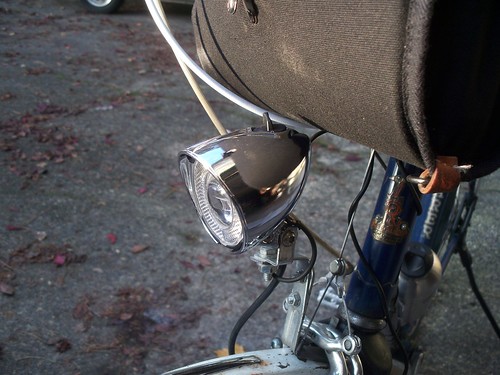
Option 2 - Dyno Powered LED Busch & Muller HL Classic
Thanks
Canflyboy
Can anyone comment on how much brighter these two lights would be versus the original stock filament bulb? Is it worth it or do I install a Cygolite for night riding and keep the originals for looks only?
Option 1 - Battery powered LED Light
Option 2 - Dyno Powered LED Busch & Muller HL Classic
Thanks
Canflyboy
 12-19-12 | 12:38 AM
#2

Senior Member
Joined: Oct 2009
Posts: 2,470
Likes: 4
From: Minneapolis
Bikes: -1973 Motobecane Mirage -197? Velosolex L'Etoile -'71 Raleigh Super Course
There is absolutely no comparison; the LEDs do such a much better job. Now, that said, simply upgrading to a halogen or Krypton bulb helps a great deal. On my 6v systems, I like to run a 4.8V Krypton bulb. "Overclocking" the bulb takes a good bit of life out of them, but I also get a lot more light. Some-- our own Forumite Minisystem-- have had good luck retrofitting LEDs into vintage shells. I tried it and my results were lousy: the reflectors weren't designed with a tiny bright point source shining only forward in mind.
Some of the folks at the Candlepower forums are getting better results, but I don't know any specifics.
Some of the folks at the Candlepower forums are getting better results, but I don't know any specifics.
12-19-12 | 01:34 AM
#3
Full Member

Joined: May 2012
Posts: 254
Likes: 23
From: Belgium, Bicycle country
Bikes: 50 ? More?
I came to have a look, the post title was attracting me.
I use other race vintage bikes with removable lights to cycle at night
But for the older ones, I'll keep to the original lights
Here is the front lamps of my 1936-37 Bekaert
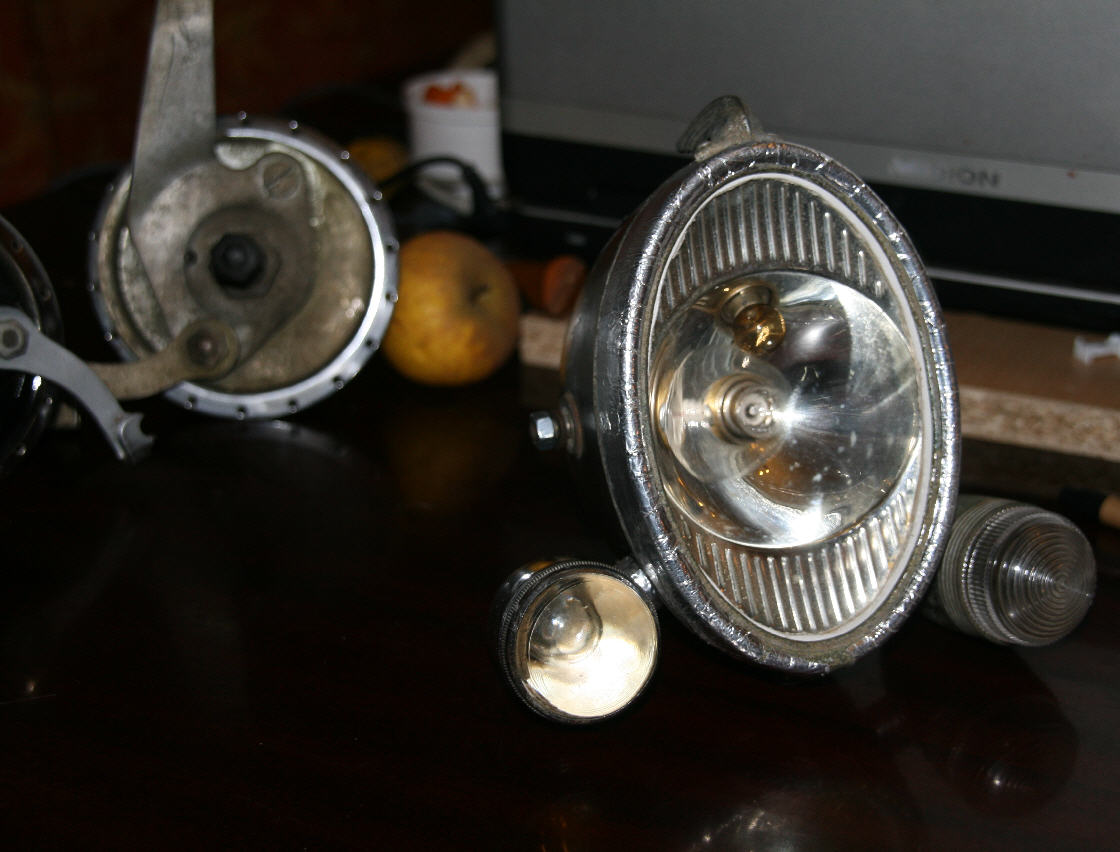
I still want to reproduce the orignal right lens.
I'm planning to reproduce the left one in a silicon mold and duplicate it with transparant resin.
I use other race vintage bikes with removable lights to cycle at night
But for the older ones, I'll keep to the original lights
Here is the front lamps of my 1936-37 Bekaert
I still want to reproduce the orignal right lens.
I'm planning to reproduce the left one in a silicon mold and duplicate it with transparant resin.
12-19-12 | 02:29 AM
#4

Senior Member
Joined: Apr 2010
Posts: 3,081
Likes: 10
From: vermont
Bikes: Many
I came to have a look, the post title was attracting me.
I use other race vintage bikes with removable lights to cycle at night
But for the older ones, I'll keep to the original lights
Here is the front lamps of my 1936-37 Bekaert
I still want to reproduce the orignal right lens.
I'm planning to reproduce the left one in a silicon mold and duplicate it with transparant resin.
I use other race vintage bikes with removable lights to cycle at night
But for the older ones, I'll keep to the original lights
Here is the front lamps of my 1936-37 Bekaert
I still want to reproduce the orignal right lens.
I'm planning to reproduce the left one in a silicon mold and duplicate it with transparant resin.
That is one accessory that seems to evade me . Lights. Is that one generator or battery?
 12-19-12 | 06:48 AM
#6

Senior Member

Joined: Aug 2010
Posts: 3,123
Likes: 98
From: Liberty, Missouri
Bikes: 1966 Paramount | 1971 Raleigh International | ca. 1970 Bernard Carre | 1989 Waterford Paramount | 2012 Boulder Brevet | 2019 Specialized Diverge
I've given it a shot several times and had marginal success at best. As already noted, the reflectors seem to be the fly in the ointment (at least for me) in retrofitting. I am not especially well-versed in things electrical either, and I've attempted to emulate what seems to be greater success stories from the internet. I'm still coming up short and would love to see some success stories from our BF friends posted here.
12-19-12 | 07:02 AM
#7

What??? Only 2 wheels?

Joined: Apr 2010
Posts: 13,496
Likes: 935
From: Boston-ish, MA
Bikes: 72 Peugeot UO-8, 82 Peugeot TH8, 87 Bianchi Brava, 76? Masi Grand Criterium, 74 Motobecane Champion Team, 86 & 77 Gazelle champion mondial, 81? Grandis, 82? Tommasini, 83 Peugeot PF10
I've noticed (but not purchased) a retro-looking, metal light in a B&M package hanging on the wall at my LBS (Harris). Given how effective other B&M headlights are, I'd expect this one to be good too. But they aren't cheap.
__________________
Real cyclists use toe clips.
With great bikes comes great responsibility.
jimmuller
Real cyclists use toe clips.
With great bikes comes great responsibility.
jimmuller
12-19-12 | 07:21 AM
#8


multimodal commuter
Joined: Nov 2006
Posts: 19,810
Likes: 597
From: NJ, NYC, LI
Bikes: 1940s Fothergill, 1959 Allegro Special, 1963? Claud Butler Olympic Sprint, Lambert 'Clubman', 1974 Fuji "the Ace", 1976 Holdsworth 650b conversion rando bike, 1983 Trek 720 tourer, 1984 Counterpoint Opus II, 1993 Basso Gap, 2010 Downtube 8h, and...
To retrofit an old headlight housing to run an LED, you have to fit the LED together with its own lens (which is a small acrylic parabolic reflecto). The LED comes on a hexagonal aluminum plate about 2 cm across, and the lens is in a cylinder about 2 cm long that fits onto that. You may be able to fit that LED and reflector combination into the parabolic reflector of an old lamp, or maybe not. It depends how the light bulb was attached to the parabola. You can get narrow, medium or wide lenses for most LED's now, and a narrow one provides very well focused light that is ideal for bicycle headlights.
Aside from fitting the LED and its lens, there is the matter of a heat sink. An LED produces heat and light at the same time, in the same place. It isn't a great deal of heat, but it is pretty intense at that point. The aluminum hexagon will disperse it to some degree, but you also want to attach that aluminum hexagon to another, bigger, piece of metal to disperse the heat farther. One way to do this is to replace the original parabolic reflector of your lamp with a disc of sheet copper, and attach the LED, with its reflector, to that. The copper disc mounts to the lamp with the same steel springs that held the original parabola, so the heat produced is transferred first to the copper and then to the lamp housing, which has enough mass that you won't even notice it getting warm.
As for the electronics, the fundamental challenge is that a dynamo produces AC power and an LED requires DC power. You can put a bridge rectifier in the circuit (this requires four soldered connections) or assemble your own from diodes (this also requires four soldered connections, so it isn't actually any more work than using a pre-assembled unit). Or you can go caveman and wire your headlight and tail light opposite; so one wire from the dynamo goes to the positive connection of the headlight and the negative of the taillight, while the other goes to the negative of the headlight and the positive of the taillight. As you ride, they will flash alternately.
Aside from fitting the LED and its lens, there is the matter of a heat sink. An LED produces heat and light at the same time, in the same place. It isn't a great deal of heat, but it is pretty intense at that point. The aluminum hexagon will disperse it to some degree, but you also want to attach that aluminum hexagon to another, bigger, piece of metal to disperse the heat farther. One way to do this is to replace the original parabolic reflector of your lamp with a disc of sheet copper, and attach the LED, with its reflector, to that. The copper disc mounts to the lamp with the same steel springs that held the original parabola, so the heat produced is transferred first to the copper and then to the lamp housing, which has enough mass that you won't even notice it getting warm.
As for the electronics, the fundamental challenge is that a dynamo produces AC power and an LED requires DC power. You can put a bridge rectifier in the circuit (this requires four soldered connections) or assemble your own from diodes (this also requires four soldered connections, so it isn't actually any more work than using a pre-assembled unit). Or you can go caveman and wire your headlight and tail light opposite; so one wire from the dynamo goes to the positive connection of the headlight and the negative of the taillight, while the other goes to the negative of the headlight and the positive of the taillight. As you ride, they will flash alternately.
Last edited by rhm; 12-19-12 at 07:25 AM.
12-19-12 | 05:56 PM
#10
Senior Member
Joined: Apr 2010
Posts: 3,081
Likes: 10
From: vermont
Bikes: Many
To retrofit an old headlight housing to run an LED, you have to fit the LED together with its own lens (which is a small acrylic parabolic reflecto). The LED comes on a hexagonal aluminum plate about 2 cm across, and the lens is in a cylinder about 2 cm long that fits onto that. You may be able to fit that LED and reflector combination into the parabolic reflector of an old lamp, or maybe not. It depends how the light bulb was attached to the parabola. You can get narrow, medium or wide lenses for most LED's now, and a narrow one provides very well focused light that is ideal for bicycle headlights.
Aside from fitting the LED and its lens, there is the matter of a heat sink. An LED produces heat and light at the same time, in the same place. It isn't a great deal of heat, but it is pretty intense at that point. The aluminum hexagon will disperse it to some degree, but you also want to attach that aluminum hexagon to another, bigger, piece of metal to disperse the heat farther. One way to do this is to replace the original parabolic reflector of your lamp with a disc of sheet copper, and attach the LED, with its reflector, to that. The copper disc mounts to the lamp with the same steel springs that held the original parabola, so the heat produced is transferred first to the copper and then to the lamp housing, which has enough mass that you won't even notice it getting warm.
As for the electronics, the fundamental challenge is that a dynamo produces AC power and an LED requires DC power. You can put a bridge rectifier in the circuit (this requires four soldered connections) or assemble your own from diodes (this also requires four soldered connections, so it isn't actually any more work than using a pre-assembled unit). Or you can go caveman and wire your headlight and tail light opposite; so one wire from the dynamo goes to the positive connection of the headlight and the negative of the taillight, while the other goes to the negative of the headlight and the positive of the taillight. As you ride, they will flash alternately.
Aside from fitting the LED and its lens, there is the matter of a heat sink. An LED produces heat and light at the same time, in the same place. It isn't a great deal of heat, but it is pretty intense at that point. The aluminum hexagon will disperse it to some degree, but you also want to attach that aluminum hexagon to another, bigger, piece of metal to disperse the heat farther. One way to do this is to replace the original parabolic reflector of your lamp with a disc of sheet copper, and attach the LED, with its reflector, to that. The copper disc mounts to the lamp with the same steel springs that held the original parabola, so the heat produced is transferred first to the copper and then to the lamp housing, which has enough mass that you won't even notice it getting warm.
As for the electronics, the fundamental challenge is that a dynamo produces AC power and an LED requires DC power. You can put a bridge rectifier in the circuit (this requires four soldered connections) or assemble your own from diodes (this also requires four soldered connections, so it isn't actually any more work than using a pre-assembled unit). Or you can go caveman and wire your headlight and tail light opposite; so one wire from the dynamo goes to the positive connection of the headlight and the negative of the taillight, while the other goes to the negative of the headlight and the positive of the taillight. As you ride, they will flash alternately.
12-19-12 | 08:09 PM
#11

perpetually frazzled
Joined: Sep 2008
Posts: 2,469
Likes: 9
From: Linton, IN
Bikes: 1977 Bridgestone Kabuki Super Speed; 1979 Raleigh Professional; 1983 Raleigh Rapide mixte; 1974 Peugeot UO-8; 1993 Univega Activa Trail; 1972 Raleigh Sports; 1967 Phillips; 1981 Schwinn World Tourist; 1976 Schwinn LeTour mixte; 1964 Western Flyer
COuldn't you do a plate that goes right on the glass of a vintage headlight and mount 2-3 LED's with their reflectors, then run the heat sink behind it? If you vented the bottom, nobody would see it, and it would blow over the sink
12-20-12 | 04:48 AM
#12
Senior Member
Joined: Feb 2007
Posts: 1,157
Likes: 1
12-20-12 | 09:03 AM
#13

Get off my lawn!
Joined: Nov 2010
Posts: 6,035
Likes: 118
From: The Garden State
Bikes: 1917 Loomis, 1923 Rudge, 1930 Hercules Renown, 1947 Mclean, 1948 JA Holland, 1955 Hetchins, 1957 Carlton Flyer, 1962 Raleigh Sport, 1978&81 Raleigh Gomp GS', 2010 Raliegh Clubman
How about using one of these, they have a pair (clear +red)with a screw base that will work with a Miller lamp and SA dymo hub.
If you just install the bulbs, you'll get a much brighter light but with a strobe effect. Maybe that's good for day light riding? I was looking at the birdge recifiers at the Radio Shack, they seem small enough to fit in the housing of the lamp easy.

Then I thought....Since the lamp has a 3 position switch, why not run one straight for daylight ( strobe) One through the Bridge rectifier for night riding and one as an off setting?
NICELITE SUPER LED LIGHT BULBSSUPERIOR REPLACEMENT MINIATURE L.E.D. BULBS FOR CYCLE LIGHTS, BICYCLE DYNAMOS AND HUB GENERATORS, FLASHLIGHTS,
HEAD TORCHES, HAND LAMPS, MAGLITE®, MINI-MAGLITE®, ELECTRIC E-BIKES, LANTERNS, 3-D VIEWERS, INCLUDING VINTAGE MODELS
NiceliteTM is a range of the highest quality LED light bulbs,
around 6 times more efficient than halogen:
HEAD TORCHES, HAND LAMPS, MAGLITE®, MINI-MAGLITE®, ELECTRIC E-BIKES, LANTERNS, 3-D VIEWERS, INCLUDING VINTAGE MODELS
NiceliteTM is a range of the highest quality LED light bulbs,
around 6 times more efficient than halogen:
Then I thought....Since the lamp has a 3 position switch, why not run one straight for daylight ( strobe) One through the Bridge rectifier for night riding and one as an off setting?
Last edited by Velognome; 12-20-12 at 09:15 AM.
12-20-12 | 11:51 AM
#14
Senior Member
Joined: Mar 2005
Posts: 726
Likes: 2
From: South Florida
If your original lights have screw bases, why not check out Tektite bulbs?
They make a led side emitting bulb which you could use with your original reflectors.
Unlike the front prefocused bulbs, this one emits light like your standard incadescent bulb. All around.
I think they come in preset voltages. You would have to check that out
The part # is LS407--$29.95--6V
They make a led side emitting bulb which you could use with your original reflectors.
Unlike the front prefocused bulbs, this one emits light like your standard incadescent bulb. All around.
I think they come in preset voltages. You would have to check that out
The part # is LS407--$29.95--6V
Last edited by bobn; 12-20-12 at 11:58 AM.
12-20-12 | 03:53 PM
#15

Count Orlok Member
Joined: May 2009
Posts: 1,856
Likes: 208
From: St. Paul, MN
Bikes: Raleigh Sports, Raleigh Twenty, Raleigh Wyoming, Raleigh DL1, Schwinn Winter Bike
12-20-12 | 04:25 PM
#16
What??? Only 2 wheels?
Joined: Apr 2010
Posts: 13,496
Likes: 935
From: Boston-ish, MA
Bikes: 72 Peugeot UO-8, 82 Peugeot TH8, 87 Bianchi Brava, 76? Masi Grand Criterium, 74 Motobecane Champion Team, 86 & 77 Gazelle champion mondial, 81? Grandis, 82? Tommasini, 83 Peugeot PF10
__________________
Real cyclists use toe clips.
With great bikes comes great responsibility.
jimmuller
Real cyclists use toe clips.
With great bikes comes great responsibility.
jimmuller
12-20-12 | 04:49 PM
#17

K2ProFlex baby!
Joined: Feb 2007
Posts: 6,134
Likes: 59
From: My response would have been something along the lines of: "Does your bike have computer controlled suspension? Then shut your piehole, this baby is from the future!"
Bikes: to many to list
All the lights I use are vintage generator powered, there to complete a certain vintage look that no new light can reproduce. You need a bike light because you actually need it to light your way so your idea to convert an old light with LEDS is a fine idea. I'd keep it generator powered, that way you'll save on batteries and you'll get a nice bright light while keeping that sweet vintage look. 


This one is in line to be converted to a bike light. Its going to be mounted on my Schwinn Phantoms stem. (pictured below)


This one is in line to be converted to a bike light. Its going to be mounted on my Schwinn Phantoms stem. (pictured below)
__________________
You see, their morals, their code...it's a bad joke, dropped at the first sign of trouble. They're only as good as the world allows them to be. I'll show you. When the chips are down, these...These "civilized" people...they'll eat each other. See, I'm not a monster. I'm just ahead of the curve
You see, their morals, their code...it's a bad joke, dropped at the first sign of trouble. They're only as good as the world allows them to be. I'll show you. When the chips are down, these...These "civilized" people...they'll eat each other. See, I'm not a monster. I'm just ahead of the curve
Last edited by ilikebikes; 12-20-12 at 05:26 PM.
12-20-12 | 06:08 PM
#18

Senior Member
Joined: Jun 2011
Posts: 180
Likes: 0
Bikes: All City Space Horse
I've always wondered about these LED bulb replacements:
https://www.home.earthlink.net/~stein...erchandise.htm
https://www.home.earthlink.net/~stein...erchandise.htm
12-21-12 | 07:49 PM
#19

Membership Not Required
Joined: Jan 2005
Posts: 16,853
Likes: 18
From: On the road-USA
Bikes: Giant Excursion, Raleigh Sports, Raleigh R.S.W. Compact, Motobecane? and about 20 more! OMG
I've always wondered about these LED bulb replacements:
https://www.home.earthlink.net/~stein...erchandise.htm
https://www.home.earthlink.net/~stein...erchandise.htm
Aaron
__________________
Webshots is bailing out, if you find any of my posts with corrupt picture files and want to see them corrected please let me know. :(
ISO: A late 1980's Giant Iguana MTB frameset (or complete bike) 23" Red with yellow graphics.
"Cycling should be a way of life, not a hobby.
RIDE, YOU FOOL, RIDE!"_Nicodemus
"Steel: nearly a thousand years of metallurgical development
Aluminum: barely a hundred
Which one would you rather have under your butt at 30mph?"_krazygluon
Webshots is bailing out, if you find any of my posts with corrupt picture files and want to see them corrected please let me know. :(
ISO: A late 1980's Giant Iguana MTB frameset (or complete bike) 23" Red with yellow graphics.
"Cycling should be a way of life, not a hobby.
RIDE, YOU FOOL, RIDE!"_Nicodemus
"Steel: nearly a thousand years of metallurgical development
Aluminum: barely a hundred
Which one would you rather have under your butt at 30mph?"_krazygluon
12-21-12 | 08:12 PM
#20

Palmer
Joined: Mar 2007
Posts: 9,151
Likes: 2,261
From: Parts Unknown
Bikes: Mike Melton custom, Alex Moulton AM, Dahon Curl
Electricity. It's a fad.
12-22-12 | 09:29 AM
#21

Senior Member
Joined: Nov 2008
Posts: 1,959
Likes: 142
From: South Jersey
Bikes: Too many Bicycles to list
To retrofit an old headlight housing to run an LED, you have to fit the LED together with its own lens (which is a small acrylic parabolic reflecto). The LED comes on a hexagonal aluminum plate about 2 cm across, and the lens is in a cylinder about 2 cm long that fits onto that. You may be able to fit that LED and reflector combination into the parabolic reflector of an old lamp, or maybe not. It depends how the light bulb was attached to the parabola. You can get narrow, medium or wide lenses for most LED's now, and a narrow one provides very well focused light that is ideal for bicycle headlights.
Aside from fitting the LED and its lens, there is the matter of a heat sink. An LED produces heat and light at the same time, in the same place. It isn't a great deal of heat, but it is pretty intense at that point. The aluminum hexagon will disperse it to some degree, but you also want to attach that aluminum hexagon to another, bigger, piece of metal to disperse the heat farther. One way to do this is to replace the original parabolic reflector of your lamp with a disc of sheet copper, and attach the LED, with its reflector, to that. The copper disc mounts to the lamp with the same steel springs that held the original parabola, so the heat produced is transferred first to the copper and then to the lamp housing, which has enough mass that you won't even notice it getting warm.
As for the electronics, the fundamental challenge is that a dynamo produces AC power and an LED requires DC power. You can put a bridge rectifier in the circuit (this requires four soldered connections) or assemble your own from diodes (this also requires four soldered connections, so it isn't actually any more work than using a pre-assembled unit). Or you can go caveman and wire your headlight and tail light opposite; so one wire from the dynamo goes to the positive connection of the headlight and the negative of the taillight, while the other goes to the negative of the headlight and the positive of the taillight. As you ride, they will flash alternately.
Aside from fitting the LED and its lens, there is the matter of a heat sink. An LED produces heat and light at the same time, in the same place. It isn't a great deal of heat, but it is pretty intense at that point. The aluminum hexagon will disperse it to some degree, but you also want to attach that aluminum hexagon to another, bigger, piece of metal to disperse the heat farther. One way to do this is to replace the original parabolic reflector of your lamp with a disc of sheet copper, and attach the LED, with its reflector, to that. The copper disc mounts to the lamp with the same steel springs that held the original parabola, so the heat produced is transferred first to the copper and then to the lamp housing, which has enough mass that you won't even notice it getting warm.
As for the electronics, the fundamental challenge is that a dynamo produces AC power and an LED requires DC power. You can put a bridge rectifier in the circuit (this requires four soldered connections) or assemble your own from diodes (this also requires four soldered connections, so it isn't actually any more work than using a pre-assembled unit). Or you can go caveman and wire your headlight and tail light opposite; so one wire from the dynamo goes to the positive connection of the headlight and the negative of the taillight, while the other goes to the negative of the headlight and the positive of the taillight. As you ride, they will flash alternately.
Glenn
Last edited by Glennfordx4; 12-22-12 at 09:38 AM.
12-22-12 | 09:01 PM
#22

Senior Member
Joined: Aug 2011
Posts: 66
Likes: 0
From: Sarasota, Florida
Bikes: Gary Fisher Simple City 3; 1989 Bianchi Sport SX; 1970 Schwinn Twinn in need of work; other project bikes in various states of disrepair.
12-22-12 | 11:47 PM
#23
Senior Member
Joined: Oct 2009
Posts: 2,470
Likes: 4
From: Minneapolis
Bikes: -1973 Motobecane Mirage -197? Velosolex L'Etoile -'71 Raleigh Super Course
Here's a thought:
Since I have an old dual-bulb Miller with an actual silvered reflector, and since the reflector is in contact with the shell, would that work as a heat sink? Or would I want to try to solder something to the backside, in order to gain more mass?
Since I have an old dual-bulb Miller with an actual silvered reflector, and since the reflector is in contact with the shell, would that work as a heat sink? Or would I want to try to solder something to the backside, in order to gain more mass?
12-23-12 | 01:56 PM
#24
Senior Member
Joined: Jun 2009
Posts: 375
Likes: 0
Here's a pic taken in 1981 of my old Raleigh Sports with a big headlight from Bicycle Lighting Systems. It used a 6v sealed beam lamp that had a trapezoidal pattern. I think they were designed for scooters. Absolutely the best beam pattern I've ever seen for a bike headlight. The NiCd battery is in the water bottle holder on the seat tube. I still have two of the lamps. The housing was a typical 4" diameter piece typically seen on tractors and probably still available in the hardware store. Whoppin' huge amount of light for the time!

12-23-12 | 02:31 PM
#25

Senior Member
Joined: Feb 2010
Posts: 1,078
Likes: 159
From: Portland, Oregon
I have a B&M Classic (actually 3 of them) they put a solid pattern of light down and have the stand light too. My only issue is they are smaller than the 70's vintage chrome Raleigh headlights, roughly a third smaller and don't look quite right. I do use one on my Raleigh Twenty and it looks okay to me on that bike.