


3D Printing
 01-07-14 | 08:34 AM
#1

Thread Starter
Senior Member
Joined: Aug 2010
Posts: 91
Likes: 0
From: East Coast, Canada
3D Printing
 01-07-14 | 08:45 AM
#2
Senior Member

Joined: Jul 2006
Posts: 14,492
Likes: 269
From: STP
He has a couple of ideas for projects that sound interesting as well.
01-07-14 | 08:59 AM
#3

Senior Member

Joined: Mar 2013
Posts: 3,832
Likes: 366
From: Maryland
Bikes: Lots of English 3-speeds, a couple of old road bikes, 3 mountain bikes, 1 hybrid, and a couple of mash-ups
01-07-14 | 09:01 AM
#4

Senior Member
Joined: Mar 2011
Posts: 1,698
Likes: 6
From: Tampa Bay, Florida
Bikes: 87 Bridgestone 550 (Shocking Electric Metallic Pink)
Yes...but.... "with some parts costing less than £100".....to get the strength and quality.....it will still cost. There is hope in the future, costs will come down and quality will go up.
01-07-14 | 09:04 AM
#5

 01-07-14 | 09:35 AM
#6
Senior Member
Joined: Mar 2013
Posts: 3,832
Likes: 366
From: Maryland
Bikes: Lots of English 3-speeds, a couple of old road bikes, 3 mountain bikes, 1 hybrid, and a couple of mash-ups
I agree. I was thinking about headbadges, clamps, stops and the like. I don't know enough about the technology or which materials the printer can work with.
01-07-14 | 11:24 AM
#7
Senior Member

Joined: May 2008
Posts: 10,106
Likes: 2,760
From: Fredericksburg, Va
Bikes: ? Proteous, '65 Frejus TDF, '73 Bottecchia Giro d'Italia, '83 Colnago Superissimo, '84 Trek 610, '84 Trek 760, '88 Pinarello Veneto, '88 De Rosa Pro, '89 Pinarello Montello, 'Litespeed Catalyst'94 Burley Duet, 97 Specialized RockHopper, 2010 Langster
Think models, not functional parts. My knowledge may need calibration but, the mechanical properties of the "parts" produced are enough to support the model and the handling of it, not the intended use. Over time, this will change as material properties and the process is improved and developed to produce parts for intended use.
It is difficult for some people to visualize a 3D part in their head. Creating a physical model helps overcome the communication challenge. It also helps the designer to check his model in a physical world.
It is difficult for some people to visualize a 3D part in their head. Creating a physical model helps overcome the communication challenge. It also helps the designer to check his model in a physical world.
01-07-14 | 12:11 PM
#8
Think models, not functional parts. My knowledge may need calibration but, the mechanical properties of the "parts" produced are enough to support the model and the handling of it, not the intended use. Over time, this will change as material properties and the process is improved and developed to produce parts for intended use.
It is difficult for some people to visualize a 3D part in their head. Creating a physical model helps overcome the communication challenge. It also helps the designer to check his model in a physical world.
It is difficult for some people to visualize a 3D part in their head. Creating a physical model helps overcome the communication challenge. It also helps the designer to check his model in a physical world.
01-07-14 | 12:35 PM
#9

multimodal commuter
Joined: Nov 2006
Posts: 19,810
Likes: 597
From: NJ, NYC, LI
Bikes: 1940s Fothergill, 1959 Allegro Special, 1963? Claud Butler Olympic Sprint, Lambert 'Clubman', 1974 Fuji "the Ace", 1976 Holdsworth 650b conversion rando bike, 1983 Trek 720 tourer, 1984 Counterpoint Opus II, 1993 Basso Gap, 2010 Downtube 8h, and...
Here's a saddle I recovered with help from 3D printing:
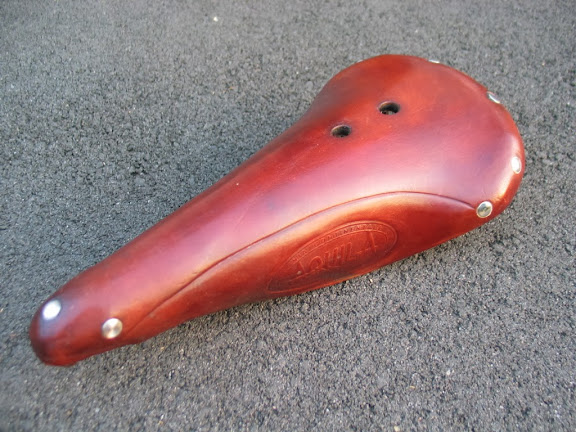

I designed the graphics in CorelDraw, had the skirt stamps printed in white plastic, and used the stamps to form the leather. The badge on the back was also 3D printed in " aluminide" which is a plastic with aluminum dust in the mix.
I wish they offered the option of printing in aluminum or magnesium! Not an option now, though. Which brings me to the next question: if you have a good model 3D printed in plastic and want to have it manufactured in aluminum or magnesium (or titanium ) how would you go about that?
I designed the graphics in CorelDraw, had the skirt stamps printed in white plastic, and used the stamps to form the leather. The badge on the back was also 3D printed in " aluminide" which is a plastic with aluminum dust in the mix.
I wish they offered the option of printing in aluminum or magnesium! Not an option now, though. Which brings me to the next question: if you have a good model 3D printed in plastic and want to have it manufactured in aluminum or magnesium (or titanium
) how would you go about that?
__________________
www.rhmsaddles.com.
www.rhmsaddles.com.
01-07-14 | 12:50 PM
#10
Senior Member
Joined: May 2008
Posts: 10,106
Likes: 2,760
From: Fredericksburg, Va
Bikes: ? Proteous, '65 Frejus TDF, '73 Bottecchia Giro d'Italia, '83 Colnago Superissimo, '84 Trek 610, '84 Trek 760, '88 Pinarello Veneto, '88 De Rosa Pro, '89 Pinarello Montello, 'Litespeed Catalyst'94 Burley Duet, 97 Specialized RockHopper, 2010 Langster
For a limited run you could have soft tooling done. Use the model to create a rubber mold (-) which is used to create another mold (+) that used to create the final soft tooling for the limited run. May be good for a couple of hundred castings. Key here is taking shrink into account for all the materials used. This has to be done in the 3D model for the printing so it will be "transferred" to the final mold and base. Keep in mind that draft should be taken into account too. Straight walls cause the part to "stick" to the mold and not come out. The other option is using a Lost Wax process where wax is used to creat the mold. It is destroyed for each part but the material can be recovered for new molds. In addition, sprues need to be designed in for the material flow along with vents to ensure the matieral flows into all the cavities. And we thought castings were straightforward!
01-07-14 | 01:01 PM
#11
"Lost foam" casting was used and might still be used in the automotive industry. (Saturn was proud of their efforts)
I have seen ti investment cast. Steel of course is.
Part of the problem is to find a foundry interested in doing prototype qty. parts for an acceptable cost.
When I saw the results that rhm did on that vintage saddle replicant I immediately thought of headbadges.
I have seen ti investment cast. Steel of course is.
Part of the problem is to find a foundry interested in doing prototype qty. parts for an acceptable cost.
When I saw the results that rhm did on that vintage saddle replicant I immediately thought of headbadges.
01-07-14 | 02:48 PM
#12

Senior Member
Joined: Aug 2008
Posts: 4,134
Likes: 192
From: Somerville, MA and Catskill Mtns
Here's a saddle I recovered with help from 3D printing:
I designed the graphics in CorelDraw, had the skirt stamps printed in white plastic, and used the stamps to form the leather. The badge on the back was also 3D printed in " aluminide" which is a plastic with aluminum dust in the mix.
I wish they offered the option of printing in aluminum or magnesium! Not an option now, though. Which brings me to the next question: if you have a good model 3D printed in plastic and want to have it manufactured in aluminum or magnesium (or titanium) how would you go about that?
I designed the graphics in CorelDraw, had the skirt stamps printed in white plastic, and used the stamps to form the leather. The badge on the back was also 3D printed in " aluminide" which is a plastic with aluminum dust in the mix.
I wish they offered the option of printing in aluminum or magnesium! Not an option now, though. Which brings me to the next question: if you have a good model 3D printed in plastic and want to have it manufactured in aluminum or magnesium (or titanium
) how would you go about that?
01-07-14 | 03:05 PM
#13
I'm not certain of this, but I think I read somewhere that the file format that defines the 3D printed object is the same one used for CNC milling, even though the processes themselves are sort of inversions of one another. I'd contact someone who does CNC milling and ask, since that would seem to be the best way to get something like this made from aluminum.
01-07-14 | 04:49 PM
#14
multimodal commuter
Joined: Nov 2006
Posts: 19,810
Likes: 597
From: NJ, NYC, LI
Bikes: 1940s Fothergill, 1959 Allegro Special, 1963? Claud Butler Olympic Sprint, Lambert 'Clubman', 1974 Fuji "the Ace", 1976 Holdsworth 650b conversion rando bike, 1983 Trek 720 tourer, 1984 Counterpoint Opus II, 1993 Basso Gap, 2010 Downtube 8h, and...
Is magnesium typically cast to final form? I believe that is the case. Wax can be 3D printed so perhaps magnesium parts could be made through a combination of 3D printing and lost wax casting, but it seems a complicated and (prohibitively) expensive way to go about it.
I really don't think cast aluminum would have the strength needed. The parts of want made in aluminum would have to be stamped or forged.
I really don't think cast aluminum would have the strength needed. The parts of want made in aluminum would have to be stamped or forged.
__________________
www.rhmsaddles.com.
www.rhmsaddles.com.
01-07-14 | 05:10 PM
#15

Junior Member
Joined: Sep 2010
Posts: 197
Likes: 4
I've recently got my hands on a CNC engraver and could see cutting rhm's badge and stamp with it. It's basically a light duty 3 axis mill.
I'm having a ball with it.
I'm having a ball with it.
__________________
Mark
Nashville, TN
We don't life, for be sad- Peter Sagan
Mark
Nashville, TN
We don't life, for be sad- Peter Sagan
01-07-14 | 05:58 PM
#16

Senior Member

Joined: Jun 2006
Posts: 12,882
Likes: 5,413
From: NW Burbs, Chicago
I'm not certain of this, but I think I read somewhere that the file format that defines the 3D printed object is the same one used for CNC milling, even though the processes themselves are sort of inversions of one another. I'd contact someone who does CNC milling and ask, since that would seem to be the best way to get something like this made from aluminum.
Native Solidworks, native ProE, .stp and .igs for machining. Although that gets converted to cam data depending on what type of mill used.
3D printing is not ready for prime time. Maybe in 5-10 years.
01-07-14 | 08:20 PM
#17

Senior Member
Joined: Dec 2007
Posts: 1,906
Likes: 5
From: The Sunny South
https://mashable.com/2013/11/11/3d-printed-metal-gun/
I don't think durability is an issue......just a matter of costs...
I don't think durability is an issue......just a matter of costs...
01-08-14 | 07:55 AM
#20

Cisalpinist
Joined: Jan 2011
Posts: 5,557
Likes: 18
From: Holland
Bikes: blue ones.
OP: I was in a 3D printing workshop from my uni last month, I'll post the link to my project once they put it online. I specifically asked the industry people what use current gen 3D printing has in the restoration world, and they confirmed the suspisions we had on this forum in an earlier thread that you can't really replicate the structure of the materials you try to reproduce, meaning you can't print reliable replacements yet.
01-08-14 | 08:54 AM
#21
Senior Member
Joined: Feb 2011
Posts: 807
Likes: 10
This gives an idea of what can be done currently.
https://www.youtube.com/watch?v=tkwd2...e_gdata_player
https://www.youtube.com/watch?v=tkwd2...e_gdata_player
 01-08-14 | 09:06 AM
#23
Is magnesium typically cast to final form? I believe that is the case. Wax can be 3D printed so perhaps magnesium parts could be made through a combination of 3D printing and lost wax casting, but it seems a complicated and (prohibitively) expensive way to go about it.
I really don't think cast aluminum would have the strength needed. The parts of want made in aluminum would have to be stamped or forged.
I really don't think cast aluminum would have the strength needed. The parts of want made in aluminum would have to be stamped or forged.
01-08-14 | 09:23 AM
#24
Cisalpinist
Joined: Jan 2011
Posts: 5,557
Likes: 18
From: Holland
Bikes: blue ones.
01-08-14 | 10:49 AM
#25
It seems that Kirk, of Kirk Precision frame, found out as well when the factory went through a fierce fire caused by a magnesium dust explosion. Temperamental stuff. https://www.kirk-bicycles.co.uk/Kirk-History.htm