


Thinking about pulleys
 01-28-14 | 02:18 PM
#1

Thread Starter
What??? Only 2 wheels?


Joined: Apr 2010
Posts: 13,498
Likes: 962
From: Boston-ish, MA
Bikes: 72 Peugeot UO-8, 82 Peugeot TH8, 87 Bianchi Brava, 76? Masi Grand Criterium, 74 Motobecane Champion Team, 86 & 77 Gazelle champion mondial, 81? Grandis, 82? Tommasini, 83 Peugeot PF10
Thinking about pulleys
I know this has been discussed before but almost always ensconced in a cloud of Shimano model numbers which puts me to sleep, RG7402, Xlt12, SRS76B 122BBakerSt, 27000.033J, 3.14159, etc.  Plus I've rarely had reason to pay attention.
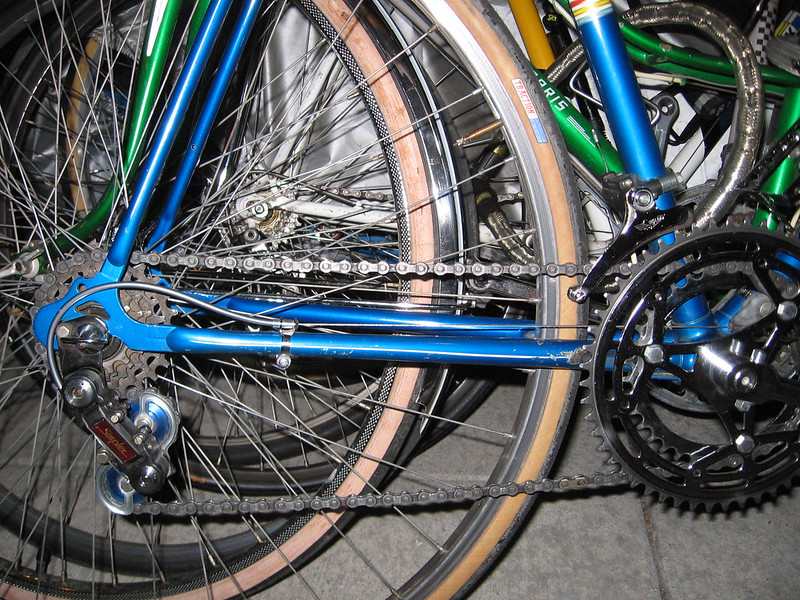
I'm looking to replace the pulleys on my Masi's GT-caged Campy NR-style RD. They have 10T and appear to be aftermarket pulleys. Eleven teeth for at least the guide pulley would increase its radius by 10% and place the chain closer to the FW and thus maybe improve the mid-gear shifting, especially on upshift while on the large chainring. The two cage plates are separate pieces so pulley&bushing thickness would seem to be important only for the length of the bolts. The bushing inner diameters would have to match the exiting bolt diameter.
So what should I be looking for? Pulley thickness and bolt diameter? Ir to put it another way, what models of available 11T pulleys would be drop-in-able?
Thanks,
Jim
Plus I've rarely had reason to pay attention.I'm looking to replace the pulleys on my Masi's GT-caged Campy NR-style RD. They have 10T and appear to be aftermarket pulleys. Eleven teeth for at least the guide pulley would increase its radius by 10% and place the chain closer to the FW and thus maybe improve the mid-gear shifting, especially on upshift while on the large chainring. The two cage plates are separate pieces so pulley&bushing thickness would seem to be important only for the length of the bolts. The bushing inner diameters would have to match the exiting bolt diameter.
So what should I be looking for? Pulley thickness and bolt diameter? Ir to put it another way, what models of available 11T pulleys would be drop-in-able?
Thanks,
Jim
__________________
Real cyclists use toe clips.
With great bikes comes great responsibility.
jimmuller
Real cyclists use toe clips.
With great bikes comes great responsibility.
jimmuller
 01-28-14 | 02:23 PM
#2


multimodal commuter
Joined: Nov 2006
Posts: 19,810
Likes: 597
From: NJ, NYC, LI
Bikes: 1940s Fothergill, 1959 Allegro Special, 1963? Claud Butler Olympic Sprint, Lambert 'Clubman', 1974 Fuji "the Ace", 1976 Holdsworth 650b conversion rando bike, 1983 Trek 720 tourer, 1984 Counterpoint Opus II, 1993 Basso Gap, 2010 Downtube 8h, and...
Red ones 
__________________
www.rhmsaddles.com.
www.rhmsaddles.com.
01-28-14 | 03:14 PM
#3
Thread Starter
What??? Only 2 wheels?
Joined: Apr 2010
Posts: 13,498
Likes: 962
From: Boston-ish, MA
Bikes: 72 Peugeot UO-8, 82 Peugeot TH8, 87 Bianchi Brava, 76? Masi Grand Criterium, 74 Motobecane Champion Team, 86 & 77 Gazelle champion mondial, 81? Grandis, 82? Tommasini, 83 Peugeot PF10
Very informative as always, rhm. Thank you. I should mention that I had already decided they should be red. I'm not a complete novice at this sort of thing, you know. 
__________________
Real cyclists use toe clips.
With great bikes comes great responsibility.
jimmuller
Real cyclists use toe clips.
With great bikes comes great responsibility.
jimmuller
01-28-14 | 03:31 PM
#4

Ride, Wrench, Swap, Race
Joined: Jan 2010
Posts: 9,818
Likes: 1,791
From: Northern California
Bikes: Cheltenham-Pedersen racer, Boulder F/S Paris-Roubaix, Varsity racer, '52 Christophe, '62 Continental, '92 Merckx, '75 Limongi, '76 Presto, '72 Gitane SC, '71 Schwinn SS, etc.
First thought is what width of chain you will use, and my first preference for use with Asian freewheels is modern 9-sp chain, crankset allowing.
Of course the bolt length is correctible in all cases with a washer under the bolt head.
Pullies tend to come in two widths, .41" (traditional) and .34" (~9-speed onward). Modern Campag may be somewhat in-between, as they do everything possible to force use of their bits.
I like the idea of choosing a larger guide pulley, so sad that this can't be done on the venerable Allvit, since one of the top pulley's bearing cones has a threaded snout.


Of course the bolt length is correctible in all cases with a washer under the bolt head.
Pullies tend to come in two widths, .41" (traditional) and .34" (~9-speed onward). Modern Campag may be somewhat in-between, as they do everything possible to force use of their bits.
I like the idea of choosing a larger guide pulley, so sad that this can't be done on the venerable Allvit, since one of the top pulley's bearing cones has a threaded snout.
01-28-14 | 03:36 PM
#5

Senior Member

Joined: Feb 2005
Posts: 2,584
Likes: 107
From: Scranton, PA, USA
Bikes: '77 Centurion "Pro Tour"; '67 Carlton "The Flyer"; 1984 Ross MTB (stored at parents' house)
Before going to 11 teeth, I'd make sure that you have enough clearance around the chain on the original 10 tooth pulleys. I tried this maneuver on a Suntour unit, and I'll be damned if it didn't rub on part of the cage, forcing me to go with different 10 tooth pulleys.
01-28-14 | 03:56 PM
#6

Before going to 11 teeth, I'd make sure that you have enough clearance around the chain on the original 10 tooth pulleys. I tried this maneuver on a Suntour unit, and I'll be damned if it didn't rub on part of the cage, forcing me to go with different 10 tooth pulleys.
I just went with the $15 per pair "forte" brand sealed pulleys from questionable performance. I don't recall is they were 10 or 11 teeth. Sealed bearings, machined spacers to space things accordingly…
It was a low effort deal.
Cheaper than Red Bullseye units. I like those, but one has to order them.
I think the 11t clearance issue would be if/when you have a 26 or 28 and have that chain just the wrong length.
01-28-14 | 03:57 PM
#7
Ride, Wrench, Swap, Race
Joined: Jan 2010
Posts: 9,818
Likes: 1,791
From: Northern California
Bikes: Cheltenham-Pedersen racer, Boulder F/S Paris-Roubaix, Varsity racer, '52 Christophe, '62 Continental, '92 Merckx, '75 Limongi, '76 Presto, '72 Gitane SC, '71 Schwinn SS, etc.
Before going to 11 teeth, I'd make sure that you have enough clearance around the chain on the original 10 tooth pulleys. I tried this maneuver on a Suntour unit, and I'll be damned if it didn't rub on part of the cage, forcing me to go with different 10 tooth pulleys.
Assuming you were using modern chain instead of older chain (usually with taller sideplates), not much you could do 'cept use the 10t.
Then again, with the 11t version of those "Canadian" pullies with the alloy "hub caps", you could have filed the holes out to one side, then offset the pulley as needed!
 01-28-14 | 04:35 PM
#9
Senior Member
Joined: Feb 2005
Posts: 2,584
Likes: 107
From: Scranton, PA, USA
Bikes: '77 Centurion "Pro Tour"; '67 Carlton "The Flyer"; 1984 Ross MTB (stored at parents' house)
Actually, looking back, part of the pulley itself actually hit the wrapped-over part of the cage near the upper pulley, as I've highlighted in the ellipse below. Not much I could have done about that except use 10 tooth pulleys.

I suppose the original Cyclone GT is an unusual derailleur in a lot of regards.
I suppose the original Cyclone GT is an unusual derailleur in a lot of regards.
01-28-14 | 04:36 PM
#10
Senior Member
Joined: Jan 2014
Posts: 272
Likes: 2
while i dont have experience with campy, i have installed aest pulleys (china made with a us distributer) on 2 newer 105 derailleurs and 1 sis light action derailleur. on the newer one, a 5700, the 11t bolted on with no issues or adjustments needed, on the other newer one, a 5600 which there was alot of adjusting to be had. i assume that was due to moving from 10t to 11t, the b-screw, high/low limits, and index adjustments had to be played with to get smooth shifting. on the older light action sis derailleur i had a bunch of problems. first the inner bushings of the new pulley would not fit over the shouldered pulley bolt, a standard bolt would not work as it over tensions the pulley and it will not spin, you could use a nut on the back side but it comes really close to the spokes. then the larger 11t pulley hit a nub or guide on the back plate, a quick dremel pass and now it spins freely. i used the existing shouldered bolts without bushings, the space difference is almost incomprehensible, like less then 1mm, if i have time to file down the inside of the new bushings then i will but until then i think they will work. some would say that .5mm difference is too much but for me its close enough as the existing pulley bushings had play from use anyway. again, not campy but in relation to installing pulleys maybe you can grab some useful info from this. also some aftermarket pulleys have play, some do not, the ones without play or lateral movement will take finer adjustments to function to your preference. have i noticed a improvement while riding? no. does it look clean and really cool? yes.
01-28-14 | 06:04 PM
#11
Thread Starter
What??? Only 2 wheels?
Joined: Apr 2010
Posts: 13,498
Likes: 962
From: Boston-ish, MA
Bikes: 72 Peugeot UO-8, 82 Peugeot TH8, 87 Bianchi Brava, 76? Masi Grand Criterium, 74 Motobecane Champion Team, 86 & 77 Gazelle champion mondial, 81? Grandis, 82? Tommasini, 83 Peugeot PF10
Okay, so I'll look for red ones. Now about dimensions... Bolt diameters? 6mm or 5mm, I've read? (I know what you're thinking, did he fire six shots or was it five? Tell you the truth, in all the excitement I kinda' lost count myself. So if I buy pulleys, am I feeling lucky today?)
These cage plates are fully detached from each other and shaped like Rally plates. They do not touch the cogs. (I've seen that problem with a Vx and a large FW.) The chain is a PC870, and the FW is a, ah..., it doesn't matter, but probably Shimuntour. I just want to replace pulleys, that's all. I do need them to fit.
Of course, when you force the pulley to accommodate more chain it pulls the tension pulley forward. With a Crane-type action, that pulls the guide pulley down and you lose some of the benefit.
These cage plates are fully detached from each other and shaped like Rally plates. They do not touch the cogs. (I've seen that problem with a Vx and a large FW.) The chain is a PC870, and the FW is a, ah..., it doesn't matter, but probably Shimuntour. I just want to replace pulleys, that's all. I do need them to fit.
Of course, when you force the pulley to accommodate more chain it pulls the tension pulley forward. With a Crane-type action, that pulls the guide pulley down and you lose some of the benefit.
__________________
Real cyclists use toe clips.
With great bikes comes great responsibility.
jimmuller
Real cyclists use toe clips.
With great bikes comes great responsibility.
jimmuller
01-28-14 | 07:42 PM
#12

Extraordinary Magnitude
Joined: Aug 2009
Posts: 14,081
Likes: 2,136
From: Waukesha WI
Bikes: 1978 Trek TX700; 1978/79 Trek 736; 1984 Specialized Stumpjumper Sport; 1984 Schwinn Voyageur SP; 1985 Trek 620; 1985 Trek 720; 1986 Trek 400 Elance; 1987 Schwinn High Sierra; 1990 Miyata 1000LT
Jim, what are you gonna get? Hey... I gotsta know.
__________________
*Recipient of the 2006 Time Magazine "Person Of The Year" Award*
Commence to jigglin’ huh?!?!
"But hey, always love to hear from opinionated amateurs." -says some guy to Mr. Marshall.
Commence to jigglin’ huh?!?!
"But hey, always love to hear from opinionated amateurs." -says some guy to Mr. Marshall.
01-28-14 | 10:14 PM
#13
Thread Starter
What??? Only 2 wheels?
Joined: Apr 2010
Posts: 13,498
Likes: 962
From: Boston-ish, MA
Bikes: 72 Peugeot UO-8, 82 Peugeot TH8, 87 Bianchi Brava, 76? Masi Grand Criterium, 74 Motobecane Champion Team, 86 & 77 Gazelle champion mondial, 81? Grandis, 82? Tommasini, 83 Peugeot PF10
01-28-14 | 11:49 PM
#15
Ride, Wrench, Swap, Race
Joined: Jan 2010
Posts: 9,818
Likes: 1,791
From: Northern California
Bikes: Cheltenham-Pedersen racer, Boulder F/S Paris-Roubaix, Varsity racer, '52 Christophe, '62 Continental, '92 Merckx, '75 Limongi, '76 Presto, '72 Gitane SC, '71 Schwinn SS, etc.
The KCNC-type pulleys have the alloy caps that fit into the very large-dia thin bearings, so the caps can be drilled from 5mm to 6mm in a few minutes.
Best to fixture the cap from spinning while taking the drill or reamer to it.
I used a big plier with curved jaws lined with a leather toe strap.
I stuck with 10t pullies, and only needed to drill the caps and add the washers under the bolt heads in order to use them on my Simplex.
Then, to reduce the chain gap with my new, smaller 13-24t UG freewheel, I adjusted the cage pivot spring tension a little tighter, using the cage pivot bolt's hex key socket and the hex-locknut that is tightened against the cage. This setup has been shifting well now for over a year and 2500 miles, using a SRAM 9s PG51 chain.
Best to fixture the cap from spinning while taking the drill or reamer to it.
I used a big plier with curved jaws lined with a leather toe strap.
I stuck with 10t pullies, and only needed to drill the caps and add the washers under the bolt heads in order to use them on my Simplex.
Then, to reduce the chain gap with my new, smaller 13-24t UG freewheel, I adjusted the cage pivot spring tension a little tighter, using the cage pivot bolt's hex key socket and the hex-locknut that is tightened against the cage. This setup has been shifting well now for over a year and 2500 miles, using a SRAM 9s PG51 chain.
Last edited by dddd; 01-28-14 at 11:53 PM.
01-29-14 | 04:52 AM
#16

Senior Member

Joined: Jun 2011
Posts: 1,406
Likes: 105
From: Dayton, Ohio
Bikes: Trek 720, Trek 620, Trek 520, Steel Schwinns, AD Puch, Kona, Nishiki Pro, All City Disc Spacehorse, Waterford
Why don't you just go with the 10 tooth Bullseye red pulleys?
That would fit the Campy perfectly, look great, and operate well?
Just a thought.
That would fit the Campy perfectly, look great, and operate well?
Just a thought.
01-29-14 | 06:33 AM
#17
Thread Starter
What??? Only 2 wheels?
Joined: Apr 2010
Posts: 13,498
Likes: 962
From: Boston-ish, MA
Bikes: 72 Peugeot UO-8, 82 Peugeot TH8, 87 Bianchi Brava, 76? Masi Grand Criterium, 74 Motobecane Champion Team, 86 & 77 Gazelle champion mondial, 81? Grandis, 82? Tommasini, 83 Peugeot PF10
Suntour's quick-cage. Another clever idea from those wizards. It was also used on the some of the Vx and maybe VGT. It let the tension pulley be open so the chain could be lifted off easily. I did have the chain bounce out of the cage once when the FD threw it off the small chainring. It was on a Vx, not a Cyclone. I guess every good idea has a down-side.
__________________
Real cyclists use toe clips.
With great bikes comes great responsibility.
jimmuller
Real cyclists use toe clips.
With great bikes comes great responsibility.
jimmuller
01-29-14 | 09:11 AM
#18

Senior Member
Joined: Dec 2009
Posts: 8,343
Likes: 16
From: Louisville
I replaced the pulleys on a 9s 105 derailleur with these. They come with all sorts of spacers and are much nicer than the price would indicate. I would see if they will work for your project. If not, put them on something else.

02-07-14 | 05:23 PM
#19
Thread Starter
What??? Only 2 wheels?
Joined: Apr 2010
Posts: 13,498
Likes: 962
From: Boston-ish, MA
Bikes: 72 Peugeot UO-8, 82 Peugeot TH8, 87 Bianchi Brava, 76? Masi Grand Criterium, 74 Motobecane Champion Team, 86 & 77 Gazelle champion mondial, 81? Grandis, 82? Tommasini, 83 Peugeot PF10
A quick followup here. I dropped by a LBS today and picked up an eleven tooth pulley to replace the Masi's guide pulley. I think he said it was an Ultegra. It was a single pulley of a pair someone had apparently split up, so he didn't charge me much. It was about 2mm thinner than the Campy pulley it replaced so I added a washer on each side. In bench testing, which we all know is perfectly exactly 100% equivalent to real road riding, it does okay. Some of the shifts are still pretty sensitive but doable, about as doable as they were before and perhaps a little better. There is enough clearance between the pulley and big cog that I could have used a 12. I actually saw a 13T and a 14T on ebay, but the only 12's available have to come from Taiwan or China and are expensive. Not sure I want to go there yet.
Henry III modeled the cage plates from a Campy Rally, but I'm not sure which one. In studying a version 2 I saw on ebay it looks like the Rally held the guide pulley closer to the FW than my RD does. (I "watched" it and in the last 5 minutes it jumped from $36 to $89, so I wasn't going to play that game.) I also see that it doesn't have the ideal ratio of Pi (or just 3) for the distances from cage pivot to the pulleys. Campy must have been being conservative. The result is that the guide pulley doesn't move up and down with cog size as much as it should. The pulley position w.r.t. the big cog is okay but it gets too far away as the cogs shrink. Of course the ideal ratio of pivot-to-pulley distances doesn't take into account shifting in front, which is why keeping it conservative makes some sense. Since I'm using half-step crossover gearing, the front shift isn't very big, so I could tolerate more aggressive guide pulley movement and a higher pulley position in general. If I could make my own I'd modify the geometry a little. Then too, the shift which is most problematical on the test stand is from the 5th largest (out of 6) to the 4th largest cog, larger rather than smaller. The RD lateral movement per angular movement of the shift lever just isn't very friendly. Maybe it feels different on the road and will seem improved. (The truth is, I don't recall which shift was most problematical, and I've had a strong enough beer now that I'm not sure this is even coherent).
But it's a fun exercise anyway.
Henry III modeled the cage plates from a Campy Rally, but I'm not sure which one. In studying a version 2 I saw on ebay it looks like the Rally held the guide pulley closer to the FW than my RD does. (I "watched" it and in the last 5 minutes it jumped from $36 to $89, so I wasn't going to play that game.) I also see that it doesn't have the ideal ratio of Pi (or just 3) for the distances from cage pivot to the pulleys. Campy must have been being conservative. The result is that the guide pulley doesn't move up and down with cog size as much as it should. The pulley position w.r.t. the big cog is okay but it gets too far away as the cogs shrink. Of course the ideal ratio of pivot-to-pulley distances doesn't take into account shifting in front, which is why keeping it conservative makes some sense. Since I'm using half-step crossover gearing, the front shift isn't very big, so I could tolerate more aggressive guide pulley movement and a higher pulley position in general. If I could make my own I'd modify the geometry a little. Then too, the shift which is most problematical on the test stand is from the 5th largest (out of 6) to the 4th largest cog, larger rather than smaller. The RD lateral movement per angular movement of the shift lever just isn't very friendly. Maybe it feels different on the road and will seem improved. (The truth is, I don't recall which shift was most problematical, and I've had a strong enough beer now that I'm not sure this is even coherent).
But it's a fun exercise anyway.
__________________
Real cyclists use toe clips.
With great bikes comes great responsibility.
jimmuller
Real cyclists use toe clips.
With great bikes comes great responsibility.
jimmuller
02-07-14 | 06:45 PM
#20

This is kind of hard to follow, but near the end it seems like you are expecting the guide pulley on a Campy NR to follow the shape of the cluster and that's not going to happen. A Rally cage won't make the slightest difference. I've tried that. I can think of three solutions. The NR will work beautifully with a corncob freewheel because that's what it's designed for. It's a racing derailer. Switch to a Suntour RD with a slant parallelogram. Switch to a more modern Campy with a slant parallelogram.
You might try a stiffer chain. I have this theory that it will work better because of the long distance between the NR jockey pulley and the cogs, but I haven't tested it.
If this is incoherent, it's because I've had a couple of glasses of Merlot.
You might try a stiffer chain. I have this theory that it will work better because of the long distance between the NR jockey pulley and the cogs, but I haven't tested it.
If this is incoherent, it's because I've had a couple of glasses of Merlot.
02-07-14 | 06:50 PM
#21
Ride, Wrench, Swap, Race
Joined: Jan 2010
Posts: 9,818
Likes: 1,791
From: Northern California
Bikes: Cheltenham-Pedersen racer, Boulder F/S Paris-Roubaix, Varsity racer, '52 Christophe, '62 Continental, '92 Merckx, '75 Limongi, '76 Presto, '72 Gitane SC, '71 Schwinn SS, etc.
Any time that I have a lazy shift appear somewhere along the freewheel's stack, after doing my best with A/B tensioning the next step is to bevel a few teeth on one of the freewheel's cogs.
There are two situations here, one for upshifting to a smaller cog, and another for downshifting to a larger cog.
In the first instance, i.e. of a lazy upshift to the next-smaller cog, the tooth count of the affected cog is considered, and a sequence of odd-number tooth spans is layed out for beveling of say, every third or fifth tooth.
So, if it's a 17-tooth cog, I put a 45-degree bevel on every fifth tooth, and after grinding 3 teeth then counting 3 teeth to the next grind location, and finally 4 teeth lead back to the first tooth that was beveled.
***These "upshift-assist" bevels needs to cant toward the smaller cogs***
The odd number assures that an inner plate of the chain arrives to a beveled tooth at least every half-turn of the cog, which is the point where a shift will occur with less angling of the chain, which otherwise might over-shift to the cog that's fully two positions over.
In the second instance, i.e. of a lazy downshift to the next-largest cog, it's the next-larger cog that you want to shift to, so the next-larger cog is beveled to allow the chain's outer plates to more-easily snag one of the beveled teeth.
Of course here, the bevels need to be ground toward the non-drive side of the tips of the teeth, and also here it doesn't matter if the teeth are beveled in any odd or even # pattern, since the chain is not yet engaged with this sprocket.
It may be necessary in the rare case to rotate one of the two affected sprockets to a different position, if the initial beveling of a few teeth somehow isn't effective. Usually though, it is.
I can do the grinding with sprockets still on the bike, using a Dremel stone wheel and enough caution so as not to gring on other teeth or bike parts that are not in need of grinding! The grinding dust is no concern.
The angling position of the stone is more critical/sensitive with narrower cog spacing and larger ratio gaps in the second instance, due to the presence of larger cog's teeth that can get in the way.
So, a lot of fine-tuning of the shifting response is possible simply with simple beveling of the cog's teeth one way or the other.
Note also that any tendency of a particular chain to "skate" on a particular sprocket can be addressed with either a chain swap of by adding a pattern of bevels which help guide the chain more directly over the centerline of the affected sprocket.
That's one more way to address any less-than-contemporary shifting performance.
As usual, I wrote this after drinking coffee, which pppresents ittt's own cccchallenges!
And now, to have a Becks.
There are two situations here, one for upshifting to a smaller cog, and another for downshifting to a larger cog.
In the first instance, i.e. of a lazy upshift to the next-smaller cog, the tooth count of the affected cog is considered, and a sequence of odd-number tooth spans is layed out for beveling of say, every third or fifth tooth.
So, if it's a 17-tooth cog, I put a 45-degree bevel on every fifth tooth, and after grinding 3 teeth then counting 3 teeth to the next grind location, and finally 4 teeth lead back to the first tooth that was beveled.
***These "upshift-assist" bevels needs to cant toward the smaller cogs***
The odd number assures that an inner plate of the chain arrives to a beveled tooth at least every half-turn of the cog, which is the point where a shift will occur with less angling of the chain, which otherwise might over-shift to the cog that's fully two positions over.
In the second instance, i.e. of a lazy downshift to the next-largest cog, it's the next-larger cog that you want to shift to, so the next-larger cog is beveled to allow the chain's outer plates to more-easily snag one of the beveled teeth.
Of course here, the bevels need to be ground toward the non-drive side of the tips of the teeth, and also here it doesn't matter if the teeth are beveled in any odd or even # pattern, since the chain is not yet engaged with this sprocket.
It may be necessary in the rare case to rotate one of the two affected sprockets to a different position, if the initial beveling of a few teeth somehow isn't effective. Usually though, it is.
I can do the grinding with sprockets still on the bike, using a Dremel stone wheel and enough caution so as not to gring on other teeth or bike parts that are not in need of grinding! The grinding dust is no concern.
The angling position of the stone is more critical/sensitive with narrower cog spacing and larger ratio gaps in the second instance, due to the presence of larger cog's teeth that can get in the way.
So, a lot of fine-tuning of the shifting response is possible simply with simple beveling of the cog's teeth one way or the other.
Note also that any tendency of a particular chain to "skate" on a particular sprocket can be addressed with either a chain swap of by adding a pattern of bevels which help guide the chain more directly over the centerline of the affected sprocket.
That's one more way to address any less-than-contemporary shifting performance.
As usual, I wrote this after drinking coffee, which pppresents ittt's own cccchallenges!
And now, to have a Becks.
Last edited by dddd; 02-07-14 at 10:10 PM.
02-07-14 | 07:07 PM
#22
Thread Starter
What??? Only 2 wheels?
Joined: Apr 2010
Posts: 13,498
Likes: 962
From: Boston-ish, MA
Bikes: 72 Peugeot UO-8, 82 Peugeot TH8, 87 Bianchi Brava, 76? Masi Grand Criterium, 74 Motobecane Champion Team, 86 & 77 Gazelle champion mondial, 81? Grandis, 82? Tommasini, 83 Peugeot PF10
You are right that a NR RD would work fine on a corncob, but I'm an oldster riding in New England. So my FW is a 6-speed from 34 to 14, which ain't a corncob. A NR won't handle a 34, I'm pretty sure! The setup I have now works well with the 34, and does pretty well for the whole range, but could be better. A larger pulley moves the chain closer to the cogs. I'm running a PC870, pretty stiff so there is not much to be gained there.
It's a custom arrangement, a unique drivetrain that no one else has, you might say.
__________________
Real cyclists use toe clips.
With great bikes comes great responsibility.
jimmuller
Real cyclists use toe clips.
With great bikes comes great responsibility.
jimmuller
02-07-14 | 10:22 PM
#23
Ride, Wrench, Swap, Race
Joined: Jan 2010
Posts: 9,818
Likes: 1,791
From: Northern California
Bikes: Cheltenham-Pedersen racer, Boulder F/S Paris-Roubaix, Varsity racer, '52 Christophe, '62 Continental, '92 Merckx, '75 Limongi, '76 Presto, '72 Gitane SC, '71 Schwinn SS, etc.
Well, the idea behind a Crane GS-type pulley cage, and I would think the Rally too, is that the guide pulley is behind the pivot, and the tension pulley is underneath the pivot. With this L-shaped configuration, as chain is released or taken up to move the tension pulley backward or forward, the guide pulley moves up and down. And it could track the cog size perfectly if the effective chain length wasn't also subject to front shifts; with a small front shift this becomes moot. But to track the cogs perfectly, and assuming that the chain wraps halfway around the cogs, the ratio of pivot-guide pulley distance to pivot-tension pulley distance must be approximately PI, or 3 more or less. On the cage plates I have the ratio is more like 4 or 5, so the guide pulley doesn't move up and down enough. In addition, the guide pulley is pretty far away from the cogs anyway.
You are right that a NR RD would work fine on a corncob, but I'm an oldster riding in New England. So my FW is a 6-speed from 34 to 14, which ain't a corncob. A NR won't handle a 34, I'm pretty sure! The setup I have now works well with the 34, and does pretty well for the whole range, but could be better. A larger pulley moves the chain closer to the cogs. I'm running a PC870, pretty stiff so there is not much to be gained there.
It's a custom arrangement, a unique drivetrain that no one else has, you might say.
You are right that a NR RD would work fine on a corncob, but I'm an oldster riding in New England. So my FW is a 6-speed from 34 to 14, which ain't a corncob. A NR won't handle a 34, I'm pretty sure! The setup I have now works well with the 34, and does pretty well for the whole range, but could be better. A larger pulley moves the chain closer to the cogs. I'm running a PC870, pretty stiff so there is not much to be gained there.
It's a custom arrangement, a unique drivetrain that no one else has, you might say.
Well, a PC870 is a modern, flexible chain, and there is an argument to be offered that a stiffer bushing-type chain allows the derailer to need less over-shift movement to effect a shift, up or down.
That leaves one to consider using a vintage bushing-type chain, which presents it's own problems with engaging under power and with tending to make noisy contact with any next-larger cog, as well as with needing more lube.
But it might be something to try in this case, as that 14-34t 5-speed freewheel is radically spread-out and as you've noted would benefit from a custom pulley cage.
You could of course make a custom set of cages, made from simple flat stock, or you might even try using the offset cage from a Gran-Turismo.
Speaking of the Gran-Turismo, it's sprung upper "B" pivot should help compensate for tension variation from chainring shifts, while the cage offset might handle a 14-34t in back.
With their A and B-pivot spring adjusted to be in balance, and with the needed cage offset, these servo-panta type (2 sprung pivots) derailers are able to track front and rear sprocket changes if the sprocket sizes are in keeping with the actual range that the derailer is optimized around, and I can think of many bikes that had wide gearing and used this type of derailer.
Last edited by dddd; 02-07-14 at 10:37 PM.
02-07-14 | 11:01 PM
#24

Senior Member
Joined: Aug 2011
Posts: 1,302
Likes: 52
From: NYC+NNJ
Bikes: i don't have a bike. a few frames, forks and some parts. that's all
(not sure how much i could really follow the threads here but)
this could be something relevant?
https://www.renehersestore.com/servle...y-style/Detail

this could be something relevant?
https://www.renehersestore.com/servle...y-style/Detail
02-08-14 | 07:19 AM
#25
Thread Starter
What??? Only 2 wheels?
Joined: Apr 2010
Posts: 13,498
Likes: 962
From: Boston-ish, MA
Bikes: 72 Peugeot UO-8, 82 Peugeot TH8, 87 Bianchi Brava, 76? Masi Grand Criterium, 74 Motobecane Champion Team, 86 & 77 Gazelle champion mondial, 81? Grandis, 82? Tommasini, 83 Peugeot PF10
orange and dx4, thanks for the responses. Here's the thing, I'm wanting to improve the shifting precision of this:

The short story: The guide pulley is a bit far from the cogs. A larger pulley would move the chain closer. Those plates were modeled after the Rally plates so the Soma cage should be no different.
With a cage like this the G pulley moves up and down, mimicking the action of a slant parallelogram. It's even better because if the arm lengths are correct it can track cogs of any size whereas the slant parallelogram is set to a fixed angle. Its flaw is that you can choose a chain length to give the ideal pulley-cog distance for one chainring, but when you shift the front that distance changes. So you have to pick the chain length for the small ring and let the big ring suffer. However if the rings aren't too different (mine are 47/42) then the effect isn't too bad.
All that begin said, the real problem with this cage is that, as Grand Bois pointed out, it doesn't work very well. The reason is that the ratio of arm lengths should be about 3:1 (T:G), but these are more like 5:1. So the G pulley doesn't really move up and down enough. Unless I used (i.e. made) different plates the best I can do is move the pulley as close as possible to the biggest cog, which means it will be closer to all of them. Hence, the larger pulley.
The short story: The guide pulley is a bit far from the cogs. A larger pulley would move the chain closer. Those plates were modeled after the Rally plates so the Soma cage should be no different.
With a cage like this the G pulley moves up and down, mimicking the action of a slant parallelogram. It's even better because if the arm lengths are correct it can track cogs of any size whereas the slant parallelogram is set to a fixed angle. Its flaw is that you can choose a chain length to give the ideal pulley-cog distance for one chainring, but when you shift the front that distance changes. So you have to pick the chain length for the small ring and let the big ring suffer. However if the rings aren't too different (mine are 47/42) then the effect isn't too bad.
All that begin said, the real problem with this cage is that, as Grand Bois pointed out, it doesn't work very well. The reason is that the ratio of arm lengths should be about 3:1 (T:G), but these are more like 5:1. So the G pulley doesn't really move up and down enough. Unless I used (i.e. made) different plates the best I can do is move the pulley as close as possible to the biggest cog, which means it will be closer to all of them. Hence, the larger pulley.
__________________
Real cyclists use toe clips.
With great bikes comes great responsibility.
jimmuller
Real cyclists use toe clips.
With great bikes comes great responsibility.
jimmuller

Thread
Thread Starter
Forum
Replies
Last Post
SteveSGP
Classic and Vintage Bicycles: Whats it Worth? Appraisals.
9
01-27-12 01:38 AM
