


Make PX10 Into Fixie?



 02-20-14 | 09:22 AM
#77

I've noticed that a lot of the kids on the cool fixies around here actually have freewheels. They only coast when they think nobody is looking.
02-20-14 | 10:35 AM
#78

Senior Member

Joined: Mar 2010
Posts: 6,970
Likes: 59
From: Catskills/Brooklyn, NY
Bikes: See sig
Oh yeah, lots of those here, too! Nothing wrong with it, IMO. I just built one for my friend. I'd probably personally rather have a single speed than a fixed gear as well.
02-20-14 | 10:44 AM
#79

Hogosha Sekai

Joined: Jun 2011
Posts: 6,674
Likes: 26
From: STS
Bikes: Leader 725, Centurion Turbo, Scwhinn Peloton, Schwinn Premis, GT Tequesta, Bridgestone CB-2,72' Centurion Lemans, 72 Raleigh Competition
I like weirding out the hipsters with my commuter.. they assume I'm on a fixed until I stop pedaling (It's a coaster brake). The ones that do notice the reaction is priceless, jaws just start hanging.
02-20-14 | 01:24 PM
#80

Get off my lawn!

Joined: Nov 2010
Posts: 6,035
Likes: 119
From: The Garden State
Bikes: 1917 Loomis, 1923 Rudge, 1930 Hercules Renown, 1947 Mclean, 1948 JA Holland, 1955 Hetchins, 1957 Carlton Flyer, 1962 Raleigh Sport, 1978&81 Raleigh Gomp GS', 2010 Raliegh Clubman
The better reaction is to catch up and ride with a few Roadies....they usually can't conceive how your keeping up with a single speed......then bug off after a block or two to grab your chest and gasp for air in solitude 
02-20-14 | 01:27 PM
#81

Cisalpinist
Joined: Jan 2011
Posts: 5,557
Likes: 18
From: Holland
Bikes: blue ones.
 02-20-14 | 01:48 PM
#82

Senior Member
Joined: Jul 2009
Posts: 11,128
Likes: 39
Bikes: 1986 Alan Record Carbonio, 1985 Vitus Plus Carbone 7, 1984 Peugeot PSV, 1972 Line Seeker, 1986(est.) Medici Aerodynamic (Project), 1985(est.) Peugeot PY10FC
I suspect that a lot of younger people on SS/FG's never learned how to shift a geared bike and will never see it necessary to ever do so. So I figured that wringing our hands about them........ is pretty much just mostly a waste of time, just like trying to figure out what they see in Bieber style baggy butt pants and all those new vampire movies.....

....But I seriously doubt that jyl watches all these new vampire movies and wear Bieber pants these days......
....But I seriously doubt that jyl watches all these new vampire movies and wear Bieber pants these days......
02-20-14 | 02:13 PM
#83
Senior Member
Joined: Sep 2011
Posts: 3,372
Likes: 598
From: Baltimore MD
Bikes: '72 Motobecane Grand Record, '72 Gitane tandem, '72 Raleigh Super Course, '73 Raleigh Gran Sport, '73 Colnago Super, '76 Fiorelli Coppi, '78 Raleigh SBDU Team Pro, '78 Trek 930, '81 Holdsworth Special 650B, '86 Masi GC, ’94 Bridgestone RB-T
Johnwvara was looking for a worn Stronglight chainring if your big ring is shot:
https://www.bikeforums.net/showthread...1#post16489253
https://www.bikeforums.net/showthread...1#post16489253
__________________
The man who dies with the most toys…is dead. - Rootboy
The man who dies with the most toys…is dead. - Rootboy
02-20-14 | 02:15 PM
#84
Hogosha Sekai
Joined: Jun 2011
Posts: 6,674
Likes: 26
From: STS
Bikes: Leader 725, Centurion Turbo, Scwhinn Peloton, Schwinn Premis, GT Tequesta, Bridgestone CB-2,72' Centurion Lemans, 72 Raleigh Competition
02-20-14 | 02:19 PM
#85
Cisalpinist
Joined: Jan 2011
Posts: 5,557
Likes: 18
From: Holland
Bikes: blue ones.
02-20-14 | 02:30 PM
#86
Hogosha Sekai
Joined: Jun 2011
Posts: 6,674
Likes: 26
From: STS
Bikes: Leader 725, Centurion Turbo, Scwhinn Peloton, Schwinn Premis, GT Tequesta, Bridgestone CB-2,72' Centurion Lemans, 72 Raleigh Competition
Ohhh like track drops on road only fixed gears basically.. I gotcha.
02-20-14 | 02:40 PM
#87
Cisalpinist
Joined: Jan 2011
Posts: 5,557
Likes: 18
From: Holland
Bikes: blue ones.
 02-20-14 | 02:42 PM
#88
Senior Member
Joined: Jul 2009
Posts: 11,128
Likes: 39
Bikes: 1986 Alan Record Carbonio, 1985 Vitus Plus Carbone 7, 1984 Peugeot PSV, 1972 Line Seeker, 1986(est.) Medici Aerodynamic (Project), 1985(est.) Peugeot PY10FC
02-20-14 | 02:59 PM
#89

Ride, Wrench, Swap, Race
Joined: Jan 2010
Posts: 9,835
Likes: 1,816
From: Northern California
Bikes: Cheltenham-Pedersen racer, Boulder F/S Paris-Roubaix, Varsity racer, '52 Christophe, '62 Continental, '92 Merckx, '75 Limongi, '76 Presto, '72 Gitane SC, '71 Schwinn SS, etc.
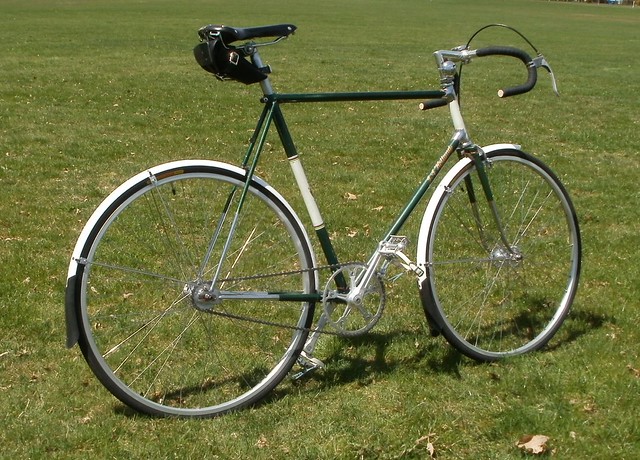
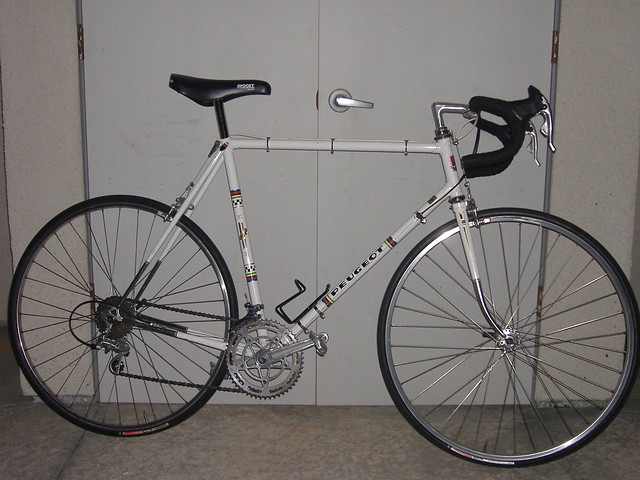
I have no idea if the Nervex Pro models were produced as late as 1975, but I have one of these (as repegage correctly noted) ultra-steep-angled PX10 models that is post-1973 I believe. These steep ones were the last batch built with the NervexPro lugs from all that I've seen, and have the same 76+degree frame angles as the Thevenet-era PX10LE models.
As such, this frameset will mimic a track bike on the street, harsh-riding, twitchy, but with a zeal for attacking a steeper hill in the one gear you're carrying. It is also drilled for brakes and can even run 27" tires with fenders.
It was a good-looking bike as shown complete, but only certain riders will appreciate that steep geometry, and only over certain road conditions I'd imagine.
A longer and stronger stem with quill sanded down to 22mm and with slightly wider bars would calm this bike down a bit, and would be in keeping with it's "attack that hill" mission in life.
Last edited by dddd; 02-20-14 at 03:02 PM.
02-21-14 | 06:30 AM
#90
I always thought that the idea behind the steep head tubes was to make the bike more maneuverable and thus more suitable for criterium racing. I''m having trouble understanding how it can help you "attack that hill".
02-21-14 | 12:00 PM
#91
Ride, Wrench, Swap, Race
Joined: Jan 2010
Posts: 9,835
Likes: 1,816
From: Northern California
Bikes: Cheltenham-Pedersen racer, Boulder F/S Paris-Roubaix, Varsity racer, '52 Christophe, '62 Continental, '92 Merckx, '75 Limongi, '76 Presto, '72 Gitane SC, '71 Schwinn SS, etc.
Strictly in terms of criterium racing, which is a very high-intensity and thus necessarily-short race with emphasis on attacks, sprints, and with the rider being constantly positioned for aerodynamics and the sudden delivery of acceleration, the advantages with respect to climbing are surprisingly much the same.
While climbing steeper sections off of the saddle, both the head- and seat-tube angles are preferably steep, not so much for maneuverability but for keeping the bike steering mostly straight, in an effortless way as the rider leans the bike to-and-fro in response to heavy pedaling. The steeper head tube angle tracks/corrects these leaning motions with less arm effort, so the more-instant centering reduces front tire scrub.
The effect of shorter chainstays is similarly related, in that the shorter lever arm distance from the rear axle to the bb puts less lateral pedaling loads into the bike's front end, directly reducing front-end push, reducing steering effort and tire scrub. Short stays are thus indeed great for climbing.
The steeper head and seat tube angles both allow a more-forward rider position, which makes the transition to standing (while also leaning forward) much less of an effort, thus allowing more-frequent transitions as needed, with less wasted energy and lost momentum.
And, at the highest pedaling force levels, the more forward-positioned rider will have to exert less, if any, pulling force on the bars.
A steeper head tube angle also allows neutral steering with longer stem lengths, which can both calm a twitchy bike's steering at speed and allow a more-forward rider position, primarily when the rider is out of the saddle.
A steeper head tube angle also allows for closer drafting, by shortening the wheelbase, pulling the front axle back relative to the handlebars and thus also relative to the rider.
A steeper seat tube angle of course moves the seatpost forward, but also moves the head tube forward for any given top tube length.
So there is great advantage to allowing the rider to lean forward more either when racing in a criterium or when attacking a steep hill.
The same doesn't so much apply to riding centuries, so as with my Merckx Century model, just the seat tube angle has been relaxed, pulling the seat tube and head tube rearward relative to the bb. After all, a rider's arms would tire if they had to put in 100 miles and perhaps six hours in such a forward position, but for the short effort of a criterium or for climbing steep switchbacks, the steeper frame actually reduces the rider's fatigue, even in their arms!
These ultra-steep PX10's seem to have been modeled after true "team" geometry, which of course favors the fittest riders who can produce the sustained pedaling torque to directly offset any tendency for too much of the rider's weight to fall on their arms.
That these bikes can also assist the amateur rider in certain specific situations of more-intense pedaling effort makes them a potentially amusing ride for more-spirited club events.
BTW, I compared the dimensions of the pictured PX10LE (older photo btw) with the "pro" bikes in a Cervelo/Trek dealership recently, and in order to get the handlebars as forward of the bb as on this Peugeot, I would have had to also use a much-longer stem on a larger frame which also had a too-much-longer head tube. The "effective" difference in forward reach for like-sized frames was literally several cm!
That said, I can easily put in a fast 3hr ride on this PX10LE, which over-taxes my arm muscles less than it spares my leg muscles.
It is effective, if also rather harsh and twitchy. In short, it's more of a pro's bike than a pleasure ride.
Last edited by dddd; 02-21-14 at 12:14 PM.
02-21-14 | 12:47 PM
#92
Senior Member
Joined: Jul 2009
Posts: 11,128
Likes: 39
Bikes: 1986 Alan Record Carbonio, 1985 Vitus Plus Carbone 7, 1984 Peugeot PSV, 1972 Line Seeker, 1986(est.) Medici Aerodynamic (Project), 1985(est.) Peugeot PY10FC
Understand what you are saying about steep head tubes and climbs,...but does the steep ehad tube it also help when you bomb down on the other side of the mountain? Would the quick steering mean a more "nervous" front end that won't be fun in long fast downhill runs?
02-21-14 | 01:17 PM
#93
Get off my lawn!
Joined: Nov 2010
Posts: 6,035
Likes: 119
From: The Garden State
Bikes: 1917 Loomis, 1923 Rudge, 1930 Hercules Renown, 1947 Mclean, 1948 JA Holland, 1955 Hetchins, 1957 Carlton Flyer, 1962 Raleigh Sport, 1978&81 Raleigh Gomp GS', 2010 Raliegh Clubman
The only "hill" I've ever attached was made of mash potatoes
02-21-14 | 03:04 PM
#94
That's what it has always meant for me, even when I was young and fearless.
02-21-14 | 03:08 PM
#95
Ride, Wrench, Swap, Race
Joined: Jan 2010
Posts: 9,835
Likes: 1,816
From: Northern California
Bikes: Cheltenham-Pedersen racer, Boulder F/S Paris-Roubaix, Varsity racer, '52 Christophe, '62 Continental, '92 Merckx, '75 Limongi, '76 Presto, '72 Gitane SC, '71 Schwinn SS, etc.
Well, like when you're on a singlespeed or an older bike with a small chainring that's 49t, any steep hill has to be attacked,, the only other option might be walking!
Doing training rides here on my 1952 Christophe, low gear is like 47/20t, so hills need to be anticipated AND attacked.
But that bike is quick as a cat, has unbelievably-steep angles, as steep as the PX10LE's, if not steeper. It loves to take rolling hills in big bites.
Shown here with perhaps a 13-24t freewheel and somewhat too-short stem. Handling is not for the timid!

Doing training rides here on my 1952 Christophe, low gear is like 47/20t, so hills need to be anticipated AND attacked.
But that bike is quick as a cat, has unbelievably-steep angles, as steep as the PX10LE's, if not steeper. It loves to take rolling hills in big bites.
Shown here with perhaps a 13-24t freewheel and somewhat too-short stem. Handling is not for the timid!
02-21-14 | 03:21 PM
#96
Ride, Wrench, Swap, Race
Joined: Jan 2010
Posts: 9,835
Likes: 1,816
From: Northern California
Bikes: Cheltenham-Pedersen racer, Boulder F/S Paris-Roubaix, Varsity racer, '52 Christophe, '62 Continental, '92 Merckx, '75 Limongi, '76 Presto, '72 Gitane SC, '71 Schwinn SS, etc.
Why? Because the steep head tube needs a longer stem to calm the bike's steering at higher speeds, yet the frame's toptube reach is too large for the rider to use a longer stem. A bike like this is one that I can't feel stable on, so I would sell it.
So yes, a steeper front end makes for quicker steering, but with shallower fork rake and a longer stem, the bike may handle well at high speed.
The Peugeot PX10LE above handles very quick but can be ridden at very high speeds with no wobble or weave. I would not want to descend at speed on rougher roads, and I would especially not want to have to change hand position while riding it under any challenging conditions, as the steering has so little effect of holding it's own line. You could say it is flighty, but with both hands on the bars it is actually safe to move around on within a fast, tight group of riders.
Climbing off of the LE and onto a Raleigh International is the most comforting thing however, since suddenly you can ride around one-handed, take a drink, bomb confidently down a bumpy descent or take a long look behind you while riding. You take none of these things for granted on an LE, or on the E. Christophe pictured above.
Last edited by dddd; 02-21-14 at 03:28 PM.
02-21-14 | 04:06 PM
#97
I almost immediately replaced the stem on my PX10LE with one with a shorter reach after I bought it new. It made it even more twitchy, but it was necessary for comfort. I was just too stretched out with the original stem. I still have both stems. The shorter one is on my PA10 where it wortks fine with its relaxed geometry. The long one is in a parts bin. The PX10 now has a Nitto.
02-21-14 | 05:23 PM
#98

Thread Starter
Senior Member
Joined: Aug 2006
Posts: 7,643
Likes: 68
From: Portland OR
Bikes: 61 Bianchi Specialissima 71 Peugeot G50 7? P'geot PX10 74 Raleigh GranSport 75 P'geot UO8 78? Raleigh Team Pro 82 P'geot PSV 86 P'geot PX 91 Bridgestone MB0 92 B'stone XO1 97 Rans VRex 92 Cannondale R1000 94 B'stone MB5 97 Vitus 997
dddd, your explanation of the rationale for and effect of ultra steep head angle, short chainstays, etc is very interesting, and very clear. Thanks!
Coincidentally, I have a long torso and usually need long stems, which sounds suitable for this bike.
Coincidentally, I have a long torso and usually need long stems, which sounds suitable for this bike.
02-21-14 | 05:26 PM
#99

Bicycle Repair Man !!!
Joined: Sep 2007
Posts: 27,266
Likes: 152
From: YEG
Bikes: See my sig...
Some interesting commentary on geometry and handling although there are no absolutes... my Ron Cooper that has racing geometry does everything remarkably well while my Proctor road bike has a steeper head tube and longer chainstays and is a brilliant bike to have on climbs and is not at all twitchy at speed.
The Cooper also excels at distance riding... it is no more fatiguing to ride this than it is my touring bicycles and the ride quality is something to be experienced.
My 1957 Peugeot PLX has a longer wheelbase and is a rando bike... it climbs like a goat on steroids and lots of this comes from those longer chainstays also being stiffer... in the days of steel bicycles the best way to add stiffness without adding weight was to make the rear triangle as tight as possible while newer alloys and materials like aluminium and carbon fibre can allow for a longer wheelbase without compromising stiffness.
We have built TT bikes with longer rear stays to increase the wheelbase and better centre the rider... they gave up nothing to conventional frames and had the UBI not been such a backwards bunch when it came to design you might see bicycles with less conventional frames in races.
The Cooper also excels at distance riding... it is no more fatiguing to ride this than it is my touring bicycles and the ride quality is something to be experienced.
My 1957 Peugeot PLX has a longer wheelbase and is a rando bike... it climbs like a goat on steroids and lots of this comes from those longer chainstays also being stiffer... in the days of steel bicycles the best way to add stiffness without adding weight was to make the rear triangle as tight as possible while newer alloys and materials like aluminium and carbon fibre can allow for a longer wheelbase without compromising stiffness.
We have built TT bikes with longer rear stays to increase the wheelbase and better centre the rider... they gave up nothing to conventional frames and had the UBI not been such a backwards bunch when it came to design you might see bicycles with less conventional frames in races.