


Mafac Cantilever Help
 06-23-14 | 08:46 AM
#1

Thread Starter
Senior Member

Joined: Feb 2004
Posts: 7,176
Likes: 56
From: Clev Oh
Bikes: Specialized, Schwinn
Mafac Cantilever Help
For all you experts, I just cleaned up a set of Mafac cantis. The straddle wires are frayed and need to be replaced. It looks like they are almost a derailleur cable. There is a really small know on the end of the wire. It sure doesn't look like a Shimano cable. Is there a special wire I need to use?
 06-23-14 | 09:39 AM
#2


I use derailer cable to make straddle wires for MAFAC center pulls. It's close to the size of the originals.
06-23-14 | 09:46 AM
#3
Thread Starter
Senior Member
Joined: Feb 2004
Posts: 7,176
Likes: 56
From: Clev Oh
Bikes: Specialized, Schwinn
06-23-14 | 10:45 AM
#4

What??? Only 2 wheels?


Joined: Apr 2010
Posts: 13,501
Likes: 995
From: Boston-ish, MA
Bikes: 72 Peugeot UO-8, 82 Peugeot TH8, 87 Bianchi Brava, 76? Masi Grand Criterium, 74 Motobecane Champion Team, 86 & 77 Gazelle champion mondial, 81? Grandis, 82? Tommasini, 83 Peugeot PF10
I used derailleur cables also.
One thing to consider re length. Depending on your wheel width and brake pad thickness, the angle of the lever when the pad hits the wheel may be such that the cable anchor at the end of the lever is below the pivot. If so you'll get better leverage, i.e. better stopping power, if the straddle cable is longer. A longer straddle cable will also see less tension and therefore be less prone to failure, in case you are worried about the strength of the knob.
This is unlike the typical Weinmann or DiaCompe centerpull where the cable anchor is even with or above the pivot. With those you generally get more power with a shorter cable. With the Mafac geometry you want the straddle cable as long as possible without the hanger hitting the housing stop.
I've posted the analysis of this geometry before but don't have the specifics at my fingertips right now. PM me if you really want to see it, and I"ll try to dig it up.
One thing to consider re length. Depending on your wheel width and brake pad thickness, the angle of the lever when the pad hits the wheel may be such that the cable anchor at the end of the lever is below the pivot. If so you'll get better leverage, i.e. better stopping power, if the straddle cable is longer. A longer straddle cable will also see less tension and therefore be less prone to failure, in case you are worried about the strength of the knob.
This is unlike the typical Weinmann or DiaCompe centerpull where the cable anchor is even with or above the pivot. With those you generally get more power with a shorter cable. With the Mafac geometry you want the straddle cable as long as possible without the hanger hitting the housing stop.
I've posted the analysis of this geometry before but don't have the specifics at my fingertips right now. PM me if you really want to see it, and I"ll try to dig it up.
__________________
Real cyclists use toe clips.
With great bikes comes great responsibility.
jimmuller
Real cyclists use toe clips.
With great bikes comes great responsibility.
jimmuller
06-23-14 | 11:29 AM
#5
Banned
Joined: Jun 2010
Posts: 43,586
Likes: 1,380
From: NW,Oregon Coast
Bikes: 8
You may want to file the barrel end so it fits in the piece that becomes your QR.. using a stainless steel Gear cable would be a good improvement..
But the original one of mine, Zn treated plain steel, is still OK .. 30 years later..
soldering the end before you cut it is a nice step, but that is more difficult when the cable is Stainless steel, easier with Zn treated steel ..
But the original one of mine, Zn treated plain steel, is still OK .. 30 years later..
soldering the end before you cut it is a nice step, but that is more difficult when the cable is Stainless steel, easier with Zn treated steel ..
06-23-14 | 01:05 PM
#7

Senior Member
Joined: Nov 2005
Posts: 4,066
Likes: 2,153
From: NW Ohio
Bikes: 1984 Miyata 310, 1986 Schwinn Sierra, 1987 Ross Mt. Hood, 1988 Schwinn LeTour, 1988 Trek 400T, 1981 Fuji S12-1977 Univega Grand Rally, S LTD, 1973 Sears Free Spirit 531, 197? FW Evans
I used derailleur cables also.
One thing to consider re length. Depending on your wheel width and brake pad thickness, the angle of the lever when the pad hits the wheel may be such that the cable anchor at the end of the lever is below the pivot. If so you'll get better leverage, i.e. better stopping power, if the straddle cable is longer. A longer straddle cable will also see less tension and therefore be less prone to failure, in case you are worried about the strength of the knob.
This is unlike the typical Weinmann or DiaCompe centerpull where the cable anchor is even with or above the pivot. With those you generally get more power with a shorter cable. With the Mafac geometry you want the straddle cable as long as possible without the hanger hitting the housing stop.
I've posted the analysis of this geometry before but don't have the specifics at my fingertips right now. PM me if you really want to see it, and I"ll try to dig it up.
One thing to consider re length. Depending on your wheel width and brake pad thickness, the angle of the lever when the pad hits the wheel may be such that the cable anchor at the end of the lever is below the pivot. If so you'll get better leverage, i.e. better stopping power, if the straddle cable is longer. A longer straddle cable will also see less tension and therefore be less prone to failure, in case you are worried about the strength of the knob.
This is unlike the typical Weinmann or DiaCompe centerpull where the cable anchor is even with or above the pivot. With those you generally get more power with a shorter cable. With the Mafac geometry you want the straddle cable as long as possible without the hanger hitting the housing stop.
I've posted the analysis of this geometry before but don't have the specifics at my fingertips right now. PM me if you really want to see it, and I"ll try to dig it up.
06-23-14 | 07:10 PM
#8
What??? Only 2 wheels?
Joined: Apr 2010
Posts: 13,501
Likes: 995
From: Boston-ish, MA
Bikes: 72 Peugeot UO-8, 82 Peugeot TH8, 87 Bianchi Brava, 76? Masi Grand Criterium, 74 Motobecane Champion Team, 86 & 77 Gazelle champion mondial, 81? Grandis, 82? Tommasini, 83 Peugeot PF10
Here is what Sheldon Brown had to say: The Geometry of Cantilever Brakes
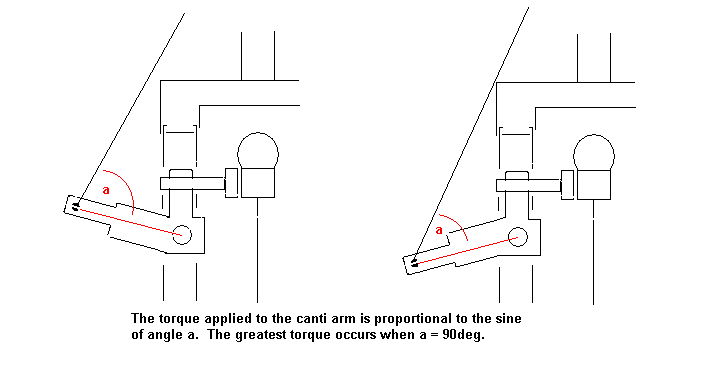
Though he identifies types by what he calls cantilever angle, that doesn't really affect the performance directly. The arm is one rigid piece so it could have any arbitrary shape. The key property is how much torque the cable can apply to the arm, and that depends on the tension in the cable and the angle a. The closer a is to 90deg, the more torque you get and thus the more force of the pad against the rim.
Centerpull brakes get more power with a shorter cable by having more tension due to a greater mechanical advantage. Sheldon Brown describes this correctly. It is determined by "how straight" the straddle cable is, i.e. by the angle at which the two sides comes off each other at the yoke. With a centerpull, angle a doesn't get small enough to offset the increased tension from greater mechanical advantage.
But with the cantilever shown on the right a short enough cable can make the angle such that it pulls at 0 deg, directly into the arm, thus giving no torque at all. In fact, if you make it so short that it runs directly over to the other side in a line below the pivots, then it will pull the arm away from the rim!
A year or two ago I did a complete mathematical analysis of the tensions and torques due to these different angles, specifically the angle a and the angle of the straddle cable from the center to each side. I posted the results here in C&V but it's probably lost in the depths of dead threads. Anyway, one key conclusion is that when the end of the straddle cable is below the arm pivot as shown on the right above, there is no way you can get angle a near 90deg, and the torque lost from that effect will be greater than any increase in mechanical advantage you can get with a shorter cable. Inotherwords, a longer cable is better for that kind of brake.
__________________
Real cyclists use toe clips.
With great bikes comes great responsibility.
jimmuller
Real cyclists use toe clips.
With great bikes comes great responsibility.
jimmuller
06-24-14 | 08:50 AM
#9
I set up my MAFAC center pulls with longer straddle cables to get them closer to 90° to the arms. Many "experts" will tell you to do exactly the opposite. A wider yoke should accomplish the same thing, but I haven't tried it.
06-24-14 | 09:02 AM
#10
What??? Only 2 wheels?
Joined: Apr 2010
Posts: 13,501
Likes: 995
From: Boston-ish, MA
Bikes: 72 Peugeot UO-8, 82 Peugeot TH8, 87 Bianchi Brava, 76? Masi Grand Criterium, 74 Motobecane Champion Team, 86 & 77 Gazelle champion mondial, 81? Grandis, 82? Tommasini, 83 Peugeot PF10
True, except that the length of the arm is what it is. You can adjust it only be replacing it, in which case it isn't a Mafac cantilever anymore. Well, I guess you could design an extension to the arm.
__________________
Real cyclists use toe clips.
With great bikes comes great responsibility.
jimmuller
Real cyclists use toe clips.
With great bikes comes great responsibility.
jimmuller
06-24-14 | 09:27 AM
#11
I didn't use any math or diagrams to figure it out. It's what an old professor of mine used to call "intuitively obvious".
06-24-14 | 10:04 AM
#12

Senior Member

Joined: Oct 2011
Posts: 10,050
Likes: 2,508
From: Fairplay Co
Bikes: Current 79 Nishiki Custum Sport, Jeunet 620, notable previous bikes P.K. Ripper loop tail, Kawahara Laser Lite, Paramount Track full chrome, Raliegh Internatioanl, Motobecan Super Mirage. 59 Crown royak 3 speed
I used derailleur cables also.
One thing to consider re length. Depending on your wheel width and brake pad thickness, the angle of the lever when the pad hits the wheel may be such that the cable anchor at the end of the lever is below the pivot. If so you'll get better leverage, i.e. better stopping power, if the straddle cable is longer. A longer straddle cable will also see less tension and therefore be less prone to failure, in case you are worried about the strength of the knob.
This is unlike the typical Weinmann or DiaCompe centerpull where the cable anchor is even with or above the pivot. With those you generally get more power with a shorter cable. With the Mafac geometry you want the straddle cable as long as possible without the hanger hitting the housing stop.
I've posted the analysis of this geometry before but don't have the specifics at my fingertips right now. PM me if you really want to see it, and I"ll try to dig it up.
One thing to consider re length. Depending on your wheel width and brake pad thickness, the angle of the lever when the pad hits the wheel may be such that the cable anchor at the end of the lever is below the pivot. If so you'll get better leverage, i.e. better stopping power, if the straddle cable is longer. A longer straddle cable will also see less tension and therefore be less prone to failure, in case you are worried about the strength of the knob.
This is unlike the typical Weinmann or DiaCompe centerpull where the cable anchor is even with or above the pivot. With those you generally get more power with a shorter cable. With the Mafac geometry you want the straddle cable as long as possible without the hanger hitting the housing stop.
I've posted the analysis of this geometry before but don't have the specifics at my fingertips right now. PM me if you really want to see it, and I"ll try to dig it up.
06-24-14 | 11:05 AM
#13

Senior Member
Joined: Sep 2009
Posts: 1,390
Likes: 118
From: EagleRiver AK
Good mathematical analysis of cantilever geometry at https://www.circleacycles.com/cantile...i-geometry.pdf
Interesting to note that standard narrow angle cantis start with high MA but then regressively loose MA as they are pulled upward. Wide angle cantis have less MA but they provide linear response as cable anchor height changes. Ultra-wide cantis (such as mafac) have the least initial MA but they progressively increase the MA as cable anchor is raised.
Interesting to note that standard narrow angle cantis start with high MA but then regressively loose MA as they are pulled upward. Wide angle cantis have less MA but they provide linear response as cable anchor height changes. Ultra-wide cantis (such as mafac) have the least initial MA but they progressively increase the MA as cable anchor is raised.
06-24-14 | 03:04 PM
#14
Senior Member
Joined: Oct 2011
Posts: 10,050
Likes: 2,508
From: Fairplay Co
Bikes: Current 79 Nishiki Custum Sport, Jeunet 620, notable previous bikes P.K. Ripper loop tail, Kawahara Laser Lite, Paramount Track full chrome, Raliegh Internatioanl, Motobecan Super Mirage. 59 Crown royak 3 speed
The math is unambiguous. For that geometry a shorter cable makes it worse.
True, except that the length of the arm is what it is. You can adjust it only be replacing it, in which case it isn't a Mafac cantilever anymore. Well, I guess you could design an extension to the arm.
True, except that the length of the arm is what it is. You can adjust it only be replacing it, in which case it isn't a Mafac cantilever anymore. Well, I guess you could design an extension to the arm.
06-24-14 | 03:38 PM
#15
What??? Only 2 wheels?
Joined: Apr 2010
Posts: 13,501
Likes: 995
From: Boston-ish, MA
Bikes: 72 Peugeot UO-8, 82 Peugeot TH8, 87 Bianchi Brava, 76? Masi Grand Criterium, 74 Motobecane Champion Team, 86 & 77 Gazelle champion mondial, 81? Grandis, 82? Tommasini, 83 Peugeot PF10
The point I tried to make earlier is that there are two variable factors at play, the angle between the cable and a line from cable end to pivot, and the cable tension. Which one is dominant is not intuitively obvious at all until you have analyzed how they both vary with straddle cable length. For those cantilevers any change as a result of the angle dominates any change you can get in tension. For centerpulls that relationship isn't the same.
Yes it is nice to have the ability to adjust them. Sometimes you may want more power, sometimes you may want more linearity or modulation.
__________________
Real cyclists use toe clips.
With great bikes comes great responsibility.
jimmuller
Real cyclists use toe clips.
With great bikes comes great responsibility.
jimmuller
06-24-14 | 07:08 PM
#17
More work for no gain.
06-24-14 | 09:45 PM
#18
Senior Member
Joined: Oct 2011
Posts: 10,050
Likes: 2,508
From: Fairplay Co
Bikes: Current 79 Nishiki Custum Sport, Jeunet 620, notable previous bikes P.K. Ripper loop tail, Kawahara Laser Lite, Paramount Track full chrome, Raliegh Internatioanl, Motobecan Super Mirage. 59 Crown royak 3 speed
Not to quibble, but this depends on what you mean by "best".
The point I tried to make earlier is that there are two variable factors at play, the angle between the cable and a line from cable end to pivot, and the cable tension. Which one is dominant is not intuitively obvious at all until you have analyzed how they both vary with straddle cable length. For those cantilevers any change as a result of the angle dominates any change you can get in tension. For centerpulls that relationship isn't the same.
Yes it is nice to have the ability to adjust them. Sometimes you may want more power, sometimes you may want more linearity or modulation.
The point I tried to make earlier is that there are two variable factors at play, the angle between the cable and a line from cable end to pivot, and the cable tension. Which one is dominant is not intuitively obvious at all until you have analyzed how they both vary with straddle cable length. For those cantilevers any change as a result of the angle dominates any change you can get in tension. For centerpulls that relationship isn't the same.
Yes it is nice to have the ability to adjust them. Sometimes you may want more power, sometimes you may want more linearity or modulation.

