


1976 Schwinn Varsity question
 02-06-15 | 06:04 PM
#1

Thread Starter
Calamari Marionette Ph.D
Joined: Dec 2013
Posts: 7,861
Likes: 41
From: Coeur d' Alene
Bikes: 3 Chinese Gas Pipe Nerdcycles and 2 Chicago Electroforged Boat Anchors
1976 Schwinn Varsity question
Hi all
I dug around but can't seem to find this number. What is the rear dropout spacing on a 1976 Schwinn Varsity?
Thanks for any and all input.
I dug around but can't seem to find this number. What is the rear dropout spacing on a 1976 Schwinn Varsity?
Thanks for any and all input.
 02-06-15 | 06:19 PM
#2

Ride, Wrench, Swap, Race

Joined: Jan 2010
Posts: 9,831
Likes: 1,809
From: Northern California
Bikes: Cheltenham-Pedersen racer, Boulder F/S Paris-Roubaix, Varsity racer, '52 Christophe, '62 Continental, '92 Merckx, '75 Limongi, '76 Presto, '72 Gitane SC, '71 Schwinn SS, etc.
I believe mine is 126mm, the extra was to accommodate the chain-catcher ring on the small end of the freewheel
I have since fitted a six-speed freewheel to the original wheel, but be aware that the original derailer needed modification to handle it.
Can we assume that you are perhaps ordering an alloy-rimmed wheelset at this time?
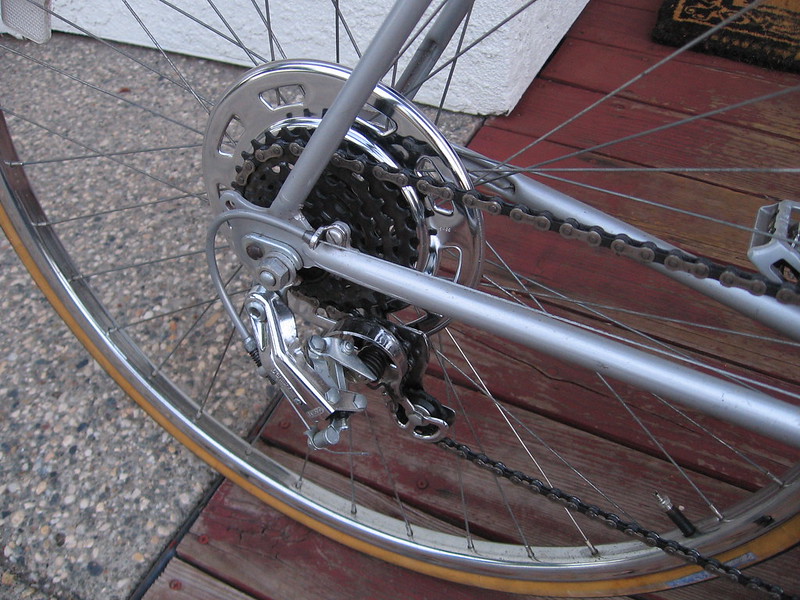
I have since fitted a six-speed freewheel to the original wheel, but be aware that the original derailer needed modification to handle it.
Can we assume that you are perhaps ordering an alloy-rimmed wheelset at this time?
02-06-15 | 06:21 PM
#3

Disco Infiltrator


Joined: May 2013
Posts: 15,345
Likes: 3,542
From: Folsom CA
Bikes: Stormchaser, Paramount, Tilt, Samba tandem
[MENTION=226065]Metacortex[/MENTION] always has the answer.
...I've now measured 125-126mm OLD on all of the '69 through '80 Schwinn Approved rear hubs I've checked (15+ sets so far), regardless of whether they were solid or hollow axle, EF or FB bikes.
__________________
Genesis 49:16-17
"Well, well!" said Holmes, impatiently. "A good cyclist does not need a high road. The moor is intersected with paths and the moon is at the full."
Genesis 49:16-17
"Well, well!" said Holmes, impatiently. "A good cyclist does not need a high road. The moor is intersected with paths and the moon is at the full."
02-06-15 | 06:27 PM
#4
Senior Member
Joined: Apr 2011
Posts: 2,347
Likes: 21
Bikes: Fillet-brazed Schwinns
I believe that the spacing changed from 120mm to 125/126mm in '68 when the hubs changed from Sprint to Schwinn Approved. Note that Schwinn didn't incorporate the "top protector" (outer cog chainguard) on its freewheels until '71.
02-06-15 | 06:36 PM
#5
Ride, Wrench, Swap, Race
Joined: Jan 2010
Posts: 9,831
Likes: 1,809
From: Northern California
Bikes: Cheltenham-Pedersen racer, Boulder F/S Paris-Roubaix, Varsity racer, '52 Christophe, '62 Continental, '92 Merckx, '75 Limongi, '76 Presto, '72 Gitane SC, '71 Schwinn SS, etc.
Even many bike's rear hubs set up for 5 speed freewheels (and with 120/121mm spacing) had room for standard 6-speed freewheels if these bolts were shortened to the point of being flush.
Campagnolo 5-speed hubs did not feature these excesses of axle protrusion, the better to preserve axle longevity, but cheaper French hubs very often did.
And especially when using modern chains, the outer face of the smallest cog can be as close as 3mm to the inside dropout face in some instances! Very little excess axle protrusion needed.
02-06-15 | 06:40 PM
#6


feros ferio

Joined: Jul 2000
Posts: 22,411
Likes: 1,876
From: www.ci.encinitas.ca.us
Bikes: 1959 Capo Modell Campagnolo; 1960 Capo Sieger (2); 1962 Carlton Franco Suisse; 1970 Peugeot UO-8; 1982 Bianchi Campione d'Italia; 1988 Schwinn Project KOM-10;
Thanks for the clarification on overlock dimension. Without the pie plate and the high gear guard, there should be ample room for a 6-speed freewheel, maybe even a 7-speed.
__________________
"Far and away the best prize that life offers is the chance to work hard at work worth doing." --Theodore Roosevelt
Capo: 1959 Modell Campagnolo, S/N 40324; 1960 Sieger (2), S/N 42624, 42597
Carlton: 1962 Franco Suisse, S/N K7911
Peugeot: 1970 UO-8, S/N 0010468
Bianchi: 1982 Campione d'Italia, S/N 1.M9914
Schwinn: 1988 Project KOM-10, S/N F804069
"Far and away the best prize that life offers is the chance to work hard at work worth doing." --Theodore Roosevelt
Capo: 1959 Modell Campagnolo, S/N 40324; 1960 Sieger (2), S/N 42624, 42597
Carlton: 1962 Franco Suisse, S/N K7911
Peugeot: 1970 UO-8, S/N 0010468
Bianchi: 1982 Campione d'Italia, S/N 1.M9914
Schwinn: 1988 Project KOM-10, S/N F804069
02-06-15 | 06:56 PM
#7
Thread Starter
Calamari Marionette Ph.D
Joined: Dec 2013
Posts: 7,861
Likes: 41
From: Coeur d' Alene
Bikes: 3 Chinese Gas Pipe Nerdcycles and 2 Chicago Electroforged Boat Anchors
Thanks for the response.
I am looking at a bike on Craig's List and the seller isn't Johnny Helpful, and it's located far enough away that I want to be sure before I pull the trigger. I am just beginning to make plans for either cold setting the frame or spacing the hub out. 126 should be doable either way. It'll be single speed Townie/grocery getter conversion.
May I see a pic of your whole bike please? Looks good.
I am looking at a bike on Craig's List and the seller isn't Johnny Helpful, and it's located far enough away that I want to be sure before I pull the trigger. I am just beginning to make plans for either cold setting the frame or spacing the hub out. 126 should be doable either way. It'll be single speed Townie/grocery getter conversion.
May I see a pic of your whole bike please? Looks good.
I believe mine is 126mm, the extra was to accommodate the chain-catcher ring on the small end of the freewheel
I have since fitted a six-speed freewheel to the original wheel, but be aware that the original derailer needed modification to handle it.
Can we assume that you are perhaps ordering an alloy-rimmed wheelset at this time?
I have since fitted a six-speed freewheel to the original wheel, but be aware that the original derailer needed modification to handle it.
Can we assume that you are perhaps ordering an alloy-rimmed wheelset at this time?
02-06-15 | 07:37 PM
#9
Banned.
Joined: May 2011
Posts: 4,816
Likes: 29
From: on the beach
Bikes: '73 falcon sr, '76 grand record, '84 davidson
"barsity" ... that's the bike you don't mind riding home drunk.
edit: this post no longer makes as much sense in light of the corrected title typo.
edit: this post no longer makes as much sense in light of the corrected title typo.
Last edited by eschlwc; 02-07-15 at 04:17 PM.
02-06-15 | 09:36 PM
#10
Banned.
Joined: Sep 2014
Posts: 240
Likes: 1
I think, I have done, you could put your shoe against one side of the rear triangle,both paws opposite and stretch your foot enough to make those bomb proof Continentals, varsity's collegiate's, any size, including 250 MOTORCYCLE TIRE. They are strong flexible, and adopt to anything. With those bicycles, "frame dimension is adjustable"
02-06-15 | 10:24 PM
#11
Ride, Wrench, Swap, Race
Joined: Jan 2010
Posts: 9,831
Likes: 1,809
From: Northern California
Bikes: Cheltenham-Pedersen racer, Boulder F/S Paris-Roubaix, Varsity racer, '52 Christophe, '62 Continental, '92 Merckx, '75 Limongi, '76 Presto, '72 Gitane SC, '71 Schwinn SS, etc.
Good luck with acquisition of a large-sized Varsity. A varsity typically fits a rider well while riding if it seems to be too big while first standing and straddling the bike(!). The slack (70-degree) seat tube angle pulls a few cm of length out of the front end, and the bottom bracket is very high to accommodate novices riding around corners while pedaling.
Also, the (very) slack head tube angle limits the ability to get fitted using any stem longer than 90mm without also adding wider handlebars to maintain neutral steering behavior.
Here's a big picture or two. I added a longer 9cm stem and cut an inch off of each end of the handlebar to prevent my knees hitting the ends of the bars. I'm 5'9" and the frame size is 24" to the top of the seat tube clamp:


Also, the (very) slack head tube angle limits the ability to get fitted using any stem longer than 90mm without also adding wider handlebars to maintain neutral steering behavior.
Here's a big picture or two. I added a longer 9cm stem and cut an inch off of each end of the handlebar to prevent my knees hitting the ends of the bars. I'm 5'9" and the frame size is 24" to the top of the seat tube clamp:
02-06-15 | 10:32 PM
#12
Ride, Wrench, Swap, Race
Joined: Jan 2010
Posts: 9,831
Likes: 1,809
From: Northern California
Bikes: Cheltenham-Pedersen racer, Boulder F/S Paris-Roubaix, Varsity racer, '52 Christophe, '62 Continental, '92 Merckx, '75 Limongi, '76 Presto, '72 Gitane SC, '71 Schwinn SS, etc.
I think, I have done, you could put your shoe against one side of the rear triangle,both paws opposite and stretch your foot enough to make those bomb proof Continentals, varsity's collegiate's, any size, including 250 MOTORCYCLE TIRE. They are strong flexible, and adopt to anything. With those bicycles, "frame dimension is adjustable"
You don't want to ever spread the stays by pulling one side against the other. Each side must be moved outward in a measured way, one side at a time, else the yielding will always concentrate on one side, putting the frame out of alignment and with the original center reference lost.
You can use a length of 2x4 as leverage bending one side at a time, or you can lay the bike on it's side and push the lower chainstay down with your foot, using the pedal, saddle and handlebar to "tripod" the bike in a fixed position while bending and measuring. Then you can flip the bike over and bend the other side, measuring again to bend another 3mm for a total width increase of 6mm.
But these 1970's Schwinns were set at about 126mm at the factory, as per metacortex and my own recollection.
02-07-15 | 02:32 PM
#13
Banned.
Joined: Sep 2014
Posts: 240
Likes: 1
I am of the opinion that you are right, but, my opinion that you could tie two horses to each end of the rear triangle and have them pull, the schwinn would come out on top. I am not talking about old masi's colnago's but schwinn varsity's. If you have all the time in the world i say do it your way. If you need to get a messenger back on the road immediately after he pretzeled his wheel, i me myself have with great reward spread a frame open by pulling it apart in a reverse way, similar to a reverse bench pec dec exercise. Thats all, it worked for me, and i never had a complaint that i remember.
02-07-15 | 03:54 PM
#14
Ride, Wrench, Swap, Race
Joined: Jan 2010
Posts: 9,831
Likes: 1,809
From: Northern California
Bikes: Cheltenham-Pedersen racer, Boulder F/S Paris-Roubaix, Varsity racer, '52 Christophe, '62 Continental, '92 Merckx, '75 Limongi, '76 Presto, '72 Gitane SC, '71 Schwinn SS, etc.
I should say that I have no qualms with forcing a wider-spaced rear wheel into the rear triangle, where I expect both sides to flex near-equally!
It's when you do the cold-setting that one side always seems to have a lower "yield point" of force, where if they see equal and opposite force then one side springs back while the other side doesn't. Only in this scenario (what I thought you had earlier described) will a significant to-one-side offset likely result at the rear wheel.
Sometimes such an offset (toward the driveside) of the rear frame can be useful, as when a badly-bent wheel can better be trued with less dish applied, so the assembled bike could then possibly have both a stronger, straighter wheel and perfect wheel tracking at the same time! The chainline might also even improve! And, as I think you implied, what better bike to do it on than one with malleable steel chainstays?
It's when you do the cold-setting that one side always seems to have a lower "yield point" of force, where if they see equal and opposite force then one side springs back while the other side doesn't. Only in this scenario (what I thought you had earlier described) will a significant to-one-side offset likely result at the rear wheel.
Sometimes such an offset (toward the driveside) of the rear frame can be useful, as when a badly-bent wheel can better be trued with less dish applied, so the assembled bike could then possibly have both a stronger, straighter wheel and perfect wheel tracking at the same time! The chainline might also even improve! And, as I think you implied, what better bike to do it on than one with malleable steel chainstays?
02-08-15 | 09:30 AM
#15
Thread Starter
Calamari Marionette Ph.D
Joined: Dec 2013
Posts: 7,861
Likes: 41
From: Coeur d' Alene
Bikes: 3 Chinese Gas Pipe Nerdcycles and 2 Chicago Electroforged Boat Anchors
02-08-15 | 11:07 AM
#16

Senior Member
Joined: Nov 2010
Posts: 22,994
Likes: 10,498
From: Sacramento, CA
Bikes: old ones
.
...IME, Varsities and their dropouts bend with little effort, but if you want your resulting bicycle to track, you need to pay attention to the centering of the rear triangle in relation to the frame.
This seems so obvious that it should not require much in the way of exposition.
I do this sort of thing with the frame held in a bench vise by the BB shell, after removing the crank, but it sounds like maybe you won't need to.
...IME, Varsities and their dropouts bend with little effort, but if you want your resulting bicycle to track, you need to pay attention to the centering of the rear triangle in relation to the frame.
This seems so obvious that it should not require much in the way of exposition.
I do this sort of thing with the frame held in a bench vise by the BB shell, after removing the crank, but it sounds like maybe you won't need to.
02-08-15 | 05:03 PM
#17
Ride, Wrench, Swap, Race
Joined: Jan 2010
Posts: 9,831
Likes: 1,809
From: Northern California
Bikes: Cheltenham-Pedersen racer, Boulder F/S Paris-Roubaix, Varsity racer, '52 Christophe, '62 Continental, '92 Merckx, '75 Limongi, '76 Presto, '72 Gitane SC, '71 Schwinn SS, etc.
 Originally Posted by dddd
What I was saying is that if you are measuring your frame's forward reach (from the bb shell forward), that whatever length of top tube that you have, a slacker seat tube angle will pull the entire top tube (and both of it's endpoints) rearward, relative to the bb.
The result is that the big bike now will feel much smaller while riding, equivalent in some cases to several cm of toptube of stem extension length!
A 24" (61cm) Schwinn Varsity frame thus feels about like a 55cm(!) frame while riding, especially since the similarly-slack headtube angle will not provide neutral steering if the stem extension exceeds 9cm, unless proportional increases in handlebar width are also made, which is limited.
On my 24" Varsity (the silver/gray one pictured above), I thus had to shorten the ends of the handlebar, for knee clearance, even after replacing the original 7.5cm steel stem with a 9cm stem. And I'm only 5'9".
The modern specification of frame sizing, using the new terms "stack" and "reach" are used remove the complicating effect of bottom bracket height and seattube angle, respectively, when describing the principle frame fit parameters of the frame's height and forward reach.
This will only be useful however when comparing frames that are both described using these terms, or perhaps when sizing a new rider to a new bicycle.
Last edited by dddd; 02-08-15 at 05:24 PM.
02-08-15 | 05:32 PM
#18
Thread Starter
Calamari Marionette Ph.D
Joined: Dec 2013
Posts: 7,861
Likes: 41
From: Coeur d' Alene
Bikes: 3 Chinese Gas Pipe Nerdcycles and 2 Chicago Electroforged Boat Anchors
What I was saying is that if you are measuring your frame's forward reach (from the bb shell forward), that whatever length of top tube that you have, a slacker seat tube angle will pull the entire top tube (and both of it's endpoints) rearward, relative to the bb.
The result is that the big bike now will feel much smaller while riding, equivalent in some cases to several cm of toptube of stem extension length!
A 24" (61cm) Schwinn Varsity frame thus feels about like a 55cm(!) frame while riding, especially since the similarly-slack headtube angle will not provide neutral steering if the stem extension exceeds 9cm, unless proportional increases in handlebar width are also made, which is limited.
On my 24" Varsity (the silver/gray one pictured above), I thus had to shorten the ends of the handlebar, for knee clearance, even after replacing the original 7.5cm steel stem with a 9cm stem. And I'm only 5'9".
The modern specification of frame sizing, using the new terms "stack" and "reach" are used remove the complicating effect of bottom bracket height and seattube angle, respectively, when describing the principle frame fit parameters of the frame's height and forward reach.
This will only be useful however when comparing frames that are both described using these terms, or perhaps when sizing a new rider to a new bicycle.
The result is that the big bike now will feel much smaller while riding, equivalent in some cases to several cm of toptube of stem extension length!
A 24" (61cm) Schwinn Varsity frame thus feels about like a 55cm(!) frame while riding, especially since the similarly-slack headtube angle will not provide neutral steering if the stem extension exceeds 9cm, unless proportional increases in handlebar width are also made, which is limited.
On my 24" Varsity (the silver/gray one pictured above), I thus had to shorten the ends of the handlebar, for knee clearance, even after replacing the original 7.5cm steel stem with a 9cm stem. And I'm only 5'9".
The modern specification of frame sizing, using the new terms "stack" and "reach" are used remove the complicating effect of bottom bracket height and seattube angle, respectively, when describing the principle frame fit parameters of the frame's height and forward reach.
This will only be useful however when comparing frames that are both described using these terms, or perhaps when sizing a new rider to a new bicycle.
02-08-15 | 07:45 PM
#19
Ride, Wrench, Swap, Race
Joined: Jan 2010
Posts: 9,831
Likes: 1,809
From: Northern California
Bikes: Cheltenham-Pedersen racer, Boulder F/S Paris-Roubaix, Varsity racer, '52 Christophe, '62 Continental, '92 Merckx, '75 Limongi, '76 Presto, '72 Gitane SC, '71 Schwinn SS, etc.
The saddle actually will move closer to the stem, since each rider will arrive at their preferred balance point above the pedals by sliding the saddle fore and aft, and as the seat tube angle moves "rearward" from the bb, the rider compensates this by sliding the saddle forward.
Remember, that as the seat tube angle goes "slack" or rearward, the bike's head tube gets pulled back with it, making for an effectively smaller (shorter) frame and wheelbase.
Only if the top tube were also made longer could the bike's fit and wheelbase not shrink, but bikes with a slack seattube angle don't usually have any longer of a toptube than on steeper bikes.
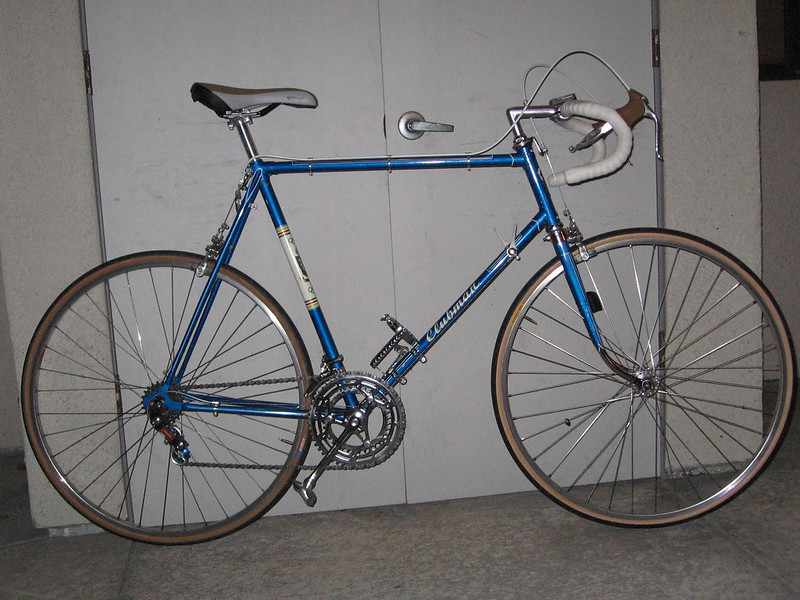
This bike has very slack angles, 71-degrees, and a 59cm top tube commensurate with it's 61cm frame size.
Notice how the Steyr's resulting setup loses 2-3cm of effective length as the seat cluster has moved so far rearward of the nose of the saddle.
The saddle is in the normal position relative to the bb, but the 59cm toptube has been pulled rearward, shortening the "reach" and wheelbase, thus shortening the rider's reach to the bars.
The resulting bike actually fits me just about like a smaller 57cm bike that has steeper road geometry (say with 57cm toptube and 74-degree seattube angle), and the post-1978 Peugeot U09 doesn't even need as long of a stem as the Steyr Clubman.

Last edited by dddd; 02-08-15 at 08:09 PM.
02-09-15 | 08:56 AM
#20
Thread Starter
Calamari Marionette Ph.D
Joined: Dec 2013
Posts: 7,861
Likes: 41
From: Coeur d' Alene
Bikes: 3 Chinese Gas Pipe Nerdcycles and 2 Chicago Electroforged Boat Anchors
The saddle actually will move closer to the stem, since each rider will arrive at their preferred balance point above the pedals by sliding the saddle fore and aft, and as the seat tube angle moves "rearward" from the bb, the rider compensates this by sliding the saddle forward.
02-09-15 | 02:18 PM
#21
Ride, Wrench, Swap, Race
Joined: Jan 2010
Posts: 9,831
Likes: 1,809
From: Northern California
Bikes: Cheltenham-Pedersen racer, Boulder F/S Paris-Roubaix, Varsity racer, '52 Christophe, '62 Continental, '92 Merckx, '75 Limongi, '76 Presto, '72 Gitane SC, '71 Schwinn SS, etc.
A lot of people will look at a road bike and see only the road handlebar, and think the reach for the drops is what makes a road bike a road bike.
But road bikes evolved primarily from competitive riding, where riders of widely-varying ability have long wanted to at least give their own "physical endurance level limits" every chance at finishing a grueling ride, and in as little time as possible.
Thus the principle road bike virtue comes when the rider is positioned in the saddle such that rising to a balanced "standing" position can be as effortlessly and quickly done as possible.
This requires a somewhat-forward seated position, and allows the rider both to let their legs "spin" (in the saddle) and "extend" (out of the saddle), as such needs are imposed by undulating terrain.
As well, a forward seated position spares a rider's energy by being more aerodynamic, and the resulting somewhat "forward-rotated" lower half of the rider's body allows the rider to maintain a lower tuck while not having to bend as sharply at the waist, improving both comfort and power output.
The out-of-saddle position and fit, as determined solely by the bend and positioning of the handlebar, is critical to the rider being able to straighten their torso, lean forward and thus to use their entire body's range-of-motion in order to allow the knee joints to operate within a less-sharp angle, in order to effect much greater force at the pedals with far less stress at the knee.
Not being able to quickly and effortlessly transition to a forward-leaning standing position sharply limits how much power that the rider can maintain without knee-region stress and injury, thus also greatly increasing the need for low gearing in order to conquer hilly terrain!
Remember that a balanced forward-leaning position above the bottom bracket is directly related (proportional) to the force/torque that is applied to the pedals, thus a "rearward-fitted" or touring-style road bike will thus need much lower gearing, and the end result no longer resembles an actual road bike.
Schwinn took what were layed-back cruiser bikes with 27" "narrow" tires, and fitted road handlebars to them. This was the Varsity/Continental recipe.
It takes about every trick in the book to get a hard-charging rider properly fitted to one of these bikes, and still makes for an extra dose of upper-body workout so as to hold oneself in a needed forward-leaning position when riding up steep hills. It becomes all one can do just to keep their knees from hitting the handlebar ends.
But those bikes were/are great for riding at lower intensities on more-level ground. Sound familiar?
But road bikes evolved primarily from competitive riding, where riders of widely-varying ability have long wanted to at least give their own "physical endurance level limits" every chance at finishing a grueling ride, and in as little time as possible.
Thus the principle road bike virtue comes when the rider is positioned in the saddle such that rising to a balanced "standing" position can be as effortlessly and quickly done as possible.
This requires a somewhat-forward seated position, and allows the rider both to let their legs "spin" (in the saddle) and "extend" (out of the saddle), as such needs are imposed by undulating terrain.
As well, a forward seated position spares a rider's energy by being more aerodynamic, and the resulting somewhat "forward-rotated" lower half of the rider's body allows the rider to maintain a lower tuck while not having to bend as sharply at the waist, improving both comfort and power output.
The out-of-saddle position and fit, as determined solely by the bend and positioning of the handlebar, is critical to the rider being able to straighten their torso, lean forward and thus to use their entire body's range-of-motion in order to allow the knee joints to operate within a less-sharp angle, in order to effect much greater force at the pedals with far less stress at the knee.
Not being able to quickly and effortlessly transition to a forward-leaning standing position sharply limits how much power that the rider can maintain without knee-region stress and injury, thus also greatly increasing the need for low gearing in order to conquer hilly terrain!
Remember that a balanced forward-leaning position above the bottom bracket is directly related (proportional) to the force/torque that is applied to the pedals, thus a "rearward-fitted" or touring-style road bike will thus need much lower gearing, and the end result no longer resembles an actual road bike.
Schwinn took what were layed-back cruiser bikes with 27" "narrow" tires, and fitted road handlebars to them. This was the Varsity/Continental recipe.
It takes about every trick in the book to get a hard-charging rider properly fitted to one of these bikes, and still makes for an extra dose of upper-body workout so as to hold oneself in a needed forward-leaning position when riding up steep hills. It becomes all one can do just to keep their knees from hitting the handlebar ends.
But those bikes were/are great for riding at lower intensities on more-level ground. Sound familiar?
Last edited by dddd; 02-09-15 at 02:46 PM.
03-10-15 | 10:02 PM
#22

Senior Member
Joined: Aug 2014
Posts: 62
Likes: 0
Bikes: 64 Schwinn Varsity in Coppertone, 74 Raleigh Super Course MKII, 72 Mercier 300, 71 Atala Gran Prix, 2002 Trek 1200 and approximately 25 others I'm too lazy to list - of which 15 of those, are Varsity's (my fav)
Always enjoy dddd and metacortex' comments on these old Schwinns.
03-11-15 | 04:11 PM
#23
Ride, Wrench, Swap, Race
Joined: Jan 2010
Posts: 9,831
Likes: 1,809
From: Northern California
Bikes: Cheltenham-Pedersen racer, Boulder F/S Paris-Roubaix, Varsity racer, '52 Christophe, '62 Continental, '92 Merckx, '75 Limongi, '76 Presto, '72 Gitane SC, '71 Schwinn SS, etc.
The passion for the Varsity/Continental must seem to most riders of the last ~35 years to be very odd, given that the normal (and widely published) narratives as to their lack of goodness were and are everywhere.
But these narratives so often came from those either hyping or selling racier imported bikes, or from opinionated cyclists who wrote books for beginning cyclists who might have ostensibly been looking to buy lighter, high-performance bikes for competitive or higher-mileage use.
These Schwinns however were durably designed and tested more for utility and for shorter jaunts, with the road-drop style handlebars added for marketing reasons.
This doesn't mean that the electroforged bikes (even with drop bars) can't be excellent, non-racing road bikes.
But as it turns out, these bikes need very careful size fitting so as not to have the rider situated too close to the drop handlebars when riding uphill (while up off of the saddle).
So not surprisingly, these bikes are often tested by riders who climb onto a very cramped-fitting (effectively way too small) bike that, as an added "plus", has a terrible saddle, un-padded bar tape, sticky/stretchy cables, rock-hard brake pads, uneven rims and weighs forty pounds.
But given the chance to ride a conscientiously-refurbished and properly-sized Varsity or Continental, a rider might not need much saddle time to realize the advantages of rock-steady steering and of a handy kickstand that holds the bike solidly upright, all with a style that remains timelessly beautiful and is American-built.
I must admit though that getting a Varsity up to a refined state can seem like a good bit of work when there are fine, old (and much lighter) road bikes that can be had today for so little money on Craigslist.
But for an initial outlay of $20 at Salvation Army, I feel that (over 1500 or so miles) I have already nearly gotten my money/work's worth of "big ring" use out of this one.
But these narratives so often came from those either hyping or selling racier imported bikes, or from opinionated cyclists who wrote books for beginning cyclists who might have ostensibly been looking to buy lighter, high-performance bikes for competitive or higher-mileage use.
These Schwinns however were durably designed and tested more for utility and for shorter jaunts, with the road-drop style handlebars added for marketing reasons.
This doesn't mean that the electroforged bikes (even with drop bars) can't be excellent, non-racing road bikes.
But as it turns out, these bikes need very careful size fitting so as not to have the rider situated too close to the drop handlebars when riding uphill (while up off of the saddle).
So not surprisingly, these bikes are often tested by riders who climb onto a very cramped-fitting (effectively way too small) bike that, as an added "plus", has a terrible saddle, un-padded bar tape, sticky/stretchy cables, rock-hard brake pads, uneven rims and weighs forty pounds.
But given the chance to ride a conscientiously-refurbished and properly-sized Varsity or Continental, a rider might not need much saddle time to realize the advantages of rock-steady steering and of a handy kickstand that holds the bike solidly upright, all with a style that remains timelessly beautiful and is American-built.
I must admit though that getting a Varsity up to a refined state can seem like a good bit of work when there are fine, old (and much lighter) road bikes that can be had today for so little money on Craigslist.
But for an initial outlay of $20 at Salvation Army, I feel that (over 1500 or so miles) I have already nearly gotten my money/work's worth of "big ring" use out of this one.
Last edited by dddd; 03-11-15 at 04:19 PM.

Thread
Thread Starter
Forum
Replies
Last Post
BRAZUCA
Classic & Vintage
7
11-14-11 09:06 PM
