


Tri bike for commuting?
 07-20-08 | 06:43 PM
#1

Thread Starter
There's time now


Joined: Jun 2006
Posts: 773
Likes: 168
From: On a stack of books, PA
Tri bike for commuting?
My anecdotal evidence gathered through these threads over the past few years has shown that most people choose a road bike, cross, or hybrid, in that order from greatest to least. I think that I have seen maybe one tri bike. Why is this? From what I have read, tri bikes are set to rest the legs for the run portion, while road bikes are completely involving. It stands to reason that tri bike would be better suited to commuting. Thoughts, opinions?
 07-20-08 | 06:58 PM
#2

Rides again
Joined: Oct 2004
Posts: 3,282
Likes: 1
From: SW. Sacramento Region, aka, down river
Bikes: Giant OCR T, Trek SC
It depends on your commute. If you don't have to adjust for heavy traffic and can stretch out on your aero bars, then tri would work. The are not as responsive, i.e. turning as road bikes. For some routes the current standard of a double vs triple would be a deal killer
07-20-08 | 07:17 PM
#3

Senior Member
Joined: Apr 2008
Posts: 828
Likes: 0
From: Chicago
Think more.
07-20-08 | 07:19 PM
#4
Got another new bike
Joined: Nov 2007
Posts: 584
Likes: 0
From: dundalk, md
Bikes: pacific elite 3.1 w/upgrades and street slicks, got an iron horse maverick now, cannondale sr800, gt gtr pro rival
i like my brakes being close at all times, escecially when i'm going 20+ while riding with traffic. a sudden left hook and having to change hand position to brake all at 20mph, i don't think so.
 07-20-08 | 07:34 PM
#6


Been Around Awhile

Joined: Oct 2004
Posts: 30,655
Likes: 1,974
From: Burlington Iowa
Bikes: Vaterland and Ragazzi
 07-20-08 | 07:39 PM
#7

bulletproof tiger
Joined: Apr 2008
Posts: 1,934
Likes: 0
From: Portland, OR
Bikes: Waterford 2200, Litespeed Tuscany, Salsa La Cruz, Kona Fire Mountain
So can someone describe a tri bike?
I didn't even realize until recently that people ride bikes tailored to triathlons. I never thought about it I guess...
What's so special about them? Frame geometry? Gearing? Brakes (or lack of same)?
I went in a tri store a few months ago looking for something piddly and glanced around at the bikes, but they just looked like ass-ugly carbon road bikes to me, maybe smaller.
Just curious. I swam competitively for 8 or 9 years and love to ride, but I've always hated running (and can't for the time being) so I've never seriously considered triathlons. Part of my ongoing mid-life crisis seems to be enhanced competitiveness, so I'm sort of considering them now. But I doubt I'd get a special bike. And maybe I'd just fast-walk the run part.
I didn't even realize until recently that people ride bikes tailored to triathlons. I never thought about it I guess...
What's so special about them? Frame geometry? Gearing? Brakes (or lack of same)?
I went in a tri store a few months ago looking for something piddly and glanced around at the bikes, but they just looked like ass-ugly carbon road bikes to me, maybe smaller.
Just curious. I swam competitively for 8 or 9 years and love to ride, but I've always hated running (and can't for the time being) so I've never seriously considered triathlons. Part of my ongoing mid-life crisis seems to be enhanced competitiveness, so I'm sort of considering them now. But I doubt I'd get a special bike. And maybe I'd just fast-walk the run part.
07-20-08 | 07:41 PM
#8

Senior Member
Joined: Jul 2006
Posts: 11,373
Likes: 8
From: Columbus, OH
Bikes: '08 Surly Cross-Check, 2011 Redline Conquest Pro, 2012 Spesh FSR Comp EVO, 2015 Trek Domane 6.2 disc
As long as you don't hit any potholes, pebbles, rough pavement, etc... you and none of your stuff can arrive at work in record breaking time.
I'll stick with my geared cross bike or my fixed gear roadie.
I'll stick with my geared cross bike or my fixed gear roadie.
07-20-08 | 07:42 PM
#9
07-20-08 | 07:44 PM
#10
Senior Member
Joined: Jul 2006
Posts: 11,373
Likes: 8
From: Columbus, OH
Bikes: '08 Surly Cross-Check, 2011 Redline Conquest Pro, 2012 Spesh FSR Comp EVO, 2015 Trek Domane 6.2 disc
Deep section carbon aero rims (50mm or more)
Aero seat post
Wing bar with aero extensions
Internally routed cables
Cutout/bent seat-tube to accomodate:
- extra short chainstays
- 76 degree or steeper seat-tube angle
Designed to go fast, not to be comfortable.
Aero seat post
Wing bar with aero extensions
Internally routed cables
Cutout/bent seat-tube to accomodate:
- extra short chainstays
- 76 degree or steeper seat-tube angle
Designed to go fast, not to be comfortable.
07-20-08 | 07:45 PM
#11

Prefers Cicero
Joined: Jul 2005
Posts: 12,860
Likes: 146
From: Toronto
Bikes: 1984 Trek 520; 2007 Bike Friday NWT; misc others
Just curious. I swam competitively for 8 or 9 years and love to ride, but I've always hated running (and can't for the time being) so I've never seriously considered triathlons. Part of my ongoing mid-life crisis seems to be enhanced competitiveness, so I'm sort of considering them now. But I doubt I'd get a special bike. And maybe I'd just fast-walk the run part.
Google "aqua-bike": - it's a triathlon (or a biathlon, I guess) without the running.
EDIT: here you go https://www.usatriathlon.org/MultiSpo...sciplines.aspx
07-20-08 | 08:33 PM
#13
bulletproof tiger
Joined: Apr 2008
Posts: 1,934
Likes: 0
From: Portland, OR
Bikes: Waterford 2200, Litespeed Tuscany, Salsa La Cruz, Kona Fire Mountain
Google "aqua-bike": - it's a triathlon (or a biathlon, I guess) without the running.
EDIT: here you go https://www.usatriathlon.org/MultiSpo...sciplines.aspx
EDIT: here you go https://www.usatriathlon.org/MultiSpo...sciplines.aspx
 07-20-08 | 09:09 PM
#14
Junior Member
Joined: May 2008
Posts: 21
Likes: 0
Tri bikes are really intended for triathlons, not general use. From "The Complete Triathlon Book:
"The essential difference between triathlon and road bikes is that triathlon bikes are designed to perform best in time trial conditions (flat and straight), whereas road bikes are designed to perform best on hills and turns and in pack riding. To serve their function, triathlon bikes position the rider differently than road bikes. Specifically, the tilt the rider forward several degrees more and place his or her forearm on an aerobar (except when cornering, breaking, climbing, relaxing, and sometimes shifting) for a low, stretched-out, and narrow riding position that maximizes aerodynamic efficiency."
If you want to do triathlons or duathlons, go ahead and get a tri bike, otherwise avoid them. While fast, tri bikes are much less versitile than a road bike. If you ever decide to do triathlons or duathlons, you can modify a road bike to have aerobars and a more forward seat position. For commuting, avoid them. The breaks are not near your hands on a tri bike. Commuting often involves lots of stop and go, not just going fast over a long distance. Road bikes have the breaks by your hands. You can also put racks and fenders on a road bike (if you get serious about commuting, these are essential). Tri bikes aren't designed to accomodate fenders (you'll be splashed on rainy days) or racks (how will you carry anything?). I'd sooner commute on a slow beach cruiser than on a tri bike any day.
"The essential difference between triathlon and road bikes is that triathlon bikes are designed to perform best in time trial conditions (flat and straight), whereas road bikes are designed to perform best on hills and turns and in pack riding. To serve their function, triathlon bikes position the rider differently than road bikes. Specifically, the tilt the rider forward several degrees more and place his or her forearm on an aerobar (except when cornering, breaking, climbing, relaxing, and sometimes shifting) for a low, stretched-out, and narrow riding position that maximizes aerodynamic efficiency."
If you want to do triathlons or duathlons, go ahead and get a tri bike, otherwise avoid them. While fast, tri bikes are much less versitile than a road bike. If you ever decide to do triathlons or duathlons, you can modify a road bike to have aerobars and a more forward seat position. For commuting, avoid them. The breaks are not near your hands on a tri bike. Commuting often involves lots of stop and go, not just going fast over a long distance. Road bikes have the breaks by your hands. You can also put racks and fenders on a road bike (if you get serious about commuting, these are essential). Tri bikes aren't designed to accomodate fenders (you'll be splashed on rainy days) or racks (how will you carry anything?). I'd sooner commute on a slow beach cruiser than on a tri bike any day.
07-20-08 | 09:17 PM
#15
?
Joined: Oct 2006
Posts: 2,775
Likes: 0
Despite people here saying it's a bad idea. It's doable, just don't ever go into the aerobar position for heavy traffic.
The OP hasn't stated how he commutes or the road he commutes on, if it's fairly straight, minimal stuff to carry, little car traffic, tri bikes are absolutely doable for commuting.
The OP hasn't stated how he commutes or the road he commutes on, if it's fairly straight, minimal stuff to carry, little car traffic, tri bikes are absolutely doable for commuting.
07-20-08 | 09:43 PM
#16
Senior Member
Joined: Mar 2006
Posts: 942
Likes: 0
Anyone who thinks road bikes are more responsive than a tri bike has never used aerobars.
Squeeze your left hand harder than your right and you go flying off the side of the road. Thats an exaggeration of course but just barely.
They take a long time to get used to.
Squeeze your left hand harder than your right and you go flying off the side of the road. Thats an exaggeration of course but just barely.
They take a long time to get used to.
07-20-08 | 09:55 PM
#17

Senior Member
Joined: Jun 2007
Posts: 8,101
Likes: 17
From: Minneapolis
Ok,
I need to qualify this by saying I've never ridden an actual tri-bike but I do participate in triathlons, have seen hundreds of tri-bikes and my road bike has been altered some to make it more like a tri-bike (but pretty minimally).
When I first put aero bars on my road bike I was wobbling all over the place. Steering is much different and the maneuverability is not as good. I would say that this is the main disadvantage.
As far as comfort goes it's not a clear cut answer. Once you've become accustomed to it, riding on aerobars is much more comfortable than riding in the drops. Depending on which route I take for my commute, I'll have a 2 to 10 mile stretch where I can just put my head down and go, -only having to slow down a few times. In that kind of riding, a tri-bike will be more comfortable IMHO than a road bike.
If you think about ironman triathlons, -these folks are riding over 100 miles after swimming 2.5 or so. Then when they're done riding, they get to look forward to running a marathon. I don't see how you could do that on a bike that's really uncomfortable.
As much as I like riding on the aero bars, I don't do it in stop and go traffic, not only because I don't have quick access to the brakes, but because it's not worth the effort to get into that position if I've got to get out of it a block later.
As far as dealing with rough roads goes, I don't see how they'd be any better or worse than a road bike with skinny tires. My last triathlon was on mostly good roads but part of it was cobblestone, parts were rough and there were a few small potholes to avoid.
The last problem is the expense. Most of the road bikes I see people commute on are pretty old. There are exceptions of course but in this town if you only counted bikes that were 5 years old or less the percentage of road bikes vs other types would be much smaller. Most people don't want to spend that much money on a commuter.
So the bottom line is if somebody were to give me an expensive tri bike with the only condition being I had to commute with it as well as race with it, I'd give it a shot. I'd sure like to have one to race with and it would be fun to commute on a few times too. In the end though I'd probably end up giving the bike back.
I need to qualify this by saying I've never ridden an actual tri-bike but I do participate in triathlons, have seen hundreds of tri-bikes and my road bike has been altered some to make it more like a tri-bike (but pretty minimally).
When I first put aero bars on my road bike I was wobbling all over the place. Steering is much different and the maneuverability is not as good. I would say that this is the main disadvantage.
As far as comfort goes it's not a clear cut answer. Once you've become accustomed to it, riding on aerobars is much more comfortable than riding in the drops. Depending on which route I take for my commute, I'll have a 2 to 10 mile stretch where I can just put my head down and go, -only having to slow down a few times. In that kind of riding, a tri-bike will be more comfortable IMHO than a road bike.
If you think about ironman triathlons, -these folks are riding over 100 miles after swimming 2.5 or so. Then when they're done riding, they get to look forward to running a marathon. I don't see how you could do that on a bike that's really uncomfortable.
As much as I like riding on the aero bars, I don't do it in stop and go traffic, not only because I don't have quick access to the brakes, but because it's not worth the effort to get into that position if I've got to get out of it a block later.
As far as dealing with rough roads goes, I don't see how they'd be any better or worse than a road bike with skinny tires. My last triathlon was on mostly good roads but part of it was cobblestone, parts were rough and there were a few small potholes to avoid.
The last problem is the expense. Most of the road bikes I see people commute on are pretty old. There are exceptions of course but in this town if you only counted bikes that were 5 years old or less the percentage of road bikes vs other types would be much smaller. Most people don't want to spend that much money on a commuter.
So the bottom line is if somebody were to give me an expensive tri bike with the only condition being I had to commute with it as well as race with it, I'd give it a shot. I'd sure like to have one to race with and it would be fun to commute on a few times too. In the end though I'd probably end up giving the bike back.
07-20-08 | 10:03 PM
#18
Senior Member
Joined: Jun 2007
Posts: 8,101
Likes: 17
From: Minneapolis
I should add too that a road bike with aero bars probably handles a bit differently (worse) than a tri-bike. An aero bar puts you farther over the front wheel on a road bike than you would be on a true tri-bike.
Last edited by tjspiel; 07-20-08 at 10:07 PM.
07-20-08 | 10:14 PM
#19

ride for a change
Joined: Nov 2006
Posts: 2,221
Likes: 2
From: Minneapolis, MN
Bikes: Surly Cross-check & Moonlander, Pivot Mach 429, Ted Wojcik Sof-Trac, Ridley Orion. Santa Cruz Stigmata
um, yeah.......I say go for it.
How many people here have ever actually ridden a tri/time trial bike to work. It's all just negative assumptions based on opinion not evidence or experience.
so...... um, let us know how it goes.
How many people here have ever actually ridden a tri/time trial bike to work. It's all just negative assumptions based on opinion not evidence or experience.
so...... um, let us know how it goes.
07-20-08 | 10:47 PM
#20

Senior Member
Joined: Nov 2004
Posts: 3,959
Likes: 4
From: Davis CA
Bikes: Surly Cross-Check, '85 Giant road bike (unrecogizable fixed-gear conversion
My commute is perfectly flat, and mostly straight rural roads or a bike path that parallels a freeway. Lots of wind, very few turns and no car interaction until the last few miles.
I see lots of people on tri bikes. I never commuted on a bona fide tt bike, however when my road bike was set up for time trials, I commuted on it all the time.
I see lots of people on tri bikes. I never commuted on a bona fide tt bike, however when my road bike was set up for time trials, I commuted on it all the time.
07-20-08 | 11:23 PM
#21

Senior Member
Joined: Jul 2002
Posts: 40,863
Likes: 3,115
From: Sacramento, California, USA
Bikes: Specialized Tarmac, Canyon Exceed, Specialized Transition, Ellsworth Roots, Ridley Excalibur
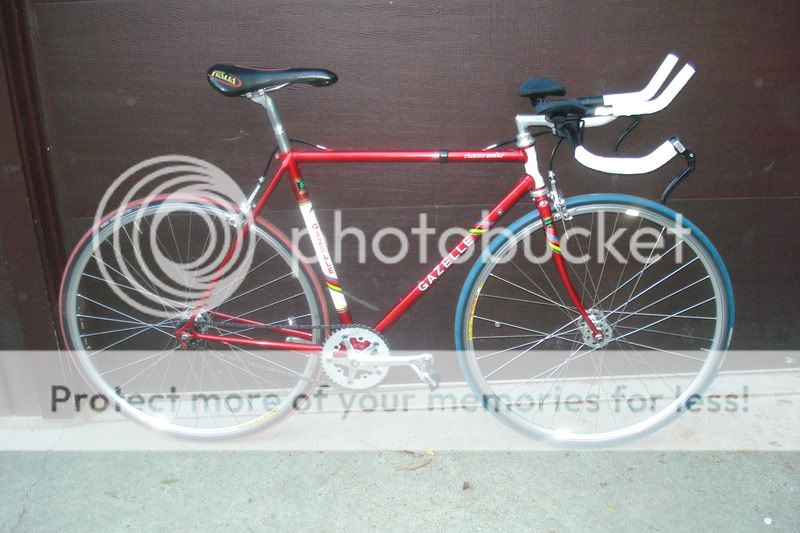 07-20-08 | 11:53 PM
#22

Senior Member
Joined: Jul 2002
Posts: 6,956
Likes: 6
I often have to test-ride customers' triathalon/time-trial bikes in a downtown environment. One of their main problems is that the shifters are way out on the tips of the aero bars. Try stopping for an unexpected red light, while also downshifting so you can actually get rolling again when the light changes green again, and you'll see why these setups are my least favorite for riding in traffic.
A road bike with brifters, plus an add-on aero bar... sure. We have some places in my city, such as the approaches to the Maple Street bridge, where I could get a 3-4mph boost from the aero bar at 40-45mph, helping to keep up with traffic better.
A road bike with brifters, plus an add-on aero bar... sure. We have some places in my city, such as the approaches to the Maple Street bridge, where I could get a 3-4mph boost from the aero bar at 40-45mph, helping to keep up with traffic better.
07-21-08 | 07:30 AM
#23

Barbieri Telefonico
Joined: Aug 2005
Posts: 3,522
Likes: 2
From: Albuquerque, New Mexico
Bikes: Crappy but operational secondhand Motobecane Messenger
My anecdotal evidence gathered through these threads over the past few years has shown that most people choose a road bike, cross, or hybrid, in that order from greatest to least. I think that I have seen maybe one tri bike. Why is this? From what I have read, tri bikes are set to rest the legs for the run portion, while road bikes are completely involving. It stands to reason that tri bike would be better suited to commuting. Thoughts, opinions?
__________________
Giving Haircuts Over The Phone
Giving Haircuts Over The Phone
07-21-08 | 07:48 AM
#24
Senior Member
Joined: Jun 2007
Posts: 8,101
Likes: 17
From: Minneapolis
I often have to test-ride customers' triathalon/time-trial bikes in a downtown environment. One of their main problems is that the shifters are way out on the tips of the aero bars. Try stopping for an unexpected red light, while also downshifting so you can actually get rolling again when the light changes green again, and you'll see why these setups are my least favorite for riding in traffic.
A road bike with brifters, plus an add-on aero bar... sure. We have some places in my city, such as the approaches to the Maple Street bridge, where I could get a 3-4mph boost from the aero bar at 40-45mph, helping to keep up with traffic better.
A road bike with brifters, plus an add-on aero bar... sure. We have some places in my city, such as the approaches to the Maple Street bridge, where I could get a 3-4mph boost from the aero bar at 40-45mph, helping to keep up with traffic better.
07-21-08 | 08:26 AM
#25
Senior Member
Joined: Jul 2006
Posts: 11,373
Likes: 8
From: Columbus, OH
Bikes: '08 Surly Cross-Check, 2011 Redline Conquest Pro, 2012 Spesh FSR Comp EVO, 2015 Trek Domane 6.2 disc
I'm not saying it can't be done. I'm just saying that there are a whole ton of other bikes better suited to commuting.